

SKT 6G ATHENA White Paper: a mid-to-long term network evolution strategy for the AI era
Introduction:
This ATHENA [1.] white paper presents SK Telecom’s (SKT’s) vision for future communication, rooted in fundamental values like security, stability, and quality, with a focus on AI-native innovation.
Note 1. The ‘ATHENA’ (AI, Trust, Hyper-connectivity, Experience, opeN, Agility) architecture outlines SKT’s roadmap to accelerate AI convergence and enhance customer experience in preparation for 6G commercialization post-2030. It reinforces SKT’s commitment to an AI-native, Zero Trust, and open network ecosystem.
SK Telecom continues to actively participate in global standardization to shape the future of communications and will showcase related core technologies at the upcoming 2026 MWC in Barcelona. SKT will showcase key related technologies, including various AI agents for networks, AI-RAN technology that provides both communication and AI services, on-device AI-based antenna optimization, and integrated communication and sensing technology that gathers environmental information via radio signals.
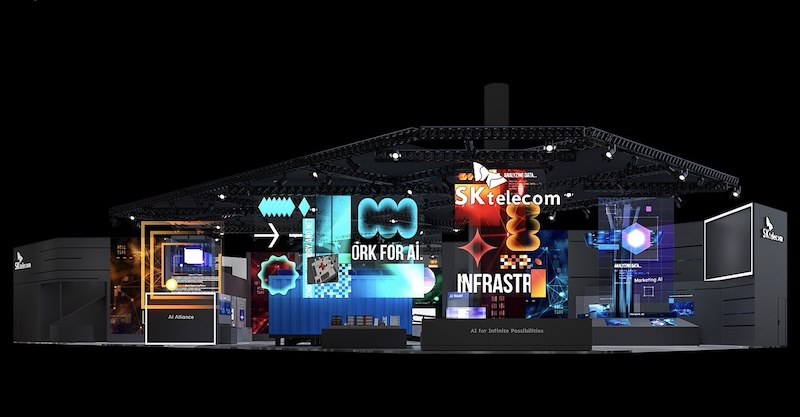
Photo Credit: SK Telecom (SKT)
Backgrounder: In 2023, SKT introduced key requirements and technology trends for 6G standardization, and in 2024, it emphasized the direction of communication infrastructure in the era of AI.
In preparation for the commercialization of 6G expected after 2030, the latest white paper comprehensively presents SKT’s mid- to long-term network evolution strategy to accelerate AI convergence, expand services such as humanoid robots and satellite communications, address advanced security threats, and shift network operation paradigms. The goal is to enhance operational efficiency, innovate customer experience, and achieve network monetization in a rapidly changing communications environment.
Through this white paper, SKT has clarified its network vision and technological evolution based on the fundamental values of security, stability, safety, and quality to prepare for future communication environments, including 6G.
Vision Based on Fundamental Network Values:
SKT has established AI-native, Zero Trust, Ubiquitous, Open, and Cloud-native as its key pillars, and aims to maximize customer experience through a Customer-centric network evolution vision that prioritizes fault prevention, security, and quality in response to diverse devices and new service environments.
AI technology is expected to evolve along two main directions: ‘AI for Network,’ which enables real-time data analysis and AI-based decision-making for self-optimizing networks; and ‘Network for AI,’ which focuses on optimizing networks to efficiently support AI services.
The security paradigm will be strengthened under the Zero Trust principle, and the infrastructure will evolve into a converged platform not tied to specific generations or technologies such as 5G, 6G, or satellite communications. An open ecosystem will be pursued through general-purpose hardware and open-source-based technologies.
The white paper also outlines the expansion of virtualization in networks for flexible resource utilization and a vision to prioritize customer needs to enhance customer experience.
To achieve this vision, SKT has defined its mid- to long-term network architecture as ATHENA*, detailing structures for the radio access network, core network, transport network, and network data platform.
* ATHENA stands for AI-native (integration of artificial intelligence throughout the network), Trust (adoption of Zero Trust security principles), Hyper-connectivity (seamless connections across diverse devices and environments), Experience (customer-centric innovation and enhanced user experience), opeN (openness through open-source technologies and collaborative ecosystems), and Agility (flexible and cloud-native network operations).
SK Telecom has presented a mid- to long-term direction to gradually apply AI- and cloud-based intelligence and automation across all network domains. The radio access network will evolve into a structure capable of AI-based autonomous optimization through virtualization and open interfaces. The core and transport networks are expected to advance toward enhanced automation and efficient control using AI in a cloud-native environment. The network data platform will expand its role as a key platform for creating AI-based services and customer value using network data.
In line with these efforts, SKT is actively participating in major international specification and standardization organizations such as 3GPP, ITU-R, and O-RAN Alliance to ensure that its future network vision and mid- to long-term architecture are effectively reflected in global standards. The company is conducting advanced R&D in core 6G technologies such as AI-RAN and autonomous networks.
Furthermore, SKT was recently elected as a new board member of the AI-RAN Alliance, contributing to discussions on the evolution of next-generation RAN through the convergence of AI and wireless technologies.
“Despite uncertainties in the 6G era, we will continue to create new growth opportunities by leading the evolution of future communication infrastructure over the next decade, prioritizing customer value and combining AI, virtualization, openness, and Zero Trust security,” said Yu Takki, Head of Network Technology Office at SK Telecom.
This white paper affirms SKT’s dedication to leading the evolution of communication infrastructure over the next decade.
About SK Telecom:
SK Telecom has been leading the growth of the mobile industry since 1984. Now, it is taking customer experience to new heights by extending beyond connectivity. By placing AI at the core of its business, SK Telecom is rapidly transforming into an AI company with a strong global presence. It is focusing on driving innovations in areas of AI Infrastructure, AI Transformation (AIX) and AI Service to deliver greater value for industry, society, and life.
References:
https://news-static.sktelecom.com/wp-content/uploads/2026/02/2026-SKT-6G-White-Paper-ATHENA_Eng.pdf
https://www.sktelecom.com/en/press/press_detail.do?idx=1657¤tPage=1&type=&keyword=
https://www.sktelecom.com/en/press/press_detail.do?idx=1656¤tPage=1&type=&keyword=
SK Telecom forms AI CIC in-house company to pursue internal AI innovation
SK Telecom (SKT) and Nokia to work on AI assisted “fiber sensing”
SK Group and AWS to build Korea’s largest AI data center in Ulsan
SK Telecom unveils plans for AI Infrastructure at SK AI Summit 2024
SKT-Samsung Electronics to Optimize 5G Base Station Performance using AI
SK Telecom and Singtel partner to develop next-generation telco technologies using AI
SK Telecom, DOCOMO, NTT and Nokia develop 6G AI-native air interface
SK Telecom, Intel develop low-latency technology for 6G core network
SK Telecom and Thales Trial Post-quantum Cryptography to Enhance Users’ Protection on 5G SA Network
2 thoughts on “SKT 6G ATHENA White Paper: a mid-to-long term network evolution strategy for the AI era”
Leave a Reply to Alan Weissberger Cancel Reply
SK Telecom CEO Jung Jai-hun unveiled SKT’s ‘AI Native’ strategy at MWC26 in Barcelona today, describing this moment as a “golden time” for transformation as the company expands from its foundation of telecom leadership to AI leadership. Positioning “Customer Value” and “AI” as its top two priorities, the strategy outlines a comprehensive transformation across telecom infrastructure and network operations, customer-centric services, scaling up of AI data centers, and the building of an AI-embedded corporate culture.
Key initiatives include AI-driven autonomous network operations supported by a Zero Trust security framework, customer-friendly redesign of products powered by integrated AI agents, expansion of 1GW-class AI data centers, and upgrading Korea’s sovereign AI foundation model to over one trillion parameters.
SKT plans to redesign its telecom services and products to be more customer-friendly, while also strengthening two-way communication with customers.
For services such as pricing, roaming, and membership, SKT will prioritize customer convenience by restructuring them into simple and intuitive formats and automatically offering personalized packages.
SKT is also developing an ‘integrated AI agent’ that connects the dispersed customer experiences across various touchpoints, such as T world (SKT’s main customer portal) and T Direct Shop (SKT’s official online store).
By quickly analyzing customers’ daily patterns and needs with AI, SKT aims to create a single agent that delivers personalized experiences at every touchpoint. In addition, SKT will enhance its AI Contact Center (AICC), enabling all customer service representatives to use AI for accurate and prompt support.
Offline stores will also leverage AI to shift from sales-focused operations to providing deeper customer experiences, accurately identifying needs, and automatically offering personalized recommendations even after a visit—delivering highly tailored curation services.
In addition, SKT plans to create ‘AI Personas’ to analyze digital behavior data across various customer segments, enabling a comprehensive understanding of each customer’s needs and preferences through natural, conversational Q&A. This approach will allow SKT to communicate more effectively with all customers.
SKT is further advancing ‘A. phone (A-DoT phone),’ developing it into a true AI agent that can automatically organize call notes and schedules, connect customers to personalized services, and even perform related actions.
SKT plans to expand opportunities for employees to engage directly with customers in the field, fostering two-way communication. This year, SKT plans to actively listen to a wide range of customer groups, as well as experts from industry and academia, and thoroughly reflect their voices in all aspects of company management.
At MWC26, SKT hosted the AIDC Conference under the theme “Redesigning Telco Infra for the Next Phase of AI.”
During his keynote speech, SKT CEO Jung Jaihun emphasized the evolving role of telecom operators as key players in AI infrastructure.
SKT introduced its ‘Sovereign AI Package’ strategy, which integrates AI data center (AIDC) infrastructure, its proprietary foundation model A.X K1, and industry-specific AI services to strengthen AI sovereignty and accelerate enterprise innovation.
CEO Jung also engaged with global telecom leaders and technology groups to explore collaboration in AI data centers, AI models, 6G, and AI-RAN. Through these global partnerships, SKT aims to build a trusted, interconnected AI infrastructure ecosystem and reinforce the role of telcos in shaping the future of AI.