

Smart electromagnetic surfaces/RIS: an optimal low-cost design for integrated communications, sensing and powering
Researchers at Xidian University in China have pioneered a smart electromagnetic surface that converts ambient electromagnetic waves into electrical power, marking a potential leap in stealth and wireless technologies. This meta-surface innovation merges advanced electromagnetic engineering with communication principles, enabling self-powered systems for demanding applications. The self-sustaining electronic system integrates wireless information transfer and energy harvesting and has the potential to upend the dynamics of electronic warfare.
The surface facilitates simultaneous energy harvesting and data transmission, drawing power from radar or environmental signals without traditional batteries. Xidian’s team highlights its role in “electromagnetic cooperative stealth,” where networked platforms collaboratively minimize radar cross-sections and sensor detectability. Prototypes demonstrate viability for real-time wave manipulation, building on metasurface designs that dynamically adjust phase and amplitude.
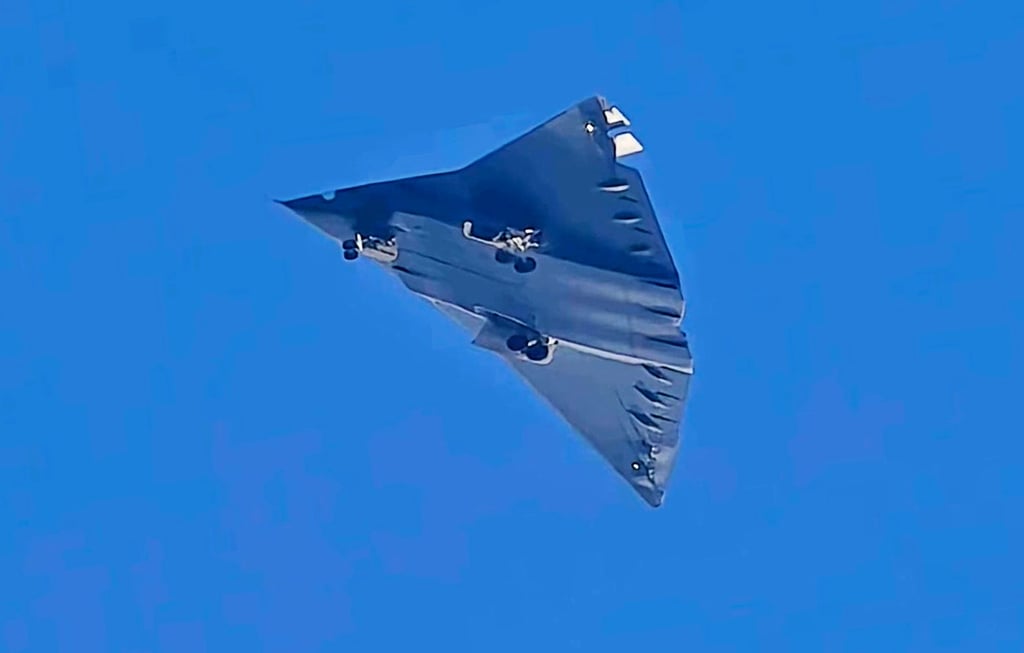
The researchers said this included investigating “electromagnetic cooperative stealth,” where multiple entities work together to reduce their visibility to radar and electromagnetic sensors. In electronic warfare, the technology flips the script on radar threats: stealth aircraft could harvest enemy beams for propulsion or comms, reducing logistical vulnerabilities. This cooperative approach extends to multi-asset formations, enhancing collective invisibility across spectra.
Early tests align with broader Reconfigurable Intelligent Surfaces (RIS), a two-dimensional reflecting surface. RIS advancements facilitate beam steering up to ±45° with low side lobes. According to a paper published in the IEEE Internet of Things magazine last year, RIS could also be used in anti-jamming technology, unmanned aerial vehicle communication and radio surveillance – all of which are difficult to do using older optimization tools.
Reconfigurable intelligent surfaces can also be configured to create intentional radio “dead zones” to mitigate interference and reduce the risk of eavesdropping, according to German electronics manufacturer Rohde & Schwarz. The European Space Agency has further highlighted RIS as a candidate technology for satellite-to-ground communications, where controllable reflection and redirection of signals could help route links around physical obstacles.
For telecommunications, the surface promises 6G breakthroughs like integrated sensing and powering satellites or base stations. China’s lead here could accelerate reconfigurable networks, improving coverage in non-line-of-sight scenarios. Ongoing refinements target complex interactions for higher precision. By including sensing, communication and power into one hardware platform, the device could allow for a range of advanced applications while reducing eavesdropping and interference.
“Ultimately, it is expected to have a broad impact on 6G communications, the Internet of Things, intelligent stealth and other related fields,” the team said in a paper published in the peer-reviewed journal National Science Review last month. Many scientists say that a key area for next-generation wireless communications will be the transmission channel.
Researchers from Fudan University, the University of Sydney and the Commonwealth Scientific and Industrial Research Organization note that, when combined with artificial intelligence (AI), this technology could significantly enhance the security of air-to-ground Internet of Things (IoT) links.
In their latest publication, the Xidian University team describes RIS as a “powerful solution” for future wireless networks, citing its low cost, high programmability and ease of deployment. However, for 6G systems, RIS must support both communication and sensing on a unified hardware platform by integrating data transmission and radar-like functionality to lower cost and optimize spectrum and hardware resource utilization.
Addressing this requirement will demand architectures that can jointly manipulate both scattered electromagnetic waves and actively radiated signals. The researchers propose that an electromagnetic all-in-one radiation–scattering RIS architecture could provide a viable path to meeting this dual-control challenge. “This achieves significant savings in physical space and cost while ensuring multifunctionality across diverse application scenarios,” the team said. The RIS system could also work in a receiver mode to harvest wireless energy to be used to power the meta-surface itself or charge other electronic devices, the paper added.
It could be used for line-of-sight wireless communication, where there is a direct, unobstructed path between a transmitter and receiver, as well as non-line-of-sight wireless communication, in which there is no direct visual link due to physical barriers like buildings.
The proposed RIS “stands out as the optimal low-cost design” for integrated communication and sensing. “In the future, this architecture could enable the development of environment-adaptive integrated sensing and communication systems, micro base stations and relay integrated systems, as well as self-powered sensing systems,” the team said.
………………………………………………………………………………………………………………………………………………………………………………………
References:
https://ieeexplore.ieee.org/document/10907868
Nokia sees new types of 6G connected devices facilitated by a “3 layer technology stack”
Electromagnetic Signal & Information Theory (ESIT): From Fundamentals to Standardization-Part I.
Electromagnetic Signal and Information Theory (ESIT): From Fundamentals to Standardization-Part II.
IMT Vision – Framework and overall objectives of the future development of IMT for 2030 and beyond
ITU-R WP5D: Studies on technical feasibility of IMT in bands above 100 GHz
Summary of ITU-R Workshop on “IMT for 2030 and beyond” (aka “6G”)
Excerpts of ITU-R preliminary draft new Report: FUTURE TECHNOLOGY TRENDS OF TERRESTRIAL IMT SYSTEMS TOWARDS 2030 AND BEYOND
Juniper Research: Global 6G Connections to be 290M in 1st 2 years of service, but network interference problem looms large