

Optus
Optus and Ericsson achieve 180MHz across 2.3GHz and 3.5GHz bands using carrier aggregation on a live 5G SA network
Australian telco Optus has demonstrated advanced 5G NR carrier aggregation (5G NR-CA) performance on its 5G standalone (SA) network by implementing four-component carrier aggregation (4CC CA) across low-, mid-, and upper-mid-band spectrum. Using Ericsson 5G SA network equipment and software, the configuration aggregates FDD bands at 900 MHz (Band n8) and 2.1 GHz (Band n1) with TDD bands at 2.3 GHz (Band n40) and 3.5 GHz (Band n78). Two-Component Carrier (2CC CA) uplink aggregation
This combined Optus’ unique two mid-band TDD spectrum holdings across 2.3GHz and 3.5GHz, achieving a record 180MHz TDD spectrum aggregation. In particular:
- Four-Component Carrier aggregation enabled 220MHz downlink bandwidth, leveraging spectrum across four different bands of 900MHz, 2.1GHz, 2.3GHz and 3.5GHz
- Two-Component Carrier uplink aggregation combined one Frequency Division Duplex (FDD) band from 900MHz and 2.1GHz with one TDD band from 2.3GHz and 3.5GHz
- Achieved peak speeds of 3.4Gbps (downlink) and 200Mbps (uplink) in a live network site with commercial devices, including the Samsung Galaxy S26 Ultra
The demonstration aligns with 3GPP Release 16 and Release 17 5G NR-CA enhancements (TS 38.300, TS 38.101-1/2), which extend carrier aggregation capabilities across heterogeneous duplex modes (FDD+TDD) and multiple frequency ranges within FR1. The downlink configuration leverages cross-band scheduling and advanced MIMO layers (likely up to 4×4 or higher per component carrier, depending on band support) to maximize spectral efficiency across aggregated carriers.
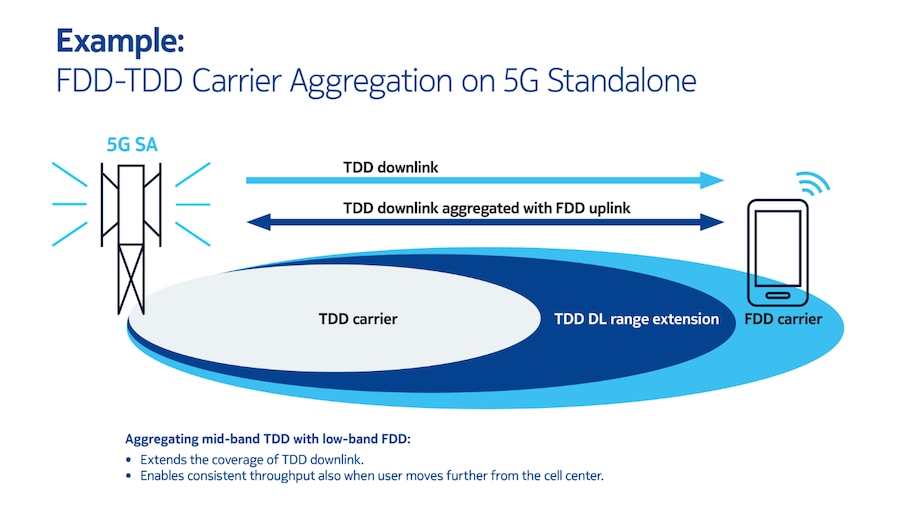
On the uplink, Optus and Ericsson reported 200 Mbps throughput using two-component carrier aggregation (2CC CA), combining FDD (n8/n1) and TDD (n40/n78) spectrum. This implementation is consistent with 3GPP Release 16 uplink enhancements, including uplink carrier aggregation and transmit (Tx) switching (TS 38.213), which enables efficient utilization of UE power resources across multiple uplink carriers, particularly in mixed duplex scenarios.
All results were achieved on a live commercial 5G SA network at Optus’ Sydney campus using commercial off-the-shelf (COTS) user equipment, including the Samsung Galaxy S26 Ultra. This indicates full compliance with 3GPP-defined UE capability signaling (TS 38.306) and the availability of device-side support for complex NR-CA band combinations, including inter-band and cross-duplex aggregation.
“This achievement demonstrates how we are translating cutting-edge 5G technology into meaningful benefits for customers in real-world environments. Through our ongoing collaboration with Ericsson, we are unlocking greater capacity and performance across our 5G network, enabling faster speeds and more reliable connectivity,” said Optus CTO Sri Amirthalingam. “This milestone marks an important step in our network evolution towards 5G Advanced, reinforcing our commitment to remain at the forefront of innovation and to deliver tangible value for our customers.”
Ludvig Landgren, head of Ericsson Australia and New Zealand operations said: “Optus continues to demonstrate strong leadership in adopting advanced 5G capabilities, and this milestone highlights the strength of our partnership. By expanding and combining multiple spectrum assets with Ericsson technology, we are helping Optus deliver meaningful performance improvements that translate directly into better everyday experiences for their customers.”
………………………………………………………………………………………………………………………………………………..
From a broader industry perspective, these results build on ongoing 5G NR-CA advancements. T-Mobile US has demonstrated approximately 6 Gbps downlink throughput using six aggregated carriers in FR1, as well as 550 Mbps uplink throughput leveraging uplink Tx switching across sub-6 GHz bands. In Europe, Vodafone and MediaTek achieved 277 Mbps uplink throughput using NR uplink CA, while Elisa, Ericsson, and MediaTek demonstrated 12CC aggregation reaching 8 Gbps downlink—highlighting the scalability of NR-CA as defined in 3GPP Release 17 and evolving into Release 18 (5G-Advanced).
Within Australia, Telstra has deployed Ericsson’s automated carrier aggregation (CA) optimization solution across more than 50 live 5G Advanced sites, leveraging dynamic CA configuration and traffic-aware scheduling—capabilities aligned with 3GPP Release 18 objectives for AI-assisted RAN optimization.
A notable aspect of the Optus/Ericsson demonstration is the aggregation of 180 MHz of mid-band spectrum across n40 (2.3 GHz) and n78 (3.5 GHz). While not a headline peak-rate milestone, this represents a first in terms of contiguous mid-band NR-CA deployment at this bandwidth scale. Mid-band aggregation is particularly significant within the 3.3–4.2 GHz “golden band” range defined in global 5G spectrum harmonization efforts, as it offers an optimal balance between coverage and capacity.
Operationally, this configuration is expected to deliver immediate gains in high-traffic scenarios—such as dense urban environments, transport hubs, and large venues—by increasing available cell throughput and improving user-level quality of service (QoS). Furthermore, the expanded mid-band capacity directly benefits fixed wireless access (FWA) deployments, where sustained throughput and cell-edge performance are critical. Because the demonstrated CA combinations are already supported by commercial UE categories, deployment can proceed without requiring new device classes, accelerating time-to-impact.
Ericsson was recently selected to modernize and expand SoftBank’s core networks, as well as accelerate the Japanese giant’s 5G SA adoption. Expanding on a previous 5G SA deal centered around its radio access network (RAN) products, Ericsson is providing SoftBank with its Core Networks’ portfolio, including a dual-mode 5G Core solution running on Ericsson’s Cloud Native Infrastructure Solution (CNIS).
……………………………………………………………………………………………………………………………..
References:
https://www.sdxcentral.com/news/ericsson-and-optus-claim-5g-sa-world-first/
https://www.ericsson.com/en/press-releases/7/2026/optus-and-ericsson-trial-ai-to-boost-5g-downlink
https://www.nokia.com/mobile-networks/ran/carrier-aggregation/5g-carrier-aggregation-explained/
China Unicom-Beijing and Huawei build “5.5G network” using 3 component carrier aggregation (3CC)
Nokia, BT Group & Qualcomm achieve enhanced 5G SA downlink speeds using 5G Carrier Aggregation with 5 Component Carriers
Finland’s Elisa, Ericsson and Qualcomm test uplink carrier aggregation on 5G SA network
T-Mobile US, Ericsson, and Qualcomm test 5G carrier aggregation with 6 component carriers
Ericsson and MediaTek set new 5G uplink speed record using Uplink Carrier Aggregation
BT tests 4CC Carrier Aggregation over a standalone 5G network using Nokia equipment
T-Mobile US achieves speeds over 3 Gbps using 5G Carrier Aggregation on its 5G SA network
Telstra Launches 5G Enabled WiFi Hotspots without 5G Devices; 5G Connected Car Up Next
Australia’s Telstra has launched what it says are the first “5G-enabled” Wi-Fi hotspots in the world. The new hotspots on the Gold Coast in Queensland, Australia will provide locals and visitors with access to free broadband services during the evaluation period. While there are no 5G-enabled consumer devices available at this time, the Australian telco will connect 5G backhaul and infrastructure from an exchange to a Wi-Fi access point, so it can be used on existing 4G devices.
The open hotspots will provide up to 10GB of downloads per device per day. They will be managed by Telstra’s recently-launched 5G innovation center on the Gold Coast. Telstra has connected 5G backhaul and related infrastructure in the Southport Exchange in the city to allow connections to the 5G network over Wi-Fi on existing devices.
“Wi-Fi has limited throughput so a single hotspot alone cannot come close to reaching the limits of 5G at our Innovation Center,” Telstra group managing director for networks Mike Wright said. “By using multiple hotspots with potentially hundreds of smartphone users served through a single 5G device we are able to get closer to demonstrating 5G in a real world environment. Our 5G backhaul is capable of delivering download speeds of more than 3 Gbps,” he added.
Telstra is also using mmWave spectrum and its 5G innovation centre to put a connected car on the road using Intel’s 5G automotive trial platform.
“Working with global technology companies Ericsson and Intel, we have put Australia’s first 5G connected car on the road. We are in the very early stages of development and are achieving download speeds approaching 1 Gbps inside the car and the vehicle is also equipped with a Wi-Fi access point,” Wright said.
The executive also highlighted the evolution of the telco’s 5G prototype during the first months of the year. “At the start of the year our 5G prototype device was the size of a bar fridge and weighed more than 200 kilograms. Now, in collaboration with Intel and Ericsson, we have one that has been shrunk down to the size of a personal computer and can be installed in a car.”
The 5G center is central to a $58 million investment Telstra has made to upgrade infrastructure on the Gold Coast to support growing demand and major events in the area. Telstra will run extensive 5G trials on the Gold Coast during the Commonwealth Games in April this year.
Telstra previously said that said that it would work with Ericsson on key 5G technologies including massive multiple-input, multiple-output (Massive MIMO), adaptive beamforming and beam tracking, and OFDM-based waveforms in its Gold Coast center.
Reference:
https://www.telstra.com.au/aboutus/media/media-releases/Telstra-offers-Australias-first-taste-of-5G
…………………………………………………………………………………………………………………………………………………………………
Telstra will have competition. Australian telecom operator Optus said it plans to roll out a fixed-wireless 5G service in key metro areas by early 2019. The announcement comes after the launch of an outdoor trial of 5G New Radio (NR), which showed 2Gbps download speeds for a fixed wireless service in homes and businesses, the Singtel subsidiary said.
The trial, conducted at its headquarters in Macquarie Park in Sydney in January, used dual-band 5G NR equipment and commercial grade CPEs for both C-band and millimeter wave band frequencies. C-band is within the same spectrum range of Optus’ 3.5GHz, which has been earmarked for 5G deployment, the operator said. The mmWave band 5G network has the capability to reach peak data speeds of 15Gbps to a single user, which is 15x what 4.5G is capable of today.
“Everyone has heard of concepts like self-driving cars, smart homes, AI and virtual reality however their full potential will require a fast and reliable network to deliver,” said Optus managing director of networks Dennis Wong.
“Seeing 5G data speeds through our trial that are up to 15x faster than current technologies allows us to show the potential of this transformative technology to support a new ecosystem of connected devices in the home, the office, the paddock and in the wider community.”
Optus will also be hosting a 5G technology showcase during the 2018 Commonwealth Games, which will be held on the Gold Coast in Queensland from April 4 to 15 (this week and next).
Reference:
https://www.telecomasia.net/content/optus-launch-fixed-wireless-5g-service-2019