

Big Tech AI spending binge results in massive job cuts!
Executive Summary:
The tech industry is undergoing a massive structural realignment. Hyperscalers, Software as a Service (SaaS) vendors, and telecom network and equipment providers are aggressively slashing workforces to reallocate capital toward massive AI infrastructure investments. Alphabet, Meta, Amazon, and Microsoft are projected to spend a collective $674 billion in 2026—over double their 2024 levels. Most of that spending is AI related.
From the referenced WSJ article:
“Tech companies are in effect playing a game of chicken with each other on capital-spending plans. They are shelling out as much as they can—more than their rivals, they hope—on AI chips and data centers that could put them in the lead in a race they feel they can’t afford to lose. That in turn is heightening competition over who can use AI to help do more with a lot less, freeing up money to spend on expensive chips.”
Hyperscalers, such as Microsoft and Meta Platforms (Meta), are the latest to their significantly reduce their workforces to scale AI-driven operations. Meta is reportedly reducing its headcount by approximately 8,000, while Microsoft has initiated a “voluntary retirement program” (aka a buyout) targeting 7% of its U.S. workforce—a strategic move to trim payroll before resorting to involuntary layoffs.
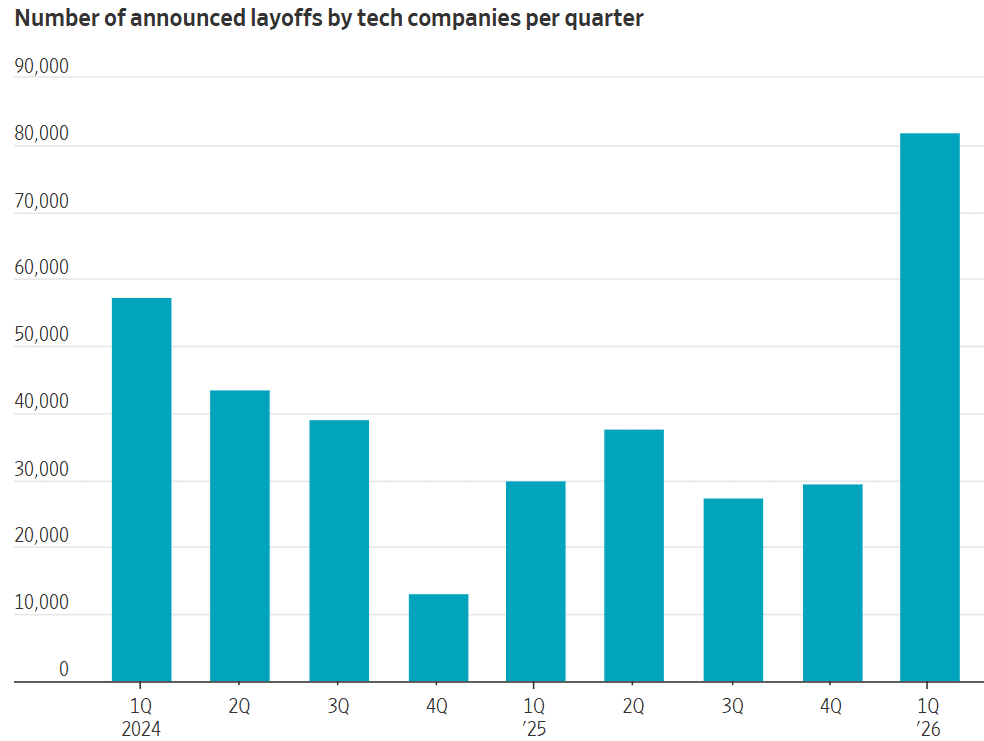
This trend is industry-wide: Oracle and Snap have executed significant reductions, while Block announced plans to cut 40% of its staff (over 4,000 employees). March 2026 represented a two-year peak in tech industry contraction, with Layoffs.fyi reporting 45,800 tech job reductions.
The AI Transformation Narrative vs. Financial Reality:
Executive leadership is framing these cuts as a strategic pivot toward an AI-native future where automated workflows replace legacy human-centric processes. While CEOs like Block’s Jack Dorsey insist these decisions aren’t driven by distress, a “game of chicken” is unfolding in capital planning.
Companies are locked in an escalating race to secure AI silicon (GPUs), High Bandwidth Memory (HBM) and expand Data Center footprints, creating a massive drain on liquidity. This heightens the pressure to achieve “doing more with less”—using AI to automate internal functions and free up the capital necessary for expensive infrastructure. However, in many cases, these cuts are simply corrective measures for pandemic-era overhiring or efforts to normalize efficiency metrics:
- Oracle: Annual revenue per employee remains significantly below industry leaders like Microsoft.
- Snap: Headcount remains 65% above pre-COVID levels despite consistent operating losses.
Strategic Risks and “Off-Balance-Sheet” Engineering:
While slashing headcounts improves Revenue Per Employee (RPE)—a key KPI for Wall Street—it introduces significant long-term risks:
- Talent Attrition & Brain Drain: Aggressive layoffs degrade morale and may drive elite engineering talent toward startups, potentially creating new competitors.
- Governance & Safety: Reducing human oversight during AI deployment could lead to safety and business model integration failures.
- Regulatory & Public Backlash: The “AI as a job killer” narrative is fueling community opposition to massive data center builds, complicating infrastructure rollouts.
The CAPEX Burden:
The financial strain is becoming evident even for “Deep Pocket” firms. Alphabet, Meta, Amazon, and Microsoft are projected to spend $674 billion in CAPEX this year—more than double their 2022 spend.
- Amazon is projected to be cash-flow negative this year.
- Meta’s CAPEX is set to exceed 50% of its annual revenue, with its debt-to-equity ratio climbing to 39% (up from 8% five years ago).
- Some firms are reportedly utilizing “off-balance-sheet financial wizardry” to maintain their AI compute growth without alarming debt markets.
Verdict of the Market?
Markets are sending mixed signals. While analysts are obsessed with efficiency metrics (questions about efficiency on earnings calls have tripled in two years), they are becoming “skittish” regarding unbridled spending. Tesla (TSLA), for instance, saw a 4% stock dip after raising its spending target to $25 billion.
Ultimately, tech giants—who already average $2M in annual revenue per employee—are betting that further workforce reductions will juice efficiency and fund the AI arms race. The trade-off remains whether these “leaner” organizations can maintain the innovation and safety standards required to lead the next technological cycle.
The telecom sector is particularly vulnerable, as AI-native “zero-touch” operations begin to replace legacy roles permanently.
- Network Operators:BT has announced plans to replace up to 10,000 roles with AI by 2030, specifically targeting network management and customer service.
- Network Equipment Vendors: Equipment giants Ericsson and Nokia have collectively shed over 36,000 roles in recent years, pivoting from traditional hardware to AI-optimized software and networking.
- Integrators:Accenture and IBM are utilizing AI to automate junior-level coding and back-office HR tasks, signaling that AI reskilling is now a prerequisite for workforce retention.
Strategic Outlook – Monetization and the “RPE” Battle:
For both MNOs and tech giants, the coming years are about monetization. Investors have shifted from cheering bold AI visions to demanding tangible results, with a heavy focus on Revenue Per Employee (RPE)—a metric that workforce reductions are designed to “juice.”
That “Great Realignment” is a high-stakes gamble, in this author’s opinion. The firms that successfully bridge the gap between massive infrastructure investments and scalable, profitable AI-native services will lead the next generation of global technology. Those that fail to balance efficiency with talent retention may find themselves outpaced by leaner, AI-native startups born from the very talent they have released.
References:
https://www.wsj.com/tech/ai/the-ai-splurge-is-costing-big-tech-its-workforce-34a88e68
AI spending boom accelerates: Big tech to invest an aggregate of $400 billion in 2025; much more in 2026!
AI infrastructure spending boom: a path towards AGI or speculative bubble?
Gartner: AI spending >$2 trillion in 2026 driven by hyperscalers data center investments
AI spending is surging; companies accelerate AI adoption, but job cuts loom large
Big tech spending on AI data centers and infrastructure vs the fiber optic buildout during the dot-com boom (& bust)
Will billions of dollars big tech is spending on Gen AI data centers produce a decent ROI?
Canalys & Gartner: AI investments drive growth in cloud infrastructure spending
5 thoughts on “Big Tech AI spending binge results in massive job cuts!”
Leave a Reply

“Those that fail to balance efficiency with talent retention may find themselves outpaced by leaner, AI-native startups born from the very talent they have released.” Very well said.
AI boosts costs as pricing power lags, say Indian telcos
Rising AI costs combined with limited pricing power have become a sore point for India’s telcos.
As AI use continues to rise, India’s telecom industry has a problem it can no longer ignore. While it is building infrastructure without which the AI economy cannot function – spending heavily on spectrum, fiber, energy and software – it has been unable to recoup those costs.
“The net investments are going to be huge, so the monetization question also needs to be answered,” said Randeep Sekhon, the CTO of Airtel, at a recent industry event organized by the Cellular Operators Association of India (COAI). “It is not just the capex or spectrum pricing, it is also about the monthly opex, the energy cost that you invest.”
https://www.lightreading.com/5g/ai-boosts-costs-as-pricing-power-lags-say-indian-telcos
Meta CEO Mark Zuckerberg predicted in January that 2026 would be the “year AI starts to dramatically change the way we work.” For the Facebook parent’s nearly 80,000 employees, the change is indeed dramatic. The tech behemoth recently revealed plans to lay off 10% of its staff, highlighting a stark new trend: AI layoffs.
Massive job cuts are suddenly in vogue among tech’s biggest names. Meta Platforms (META), Microsoft (MSFT), Oracle (ORCL) and Amazon (AMZN) all have unveiled plans to cut jobs as they dedicate more of their spending toward investments to build AI data centers and other infrastructure. Another goal seems to lurk below the surface: to demonstrate that, with the power of AI, businesses can indeed be leaner, more efficient organizations.
“We are seeing more and more examples where one or two people are building something in a week that would have previously taken dozens of people months,” Zuckerberg told analysts on the Meta second-quarter earnings call Wednesday.
“They are doing it because the others are doing it, and the perception of being aggressive about AI is very important to them,” Tavis, chair of the human capital management department at NYU’s School of Professional Studies, told Investor’s Business Daily. “They are kind of trying to outdo each other.”
Wall Street’s reaction to the layoffs has been mixed. Investors’ ears generally perk up at mentions of efficiency. But the cuts come as investment in AI infrastructure is surging. Cloud hyperscalers signaled more AI spending in this week’s Big Tech earnings. A Jefferies analyst projected Amazon, Microsoft, Alphabet (GOOGL), Meta and Oracle will spend $769 billion in capital expenditures this year.
As talk of AI layoffs mount, a debate is raging on AI’s role in the workforce, including what jobs the technology can actually replace. Prominent voices argue that tech companies are using AI as a smoke screen to cover up previous overhiring. Some experts, including Tavis, warn mass layoffs can have long-term consequences, particularly for employee morale.
Tech Job Cuts Reach Three-Year High:
Layoffs numbered 81,747 across 83 tech companies during the first three months of the year, according to the tracking website Layoffs.fyi. That was the highest total since tech employers cut 167,000 jobs in the first three months of 2023.
U.S. employers across sectors cut 60,620 jobs in March, up 25% from a month earlier, according to a report from outplacement firm Challenger, Gray & Christmas. AI was cited in 25% of the layoffs. That placed ahead of business closings and restructurings as the most common job-cut explanation during the month, according to the report.
April has been a rough month as well as AI layoffs have mounted. Up to 20,000 roles were targeted for elimination on April 23 alone, when Microsoft reportedly offered buyouts for a reported 7% of staff and Meta said it would lay off 10% of its workforce in late May. Meta also canceled hiring for 6,000 open roles.
The spike in AI layoffs has ignited fears among tech workers and economists that artificial intelligence is headed toward upending the labor market. For tech companies in particular, AI tools such as Anthropic’s Claude AI agent are helping to write computer code and generate content such as marketing materials and internal presentations.
Research published in March by Anthropic identified computer programmers among the most exposed occupations to AI’s current capabilities.
Fintech company Block (XYZ), parent of Square, cited AI directly when it announced in February a plan to cut 40% of its workforce, or roughly 4,000 employees.
“Something has changed,” Block Chief Executive Jack Dorsey said in posts to social media. “We’re already seeing that the intelligence tools we’re creating and using, paired with smaller and flatter teams, are enabling a new way of working.”
Rising Costs Drive AI Layoffs:
For Meta, Microsoft, Amazon and Oracle, the job cuts come as the companies are making huge bets on AI. That spending has included dangling eye-popping salaries to lure top AI researchers in some cases. But most AI investment is on infrastructure, such as data centers filled with advanced computing chips from Nvidia (NVDA).
Meta, for instance, expects to plow between $125 billion and $145 billion into capital expenditures this year, the company told investors on Wednesday. That was marked up from prior guidance of $115 billion to $135 billion. The new $135 billion midpoint of Meta’s range is nearly double the $70 billion Meta invested on capex last year.
Janelle Gale, the company’s chief people officer, said in a letter to Meta employees on April 23 that its layoffs were part of a “continued effort to run the company more efficiently and to allow us to offset the other investments we’re making.”
Zuckerberg underlined the importance of efficiency in a call with employees on Thursday, according to the Wall Street Journal. But he also said the company is balancing its two main costs of “people oriented things” and computing infrastructure.
“If we’re investing more in one area to serve our community, then that means that we have less capital to basically allocate to the other,” Zuckerberg said.
AI Layoffs Amid Free-Cash-Flow Crunch
In a client note earlier this month, Evercore ISI analyst Mark Mahaney estimated Meta’s job cuts could generate $3 billion in annual savings. But “we would expect those savings to be plowed back into investment spend,” he said.
That may be a reason why Meta stock slipped the day it announced the AI layoffs. The response contrasts with the last time Meta conducted a mega round of layoffs in late 2022 and early 2023. Zuckerberg’s commitment to a “Year of Efficiency” at the time helped spark a huge rally for Meta stock.
Also different this time is that Meta’s business is growing rapidly. Analysts project Meta’s revenue will rise 25% this year, according to FactSet, whereas 2022 revenue fell 1%.
But Meta fell even further following its Q1 results that included the hike in capex spending. Some analysts highlighted that Meta’s total expense guidance for 2026 went unchanged despite the layoffs.
The layoffs come as rising capex has eaten into a key metric for tech stocks: free cash flow. Following its first-quarter results Wednesday, Wall Street projects Meta’s free cash flow will decline to $2.3 billion this year from $44 billion in 2025.
Meta won’t be alone. Amazon reported trailing 12-month free-cash-flow of $1.2 billion for its March quarter. That’s cut down from $25.9 billion in Q1 2025. Oracle is expected to have negative free cash flow for its next three fiscal years, according to the FactSet analyst consensus.
AI Job Cuts As A Signal:
But not all AI layoffs are a byproduct of hyperscale cloud investments. For smaller tech players, the job cuts could offer a signal to investors that the business is ready to use AI to cut costs or boost growth.
In some cases, that has helped boost investor confidence. Block stock was down by roughly 16% year-to-date when it revealed its mass layoff plan Feb. 26, along with its Q4 earnings results. Block stock popped more than 20% immediately following the news. Shares were ahead 8% year-to-date as of Thursday.
Morgan Stanley upgraded Block from a neutral view to an overweight, or buy, rating after the announcement. The analysts pointed to the company’s overall momentum but also said its “audacious AI gambit” could deliver improved profits.
On the other hand, AI-focused layoffs in January by Pinterest (PINS) were seen by Wall Street as “foreshadowing a revenue shortfall,” analysts with RBC Capital said at the time. Shares slumped, contributing to a 22% decline over the past year and a 70% drop from an early 2021 peak.
AI Layoffs Or ‘AI Washing?’
Claims that AI is driving mass job cuts have been met with skepticism on Wall Street and beyond.
Attributing layoffs to AI has even led to a new buzzword, “AI washing,” amid claims that companies are using AI as a scapegoat. The term has been used by even some of the technology’s biggest proponents, including OpenAI Chief Executive Sam Altman.
Marc Andreessen, cofounder and general partner of the influential venture capital firm Andreessen Horowitz, said on a recent podcast that the real issue driving “AI layoffs” is that many companies are overstaffed by as much as 50% to 75%.
“Now they all have the silver bullet excuse: Ah, it’s AI,” Andreessen said.
On that note, Block’s layoffs could be more about “bloat” than AI, said Alex Johnson, author of the Fintech Takes newsletter.
“There are likely many other late-stage fintech companies (public and private) that over-hired during the pandemic and in its immediate aftermath and now need to shed staff,” Johnson told IBD.
State Of The Tech Workforce:
Indeed, overall technology industry hiring swelled in 2020 and 2021, as companies reacted to a jump in demand for digital services brought on by Covid-19.
Net technology employment in the U.S. grew from 8.7 million in 2020 to 9.6 million in 2023, according to an analysis of federal data by IT trade group CompTIA. But total tech employment has remained flat since then, still at an estimated 9.6 million for 2025.
Meta’s headcount climbed to 86,482 by the end of 2022, nearly double its 2019 levels. Layoffs in 2023 cut the total by 22%. However, Meta’s headcount climbed back up to 77,986 as of March 31, according to its Q1 earnings report.
Seth Robinson, vice president of industry research at CompTIA, said tech hiring has historically swung between periods of significant investments and pullbacks.
“We believe that there is some correction happening, where companies have heavily invested, maybe overinvested, in digital transformation,” Robinson told IBD. “Now they’re trying to rightsize that, or they’re at least trying to make sure that their investments are making sense.”
AI is “part of the mix” of reasons companies are pulling back, Robinson said. But tech hiring has shown softness since 2023, he added, when few companies were positioned to implement AI tools.
“The softness actually lines up quite a bit better with actions of the Federal Reserve, in terms of raising interest rates,” Robinson said.
AI Adoption By Enterprises:
Adoption of AI tools among businesses has been increasing, according to data tracked by Ramp, a company that offers corporate credit cards and expense management tools. The Ramp AI Index estimates that roughly half of U.S. businesses are paying for subscriptions to AI tools as of March. That’s up from 23.5% at the start of 2025.
Subscribing to AI tools, though, is not the same as using those tools to replace workers. The March 2026 study from Anthropic found that AI hasn’t led to any clear increase in unemployment within fields most exposed to the technology, such as computer programming and customer service.
However, the Anthropic economic researchers found evidence that hiring has slowed in some exposed categories, particularly for entry-level roles.
“I think companies are being more cautious about hiring, with the potential that AI is going to increase the productivity of their current workers,” Brent Schutte, chief investment officer at Northwestern Mutual Wealth Management, told IBD. “I don’t think firms as of yet have gone through and started laying off people en masse.”
Risks From AI Layoffs:
Laying off staff as a path toward AI-powered efficiency can be risky, experts warn.
“The irony is, it can end up costing them more,” said NYU’s Tavis, who has served as a human resources executive at AIG among other companies.
That’s because companies eventually may need to hire people to fill roles in a different area, or rehire for some of the same roles. That’s on top of severance payments and other costs associated with the layoffs themselves.
“Many organizations are rushing to reduce headcount before they’re actually seeing the gains of the AI investments,” Gartner analyst Kathy Ross told IBD.
The research firm recently predicted about half of companies that cut customer service staff in “AI layoffs” will rehire for those roles within a year.
Companies that conduct mass layoffs now could also suffer from damaged morale, or lose other employees who seek more stable environments.
Some large-scale layoffs are “punishing people in the workforce for, at this point, very vague ideas of what the future will look like,” Tavis said. “That does not prepare you for resilience. Resilience comes from the culture within an organization.”
Tech Industry Hiring And AI Layoffs
The unemployment rate for technology occupation employment — a category that includes tech professionals across sectors — edged up to 3.9% in March from 3.8% a month earlier, according to a CompTIA analysis of federal data. That remains below the national average of 4.3%, however.
But the CompTIA analysis also found that active job postings related to tech climbed by about 9% in March.
For job seekers, there is a “lot of confusion and a lot of frustration,” according to Chris Allaire, CEO of Averity, a New York-based tech recruiting firm.
Along with fears about the technology driving layoffs, AI has exacerbated a problem Allaire called the “application black hole.” Every open role is seeing hundreds of applicants who are using AI to optimize their resume, he said. On the other end, however, are more AI tools being used to whittle down candidates.
What Happens To Entry-Level Tech Jobs
One area that is clearly feeling the squeeze in the current market is entry-level roles.
“We’ve seen for years now that companies have been targeting slightly higher levels of experience, especially in areas like cybersecurity or data,” CompTIA’s Robinson said. “But there’s a limited pool of those types of employees. And if there continues to be pressure on early career (hiring), that pool is just going to shrink and shrink.”
Some tech companies have expressed similar concerns. IBM (IBM) Chief Executive Arvind Krishna recently told The Verge’s Decoder podcast that he disagrees with the view that AI agents can replace the work done by entry-level employees.
“Wouldn’t you rather have an entry-level person and AI makes them more like a 10-year expert?” Krishna said.
He added, “Otherwise, where is the talent who’s going to come up with the next great product?”
Johnson of Fintech Takes compared AI models to interns who are “enthusiastic and smart but lacking in wisdom and requiring tremendous amounts of supervision.”
What’s Next In The AI Layoffs Trend
Meanwhile, the S&P 500 bounced back to highs in April, helped by a strong month for technology stocks. Northwestern Mutual’s Schutte sees the risks of labor market disruption as part of the “delicate balance” investors are weighing. For now, optimism about productivity growth seems to be outweighing fears about inflation, the Iran war, the labor market and tariffs.
“In the longer term, the likely answer is (AI) is a positive for the entirety of the economy with some displaced workers in the near term, which is unfortunately always something that happens when you have technological innovation,” Schutte said. “But what impact does that have in the here and now? That’s still up for grabs.”
AI’s impact on the workforce also came up in the past week’s earnings reports.
Microsoft Chief Financial Officer Amy Hood told analysts the company expects headcount to decrease this year as it evolves “how we operate to increase our pace and agility. Therefore, we expect headcount will decrease year over year”
Zuckerberg echoed Big Tech’s optimism about AI’s promise of leaner, more streamlined organizations, with a smaller workforce. “There is a lot that we can do to enable this: building the best infrastructure for creating and delivering products at scale, streamlining our teams so they are not bigger than they need to be,” he told analysts.
https://www.investors.com/news/technology/ai-layoffs-tech-what-investors-should-know/
The bar for tech companies to make AI profitable was already high. Then came a surge in memory-chip prices that has sent costs through the roof, adding fresh urgency to questions about who’s going to pay for it all and how. The tech companies that are largely funding the AI boom have been avoiding that riddle. They need to invest in chips and data centers as fast as they can to capitalize on the world-changing potential of AI, they argue. This isn’t the time for prudence.
Now, though, the cost of AI isn’t growing just because they are adding to data-center footprints. It is rising because the stuff they need to buy to make it all work is a lot more expensive.
Memory has become a big issue of late. The most advanced AI computing setups require more of the most advanced kind of memory chips available. This is called high-bandwidth memory. Tech companies are competing to secure supplies, giving memory manufacturers the upper hand on pricing.
The impact has been dramatic. Microsoft last week said about $25 billion of its annual capital expenditures of around $190 billion were down to “higher component pricing.” That’s code for more expensive memory. Google parent Alphabet and Meta Platforms also cited higher component costs in raising their capital-spending plans.
The impact of the memory crunch has already been far-reaching in consumer electronics. It is hitting PCs and smartphones as memory makers divert production to more profitable AI-related products. Surging prices will have an impact on AI itself, too. Tech companies are already under pressure to show their AI investments are paying off as depreciation accelerates and eats into reported profit. And returns on AI ultimately must come from people who use it. That may be in the form of subscription fees, time spent watching advertisements, software licenses or some other novel way tech companies devise to get money out of customers’ pockets. Making that financial model work is suddenly a lot harder.
“We stand on the walls, sentinels of the inner sanctum, against the assault of AI slop. The Ontology is based firmly in reality—there is, here, a dialectic between ground truth, tribal knowledge, and enhancements.”
— Alex Karp, Palantir Technologies chief executive, on the advantages of his company’s approach to AI
Hyperscalers’ earnings growth this quarter was boosted by an unusually large contribution from equity stakes in private companies.
Microsoft reported “only” $942mn of other income in the first three months of the year, but this line item has now made $7.2bn over the past nine months.
Alphabet and Amazon generated “other income” totaling $53 billion in Q1 2026, which accounted for nearly 60% of those two companies’ income in Q1 and 34% of the total $155 billion in income this quarter across the five largest hyperscalers. This represents the group’s largest collective share of earnings attributable to “other income” in at least a decade. Of this $53 billion in “other income,” $49 billion was explicitly due to equity stakes in private companies.
This is another sign of just how comically codependent the AI tech industry has become.
Not only have private investments and increasingly engorged funding rounds become a meaningful driver of the hyperscalers’ aggregate earnings, but the money the hyperscalers have pumped into the likes of Anthropic and OpenAI has allowed the AI companies to sign huge computing deals with Alphabet’s Google Cloud, Microsoft’s Azure and Amazon Web Services.
OpenAI and Anthropic now make up about half of the entire cloud computing order books at Oracle, Alphabet, Amazon and Microsoft.
References:
https://www.ft.com/content/be97df0a-76b1-4cb0-9ba4-d1117d8d1450
https://fortune.com/2026/04/30/google-amazon-ai-profits-anthropic-stake-bubble-earnings-2026/