

Analysis: Equinix’s “Distributed AI Hub” vs competitive global carrier neutral offerings
Backgrounder:
As AI workloads undergo geographic decentralization across a fragmented hybrid-cloud ecosystem, enterprises face significant headwinds in maintaining deterministic performance, data sovereignty, and OpEx predictability. As AI training and autonomous agent workloads drive demand for high-bandwidth, low-latency multi-cloud architectures, the focus shifts to alleviating pressure on the backbone and access networks through densified, software-defined connectivity. Central cloud infrastructure is teetering under the weight of spiraling workloads, and being distributed east-west into regional backwaters in search of power, and north-south in the metro centers and enterprise premises in an urgent quest to actually put AI to work. Enterprises are, suddenly, stitching together training in one cloud, inference in another, and agents at the edge – all without breaking performance budgets. Which is why networks and high speed connectivity matter more than ever.
………………………………………………………………………………………………………………………………………………………………………………………
Equinix Carrier Neutral Hubs:
Equinix is positioning its carrier-neutral interconnection hubs as the strategic solution to mitigate these challenges. By optimizing last-mile backhaul and orchestrating distributed infrastructure, the platform enables localized inference at the edge. In January 2026, Equinix announced a last-mile access service (Equinix Fabric Intelligence) and yesterday (March 11, 2026), the company announced their Distributed AI Hub, to provide a single, unified framework for enterprises to connect, secure and simplify their increasingly complex and distributed AI ecosystems.
The Hub is a neutral location that allows enterprises to discover, connect to and consume AI infrastructure providers—including model companies, GPU clouds, data platforms, network and security services, and AI frameworks—all through private, low-latency connectivity at Equinix’s 280 high performance data centers.
“Enterprises are racing to deploy agentic AI but are finding that their existing infrastructure was never designed for the complexities of distributed intelligence,” said Mary Johnston Turner, Research Vice President, Digital Infrastructure Strategies at IDC.” By 2027, IDC expects 80% of enterprises will deploy distributed edge infrastructure to improve the latency and responsiveness of AI applications. Enterprises will need solutions like Equinix’s Distributed AI Hub to enable them to unify these disparate systems.”
To realize the full potential of agentic AI, enterprises must converge inherently distributed workflows—spanning model training and inferencing workloads dispersed across public clouds, private data centers, edge nodes, and an expanding set of specialized “neocloud” platforms. Each environment brings distinct latency, performance, and data sovereignty constraints. This operational fragmentation can impede innovation velocity, complicate governance, and make it exceedingly difficult to execute AI workloads in proximity to the data sources that drive them, thereby diminishing both business impact and user experience.
Equinix is addressing this challenge with the launch of the Distributed AI Hub, an evolution of its global digital infrastructure platform. The Hub provides a unified, vendor-neutral framework that federates data, compute, cloud access, and AI ecosystem partners across geographically distributed domains. It allows enterprises to deploy and orchestrate AI workloads where they achieve optimal performance—without re-architecting applications or migrating data across incompatible environments. Through consistent governance, secure interconnection, and high-performance data mobility, the Hub simplifies how organizations connect models, replicate datasets, execute inferencing, and manage multi-environment AI operations. Unlike hyperscaler AI marketplaces that prioritize vertically integrated ecosystems, the Equinix Distributed AI Hub is open by design, enabling customers to assemble best-of-breed AI stacks tailored to workload and compliance requirements.
“AI isn’t centralized—but the right infrastructure can make it run as seamlessly as if it were,” said Jon Lin, Chief Business Officer at Equinix. “Equinix is the neutral ground where AI, cloud and networking infrastructure converge. We are providing enterprises the freedom to build and scale AI wherever their data, partners, and teams already live, while running inference close to the data and users that depend on it, without the operational drag that comes from stitching together complex, distributed systems. With our Distributed AI Hub, we’re giving customers a simpler, smarter, and far more connected way to run and scale their AI today. We are building one of the most expansive and neutral AI ecosystems.”
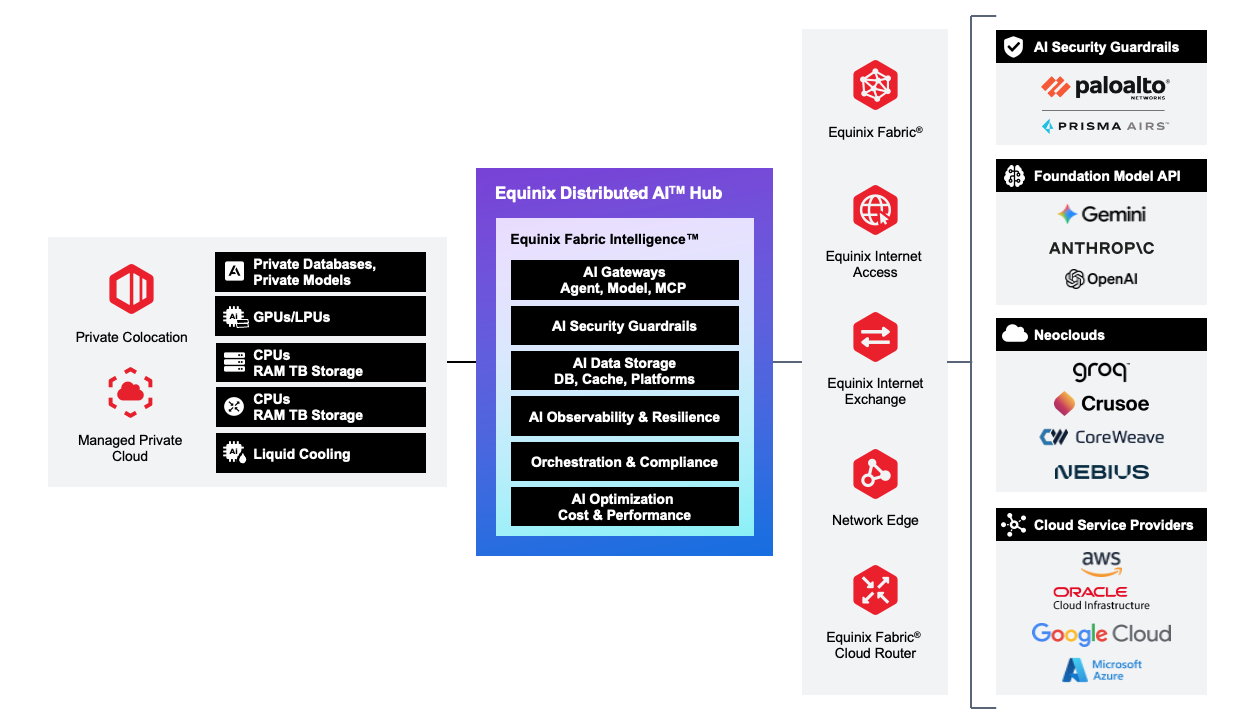
Image Credit: Equinix
…………………………………………………………………………………………………………………………………………………………………………….
The Hub’s first major integration is with Palo Alto Networks, extending AI-driven security into the distributed enterprise. The collaboration combines Equinix’s global interconnection fabric and distributed data infrastructure with Palo Alto Networks Prisma AIRS, delivering real-time protection for autonomous agents and model interactions across external data sources and tools. This integration gives enterprises unified visibility and policy control across the entire AI lifecycle—from data ingestion to inference execution—irrespective of deployment location. Furthermore, Prisma AIRS will be natively available through Equinix Network Edge, enabling centralized management of AI-centric security services at the digital edge, closer to users, clouds, and critical workloads.
“The conversation around distributed AI is finally getting real,” said Lloyd Taylor, CTO/CISO, at Alembic. “It’s more than compute and data, it’s controlling where the data lives and how the compute runs. Equinix is framing that problem the right way, by bringing placement, governance, and predictable performance into the same architecture with the Distributed AI Hub. This is what makes distributed AI viable at enterprise scale.”
The Distributed AI Hub is available globally at 280 Equinix data center locations, enabling enterprises to deploy consistent AI infrastructure patterns worldwide. Equinix will be participating at NVIDIA GTC—located at Booth 1030—and will be previewing the Hub.
Additional Resources:
- Equinix and Palo Alto Networks Partner to Enable AI You Can Trust [Blog]
- Equinix Distributed AI [Webpage]
About Equinix:
Equinix, Inc. (Nasdaq: EQIX) shortens the path to boundless connectivity anywhere in the world. Its digital infrastructure, data center footprint and interconnected ecosystems empower innovations that enhance our work, life and planet. Equinix connects economies, countries, organizations and communities, delivering seamless digital experiences and cutting-edge AI—quickly, efficiently and everywhere.
……………………………………………………………………………………………………………………………………………………………………………….
Competitive Analysis (Source: Perplexity.ai):
Equinix is the largest and most mature carrier‑neutral interconnection hub globally, but it faces serious competition at several layers of the stack.
Global carrier‑neutral players:
Major global and multi‑regional competitors offering carrier‑neutral colocation and interconnection include:
-
Digital Realty (PlatformDIGITAL, Interconnection Fabric, strong global footprint, direct cloud on‑ramps).
-
NTT Global Data Centers.
-
CyrusOne, QTS, GDS, Telehouse/KDDI, CoreSite, Flexential, Cologix and others in specific metros/regions.
Selected ecosystem comparison:
How Equinix is differentiated:
Analysts typically see Equinix’s moat in: dense metro ecosystems, breadth of on‑net networks and clouds, and the maturity of its software‑defined interconnection (Fabric) and edge services, rather than in being the only carrier‑neutral hub. Its main strategic challenge is staying ahead of peers like Digital Realty, NTT, and CyrusOne as they build similar fabrics around large, carrier‑neutral campuses and hyperscale‑adjacent deployments.
…………………………………………………………………………………………………………………………………………………………………………………………………
References:
Agents of chaos – Equinix proposes metro fix for the new AI sprawl
Orange Telco Cloud to use Equinix Bare Metal to deliver virtual services with <10 ms latency
Equinix Partners with Nokia to Increase 5G and Edge Ecosystem Innovation
Equinix and Vodafone to Build Digital Subsea Cable Hub in Genoa, Italy
Equinix to deploy Nokia’s IP/MPLS network infrastructure for its global data center interconnection services
Synergy Research: Strong demand for Colocation with Equinix, Digital Realty and NTT top providers
CoreSite Enables 50G Multi-cloud Networking with Enhanced Virtual Connections to Oracle Cloud Infrastructure FastConnect
Arrcus MCN solution now part of CoreSite’s Open Cloud Exchange®
Global Data Center Colocation Market Size forecast = $131.8 Billion by 2030 at a 14.2% CAGR
Initiatives and Analysis: Nokia focuses on data centers as its top growth market
AWS deployed in Digital Realty Data Centers at 100Gbps & for Bell Canada’s 5G Edge Computing
TMR: Data Center Networking Market sees shift to user-centric & data-oriented business + CoreSite DC Tour