

Analysis: Nvidia’s $2 billion investment in Marvell; NVLink Fusion ecosystem & RAN vendor silicon strategy
NVIDIA just announced a $2 billion investment in custom silicon developer Marvell Technology (NASDAQ:MRVL). This comes right on the heels of its $2 billion investments in Lumentum, Coherent, and $1 billion in Nokia.
- NVIDIA is also deepening its relationship with Marvell within its NVLink Fusion ecosystem. NVLink is NVIDIA’s proprietary scale-up networking system. Scale-up refers to connecting computing components within a rack rather than between racks.
- NVLink Fusion essentially allows customers to connect non-NVIDIA components to NVIDIA components within the same rack. Thus, customers can mix and match technologies from different vendors when they make a purchase. However, each platform does need to have at least one NVIDIA component.
- NVLink Fusion is in opposition to the UALink consortium, of which NVIDIA is not a member. Key NVIDIA competitors like Broadcom (NASDAQ:AVGO) and Advanced Micro Devices (NASDAQ:AMD) back UALink. Companies in this group have the same goal as NVIDIA does for NVLink Fusion: to allow customers to easily connect their devices together within racks.
- UALink’s goal is to reduce NVIDIA’s power by providing an alternative to NVLink Fusion. One of the key benefits to data center operators, the buyers of AI chips, is avoiding vendor lock-in. By being able to source components from a wide range of companies, there is greater competitive pressure, and thus more room to negotiate. Meanwhile, building AI infrastructure solely on NVLink grants NVIDIA massive bargaining power.
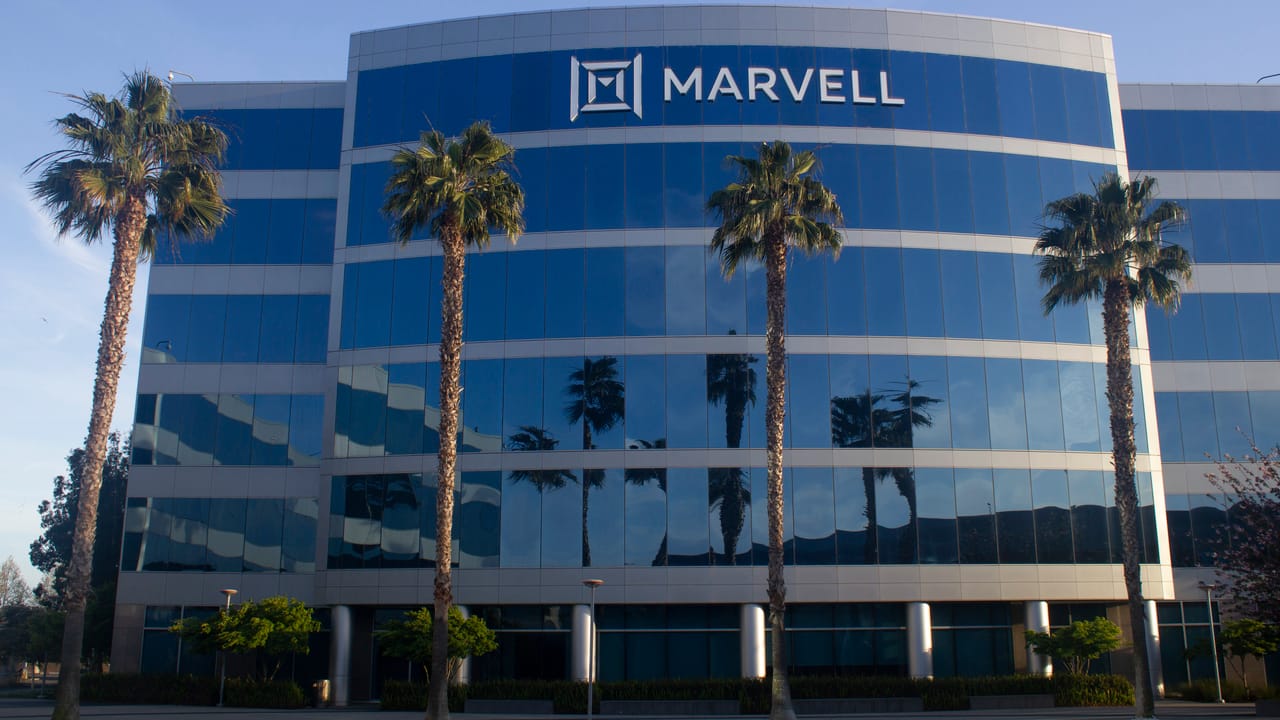
Photo Credit: Marvell Technology
Marvell has been a member of both NVLink and UALink, one of the few major chip companies that can make this claim. Now, NVIDIA is more formally recognizing Marvell’s place within NVLink, potentially expanding its ability to win customers. Meanwhile, Marvell strengthens its standing in the AI market. From Marvell’s perspective, the deal has significant benefits. Even though Marvell was already a part of NVLink Fusion, the company’s place within this ecosystem is now elevated. Not all companies in NVLink Fusion have received a multi-billion-dollar investment from NVIDIA or their own dedicated announcement.
These factors suggest that NVIDIA is particularly confident in Marvell’s solutions and that it will put in more effort to sell them to customers. NVIDIA now has 2 billion more reasons to do just that. This is particularly noteworthy, as MediaTek and Alchip Technologies are also in NVLink Fusion, and compete with Marvell in custom silicon.
In fact, Alchip has been the source of considerable volatility in Marvell shares over the recent past. This comes as some investors believed that the firm would siphon off much of the custom chip business that Marvell has built with Amazon. However, Marvell’s last earnings report helped to significantly quell these fears. Additionally, Marvell will add $2 billion to its balance sheet. That is very significant, as the company ended last quarter with cash and equivalents of just $2.64 billion, adding meaningful financial flexibility.
The announcement also outlines new products outside of custom silicon that NVIDIA and Marvell will collaborate on. This includes scale-up networking components, optical interconnect solutions, and silicon photonics. This comes just two months after Marvell completed its acquisition of Celestial AI, which it calls a “pioneer in optical interconnect technology for scale-up connectivity.”
Expanding the language of the partnership to include these very products suggests that NVLink Fusion could offer a significant pathway to grow this recently acquired business. Overall, between the $2 billion investment, the dedicated announcement, and the expanded partnership scope, Marvell now looks like the custom silicon provider of choice within NVLink Fusion.
NVIDIA is telling its customers that its technology and Marvell’s can integrate seamlessly. This could influence future customers who want to use both products to do so on NVLink. As a result, the firm could see revenue benefits by getting in on deals it otherwise might not have participated in. This logic extends to customers interested in Marvell’s optical interconnect and scale-up solutions.
……………………………………………………………………………………………………………………………………………………………………………………………………………………………..
RAN Silicon Strategy:
- Ericsson continues to prioritize its in-house custom ASICs, dismissing claims that the R&D required is unsustainable. Michael Begley, Ericsson’s Head of RAN Compute, noted at MWC that their 30-year legacy of iterative development creates a cost efficiency that a “blank sheet” competitor couldn’t match.. Despite this, Ericsson is diversifying through its Cloud RAN portfolio. Their vRAN software, currently optimized for Intel x86 architectures, is being architected for portability across AMD and Nvidia (Arm-based) platforms. While Ericsson frames this as addressing varied customer requirements, industry observers view it as a strategic hedge against the shifting hardware landscape.
- Conversely, Nokia is signaling a pivot away from proprietary hardware. Following a significant investment from Nvidia, Nokia’s leadership has articulated a shift toward general-purpose hardware and decoupled software models. Although Nokia remains contractually tied to Marvell for custom silicon through the mid-2030s, the potential to offload intensive Massive MIMO processing to Nvidia GPUs suggests a technical path toward phased-out reliance on traditional custom ASICs.
- Furthermore, Ericsson utilizing look-aside acceleration via custom ASICs while Nokia commits to in-line acceleration using SmartNICs for improved performance and TCO. Ericsson prioritizes in-house silicon for efficiency, whereas Nokia is shifting toward general-purpose hardware and Nvidia-backed GPU acceleration.
- Meanwhile, Samsung’s RAN silicon strategy has fundamentally inverted the traditional industry model: virtualized RAN (vRAN) is now its primary offering, with purpose-built custom silicon moved to the periphery. As of early 2026, Samsung is the global leader in vRAN deployments, surpassing 53,000 active sites. For vRAN, Samsung is aggressively diversifying its silicon partners beyond Intel to include AMD (x86) and NVIDIA (Arm-based Grace CPUs) to prevent hardware lock-in. The South Korean company is positioning its vRAN as the “AI-native” foundation for 5G-Advanced and 6G, aiming for fully autonomous “autopilot” networks by 2027 through its CognitiV NOS (Network Operations Suite).
- Samsung is leveraging its internal silicon foundry to develop 2nm Exynos chips and Silicon Photonics (“Dream Chip”), with a mass production target of 2028 to integrate optical transmission directly into AI accelerators and RAN modules. Its new Network in a Server (NIS) solution consolidates Core, vCU, vDU, and AI agents into a single 1U server, targeted at private 5G and enterprise edge use cases. While Samsung has pivoted heavily toward a vRAN-first strategy, it still maintains a portfolio of purpose-built (non-vRAN) equipment that utilizes custom ASICs. However, the role of these chips is shifting from a primary focus to a supporting role as the industry moves toward general-purpose hardware.
- Legacy and Specialized Support: Samsung continues to sell and support its traditional Baseband Units (BBUs), which are powered by proprietary silicon developed in partnership with companies like Marvell. These ASICs are still used for high-density, performance-critical deployments where standard CPUs are not yet chosen by the operator.
- Hardware Acceleration: In non-vRAN scenarios, custom ASICs handle the most computationally intensive Layer 1 (L1) tasks, such as beamforming for Massive MIMO and FEC (Forward Error Correction).
- Phased-Out Trajectory: Samsung executives have acknowledged that the era of proprietary hardware is likely nearing its end. Alok Shah, VP of Network Strategy at Samsung, has noted that while they still provide purpose-built BBUs, it is only a “matter of time” before vRAN becomes the universal standard.
……………………………………………………………………………………………………………………………………………………….
References:
https://www.lightreading.com/5g/nvidia-backed-marvell-pitches-one-chip-to-rule-the-ran
RAN Silicon Rethink- Part II; vRAN and General-Purpose Compute
RAN silicon rethink – from purpose built products & ASICs to general purpose processors or GPUs for vRAN & AI RAN
AI-RAN Reality Check: hype vs hesitation, shaky business case, no specific definition, no standards?
Ericsson goes with custom silicon (rather than Nvidia GPUs) for AI RAN
AT&T and Ericsson boost Cloud RAN performance with AI-native software running on Intel Xeon 6 SoC
Analysis: Rakuten Mobile and Intel partnership to embed AI directly into vRAN
Is the “far edge” a bridge to far to cross for AI inferencing? What about “Distributed AI Grids”?
Analysis: Edge AI and Qualcomm’s AI Program for Innovators 2026 – APAC for startups to lead in AI innovation
Will “AI at the Edge” transform telecom or be yet another telco monetization failure?