

NTT’s IOWN is (finally) evolving to an All Photonics Network (APN); Physics based AI for enterprise OT
Like all South Korea telecoms, NTT has revised its mid-term business strategy to center on AI infrastructure, data centers, and “value domains.” This shift follows a slowdown in its traditional telecoms “cash cow” business and aims to reorient the group toward higher growth areas. The company is prioritizing AI-related services, overseas data centers, and its vision for an IOWN [1.] based connectivity platform built for GPU, network, and power-heavy workloads.
Note 1. IOWN is NTT’s Innovative Optical and Wireless Network initiative, with a photonics optical network being at its core. An All-Photonics Network (APN) is NTT’s vision for a next-generation network that uses laser generated light, rather than electronic conversion, to move data across compute, storage, and transport layers. It is NTT’s bet on a much faster, lower-latency, and more energy-efficient network architecture for AI, data centers, and advanced telecom services.
–>The all optical network was promised by many new age telcos in the late 1990s- early 2000s but it has never seen the light of day (no pun intended)

Image Credit: NTT
…………………………………………………………………………………………………………………………………………………………………………………………………………………………………
Benefits of an all photonics network:
Today, continuous, high-volume AI data flows across clouds, data centers and edge environments rely on stable, low-latency pathways. Yet networks that rely on optical to electrical to optical (OEO) conversion cannot provide this consistently. Even small variations in routing, buffering and electrical switching reduce the predictability that AI needs. Adding bandwidth can delay the symptoms but doesn’t address the architectural challenges these networks face as data movement intensifies.
At the leading edge of this shift is the All-Photonics Network (APN), developed by the IOWN Global Forum. It’s an architectural breakthrough and a practical step to rearchitecting how data moves, designed for a world where AI is changing the rules entirely. The APN introduces a new way of architecting and operationalizing photonic transport so organizations can use it without having to manage the underlying optical engineering. Instead of relying on electrical conversions at every stage, it extends optical communication to the transport layers that connect sites, regions and data centers. That results in far more consistent network performance. It reduces jitter significantly and improves throughput by avoiding repeated processing overhead.
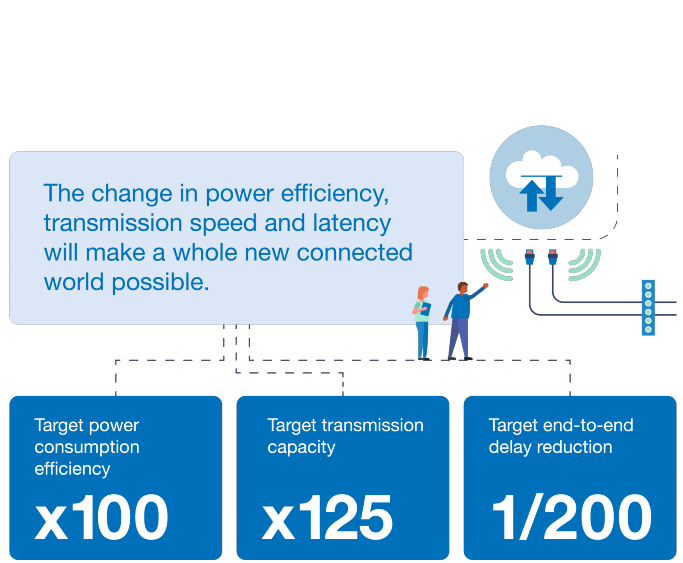
The IOWN Global Forum outlines a future where optical-first infrastructure delivers (see image below):
- Up to 100 times lower power consumption
- More than 120 times greater transmission capacity
- A reduction in end-to-end latency by as much as 200 times
NTT wants to combine AI with IOWN’s photonics-based networking to better support AI-era compute, data center, and transport demands. AIOWN is meant to solve the bottlenecks created by AI workloads, where power, latency, and bandwidth are becoming as important as raw compute.
NTT is positioning it as infrastructure for the AI era, not just as a telecom upgrade, so it sits at the center of the company’s broader shift toward AI infrastructure and data centers. Instead of relying mainly on conventional electronic networking, the pure optical IOWN aims to connect data centers and networks with photonics-based transport that can reduce energy use and improve performance. That makes it especially relevant for GPU clusters, AI cloud environments, and high-capacity backbone links.
…………………………………………………………………………………………………………………………………………………………………………………………………………………………………
NTT says the traditional telecom environment is getting tougher, with stronger competition and rising traffic demands pressuring its core business. In response, it is shifting emphasis to three growth areas: AI services for corporate clients, global data center expansion, and adjacent financial services, while also reframing its network layer for the AI era through IOWN.
The “value domains” framing is basically NTT’s way of saying it wants to move up the stack into higher-margin, customer-specific businesses rather than remain mostly a utility-like connectivity provider. In practice, that means selling integrated AI, data center, and industry solutions where NTT can capture more of the economic value than in wholesale telecom alone. NTT believes telecom cash flows will grow more slowly than AI infrastructure demand and they are likely correct. AIOWN is especially important because it ties together compute, networks, and power, which are becoming the real bottlenecks in AI deployments. The strategy also aligns with NTT’s broader enterprise AI positioning, where it can monetize infrastructure and services together rather than betting only on model development.
- Commercial Evolution (APN1.0 to APN2.0): NTT launched APN1.0 in March 2023, offering dedicated wavelength services with 1/200th the latency of conventional networks. Evolution includes the introduction of Open APN (Open All-Photonic Network) standards for interoperability.
- Performance Targets (2030): The APN aims to achieve \(100 \times\) higher power efficiency, \(125 \times\) greater capacity, and \(1/200\) end-to-end latency compared to traditional, electronics-based networks.
- Photonics-Electronics Convergence (PEC): By using light instead of electricity in network devices and servers, the APN eliminates costly, slow optical-electrical-optical conversions.
- Service Expansion: APN services are expanding to support high-demand applications like 5G/6G mobile fronthaul, remote medical services, remote construction, and AI video analysis.
-
- 2025 Milestones: NTT utilized APN for the Expo 2025 Osaka to connect pavilions and demonstrated 1Tbps-class optical paths at OFC2025.
- 2026 Developments: At MWC Barcelona 2026, NTT showcased APN-facilitated AI video analysis, in-network computing, and improved AI inference processing.
- Open Standardization: NTT is collaborating with partners (e.g., IOWN Global Forum) to develop open specifications for multi-vendor interoperability. [1, 2, 3]
…………………………………………………………………………………………………………………………………………………………………………
Most Operational Technology (OT) environments remain stuck with legacy systems, creating a gap between modern enterprise capabilities and industrial operations. NTT is addressing this enterprise OT gap caused by legacy system stagnation by implementing private 5G networks and edge computing, allowing for modernization without full system overhauls. This approach utilizes physics-based AI to provide secure, real-time insights on-premises, overcoming challenges in visibility and standardization.
…………………………………………………………………………………………………………………………………………………………………………
References:
The All-Photonics Network Enables the Next-Generation Digital Economy
https://www.rd.ntt/e/research/JN202203_17536.html
https://www.nttdata.com/global/en/insights/focus/2025/039
https://www.enterprisetimes.co.uk/2026/05/08/ntts-edge-strategy-overcomes-ot-stagnation/
NTT’s IOWN provides ultra low latency and energy efficiency in Japan and Hong Kong
NTT pins growth on IOWN (Innovative Optical and Wireless Network)
Sony and NTT (with IOWN) collaborate on remote broadcast production platform
NTT to offer optical technology-based next-generation network services under IOWN initiative; 6G to follow
NTT to launch 25 Gps FTTH service in Tokyo starting March 2026
NTT DOCOMO successful outdoor trial of AI-driven wireless interface with 3 partners