

Optus and Ericsson achieve 180MHz across 2.3GHz and 3.5GHz bands using carrier aggregation on a live 5G SA network
Australian telco Optus has demonstrated advanced 5G NR carrier aggregation (5G NR-CA) performance on its 5G standalone (SA) network by implementing four-component carrier aggregation (4CC CA) across low-, mid-, and upper-mid-band spectrum. Using Ericsson 5G SA network equipment and software, the configuration aggregates FDD bands at 900 MHz (Band n8) and 2.1 GHz (Band n1) with TDD bands at 2.3 GHz (Band n40) and 3.5 GHz (Band n78). Two-Component Carrier (2CC CA) uplink aggregation
This combined Optus’ unique two mid-band TDD spectrum holdings across 2.3GHz and 3.5GHz, achieving a record 180MHz TDD spectrum aggregation. In particular:
- Four-Component Carrier aggregation enabled 220MHz downlink bandwidth, leveraging spectrum across four different bands of 900MHz, 2.1GHz, 2.3GHz and 3.5GHz
- Two-Component Carrier uplink aggregation combined one Frequency Division Duplex (FDD) band from 900MHz and 2.1GHz with one TDD band from 2.3GHz and 3.5GHz
- Achieved peak speeds of 3.4Gbps (downlink) and 200Mbps (uplink) in a live network site with commercial devices, including the Samsung Galaxy S26 Ultra
The demonstration aligns with 3GPP Release 16 and Release 17 5G NR-CA enhancements (TS 38.300, TS 38.101-1/2), which extend carrier aggregation capabilities across heterogeneous duplex modes (FDD+TDD) and multiple frequency ranges within FR1. The downlink configuration leverages cross-band scheduling and advanced MIMO layers (likely up to 4×4 or higher per component carrier, depending on band support) to maximize spectral efficiency across aggregated carriers.
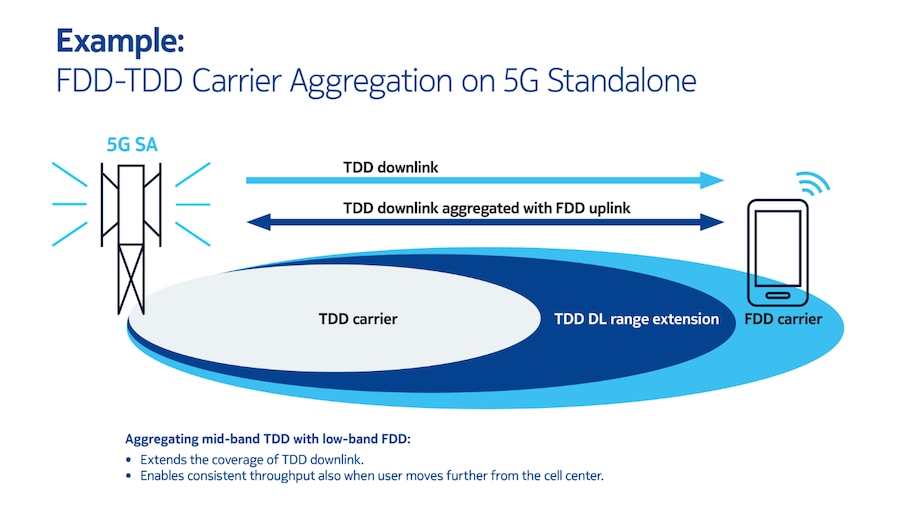
On the uplink, Optus and Ericsson reported 200 Mbps throughput using two-component carrier aggregation (2CC CA), combining FDD (n8/n1) and TDD (n40/n78) spectrum. This implementation is consistent with 3GPP Release 16 uplink enhancements, including uplink carrier aggregation and transmit (Tx) switching (TS 38.213), which enables efficient utilization of UE power resources across multiple uplink carriers, particularly in mixed duplex scenarios.
All results were achieved on a live commercial 5G SA network at Optus’ Sydney campus using commercial off-the-shelf (COTS) user equipment, including the Samsung Galaxy S26 Ultra. This indicates full compliance with 3GPP-defined UE capability signaling (TS 38.306) and the availability of device-side support for complex NR-CA band combinations, including inter-band and cross-duplex aggregation.
“This achievement demonstrates how we are translating cutting-edge 5G technology into meaningful benefits for customers in real-world environments. Through our ongoing collaboration with Ericsson, we are unlocking greater capacity and performance across our 5G network, enabling faster speeds and more reliable connectivity,” said Optus CTO Sri Amirthalingam. “This milestone marks an important step in our network evolution towards 5G Advanced, reinforcing our commitment to remain at the forefront of innovation and to deliver tangible value for our customers.”
Ludvig Landgren, head of Ericsson Australia and New Zealand operations said: “Optus continues to demonstrate strong leadership in adopting advanced 5G capabilities, and this milestone highlights the strength of our partnership. By expanding and combining multiple spectrum assets with Ericsson technology, we are helping Optus deliver meaningful performance improvements that translate directly into better everyday experiences for their customers.”
………………………………………………………………………………………………………………………………………………..
From a broader industry perspective, these results build on ongoing 5G NR-CA advancements. T-Mobile US has demonstrated approximately 6 Gbps downlink throughput using six aggregated carriers in FR1, as well as 550 Mbps uplink throughput leveraging uplink Tx switching across sub-6 GHz bands. In Europe, Vodafone and MediaTek achieved 277 Mbps uplink throughput using NR uplink CA, while Elisa, Ericsson, and MediaTek demonstrated 12CC aggregation reaching 8 Gbps downlink—highlighting the scalability of NR-CA as defined in 3GPP Release 17 and evolving into Release 18 (5G-Advanced).
Within Australia, Telstra has deployed Ericsson’s automated carrier aggregation (CA) optimization solution across more than 50 live 5G Advanced sites, leveraging dynamic CA configuration and traffic-aware scheduling—capabilities aligned with 3GPP Release 18 objectives for AI-assisted RAN optimization.
A notable aspect of the Optus/Ericsson demonstration is the aggregation of 180 MHz of mid-band spectrum across n40 (2.3 GHz) and n78 (3.5 GHz). While not a headline peak-rate milestone, this represents a first in terms of contiguous mid-band NR-CA deployment at this bandwidth scale. Mid-band aggregation is particularly significant within the 3.3–4.2 GHz “golden band” range defined in global 5G spectrum harmonization efforts, as it offers an optimal balance between coverage and capacity.
Operationally, this configuration is expected to deliver immediate gains in high-traffic scenarios—such as dense urban environments, transport hubs, and large venues—by increasing available cell throughput and improving user-level quality of service (QoS). Furthermore, the expanded mid-band capacity directly benefits fixed wireless access (FWA) deployments, where sustained throughput and cell-edge performance are critical. Because the demonstrated CA combinations are already supported by commercial UE categories, deployment can proceed without requiring new device classes, accelerating time-to-impact.
Ericsson was recently selected to modernize and expand SoftBank’s core networks, as well as accelerate the Japanese giant’s 5G SA adoption. Expanding on a previous 5G SA deal centered around its radio access network (RAN) products, Ericsson is providing SoftBank with its Core Networks’ portfolio, including a dual-mode 5G Core solution running on Ericsson’s Cloud Native Infrastructure Solution (CNIS).
……………………………………………………………………………………………………………………………..
References:
https://www.sdxcentral.com/news/ericsson-and-optus-claim-5g-sa-world-first/
https://www.ericsson.com/en/press-releases/7/2026/optus-and-ericsson-trial-ai-to-boost-5g-downlink
https://www.nokia.com/mobile-networks/ran/carrier-aggregation/5g-carrier-aggregation-explained/
China Unicom-Beijing and Huawei build “5.5G network” using 3 component carrier aggregation (3CC)
Nokia, BT Group & Qualcomm achieve enhanced 5G SA downlink speeds using 5G Carrier Aggregation with 5 Component Carriers
Finland’s Elisa, Ericsson and Qualcomm test uplink carrier aggregation on 5G SA network
T-Mobile US, Ericsson, and Qualcomm test 5G carrier aggregation with 6 component carriers
Ericsson and MediaTek set new 5G uplink speed record using Uplink Carrier Aggregation
BT tests 4CC Carrier Aggregation over a standalone 5G network using Nokia equipment
T-Mobile US achieves speeds over 3 Gbps using 5G Carrier Aggregation on its 5G SA network
One thought on “Optus and Ericsson achieve 180MHz across 2.3GHz and 3.5GHz bands using carrier aggregation on a live 5G SA network”
Leave a Reply

Optus and Ericsson have proved that advanced 5G SA carrier aggregation can work on a live network with commercial devices, which matters because it moves the concept from lab/demo status into deployable reality.
A key point is the 180 MHz aggregation across Optus’s 2.3 GHz and 3.5 GHz TDD spectrum plus broader 4CC aggregation across 900 MHz, 2.1 GHz, 2.3 GHz, and 3.5 GHz. That combination is important because it improves both capacity and user experience, and the reported live-network peaks of 3.4 Gbps downlink and 200 Mbps uplink are credible evidence that the configuration is already useful in practice. This demo was done on a live commercial 5G SA network using mainstream devices, which suggests the feature is not just a lab curiosity. For network operators, that points toward a practical path to higher spectral efficiency, better hotspot performance, and stronger fixed wireless access capacity without needing new spectrum purchases immediately.