

Automating Fiber Testing in the Last Mile: An Experiment from the Field
By Said Yakhyoev with Sridhar Talari & Ajay Thakur
The December 23, 2025 IEEE ComSoc Tech Blog post on AI-driven data center buildouts [1.] highlights the urgent need to scale optical fiber and related equipment[1]. While much of the industry focus is on manufacturing capacity and high-density components inside data centers, a different bottleneck is emerging downstream— a sprawling last-mile network that demands testing, activation, and long-term maintenance. The AI-driven fiber demand coincided with the historic federal broadband programs to bring fiber to the premises for millions of customers[2]. This not only adds near-term pressure on fiber supply chains, but also creates a longer-term operational challenge: efficiently servicing hundreds of thousands of new fiber endpoints in the field.
As standard-setting bodies and vendors are introducing optimized products and automation inside data centers, similar future-proofing is needed in the last-mile outside plant. This post presents an example of such innovation from a field perspective, based on hands-on experimentation with a robotic tool designed to automate fiber testing inside existing Fiber Distribution Hubs (FDHs).
While central office copper terminating DSLAMs—and Optical Line Terminals (OLTs) in Passive Optical Networks (PONs)—aggregate subscribers and automate testing and provisioning, FDHs function as passive patch panels[3] that deliberately omit electronics to reduce cost. Between an OLT and the subscriber, the passive distribution network remains fixed. As a result, accessing individual ports at a local FDH—and anything downstream of it—remains a manual process. In active networks, DSLAMs and OLTs can electronically manage thousands of subscribers efficiently, but during construction this manual access is a bottleneck. There are likely tens of thousands of FDHs deployed nationwide.
Consider this problem from a technician’s perspective: suburban and urban Fiber to the Home (FTTH) networks are often deployed using a hub-and-spoke architecture centered around FDHs. These cabinets carry between 144 and 432 ports serving customers in a neighborhood, and each line must be tested bidirectionally[4]. In practice, this typically requires two technicians: one stationed at the FDH to move the test equipment between ports, and another at the customer location or terminal.
Testing becomes difficult during inclement weather. Counterintuitively, the technician stationed at the hub—often standing still for long periods—is more exposed than technicians moving between poles in vehicles. In addition to discomfort, there is a real economic penalty: either a skilled technician is tied up performing repetitive port switching, or an additional helper must be assigned. Above all, dependence on both favorable weather and helper availability makes testing schedules unpredictable and slows network completion.
To mitigate this bottleneck, we developed and tested Machine2 (M2)—a compact, gantry-style robotic tool that remotely connects an optical test probe inside an FDH, allowing a single technician to perform bidirectional testing independently.
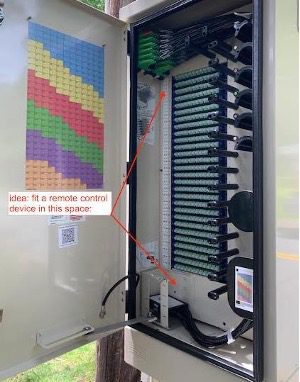
M2 was designed to retrofit into a commonly deployed 288-port Clearfield FDH used in rural and small-town networks. The available space in front of the patch panel—approximately 9.5 × 28 × 4 inches—constrained the design to a flat Cartesian mechanism capable of navigating between ports and inserting a standard SC connector. Despite the simple design, integrating M2 into an unmodified FDH in the field proved more challenging than expected. Several real-world constraints shaped the redesign.
 |
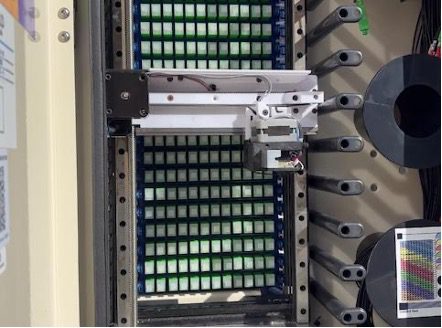 |
| FDH cabinet. Space to fit an automated switch | M2 installed for dry-run testing |
Space and geometry constraints: The patch panel occupies roughly 80% of the available volume, leaving only a narrow strip for motors, electronics, and cable routing. This forced compromises in pulley placement, leadscrew length, and motor orientation, limiting motion and requiring multiple iterations. The same constraints also limited battery size, making energy efficiency a primary design concern.
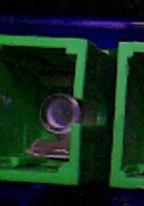
Port aiming: The patch panel is composed of cassettes with loosely constrained SC connectors. Small variations in connector position led to unreliable insertions. After repeated attempts, small misalignments accumulated, rendering the system ineffective without corrective feedback.
Communications reliability: A specialized cellular modem intended for IoT applications performed poorly for command-and-control. Message latency ranged from 1.5 seconds to over 12 seconds – and in some cases minutes – making real-time control impractical. In rural areas of Connecticut and Vermont, cellular coverage was also inconsistent or absent. Thus, the effort was abandoned between 2022 and 2024.
When the project resumed, an unexpected solution emerged. A low-cost consumer mobile hotspot proved more reliable than the specialized modem when cellular signal was available, providing predictable latency and stable Wi-Fi connectivity inside the FDH—even with the all-metal cabinet door closed and locked.
To further reduce latency, we explored using the fiber under test itself as a communication channel, a kind of temporary orderwire. When a two-piece Optical Loss Test Set (OLTS) is connected across an intact fiber, the devices indicate link readiness via an LED. By tapping this status signal, M2 can infer when a technician at the far end disconnects the meter and automatically connects to the next port. While this cue-based mode is limited, it enables near-zero-latency coordination and rapid testing of multiple ports without spoken or typed commands, which proved effective for common field workflows.
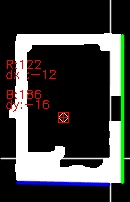
A second breakthrough came from addressing port aiming with vision. Standard computer-vision techniques such as edge detection were sufficient to micro-adjust the probe position at individual ports. To detect and avoid dust caps, M2 also uses a lightweight edge-ML[5] model trained to recognize caps under varying illumination. Using only 30 positive and 30 negative training images, the model correctly detected caps in over 80% of cases.
In our experience, lightweight vision models proved sufficient for practical field tasks, suggesting that accessibility—not sophistication—may drive adoption of automation in outside-plant environments.
| M2’s simplified vision sequence to account for nonuniformity of connectors | ||
 |
 |
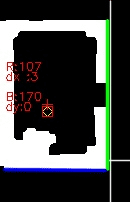 |
| Camera view: clipped to region of interest. Rough position | Processed view adjust -12px left, -16px up | Processed view after micro-adjusting |
What building M2 revealed:
- Overcoming communications issues led to an intriguing idea: optical background communication, where modulated laser light subtly changes ambient illumination inside the FDH that a camera can detect and extract instructions.
- M2 also proved useful beyond testing. For example, in a verify-as-you-splice workflow, M2 can lase a specific fiber as confirmation before splicing. Interactive port illumination and detection allow a single technician to troubleshoot complex situations.
The comparison below is illustrative and reflects observed workflows rather than controlled benchmarking.
Illustrative comparison of testing workflows in our experience
| Human helper (remote) | M2 | |
| Connect next port | 1–1.5 s | 2.5–4 s |
| Connect random / distant port | 8–24 s | ~11–30 s |
| Ease of deployment | Requires flat ground, fair weather, ground-level FDH | ~15 min setup; requires software familiarity |
| Functionality | Highly adaptable | Limited to 2–3 functions |
| Economics | Inefficient for small networks | Well-suited for small and medium networks |
| Independence factor | Low; requires two people | High; largely weather-independent |
| Best use | Variable builds, high adaptability | Repetitive builds, independent workflows |
Early insights for OSP vendors and standards
Building M2 revealed two broader lessons relevant to operators and vendors. First, there are now practical opportunities for automation to enter outside-plant workflows following developments in the power industry and datacenters[6]. Second, infrastructure design choices can facilitate this transition.
More spacious or reconfigurable FDH cabinets would simplify retrofitting active devices. Standardized attachment points on cabinets, terminals and pluggable components would allow mechanized or automated fiber management, reducing the risk of damage in dense installations.
Fiducial marks are among the lowest-cost adaptations. QR marks conveying dimensions and part architecture would help machines determine part orientation and position easily. Although these are common in the industry, it may be time to adopt them more broadly in telecom infrastructure maintenance.
Aerial terminals may benefit the most from machine-friendly design. Standardized port spacing and swing-out or hinged caps would significantly simplify autonomous or remotely assisted connections. Such cooperative interfaces could enable standoff connections without requiring a technician to climb a pole, improving safety and reducing access costs. Retrofitting aerial infrastructure to make it robot-friendly has been recommended[7] by the power industry and is also needed in the broadband utilities.
Conclusion
A growing gap is emerging between rapidly evolving data-center infrastructure and the more traditional telecom networks downstream. As fiber density increases, testing, activation, and maintenance of last-mile networks are likely to become bottlenecks. One way ISPs and vendors can future-proof outside-plant infrastructure is by proactively incorporating automation- and robot-friendly design features. M2 is one practical example that helps inform how such transitions might begin.
Short video clip from our early field trial in Massachusetts:
https://youtube.com/shorts/MiDoQd_S6Kw
References:
[1] IEEE ComSoc Technology blog post, Dec 23 2025, How will fiber and equipment vendors meet the increased demand for fiber optics in 2026 due to AI data center buildouts? ↩
[2] U.S. Dept. of Commerce Office of Inspector General, “NTIA Broadband Programs: Semiannual Status Report,” Washington, DC, USA, Rep. no. OIG-25-031-I, Sept. 24, 2025. ↩
[3] for an overview of an FTTH architecture see: Fiber Optic Association (FOA), FTTH Network Design Considerations and Fiber Optic Association (FOA), FTTH and PON Applications ↩
[4] Corning Optical Communications, “Corning Recommended Fiber Optic Test Guidelines,” Hickory, NC, USA, Application Engineering Note LAN-1561-AEN, Feb. 2020. ↩
[5] Refer to tools available for easy to use edge computing by Edge Impulse. ↩
[6] See state of the art indoor optical switches like ROME from NTT-AT and G5 from Telescent. ↩
[7] Andrew Phillips, “Autonomous overhead transmission line inspection robot (TI) development and demonstration,” IEEE PES General Meeting, 2014. ↩
About the Author:
Said Yakhyoev is a fiber optic technician with LightStep LLC in Colorado and a developer of the experimental Machine2 (M2) platform for automating fiber testing in outside-plant networks.
The author acknowledges the use of AI-assisted tools for language refinement and formatting.