

IMT-2030 (“6G”) Minimum Technology Performance Requirements for Radio Interface Technologies
At its February 2026 meeting in Geneva, ITU-R WP 5D reached agreement on the technical performance requirements for IMT-2030, also known as 6G. Formal approval is expected to follow when the parent ITU-R study group 5 meets in December 2026.
At their Feb 2026 meeting, WP 5D WG Technology Aspects/SWG Radio Aspects discussed all the 16 contributions related to that document. It was clarified that these requirements are to be evaluated according to the criteria defined in Report ITU-R M.[IMT 2030.EVAL] and M.[IMT 2030.SUBMISSION]. They are used only for development of IMT-2030 radio interface technologies (RIT/SRITs).
IMPORTANT: As noted many times, 3GPP will specify the 6G Core network and 6G Architecture which will have their own performance requirements. See References below.
The working party’s draft new report, “Minimum requirements related to technical performance for IMT‑2030 radio interface(s),” outlines 20 technical performance requirements (TPR). Seven of them are new and specific to describe the 6G performances. Those IMT 2030 technical performance requirements will be used as unified requirements to evaluate the 6G radio interfaces (RITs/SRITs).
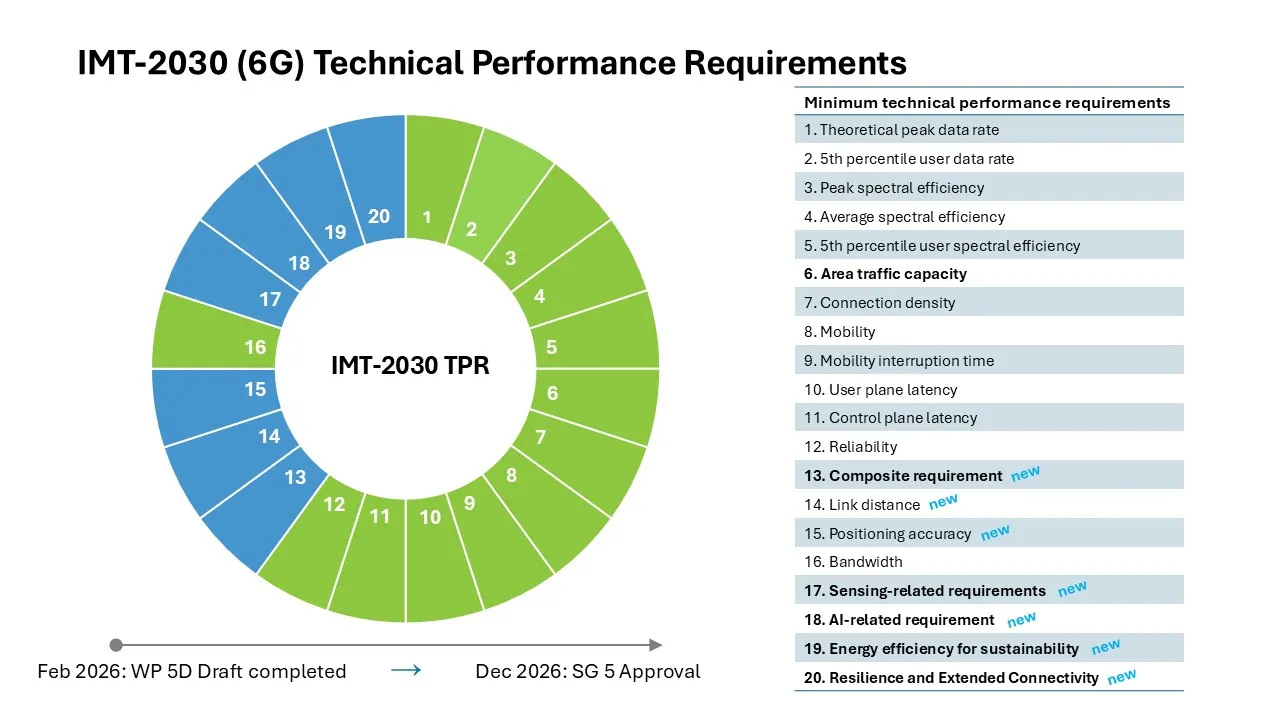
Image Credit: ITU-R
…………………………………………………………………………………………………….
The IMT-2030 Usage Scenarios:
The full set of requirements is based on six proposed usage scenarios for 6G networks:
- Immersive communication (IC)
- Hyper reliable and low‑latency communication (HRLLC)
- Massive communication (MC)
- Ubiquitous connectivity (UC)
- Artificial intelligence (AI) and communication (AIAC)
- Integrated sensing and communication (ISAC)
The IMT-2030 framework:
The newly defined 6G requirements build on the IMT‑2030 framework that ITU first published in December 2023 as a globally harmonized foundation for next‑generation connectivity (Recommendation ITU‑R M.2160). This recommendation also defines the overarching principles for future network design, notably:
- Sustainability.
- Security and resilience.
- Connecting the unconnected.
- Ubiquitous intelligence.
ITU – the United Nations agency for digital technologies – aims for the 6th generation of mobile communications (6G) to enable affordable, resilient, energy‑efficient networks for health, education, agriculture and disaster response. Advanced networks also present a way to close the persistent digital divide that today leaves many people in low-income countries behind.
This work to date provides a unified technical foundation to evaluate the candidate radio interfaces for IMT-2030 and guide the evolution of global 6G research and standardization.
Groundwork for future resilience:
IMT‑2030 lays the groundwork for affordable, high‑quality connectivity to remote and underserved communities. By setting globally harmonized performance requirements, it aims to ensure access for everyone, make communication systems more resilient, support sustainability and implement energy‑efficient technologies. ITU aims for innovative 6G services to deliver broad social and economic benefits.
The 20 requirements set out in the new draft report are meant to provide a consistent basis for specification and evaluation. While the requirements establish minimum performance levels, they do not restrict implementation approaches or guarantee real-world deployment performance.
They reflect ongoing global research and technology activities and should pave the way for concrete IMT-2030 evaluation guidelines, the next step in ITU’s global standardization process for 6G.
Accordingly, the IMT-2030 draft report has been submitted for approval to ITU‑R Study Group 5, responsible for terrestrial radiocommunication services, at a meeting scheduled for 1 December.
Until then, the draft remains available exclusively to ITU‑R members directly involved in its finalization and approval. You need a TIES login account to access ITU documents.
………………………………………………………………………………………………………………………..
About ITU-R Study Group 5:
ITU-R Study Group 5 is responsible for Terrestrial Services, including Fixed Wireless, Mobile (land, maritime and aeronautical), radiodetermination service as well as amateur and amateur-satellite services and the development of international standards, regulation and guidelines for these systems. The group’s work encompasses a wide range of topics, including spectrum management, network architecture, and radio interface technologies.
About ITU-R Working Party 5D:
ITU-R Working Party 5D is responsible for the development and harmonization of international standards for International Mobile Telecommunications (IMT) systems, including the latest IMT-2030 (6G) technology. The working party’s efforts ensure interoperability and global compatibility for wireless communication systems.
Further information on IMT‑2030 and related activities is available on the portal for IMT towards 2030 and beyond.
………………………………………………………………………………………………………..
References:
https://www.itu.int/en/ITU-R/study-groups/rsg5/rwp5d/Pages/default.aspx
Roles of 3GPP and ITU-R WP 5D in the IMT 2030/6G standards process
ITU-R M.[IMT-2030.EVAL] & ITU-R M.[IMT-2030.SUBMISSION] reports: Evaluation & Submission Guidelines for 6G RIT/SRITs (6G)
ITU-R WP 5D reports on: IMT-2030 (“6G”) Minimum Technology Performance Requirements; Evaluation Criteria & Methodology
Comparing AI Native mode in 6G (IMT 2030) vs AI Overlay/Add-On status in 5G (IMT 2020)
AI wireless and fiber optic network technologies; IMT 2030 “native AI” concept
Verizon’s 6G Innovation Forum joins a crowded list of 6G efforts that may conflict with 3GPP and ITU-R IMT-2030 work
ITU-R WP5D IMT 2030 Submission & Evaluation Guidelines vs 6G specs in 3GPP Release 20 & 21
Highlights of 3GPP Stage 1 Workshop on IMT 2030 (6G) Use Cases
Development of “IMT Vision for 2030 and beyond” from ITU-R WP 5D
2 thoughts on “IMT-2030 (“6G”) Minimum Technology Performance Requirements for Radio Interface Technologies”
Leave a Reply

IMT 2030 minimum performance requirements define the baseline Key Performance Indicators (KPIs) that candidate radio interface technologies (RITs) must meet to be officially considered for 6G RIT standardization.
Let’s hope ITU-R WP 5D does a much better job of enforcing these IMT 2030 Performance Requirements that they did for IMT 2020 which are specified in ITU-R M.2410 report. NONE of the 3 submitted and accepted (by 5D) IMT 2020 RITs/SRITs (i.e. 3GPP 5G NR, 5G-INDIA, ETSI/DECT) met the requirements for URLLC- both for ultra low latency (<1ms in data plane; <10ms in control plane) or for ultra high reliability as per ITU-R M.2410. Yet all 3 RIT/SRITs were included in ITU-R M.2150 – the official standard for IMT 2020/5G RITs/SRITs.
Furthermore, only the 3GPP 5G-NR RIT has been widely deployed in 5G RANs!
While ITU-R WP 5D provides the legal shell and the global stamp of approval, treating its certified recommendations (like ITU-R M.2150 IMT 2020 RIT/SRITs) as proof of real-world technical performance ignores the actual state of the 3GPP specs.
The technical history of 3GPP work item “Physical Layer Enhancements for NR Ultra-Reliable and Low Latency Communication” / NR_L1enh_URLLC) reveals a multi-year gap between the marketing “freeze” of Release 16 in June 2020 and actual spec completion and approval on December 22, 2022 (tracked under 3GPP Work Item ID 830074 / NR_L1enh_URLLC).
That delay meant that 3GPP pushed the overall Release 16 package out the door (“frozen”) in June 2020 to meet the initial ITU-R WP 5D deadline, the fundamental RAN Physical layer components enabling true sub-1ms latency, ultra-reliable processing sat in a state of pending completion for nearly two and a half additional years.
3GPP Release 16 URLLC RAN Physical layer specifications were entirely incomplete during the initial WP 5D IMT 2020 RIT/SRIT evaluation cycles, so they were bypassed and completely left out of both the initial Recommendation ITU-R M.2150-0 (published February 2021) and the subsequent Revision M.2150-1 (published February 2022). When M.2150-1 was being organized to align with 3GPP’s technical updates, the Release 16 URLLC RAN spec was still missing. Instead, M.2150-1 primarily updated components relating to 3GPP Release 17 changes (such as RedCap devices and new numerologies).
The baseline 3GPP Release 16 URLLC PHY layer enhancements were eventually codified and integrated structurally within subsequent revision cycles, leading up to the current ITU-R M.2150-3 version approved in February 2026. That lag meant that for the first several years of the global “5G standard,” the legal, treaty-level ITU documentation for IMT-2020 approved 5G as an overarching standard while the underlying Physical layer mechanisms to achieve actual, practical URLLC performance metrics as defined by ITU-R M.2410 were non-existent in the operational 3GPP text submissions.