

FCC updates subsea cable regulations; repeals 98 “outdated” broadcast rules and regulations
The U.S. Federal Communications Commission (FCC) is updating its regulations for subsea cables to enhance security and streamline the licensing process. The updates, adopted at an FCC open meeting on August 7th, aim to address national security concerns related to foreign adversaries (like Russia and China) and accelerate the deployment of these critical communication networks. This initiative, developed by the Office of International Affairs in collaboration with the Public Safety and Homeland Security Bureau and the Enforcement Bureau, is intended to bolster national security. The new rules address potential vulnerabilities of subsea cables to foreign adversaries, recognizing their critical role in global internet traffic and financial transactions.
FCC Chairman Brendan Carr said that while the FCC often focuses on airwaves as vital but unseen infrastructure, submarine cables are just as essential. “They are the real unseen heroes of global communications. [The Commission] must facilitate, not frustrate the buildout of submarine cable industries.” Indeed, the vast global network of subsea cables carry ~ 99% of the world’s internet traffic and support more than $10 trillion in daily financial transactions.
……………………………………………………………………………………………………………………………………………………………………………………………………………………………………………………
The risk of Russia- and China-backed attacks on undersea cables carrying international internet traffic is likely to rise amid a spate of incidents in the Baltic Sea and around Taiwan, according to a report by Recorded Future, a U.S. cybersecurity company. It singled out nine incidents in the Baltic Sea and off the coast of Taiwan in 2024 and 2025 as a harbinger for further disruptive activity. The report said that while genuine accidents remained likely to cause most undersea cable disruption, the Baltic and Taiwanese incidents pointed to increased malicious activity from Russia and China. “(Sabotage) Campaigns attributed to Russia in the North Atlantic-Baltic region and China in the western Pacific are likely to increase in frequency as tensions rise,” the company said.
……………………………………………………………………………………………………………………………………………………………………………………………………………………………………………………
The FCC also repealed 98 “outdated” broadcast rules and regulations as part of a deregulation effort aimed at streamlining and modernizing the agency’s rules. These rules, deemed obsolete or unnecessary, included outdated requirements for testing equipment and authorization procedures, as well as provisions related to technologies like analog broadcasting that are no longer in use. The move is part of the FCC’s “Delete, Delete, Delete” docket, which seeks to identify and remove rules that no longer serve the public interest.
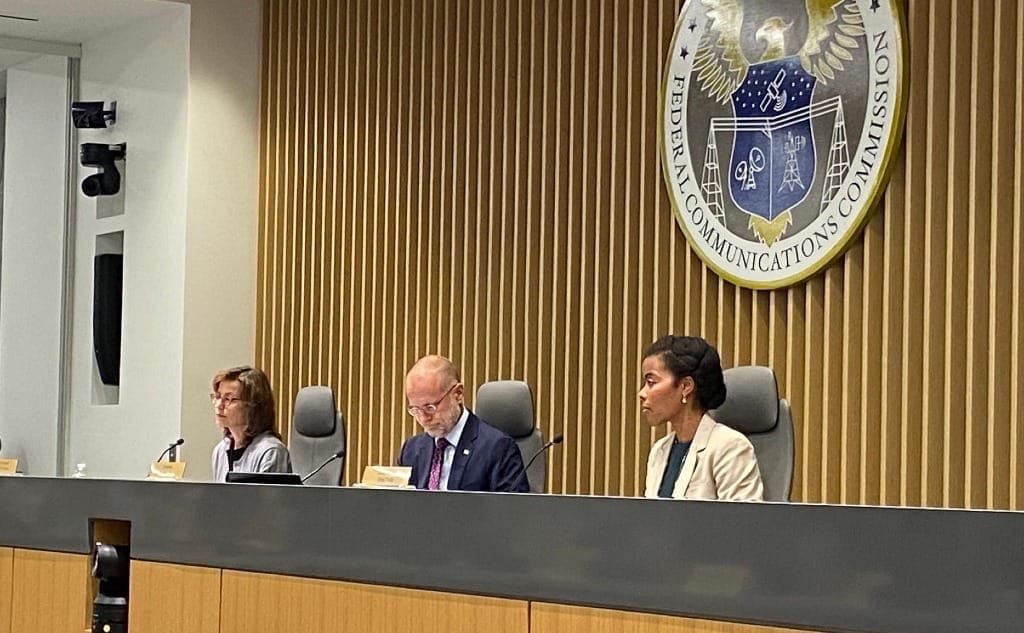
FCC Chairman Brendan Carr (middle) and Commissioners Olivia Trusty (right) and Anna Gomez (left) at the Open Meeting on August 7, 2025 in Washington, D.C. Photo credit: Broadband Breakfast/Patricia Blume.
Many of the repealed rules relate to analog-era technologies and practices that are no longer relevant in today’s digital broadcasting landscape. These rules cover various areas, such as obsolete subscription television rules, outdated equipment requirements from the 1970s, unnecessary authorization rules for standard practices, obsolete international broadcast provisions, and sections that were for reference only or were duplicative or reserved. In particular:
- The repealed rules covered equipment requirements for AM, FM, and TV stations that are now obsolete, as well as rules related to subscription television systems that operated on now-defunct analog technology.
- The FCC eliminated rules regarding international broadcasting that used outdated terms and procedures.
- Several sections that merely listed citations to outdated FCC orders, court decisions, and policies were also removed.
- The FCC eliminated a rule requiring FM stations to obtain authorization for stereophonic sound programs, which is now standard practice.
References:
https://www.fcc.gov/August2025
https://www.fcc.gov/document/fcc-deletes-outdated-broadcast-rules-and-requirements/carr-statement
https://docs.fcc.gov/public/attachments/DOC-413057A1.pdf
https://broadbandbreakfast.com/fcc-unanimously-approves-buildout-of-secure-submarine-cables/
New FCC Chairman Carr Seen Clarifying Space Rules and Streamlining Approvals Process
U.S. federal appeals court says FCC’s net neutrality/open internet rules are “unlawful”
Intentional or Accident: Russian fiber optic cable cut (1 of 3) by Chinese container ship under Baltic Sea
Sabotage or Accident: Was Russia or a fishing trawler responsible for Shetland Island cable cut?
Geopolitical tensions arise in Asia over subsea fiber optic cable projects; U.S. intervened to flip SeaMeWe-6 contractor
China seeks to control Asian subsea cable systems; SJC2 delayed, Apricot and Echo avoid South China Sea
2 thoughts on “FCC updates subsea cable regulations; repeals 98 “outdated” broadcast rules and regulations”
Leave a Reply to Anonymous Cancel Reply

Update- Dec 24, 2025
Undersea cables form the hidden backbone of global connectivity. Stretching a combined 1.3 million kilometres under the oceans, these fibre lines link continents and carry an estimated USD $10 trillion worth of financial transactions every day. In fact, more than 95 per cent of international data traffic travels through submarine cables, making them essential for cross-border business, finance and online services. Despite their invisibility in daily life, modern economies and technologies rely on this vast underwater network – and its importance is only growing as data usage soars.
The rise of AI is adding a new surge of traffic to these networks. Training and running advanced AI models involves shuttling enormous datasets between data centres, often across different continents. For example, developing a large language model can require processing terabytes of data distributed over global computing clusters – a task that demands high-capacity links with minimal delay. At the same time, real-time AI services such as financial trading algorithms and interactive assistants rely on ultra-low latency connections to deliver instant results for users around the world.
Industry analysts note that AI-related applications currently account for only a single-digit percentage of international bandwidth, but this share is climbing fast. By 2035, AI workloads could consume roughly a third of the capacity on key routes like the busy transatlantic cables, reflecting how quickly data-hungry machine learning tasks are growing.
Recognizing the strategic importance of connectivity, the world’s largest tech companies have become major builders of undersea cable systems. Firms like Google, Meta, Microsoft and Amazon are no longer just customers of telecom operators – they are funding and laying their own fibre cables beneath the ocean. This shift allows these companies to secure dedicated high-capacity routes optimised for their needs and to add network redundancy on their own terms. By owning infrastructure, they can lower latency for their users and ensure critical services stay online even if other networks fail.
Several recent major projects illustrate this trend. Meta, for instance, has announced a USD $10 billion plan to construct one of the longest cables ever. The 50,000-kilometre cable will connect the US with India, South Africa and Brazil, linking these regions with much higher capacity. Dubbed Project Waterworth, it will use 24 fibre pairs (far more than earlier cable designs) to deliver vast bandwidth for Meta’s platforms and future AI initiatives. Meta is also a lead investor in the 45,000-kilometre 2Africa cable – one of the world’s largest – linking 33 countries across Africa, Europe and Asia to boost internet capacity in emerging markets.
Google has similarly invested in over 30 subsea cables worldwide. These include private cables like Grace Hopper (connecting the US to the UK and Spain) and Equiano (connecting Europe to southern Africa with 144 Tbps (terabits per second) of capacity). Each new link bolsters Google’s cloud data centre network and helps deliver services like search, video streaming and AI-powered applications with lower delay.
Microsoft’s flagship Atlantic cable, MAREA – built with Meta – has provided Azure’s cloud with a 160 Tbps (terabits per second) connection between North America and Europe since 2018. Microsoft is now planning new, shorter cables between Ireland and the UK, aiming to directly connect its huge Dublin data centre hub to Britain and onward to continental Europe for greater resilience. Amazon, meanwhile, has until now chiefly participated in consortia or leased fibre capacity on existing routes such as the Hawaiki cable in the Pacific. Now the company is moving into owning its own subsea infrastructure. It recently announced a dedicated transatlantic cable (landing in Ireland) slated to go live by 2028, explicitly designed to handle rising cloud and AI traffic on its Amazon Web Services platform.
Underpinning these investments is an effort to future-proof against skyrocketing demand. The latest cable systems can transmit on the order of hundreds of terabits per second – enough bandwidth to stream millions of HD videos simultaneously – which is a necessity as AI and cloud services generate ever-larger data flows. For the tech giants, controlling the oceanic pipelines of data has become as crucial as the data centres and algorithms at the core of their business.
The growing dependency on undersea data routes has also put a spotlight on their vulnerability. Unlike satellites, cables concentrate huge volumes of data in physical bundles that can be damaged by natural disasters or human activity. In recent years, there have been several high-profile outages where cables were severed. Whether caused by a ship’s dragging anchor or by suspected sabotage, a single cut can knock out internet access to entire islands or regions. These incidents have prompted calls for better protection and redundancy. NATO, for example, launched a dedicated mission in the Baltic Sea in 2025 to deter interference with critical undersea fibre lines after a string of mysterious cable cuts in northern Europe.
Cable operators and governments are responding by building more diverse routes and hardening the infrastructure. New cables like Amazon’s planned Fastnet are being routed along less congested corridors and built with extra shielding near shorelines to guard against ship anchors and fishing nets. Companies are burying cables deeper in the seabed where possible and using advanced optical switching systems that can quickly reroute traffic if a line is cut. By spreading data across multiple paths, the aim is to ensure that no single break can knock major services offline. This push for resilience has become as important as raw capacity. It is not just about moving data faster, but also about keeping the data flowing under all circumstances.
All signs indicate that the subsea cable boom will continue as the AI era accelerates. Industry forecasts project that annual spending on new cable systems and upkeep will grow from roughly USD $8 billion in 2023 to around USD $10 billion by 2029. Much of this investment is driven by cloud and content companies, often in partnership with telecom carriers, to add both capacity and backup routes. New projects are on the drawing board across the globe – from transatlantic links and pan-Asian cables to regional systems connecting emerging data centre hubs in Africa, the Middle East and Southeast Asia.
Even the advent of low-Earth orbit satellites has not diminished the role of undersea fibre. The sheer volume of data required for AI applications and streaming far exceeds what satellite networks can economically handle, ensuring that subsea cables remain the workhorses of the internet. As more people come online and AI-powered services proliferate, the demand for international bandwidth shows no sign of slowing. The result is an ongoing, largely unseen expansion of oceanic infrastructure beneath the seas. Undersea cables may be out of sight, but they are firmly at the heart of the digital revolution – quietly enabling the connectivity that powers our AI-driven future.
https://telconews.asia/story/explainer-undersea-cables-quietly-powering-the-ai-revolution
The Subsea Cables Powering AI, Cloud, and the Digital Economy. Vish Iyer of Cisco Systems
Stretching across oceans and seas, the global lattice of subsea fiber-optic cables carries more than 95% of the world’s internet traffic. We rarely see them, yet we depend on them every time we open an app, watch a live stream, or train an AI model.
These cables are the digital economy’s arteries. They link cloud regions, data centers, and edge zones across continents. They are the reason a transaction in Sydney can be processed in milliseconds in Singapore, why a machine-learning model in Virginia can be instantly updated from Tokyo, and why billions of people can connect, and stay connected, every day.
Hyperscalers Join the Build-Out
A decade ago, telecom consortiums were the primary owners of this infrastructure. Today, hyperscale cloud providers have taken the helm, spending billions to directly link their global compute facilities.
This shift is redefining the economics and geography of connectivity. Throughout Asia-Pacific, new intra-regional cables are springing up to connect rapidly growing hubs like India, Indonesia, and the Middle East. TeleGeography predicts that over $13 billion in subsea investment is slated to come online between 2025 and 2027, with approximately 10%, or $1.2 billion to be exact, earmarked for Asia-only routes. These regional links are starting to rival traditional trans-Pacific systems in both capacity and strategic importance.
The reasons are clear: existing cables are filling up, cloud providers are moving from leasing to owning fiber, and operators need diverse routes to avoid downtime and cyber risk. Falling costs for installing terabit-class systems and the retirement of old infrastructure further fuel this race.
Technology Meets the Human Imperative
For service providers, this is a dual challenge. They must deliver unprecedented capacity at lower cost while keeping networks secure, sustainable, and reliable. This is not just a technical pivot, it’s a human one. Economies, hospitals, schools, and governments depend on the stability and speed of these cables to function in the modern world.
Halting disruption in one place can save millions from losing internet access. A secure link between two continents can shield sensitive financial data and protect critical national services. This scale of dependency makes reliability a moral obligation as much as a business necessity.
Innovation Beneath the Waves
At the core of the subsea revolution is coherent optical technology, a breakthrough allowing terabit-level capacity on existing fiber with far lower power requirements and physical footprint.
For engineers, this means integrating transport directly into routing layers, cutting operational expenditure (OPEX), and optimizing network performance. For society, it means we can move more data without straining energy systems or raising consumer costs.
But speed alone is not enough. Every new fiber strand widens the cyber-attack surface. Providers are now embedding security at the transport layer with always-on encryption, telemetry, and AI-driven threat detection. If the cables are the arteries, security is the immune system, protecting the lifeblood of the digital economy.
AI Traffic Changes the Game
Artificial intelligence is rewriting the rulebook for global networks. Traffic is no longer predictable and human-paced, it’s machine-to-machine, bursty, and enormous in volume. Clusters of GPUs exchange massive datasets across oceans in near-real time. Latency is the new downtime, and service providers must architect for both speed and adaptability.
Subsea networks are the foundation for this. Distributed AI models rely on cables to link training clusters across continents. The most advanced operators are now building “self-aware” transport systems, powered by AI-assisted management, coherent optics, and integrated secure routing, to react instantly to demand spikes without wasting bandwidth or power.
From Invisible to Indispensable
For nations, subsea cables are digital sovereignty. For hyperscalers, they are scalability. For service providers, they are the arena in which efficiency, innovation, and trust converge.
As global capacity needs double every few years, the winners will not simply be those who lay the most cable, but those who build the smartest, most secure networks on top of it. That means integrating transport and routing seamlessly, optimizing energy use, and seeing security not as a patch, but as architectural DNA.
The subsea era is no longer defined by the number of physical links between continents. It’s defined by how intelligently those links are used, protected, and scaled.
The cables themselves will never stand in the spotlight, but the companies mastering them will be the ones powering the next decade of cloud, AI, and human connection.
https://news-blogs.cisco.com/apjc/2025/12/02/the-subsea-cables-powering-ai-cloud-and-the-digital-economy/