

Fiber Optic Networks & Subsea Cable Systems as the foundation for AI and Cloud services
Introduction:
A foundational enabler of global AI infrastructure and cloud service expansion are the fiber-optic networks interconnecting data centers worldwide. These high-capacity optical systems form the invisible backbone of modern digital society, facilitating everything from real-time financial transactions and mission-critical enterprise traffic to defense systems, entertainment, and personal communications. Access to cloud-based AI platforms—and the data-driven intelligence they deliver—depends on efficient, low-latency connectivity to data centers. As AI workloads proliferate across industries and continents, the unifying role of optical fiber becomes paramount, ensuring equitable global access to advanced digital capabilities.
A core prerequisite for scaling AI and cloud services is the mesh of high-capacity fiber-optic networks that interconnect data centers globally. These networks silently underpin digital society, carrying the data that powers financial markets, mission-critical enterprise applications, national security, entertainment platforms, and everyday human communication.
Cloud-based AI services only become meaningful when users, enterprises, and machines can reach them with low latency, high reliability, and predictable performance. In this context, the unifying role of fiber is increasingly strategic, as it determines who can participate in the AI economy and at what scale.
Subsea (fiber) cable systems as digital unifier:
The massive capacity and spectral efficiency of optical fiber have driven its deployment from access networks to backbone routes and across the world’s oceans. Today, more than 570 subsea cables carry over 99% of international traffic, effectively stitching together a single global fabric for AI and cloud connectivity.
New subsea systems highlight how infrastructure investments are closing regional gaps rather than just adding raw terabits: the Medusa submarine cable system will help narrow the digital divide between Europe and North Africa, the Bangladesh Private Cable System (BPCS) will establish the country’s first private subsea on-ramps to global cloud and AI ecosystems, and a new Jakarta–Singapore route by PT Solusi Sinergi Digital Tbk (Surge) is set to increase data center interconnectivity while expanding affordable broadband to tens of millions of Indonesians.
As multiple new subsea cable system build outs enter planning and deployment, global bandwidth growth is expected to remain strong, extending the reach of AI and cloud platforms to more geographies, users, and industries.
From PoPs to data centers:
The traffic matrix of the AI era looks very different from that of legacy telecom networks. Instead of primarily connecting PoPs, carrier hotels, and central offices, modern optical networks are being engineered around dense, high-capacity flows between data centers.
More than 11,000 data centers, including over one thousand hyperscale facilities, now form the core nodes of the global digital infrastructure, generating on the order of thousands of petabytes of WAN traffic daily. Subsea bandwidth demand is expected to grow at roughly 30% per year as AI and cloud services scale, placing new design pressure on how subsea and terrestrial backhaul networks are engineered end-to-end.
Unifying subsea and terrestrial backhaul:
This shift is driving a deliberate architectural pivot: instead of treating subsea and terrestrial backhaul as separate domains, leading operators and cloud providers are moving toward unified, end-to-end design philosophies. Traffic no longer “terminates” at a cable landing station or central office; it flows optically and logically from data center to data center across continents.
By optimizing subsea and terrestrial segments as a single system, operators can simplify their networks, reduce CapEx and OpEx, and unlock higher effective capacity. Approaches such as optical pass-through at cable landing sites reduce cost, footprint, and power, while spectrum expansion into C+L bands can deliver a twofold or greater increase in per-fiber capacity, significantly lowering the cost of backhauling subsea traffic to inland data centers.
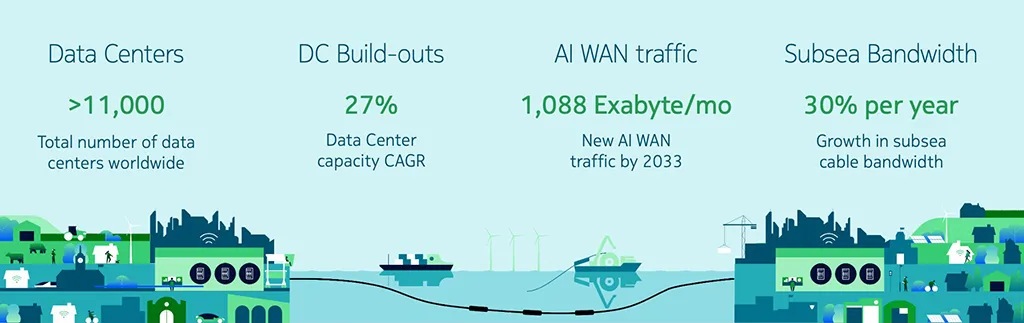
An ever-increasing number of data centers powering AI services is driving significant bandwidth growth over subsea fiber optic cables. Image Credit: Nokia
Unified optical platforms for the AI supercycle:
Realizing this vision at scale requires platforms that unify roles traditionally split across multiple, specialized systems. For Nokia’s customers, this means leveraging the 1830 Global Express (GX) compact modular portfolio as a single, DCI-optimized solution for transponders, open optical line systems (OLS), and submarine line terminal equipment (SLTE) across both subsea and terrestrial applications.
High-performance coherent transponders on the 1830 GX support 800 Gigabit Ethernet across trans-oceanic distances, using techniques such as Probabilistic Constellation Shaping, Nyquist filtering, and continuous baud rate tuning to push performance toward the Shannon limit. The integrated OLS delivers the full suite of SLTE capabilities, including ROADM-based wavelength switching and spectrum management, ASE or CW idler insertion, and optical channel monitoring, while C+L operation on terrestrial backhaul provides step-function increases in capacity per fiber and reduces the cost of leased backhaul infrastructure.
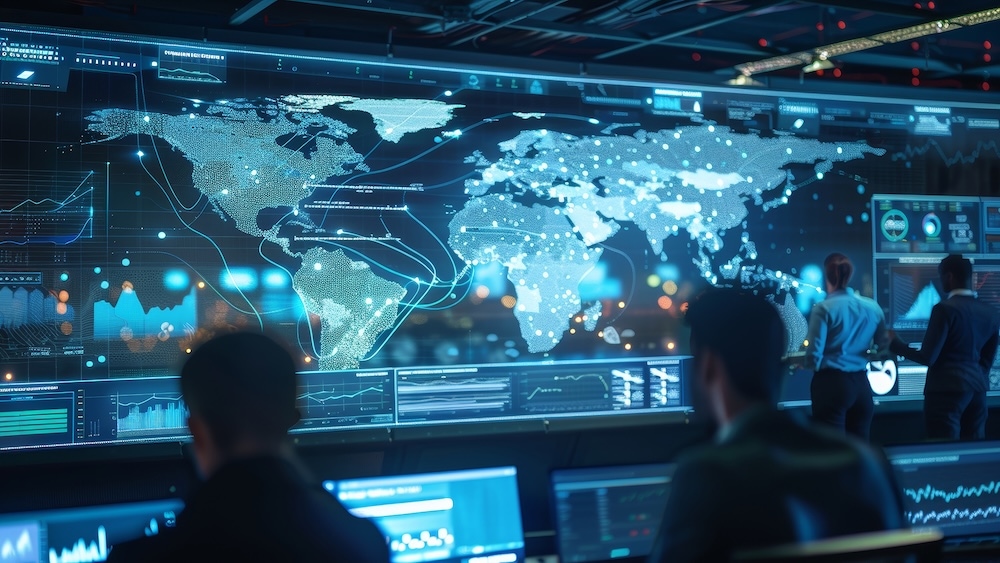
Photo Credit: Nokia
Operational simplicity and resilience:
Beyond raw capacity, unified platforms enable operators to rationalize operations. Using a common hardware and software stack across subsea and terrestrial domains simplifies planning, training, sparing, deployment, and lifecycle management.
Capabilities such as constant-power ILAs for stable end-to-end DC-to-DC transport, integrated OTDR for proactive fiber monitoring and fault localization, and a rich set of optical protection schemes for service protection and restoration help operators build networks that are not only faster and denser, but also more resilient and easier to run.
What’s next: pluggables and sensing:
The industry is now entering a phase where innovation in optics is tightly coupled to AI and automation. At PTC 2026 in Honolulu, discussions will highlight how pluggable coherent optics and fiber sensing are being introduced into subsea environments to further collapse layers and enhance awareness.
ICE-X 800G coherent pluggables are already enabling 400G, 600G, and 800G per wavelength over regional subsea spans exceeding 4,000 km, and future advances in chromatic dispersion tolerance are expected to extend the thin transponder layer paradigm to trans-Atlantic routes. In parallel, operators are exploring fiber sensing, powered by machine learning and advanced coherent techniques, to transform existing fiber assets into distributed sensors capable of supporting security, integrity monitoring, and new data-driven services.
Connectivity for all:
“Advancing connectivity for the AI supercycle” is more than a tagline; it captures two simultaneous imperatives: scaling networks for performance, efficiency, and sustainability while extending those networks to every region and community. As described herein, fiber optics connectivity is becoming the strategic control point for value creation in the age of large-scale AI.
Nokia’s Role in Subsea Fiber Optic Networks:
Nokia has invested for more than 15 years in helping subsea operators and their customers design, deploy, and operate end-to-end SLTE and terrestrial optical networks, backed by global services and multi-country program support. Following its unification with Infinera, Nokia has emerged as the number-two global vendor of subsea optical transport equipment, earning the confidence of a large majority of operators involved in the latest wave of Asia-Pacific subsea builds. These partnerships position Nokia to help the industry scale and unify networks for the AI supercycle—and to ensure that the benefits of AI-era connectivity reach as many people, countries, and enterprises as possible.
Nokia’s 1830 Global Express (GX) supports high-performance coherent transponders for transmission of high-speed data connections such as 800 Gigabit Ethernet (800GE) across trans-oceanic distances, leveraging features such as Probabilistic Constellation Shaping (PCS), Nyquist filtering and continuous baud rate adjustment to maximize optical reach and fiber capacity up to the Shannon Limit. The 1830 GX OLS supports all needed SLTE functions including ROADM-based wavelength switching and spectrum management, insertion of ASE spectrum or continuous-wave (CW) idler channels, and optical channel monitor.
……………………………………………………………………………………………………………………..
References:
https://www.nokia.com/blog/the-unifying-role-of-subsea-fiber-networks/
https://www.nokia.com/optical-networks/1830-global-express/
Subsea cable systems: the new high-capacity, high-resilience backbone of the AI-driven global network
FCC updates subsea cable regulations; repeals 98 “outdated” broadcast rules and regulations
Automating Fiber Testing in the Last Mile: An Experiment from the Field
7 thoughts on “Fiber Optic Networks & Subsea Cable Systems as the foundation for AI and Cloud services”
Leave a Reply to geometry dash Cancel Reply
The Subsea Cables Powering AI, Cloud, and the Digital Economy. Vish Iyer of Cisco Systems
Stretching across oceans and seas, the global lattice of subsea fiber-optic cables carries more than 95% of the world’s internet traffic. We rarely see them, yet we depend on them every time we open an app, watch a live stream, or train an AI model.
These cables are the digital economy’s arteries. They link cloud regions, data centers, and edge zones across continents. They are the reason a transaction in Sydney can be processed in milliseconds in Singapore, why a machine-learning model in Virginia can be instantly updated from Tokyo, and why billions of people can connect, and stay connected, every day.
Hyperscalers Join the Build-Out
A decade ago, telecom consortiums were the primary owners of this infrastructure. Today, hyperscale cloud providers have taken the helm, spending billions to directly link their global compute facilities.
This shift is redefining the economics and geography of connectivity. Throughout Asia-Pacific, new intra-regional cables are springing up to connect rapidly growing hubs like India, Indonesia, and the Middle East. TeleGeography predicts that over $13 billion in subsea investment is slated to come online between 2025 and 2027, with approximately 10%, or $1.2 billion to be exact, earmarked for Asia-only routes. These regional links are starting to rival traditional trans-Pacific systems in both capacity and strategic importance.
The reasons are clear: existing cables are filling up, cloud providers are moving from leasing to owning fiber, and operators need diverse routes to avoid downtime and cyber risk. Falling costs for installing terabit-class systems and the retirement of old infrastructure further fuel this race.
Technology Meets the Human Imperative
For service providers, this is a dual challenge. They must deliver unprecedented capacity at lower cost while keeping networks secure, sustainable, and reliable. This is not just a technical pivot, it’s a human one. Economies, hospitals, schools, and governments depend on the stability and speed of these cables to function in the modern world.
Halting disruption in one place can save millions from losing internet access. A secure link between two continents can shield sensitive financial data and protect critical national services. This scale of dependency makes reliability a moral obligation as much as a business necessity.
Innovation Beneath the Waves
At the core of the subsea revolution is coherent optical technology, a breakthrough allowing terabit-level capacity on existing fiber with far lower power requirements and physical footprint.
For engineers, this means integrating transport directly into routing layers, cutting operational expenditure (OPEX), and optimizing network performance. For society, it means we can move more data without straining energy systems or raising consumer costs.
But speed alone is not enough. Every new fiber strand widens the cyber-attack surface. Providers are now embedding security at the transport layer with always-on encryption, telemetry, and AI-driven threat detection. If the cables are the arteries, security is the immune system, protecting the lifeblood of the digital economy.
AI Traffic Changes the Game
Artificial intelligence is rewriting the rulebook for global networks. Traffic is no longer predictable and human-paced, it’s machine-to-machine, bursty, and enormous in volume. Clusters of GPUs exchange massive datasets across oceans in near-real time. Latency is the new downtime, and service providers must architect for both speed and adaptability.
Subsea networks are the foundation for this. Distributed AI models rely on cables to link training clusters across continents. The most advanced operators are now building “self-aware” transport systems, powered by AI-assisted management, coherent optics, and integrated secure routing, to react instantly to demand spikes without wasting bandwidth or power.
From Invisible to Indispensable
For nations, subsea cables are digital sovereignty. For hyperscalers, they are scalability. For service providers, they are the arena in which efficiency, innovation, and trust converge.
As global capacity needs double every few years, the winners will not simply be those who lay the most cable, but those who build the smartest, most secure networks on top of it. That means integrating transport and routing seamlessly, optimizing energy use, and seeing security not as a patch, but as architectural DNA.
The subsea era is no longer defined by the number of physical links between continents. It’s defined by how intelligently those links are used, protected, and scaled.
The cables themselves will never stand in the spotlight, but the companies mastering them will be the ones powering the next decade of cloud, AI, and human connection.
https://news-blogs.cisco.com/apjc/2025/12/02/the-subsea-cables-powering-ai-cloud-and-the-digital-economy/
Great overview—this article does a really good job of explaining how fiber and subsea cables quietly power everything behind AI and cloud services. I especially liked the focus on unifying subsea and terrestrial networks, since that shift feels key to scaling performance and global high speed internet access.
This article does a great job of clearly connecting the dots between fiber infrastructure, subsea cable systems and the AI boom. It makes a complex, behind-the-scenes topic feel genuinely important and relevant.
The article insightfully highlights how fiber-optic networks and subsea cable systems truly are the silent yet indispensable foundation of today’s global internet, enabling the low-latency, high-capacity connectivity needed to scale cloud services and AI workloads across continents. By emphasizing both the sheer volume of data these undersea links carry and the architectural shift toward unified subsea and terrestrial network designs, it underscores that expanding and optimizing this infrastructure isn’t just a technical necessity but a strategic imperative for equitable access, economic growth, and the future of digital innovation.
Really insightful read — it’s easy to overlook how critical fiber‑optic and subsea cable infrastructure is to making AI and cloud services seamless and accessible globally. The way you connect these technical advancements to broader connectivity and equity issues was particularly compelling.
AI data center construction, quantum technology leaps, and long-awaited BEAD funding is making 2026 a momentous year for fiber.
“Deploying new short interconnections for each new hyperscale data center, upgrades to existing long-haul interconnections to increase capacity, and entirely new long-haul interconnection routes will be required to meet AI’s latency and bandwidth requirements. ” -Gary Bolton, President & CEO, FBA
The Fiber Broadband Association will be conducting a deep dive into the relationship between fiber, AI, and quantum technologies with The AI and Emerging Technology Infrastructure Summit on Wednesday, May 20, 2026, at the Fiber Connect 2026 conference. For the first time, Fiber Connect is bringing together leading AI innovators, quantum savants, and technology futurists to discuss how the unlimited capacity of fiber broadband unlocks limitless possibilities for innovation and discovery.
https://bbcmag.com/why-is-2026-shaping-up-to-be-a-big-year-for-fiber/
This article is a timely reminder that the power of AI and cloud services depends not just on algorithms and data centers, but on physical infrastructure most people never see. Subsea fibre and high‑capacity optical networks are quietly enabling the world’s digital economy, and investments in these systems today will determine how equitably and efficiently AI benefits users everywhere.
The global AI and cloud ecosystem relies heavily on a physical foundation of subsea fiber-optic cables and hyperscale data centers that carry over 97% of internet traffic. As hyperscalers like Google, Amazon, Microsoft and Meta increasingly own this infrastructure to manage massive data demands, these high-capacity networks function as the “nervous system” for AI, where investments directly determine future digital equity and economic resilience.