

Blaize and Winmate Forge Strategic Partnership to Accelerate Edge AI Integration in Ruggedized Systems
Bridging the Edge Connectivity Gap:
While modern AI architecture has historically favored centralized data centers, mission-critical applications require real-time inference at the edge. For defense personnel in remote locations, maritime operations, or emergency medical responders, reliance on cloud-based processing is often non-viable due to bandwidth constraints and latency requirements.
Eldorado Hills, CA based Blaize Holdings, Inc. and Winmate Inc. (TAIWAN) have announced a Strategic Partnership Agreement aimed at generating approximately $15 million in business during its inaugural year. This collaboration integrates Blaize’s high-performance AI accelerators into Winmate’s industrial-grade ruggedized hardware ecosystem—including UAVs, handhelds, vehicle-mounted computers, and embedded systems—designed for mission-critical reliability in high-stress environments. Both organizations anticipate this agreement to be the foundation of a long-term, multi-year technological synergy.
The partnership addresses the “cloud dependency” bottleneck by leveraging Blaize’s GSP® (Graph Streaming Processor) architecture. These chips are engineered to industrial specifications, enabling sophisticated AI workloads to run locally on the device. When paired with Winmate’s ruggedized chassis—built to withstand extreme thermal fluctuations, high-velocity vibration, and dust ingress—the resulting systems provide high-compute AI capabilities in environments where traditional hardware fails.
- Border security and surveillance: Real-time threat detection and perimeter monitoring
- Mobile command and control: On-site intelligence and situational awareness for field teams
- Drones and unmanned systems: Autonomous navigation and mission execution for UAVs and ground vehicles
- Critical infrastructure: Continuous monitoring and predictive analytics for power, ports, and transportation
- Maritime domain awareness: Vessel tracking and anomaly detection at sea
- Field healthcare: Portable diagnostics and decision support in remote and disaster environments
Deal at a glance:
- First-year revenue: the parties intend to work in good faith to close approximately $15 million in business, expected to scale meaningfully in subsequent years
- Term: Three-year initial term, with automatic renewal
- Next steps: Joint engineering, sales, and marketing execution to bring integrated systems to market, with additional opportunities to be added through follow-on programs
-
- Task-Level Parallelism: The architecture leverages an on-chip hardware scheduler to analyze data dependencies in real-time. It executes deeper layers of a neural network as soon as previous layers produce sufficient intermediate results, minimizing the “idle time” typical of sequential processing.
- Performance-to-Power Ratio: The flagship Blaize 1600 SoC features 16 GSP cores delivering 16 TOPS (Tera Operations Per Second) of AI inference within a conservative 7W power envelope.
- Memory Efficiency: By streaming data through the processor and holding intermediate results in cache, the GSP reduces external DRAM access by up to 50x, which significantly lowers latency and overall system thermal output.
- Unified Development Platform: All hardware is supported by the Blaize Picasso SDK, which allows developers to port models from standard frameworks (like PyTorch or TensorFlow) into a streaming execution format without requiring low-level hardware manual coding.
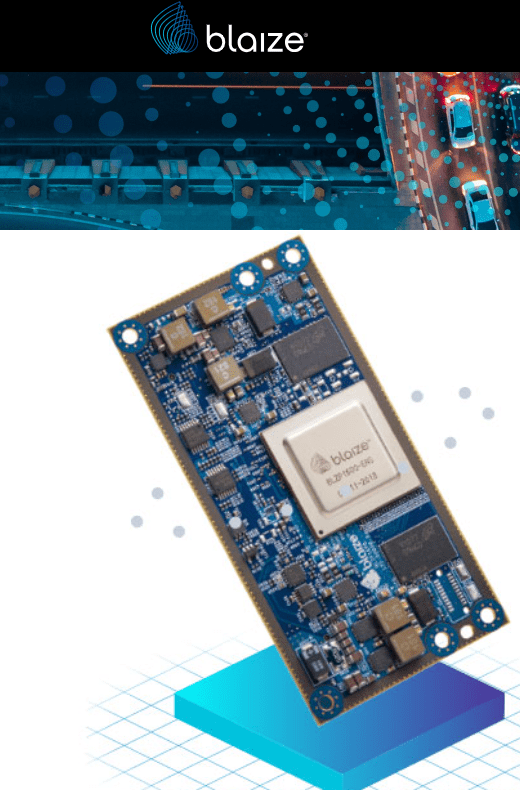
Image Credit: Blaize Holdings
………………………………………………………………………………………………………………………
- Pathfinder P1600 SOM: This System-on-Module is the primary vehicle for integration into Winmate’s handhelds and drones. It operates as a standalone unit with dual ARM Cortex-A53 processors and integrated MIPI CSI camera interfaces for real-time sensor fusion.
- Mission-Ready Durability: These systems are engineered to meet MIL-STD-810H and IP65+ standards, ensuring that Blaize’s AI silicon remains stable under extreme vibration, thermal shock (operating in sub-zero or high-heat field conditions), and high-velocity impacts.
- Sovereign Edge Computing: By processing sensitive data locally on ruggedized handhelds or vehicle-mounted units, the partnership ensures data sovereignty, preventing critical telemetry or biometric data from ever leaving the device during field operations
“Our customers can’t wait, and they often can’t rely on the cloud. They need AI that runs where the work happens. Winmate makes some of the most capable rugged systems in the industry, and our chips are designed to run AI inside exactly those kinds of devices. This partnership turns a years-long vision into a practical, deployable answer for defense and critical infrastructure operators,” said Dinakar Munagala, CEO of Blaize, Inc.
“Our platforms are deployed on naval vessels, in border outposts, on industrial sites, and in disaster zones – environments where most hardware fails. With Blaize, we can now deliver those same systems with on-device AI built in, giving customers real-time intelligence wherever they operate,” said Ken Lu, Chairman and CEO of Winmate Inc.
-
- Latency: The necessity for near-zero response times in autonomous and diagnostic systems.
- Security: The requirement to process sensitive data locally to mitigate the risks associated with transmitting information over public or compromised networks.
About Blaize, Inc.
Blaize delivers a programmable AI platform, purpose-built for AI inference workloads in real-world environments. Its Hybrid AI architecture combines the Blaize GSP (Graph Streaming Processor) with GPU-based infrastructure, enabling AI inference workloads to run across edge, cloud, and data center. Blaize solutions support computer vision, multimodal AI, and sensor-driven applications across smart cities, industrial automation, telecommunications, retail, logistics, and defense. Blaize is headquartered in El Dorado Hills, California, with a global presence across North America, Europe, the Middle East, and Asia. Visit www.blaize.com or follow us on LinkedIn @blaizeinc.
About Winmate Inc.
Winmate Inc. is a publicly traded global leader in rugged computing systems, delivering industrial-grade platforms – including handhelds, tablets, vehicle-mounted units, panel PCs, and embedded modules – for demanding environments across defense, transportation, energy, healthcare, and industrial markets.
………………………………………………………………………………………………………………………………………………………………………………………………………………………..References:
Is the “far edge” a bridge to far to cross for AI inferencing? What about “Distributed AI Grids”?
Analysis: Edge AI and Qualcomm’s AI Program for Innovators 2026 – APAC for startups to lead in AI innovation
Will “AI at the Edge” transform telecom or be yet another telco monetization failure?
Private 5G networks move to include automation, autonomous systems, edge computing & AI operations
One thought on “Blaize and Winmate Forge Strategic Partnership to Accelerate Edge AI Integration in Ruggedized Systems”
Leave a Reply

Nice to see Blaize continue to make progress. This market, where decision-making needs to be made at the edge, is a good one for the low-power, high-security, and low-latency solution they offer. I had a chance to interview them at CES where they were talking about its applicability in self-driving vehicles.
https://www.viodi.tv/2019/07/11/more-efficient-av-brains-more-ces2019/