

Blue Origin announces TeraWave – satellite internet rival for Starlink and Amazon Leo
The BBC reports that Jeff Bezos owned Blue Origin plans to create a new communications network called TeraWave, launching more than 5,400 satellites to offer global internet coverage. TeraWave will be focused on data centers, businesses and governments.
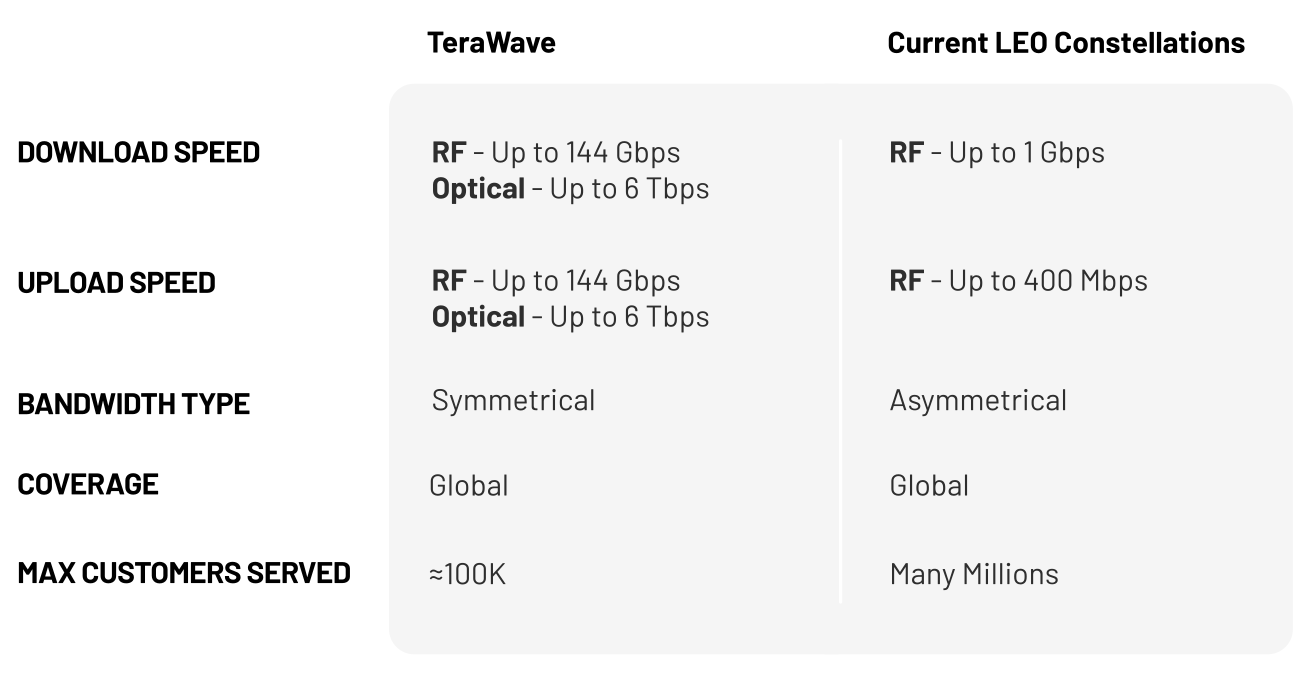
In a satellite internet market dominated by Elon Musk’s Starlink, Blue Origin would still have fewer satellites in orbit than Starlink. Yet TeraWave’s network at maximum speed would allow upload and download speeds of up to 6 terabits per second, much faster than rival commercial satellite offerings. The satellites are set to start launching by the end of 2027.
In April, Blue Origin launched an 11-minute space flight with an all-female crew, including Bezos’ now-wife Lauren Sánchez, singer Katie Perry and CBS presenter Gayle King. However, some commentators said it was “tone deaf” for celebrities to be taking part in such a fleeting and expensive trip at a time of economic struggle.
Blue Origin says TeraWave will be focused on data centers, businesses and governments. Blue Origin said its network, at its fastest, would allow upload and download speeds of as much as 6 terabits per second, much faster than rival commercial satellite services currently offer.
TeraWave is Optimized for Enterprise, Data Center, & Government Customers
- Starlink – part of Musk’s rocket firm SpaceX (which is 40% owned by Elon Musk) is by far the #1 satellite internet and phone service provider, primarily to individual customers.
- Blue Origin’s TeraWave satellite network will also compete with Amazon Leo, but they are targeting different market segments despite both being backed by Jeff Bezos. While it currently has around 180 satellites in orbit, having launched dozens more just last week, it plans to have more than 3,000 in orbit. Like Starlink, Amazon is also more focused on the general public than businesses and governments, positioning Leo as a way to offer high-speed internet access globally. It has not said when all of the Leo satellites will be in orbit.
| Feature | Blue Origin TeraWave | Amazon Leo (formerly Project Kuiper) |
|---|---|---|
| Target Market | Enterprises, data centers, governments, and other high-capacity users. | Consumers and communities in remote and underserved areas. |
| Service Goal | Provide extremely high-speed, symmetrical, and redundant backbone connectivity. | Deliver general high-speed broadband internet access (consumer speeds). |
| Projected Speeds | Up to 6 terabits per second (Tbps) via optical links in MEO. | Up to 1 gigabit per second (Gbps) for its highest-end user terminal. |
| Constellation Size | Plan for 5,408 satellites (LEO and MEO). | Plan for over 3,200 satellites (LEO only). |
In November, Blue Origin successfully landed a rocket booster on a floating platform for the first time. Only SpaceX had previously accomplished that feat.
………………………………………………………………………………………………………………………………………………………………..
References:
https://www.bbc.com/news/articles/cn0yydwe89jo
AST SpaceMobile to deliver U.S. nationwide LEO satellite services in 2026
FCC grants Amazon’s Kuiper license for NGSO satellite constellation for internet services
Amazon to Spend Billions on 38 Space Launches for Project Kuiper
Starlink doubles subscriber base; expands to to 42 new countries, territories & markets
China ITU filing to put ~200K satellites in low earth orbit while FCC authorizes 7.5K additional Starlink LEO satellites
Amazon Leo (formerly Project Kuiper) unveils satellite broadband for enterprises; Competitive analysis with Starlink
Amazon launches first Project Kuiper satellites in direct competition with SpaceX/Starlink
NBN selects Amazon Project Kuiper over Starlink for LEO satellite internet service in Australia
Elon Musk: Starlink could become a global mobile carrier; 2 year timeframe for new smartphones
GEO satellite internet from HughesNet and Viasat can’t compete with LEO Starlink in speed or latency
3 thoughts on “Blue Origin announces TeraWave – satellite internet rival for Starlink and Amazon Leo”
Leave a Reply

It’s astonishing that Blue Origin’s TeraWave satellite network directly competes with Amazon’s Leo (formerly Project Kuiper) by targeting similar high-capacity enterprise, government, and data center customers, despite both being founded by Jeff Bezos.
TeraWave focuses more on ultra-high-speed, symmetrical, point-to-point connections for major infrastructure rather than Leo’s broader consumer/business broadband. TeraWave offers specialized, powerful links, creating a three-way race with SpaceX’s Starlink for premium space-based communication services, especially for AI and data center backhaul.
Target Audience: TeraWave targets enterprise, government, and data centers needing massive bandwidth (Tbps), while Leo initially focuses on broader consumer and business broadband, though both have some customer overlap.
Service Focus: TeraWave emphasizes symmetrical speeds (equal uploads/downloads) and enterprise-grade reliability, serving as a high-capacity backbone, whereas Leo provides traditional broadband.
Technology: TeraWave utilizes a hybrid LEO/MEO (Low/Medium Earth Orbit) constellation with advanced optical links for massive throughput, while Leo is primarily LEO.
Customer Overlap: Both systems aim to serve sectors needing high-throughput connectivity, including governments and large enterprises.
Bezos’s Vision: The emergence of TeraWave adds another layer to Bezos’s broader space strategy, complementing Amazon’s Leo and potentially integrating with space-based data centers, creating parallel networks.
Market Positioning: Both aim to capture significant portions of the growing demand for space-based internet, challenging SpaceX’s dominance and creating a competitive landscape for high-capacity data transmission.
Good summary of what’s going on. It seems thatthis is a pie-growing activity. It might cannibalize some of the terrestrial fiber competitors. The lower latency associated with not having to deal with the Earth’s curvature could prove another advantage for some LEO networking applications. It is just as likely to provide redundancy and create a more resilient backbone for terrestrial fiber solutions.
It remains to be seen how well it meets its timelines and performance goals. It will also be interesting to see how companies like SpaceBeam factor into Amazon’s plan or whether Amazon will develop home-grown free-space optics technology.
Reference:
https://www.viodi.tv/2025/12/07/space-communications-via-laser-beams/
The Short Life Expectancy of Starlink’s LEO Satellites:
According to FCC filings Starlink shut down almost 500 Starlink satellites during the first half of 2025. The company had them reenter the atmosphere where they burned up. What is striking is that these satellites were all less than 5 years old. The general consensus is that LEOs have a life expectancy ranging from 5 to 8 years. Shorter than expected life spans for the satellites will hit Starlink’s income statement hard by increasing network depreciation and replacement needs. However, Starlink has managed to lower its LEO’s manufacturing costs down to $500K versus initial figures around $1 million. So these production economies of scale might offset some of the higher than expected depreciation. However, there are also rocket launch costs as well. It costs Starlink about $3 million to put a satellite into orbit. The Falcon 9 costs $67 million per flight and delivers 23 LEOs into low Earth orbit.
As a private company Starlink financials are a bit of mystery. The company press releases indicate a hefty $8 billion in 2024 revenue. But costs have remained invisible. My concern is that the financial picture may not be as rosy as the revenue figure suggests. Depreciation for LEO networks is quite high because low orbit means they will eventually experience a fiery death. Their orbits are not stable. With Starlink satellites lasting less than the five year minimum typically projected for these systems, depreciation and capital expenditures end up quite high. We also don’t know how much revenue is recurring versus one time installation charges.