

European Consortium 5G NTN transmission paves the way for standards based direct to device (D2D) connectivity
Executive Summary:
Satellite connectivity advanced meaningfully this past week as the European Trantor consortium reported the first 5G NTN transmission over a Hispasat satellite on July 8th. This is an important step because it moves NTN from proof-of-concept demonstrations toward a standards-based implementation path aligned with 3GPP’s non-terrestrial network work. In telecom terms, interoperability is the real gating factor: NTN only becomes architecturally relevant if it can integrate cleanly with 3GPP-defined access, mobility, and service procedures rather than remaining a proprietary satellite overlay.
From a technical perspective, the signal here is that NTN is evolving beyond its initial role as satellite backhaul for remote coverage and into direct-to-device (D2D) access using standard cellular devices and network functions. That transition brings a new set of engineering challenges: synchronization and timing, mobility management, spectrum coordination, terminal power efficiency, and seamless handover between terrestrial and non-terrestrial domains. The “pre-6G” label is appropriate because these developments point to a converged terrestrial-plus-space access architecture, not a standalone satellite niche.
Sanford Bernstein’s warning that direct-to-device satellite can increase competitive pressure on terrestrial network operators is credible because it erodes one of the incumbents’ traditional advantages: exclusive control over wide-area coverage. If NTN systems can support messaging, emergency connectivity, and eventually broader mobile services, then operators face substitution pressure in segments where they historically monetized coverage gaps, roaming resilience, and service continuity. This does not displace terrestrial networks, but it does reduce the ability of carriers to price certain coverage and resilience attributes as premium differentiators.
The most likely industry response is partnership rather than confrontation. Mobile operators will probably position NTN as a complementary resilience layer for coverage extension, disaster recovery, IoT continuity, and premium service tiers, rather than as a replacement for terrestrial RAN investment. At the same time, vendors and standards bodies will continue pushing multi-orbit, multi-band, and multi-vendor interoperability as the condition for commercial viability. For editorial purposes, the key question is whether NTN matures as an operator-integrated extension of the mobile network or as an adjacent service layer that partially bypasses terrestrial incumbents.
3GPP Evolution to 6G:
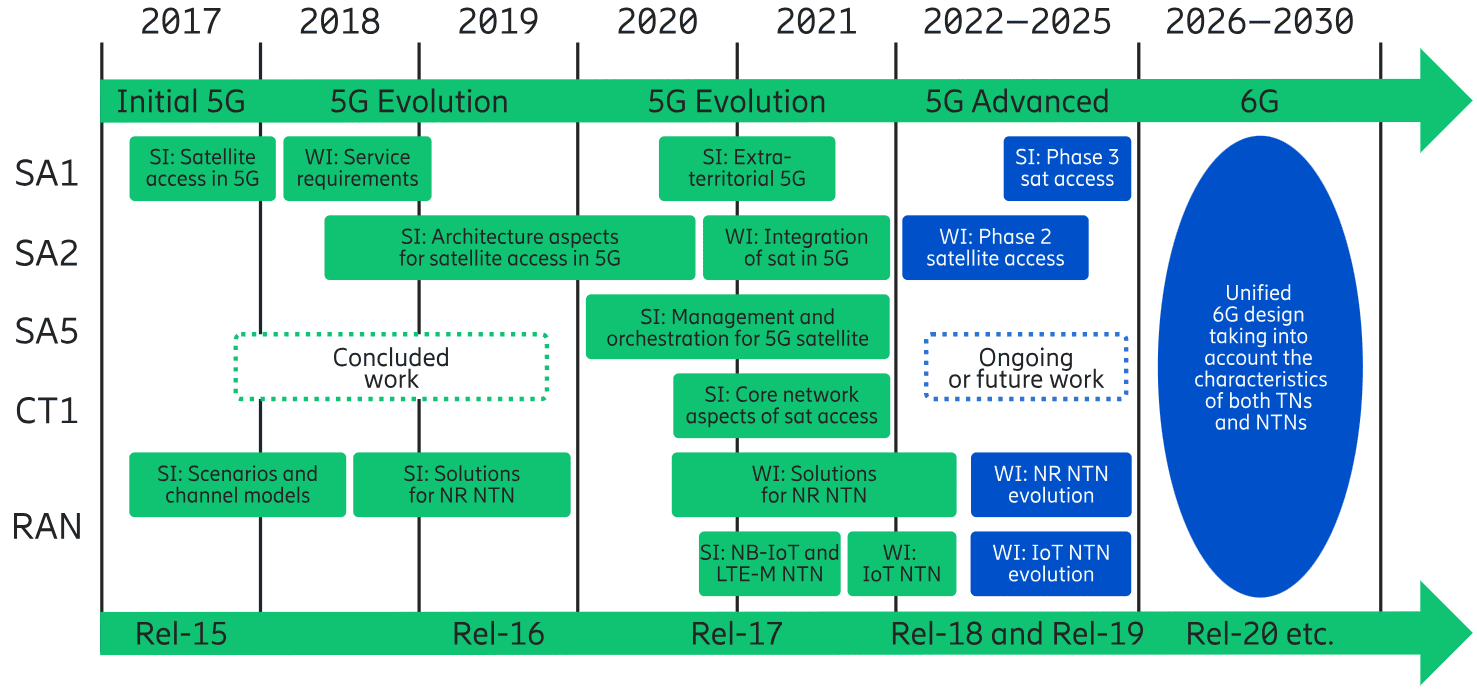
Image Credit: Ericsson
………………………………………………………………………………………………………………………………………………………………………………………………………..
Key Technology Takeaways:
-
The first 5G NTN transmission over a Hispasat satellite marks a meaningful step from lab validation to standards-aligned deployment.
-
3GPP NTN work is the key enabler because interoperability, not just link feasibility, will determine commercial viability.
-
NTN is evolving from satellite backhaul for remote coverage into direct device access for standard cellular endpoints.
-
The hardest technical problems are shifting toward timing, mobility, spectrum coordination, device power efficiency, and seamless terrestrial/non-terrestrial handover.
-
“Pre-6G” is the right framing because NTN is becoming part of a hybrid terrestrial-plus-space access architecture.
-
Direct-to-device satellite services can pressure terrestrial operators by reducing their exclusive control over last-mile coverage and resilience.
-
The most likely carrier strategy is partnership and bundling, using NTN for coverage extension, disaster recovery, and IoT continuity rather than full substitution.
-
Multi-orbit, multi-band, and multi-vendor interoperability will be essential if NTN is to become a durable commercial platform.
……………………………………………………………………………………………………………………………………………………………………………………………………………
References:
https://www.3gpp.org/technologies/ntn-overview
https://www.ericsson.com/en/blog/2024/10/ntn-payload-architecture