

AI in enterprises
IDC Survey of Networking Leaders: Enterprise AI progress stalls despite ambitious goals
New IDC research released in April 2026 highlights a growing disconnect between ambitious enterprise AI goals and the reality of their technical execution. The 2026 IDC AI in Networking Special Report (LinkedIn Video hyperlink) [1.] found that organizations expecting to move from early and selective AI use for business and IT initiatives to more advanced deployments largely haven’t. The result is a widening gap between intent and execution that is becoming harder to ignore. This widening gap in AI execution is driven by a mismatch between ambitious goals and the realities of legacy infrastructure, which cannot handle the data demands for production-grade models.
Despite high expectations, many organizations have seen their AI progress stall over the last 18 months, with “select use” adopters failing to advance to more “substantial” deployments. A critical shortage of specialized AI experienced personnel, combined with lagging security and governance controls, has caused widespread “pilot paralysis” across most enterprises. To overcome this, organizations are shifting toward “AI factories” to create a repeatable, governed pipeline for deploying AI.
Note 1. IDC’s 2026 AI in Networking Special Report is a report driven by a worldwide survey of 500+ enterprise network executives and experts. The report covers both the impact and plans for supporting AI workloads across the network and using AI-powered networking solutions. The focus of this research is comprehensive, covering datacenters, cloud services, multi-cloud environments, network core and edge, and network management.
…………………………………………………………………………………………………………………………………………………………………………………………………………………………………………
Mark Leary, IDC research director, Network Observability and Automation:
“Many solution suppliers are prioritizing a platform approach to the challenges associated with moving AI workloads into production. This survey of networking leaders highlights the shift in preference from platforms to best-in-class solutions when supporting AI workloads across their networks. As certain functional requirements intensify, as IT staff experience and expertise build, and as platforms fall short in delivering expected advantages, IT organizations are more willing to take on the added responsibilities associated with assembling their own mix of best-in-class solutions. For the supplier, the challenge is to avoid developing and delivering a platform that is classified as a jack-of-all-trades and master of none.”
“Agentic AI is to have a profound effect on the network infrastructure and on networking staff. Two years ago, AI assistants were labeled leading edge when they offered natural language processing for operator interactions and network management guidance driven by technical manual content. How things have changed! Agentic AI is no longer just a passive informer and instructor but an active intelligent virtual network engineer. Agents gather and process comprehensive network data, develop deep and precise insights, and determine and, increasingly, execute needed network management actions. Whether fixing a network problem, activating a network service, optimizing a network configuration, or responding to a developing network condition, agentic AI solutions are proving more and more useful across the entire network and the entire set of tasks required to engineer and operate the network.”
While this IDC Survey Spotlight offers only an overview of responses relating to agentic AI, detailed results are available by geographic region, select country, company size, major vertical industries, respondent role, and the AI maturity level of the respondent’s organization.
…………………………………………………………………………………………………………………………………………………………………………………………………………………………………………
Organizations are pursuing AI in networking across two categories:
1.] Supporting AI workloads across network infrastructure and
2.] Applying AI to network operations.
But in both cases, progress is constrained by persistent challenges. “2026 is when organizations find out if AI in networking delivers real operational impact—or remains stuck in pilot mode,” Leary said in the referenced LinkedIn Video.
Source: IDC
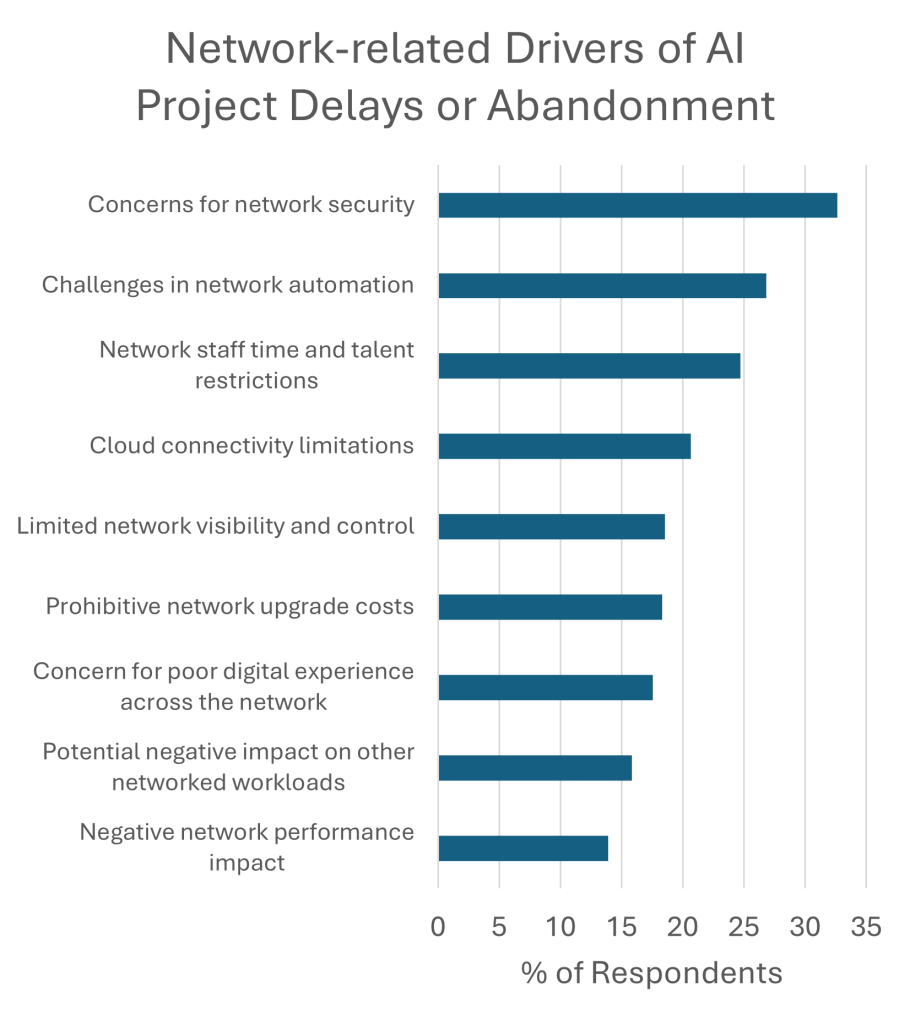
Security remains the top concern among enterprises, both as a barrier to deployment and a primary use case for AI itself. “You have to fight AI with AI from a network security perspective,” said Brandon Butler, senior research manager at IDC. “There’s a realization that nefarious actors are leveraging AI themselves. The pressure is already on the network. The question now is whether organizations can keep up with what AI is demanding of their infrastructure,” he added.
Integration with existing systems and a shortage of skilled talent follow close behind. “Most folks don’t feel their staff can fully evaluate and select the right solutions,” Leary said. As a result, many organizations are turning outward for help:
- 81% say they are increasing spending on managed service providers (MSP) to support AI initiatives.
- 89% of data centers expect to increase bandwidth by at least 11% within the next year, driven by AI workloads.
- That demand extends beyond individual facilities, with 91% expecting similar growth in inter-data center connectivity, highlighting the strain on distributed architectures.
- Nearly half of respondents (46%) prefer AI systems that can both determine and execute network actions autonomously.
- Another 41% favor a guided approach, while 13% prefer no AI involvement.
Cloud environments are seeing sharper increases in AI use. Organizations anticipate an average 49% rise in bandwidth for cloud connectivity over the next year. “The cloud is almost always involved,” Leary says. “The biggest group mixes one cloud platform with one or more data centers.”
Beyond the data center and cloud, the network edge is emerging as the next major growth area. Today, 27% of organizations have deployed AI workloads at the edge, and 54% plan to do so within two years. Butler said: “Folks who are leveraging AI more extensively are already pushing workloads to the edge. We see this as a leading indicator of where the market is going.”
“Two years in a row, the largest group said they want AI to both determine and execute actions. It was honestly surprising,” he added.
Enterprise edge bandwidth is projected to grow by an average of 51% in the next year. As AI becomes more distributed, network teams will need to manage greater complexity across environments while maintaining performance and security.
…………………………………………………………………………………………………………………………………………………………………………….
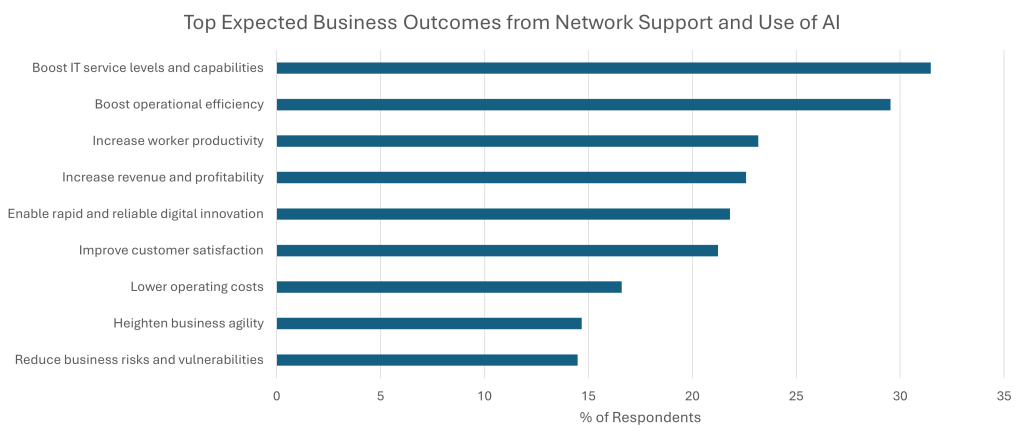
When assessing expected ROI from AI in networking, IDC survey respondents focused on elevating IT capabilities, with 31% prioritizing superior service levels and 30% focusing on operational efficiency. These outcomes ranked above worker productivity and revenue, suggesting that leaders are strategically utilizing AI to enhance foundational operational workflows. Notably, reducing operating costs ranked seventh, suggesting a focus on strategic value rather than immediate expense reduction.
Source: IDC
IDC Research identified specific applications—from automated configuration validation to AI-enhanced threat response—as catalysts for measurable performance gains and the organizational trust essential for broader implementation. For network executives, this phased approach represents the most strategic methodology for achieving long-term operational objectives.
“It doesn’t have to be handing the keys of your kingdom to AI to really get some benefits from these AI tools,” Butler concluded.
……………………………………………………………………………………………………………………………………………………………………………………….
References:
https://www.networkworld.com/article/4152655/ai-for-it-stalls-as-network-complexity-rises.html