

AI in enterprises
Anthropic’s Project Glasswing aims to reshape IT cybersecurity
Backgrounder:
Late last year, Anthropic said that state-sponsored Chinese hackers had used its artificial intelligence (AI) technology in an effort to infiltrate the computer systems of roughly 30 companies and government agencies around the world. The company said it was the first reported case of a cyberattack in which AI technologies had gathered sensitive information with limited help from human operators.
As Anthropic and its chief rival, OpenAI, prepare to release new and more powerful AI systems, cybersecurity experts are increasingly vocal in their warnings that AI is fundamentally changing cybersecurity. AI technology could allow hackers to identify security holes in computer systems far faster than in the past, vastly raising the stakes in the decades-long fight between hackers and the security experts guarding computer networks. As hackers deploy AI to break and steal, security experts are also leaning on AI to spot flaws in their systems — including some that had gone unnoticed for decades.
“This is the most change in the cyber environment, ever,” said Francis deSouza, the chief operating officer and president of security products at Google Cloud. “You have to fight A.I. “This is the most change in the cyber environment, ever,” said Francis deSouza, the chief operating officer and president of security products at Google Cloud. “You have to fight AI with AI.”
Hackers have used AI chatbots to draft phishing emails and ransom notes, cybersecurity experts said. Others have used AI to parse large quantities of stolen data and determine what information might be valuable. Without help from AI attackers could sometimes break into computer networks within minutes, Mr. deSouza said, but with the help of AI breaches can take just seconds. Some hackers specialize in breaking into systems and then selling off their access to other attackers. Those handoffs used to take as much as eight hours, as hackers negotiated the sales and passed along the compromised entry points, deSouza added. Now that process has accelerated to about 20 seconds, he said, with hackers sometimes using A.I. agents to speed up the process.
Some experts argue that the guardrails added by companies like Anthropic and OpenAI can actually provide an advantage to malicious attackers. Guardrails could cause an AI chatbot to deny help to a user trying to defend a system from an attack, they argue, but persistent hackers could be more diligent about finding vulnerabilities — and keeping those tricks to themselves.
In February, Anthropic said it had used its A.I. technologies to find over 500 so-called zero-day vulnerabilities — security holes that were unknown to software makers — in various pieces of commonly used open source software. The next month, a researcher at Anthropic revealed that he had used A.I. to find a serious security vulnerability in the core of the Linux operating system, which is software that powers much of the internet and is used in computer servers, cloud computing services, Android phones and Teslas. The bug had existed, apparently undiscovered, since 2003.
Project Glasswing Overview:
Anthropic has announced Project Glasswing – a new initiative that brings together Amazon Web Services, Anthropic, Apple, Broadcom, Cisco, CrowdStrike, Google, JPMorganChase, the Linux Foundation, Microsoft, NVIDIA, and Palo Alto Networks – in an effort to secure the world’s most critical software.
The fast growing AI private company has found that AI models (like its own Claude) have reached a level of coding capability where they can surpass all but the most skilled humans at finding and exploiting software vulnerabilities. Their Mythos Preview language model has already found thousands of high-severity vulnerabilities, including some in every major operating system and web browser.
Given the rate of AI progress, it will not be long before such capabilities proliferate, potentially beyond actors who are committed to deploying them safely. The fallout—for economies, public safety, and national security—could be severe. Project Glasswing is an urgent attempt to put these capabilities to work for defensive purposes.
The Project Glasswig partners will use Mythos Preview as part of their defensive security work. Anthropic will share what they learn so the entire IT industry can benefit. They have also extended access to a group of over 40 additional organizations that build or maintain critical software infrastructure so they can use the model to scan and secure both first-party and open-source systems.
Anthropic is committing up to $100M in usage credits for Mythos Preview across these efforts, as well as $4M in direct donations to open-source security organizations.
- Give Defenders a Head Start: The initiative aims to use Mythos’s capabilities to find and fix zero-day vulnerabilities in critical codebases before they can be discovered by malicious actors.
- Secure Critical Infrastructure: Partners use the model to scan first-party systems and open-source software that underpin global banking, energy, and logistics networks.
- Modernize Defense Practices: Anthropic is collaborating with partners to evolve security workflows, such as patching and disclosure processes, to match the “machine speed” of AI-driven vulnerability discovery.
- Zero-Day Discovery: In early testing, the model autonomously found thousands of high-severity vulnerabilities, including a 27-year-old bug in OpenBSD and a 16-year-old flaw in FFmpeg code that had been scanned by automated tools millions of times without detection.
- Performance Benchmarks: Mythos Preview scored 83% on the CyberGym cybersecurity benchmark, significantly outperforming previous models like Claude Opus.
References:
https://www.anthropic.com/glasswing
https://www.nytimes.com/2026/04/06/technology/ai-cybersecurity-hackers.html
Anthropic Glasswing: AI Vulnerability Detection Has Crossed a Threshold
Anthropic Claude Users Reveal AI Hallucinations as their Top Concern
Nvidia CEO Huang: AI is the largest infrastructure buildout in human history; AI Data Center CAPEX will generate new revenue streams for operators
New Linux Foundation white paper: How to integrate AI applications with telecom networks using standardized CAMARA APIs and the Model Context Protocol (MCP)
IDC Survey of Networking Leaders: Enterprise AI progress stalls despite ambitious goals
New IDC research released in April 2026 highlights a growing disconnect between ambitious enterprise AI goals and the reality of their technical execution. The 2026 IDC AI in Networking Special Report (LinkedIn Video hyperlink) [1.] found that organizations expecting to move from early and selective AI use for business and IT initiatives to more advanced deployments largely haven’t. The result is a widening gap between intent and execution that is becoming harder to ignore. This widening gap in AI execution is driven by a mismatch between ambitious goals and the realities of legacy infrastructure, which cannot handle the data demands for production-grade models.
Despite high expectations, many organizations have seen their AI progress stall over the last 18 months, with “select use” adopters failing to advance to more “substantial” deployments. A critical shortage of specialized AI experienced personnel, combined with lagging security and governance controls, has caused widespread “pilot paralysis” across most enterprises. To overcome this, organizations are shifting toward “AI factories” to create a repeatable, governed pipeline for deploying AI.
Note 1. IDC’s 2026 AI in Networking Special Report is a report driven by a worldwide survey of 500+ enterprise network executives and experts. The report covers both the impact and plans for supporting AI workloads across the network and using AI-powered networking solutions. The focus of this research is comprehensive, covering datacenters, cloud services, multi-cloud environments, network core and edge, and network management.
…………………………………………………………………………………………………………………………………………………………………………………………………………………………………………
Mark Leary, IDC research director, Network Observability and Automation:
“Many solution suppliers are prioritizing a platform approach to the challenges associated with moving AI workloads into production. This survey of networking leaders highlights the shift in preference from platforms to best-in-class solutions when supporting AI workloads across their networks. As certain functional requirements intensify, as IT staff experience and expertise build, and as platforms fall short in delivering expected advantages, IT organizations are more willing to take on the added responsibilities associated with assembling their own mix of best-in-class solutions. For the supplier, the challenge is to avoid developing and delivering a platform that is classified as a jack-of-all-trades and master of none.”
“Agentic AI is to have a profound effect on the network infrastructure and on networking staff. Two years ago, AI assistants were labeled leading edge when they offered natural language processing for operator interactions and network management guidance driven by technical manual content. How things have changed! Agentic AI is no longer just a passive informer and instructor but an active intelligent virtual network engineer. Agents gather and process comprehensive network data, develop deep and precise insights, and determine and, increasingly, execute needed network management actions. Whether fixing a network problem, activating a network service, optimizing a network configuration, or responding to a developing network condition, agentic AI solutions are proving more and more useful across the entire network and the entire set of tasks required to engineer and operate the network.”
While this IDC Survey Spotlight offers only an overview of responses relating to agentic AI, detailed results are available by geographic region, select country, company size, major vertical industries, respondent role, and the AI maturity level of the respondent’s organization.
…………………………………………………………………………………………………………………………………………………………………………………………………………………………………………
Organizations are pursuing AI in networking across two categories:
1.] Supporting AI workloads across network infrastructure and
2.] Applying AI to network operations.
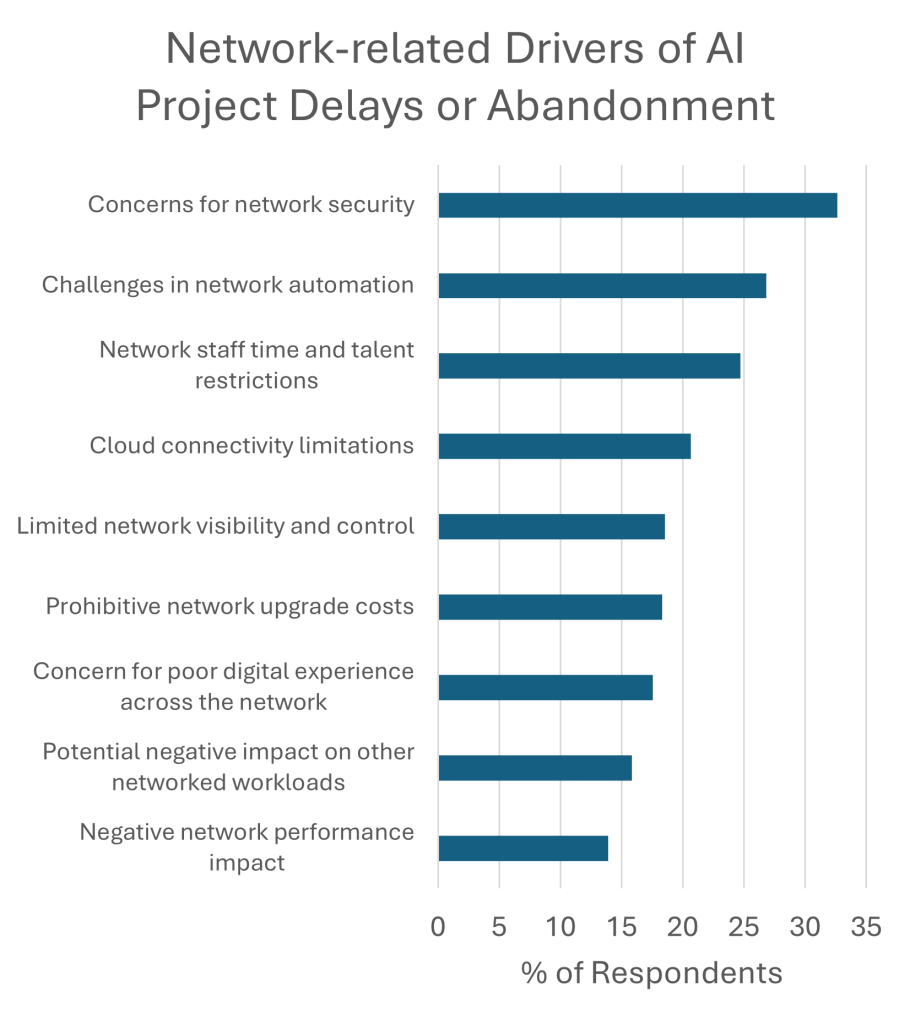
But in both cases, progress is constrained by persistent challenges. “2026 is when organizations find out if AI in networking delivers real operational impact—or remains stuck in pilot mode,” Leary said in the referenced LinkedIn Video.
Source: IDC
……………………………………………………………………………………………………………………………
Security remains the top concern among enterprises, both as a barrier to deployment and a primary use case for AI itself. “You have to fight AI with AI from a network security perspective,” said Brandon Butler, senior research manager at IDC. “There’s a realization that nefarious actors are leveraging AI themselves. The pressure is already on the network. The question now is whether organizations can keep up with what AI is demanding of their infrastructure,” he added.
Integration with existing systems and a shortage of skilled talent follow close behind. “Most folks don’t feel their staff can fully evaluate and select the right solutions,” Leary said. As a result, many organizations are turning outward for help:
- 81% say they are increasing spending on managed service providers (MSP) to support AI initiatives.
- 89% of data centers expect to increase bandwidth by at least 11% within the next year, driven by AI workloads.
- That demand extends beyond individual facilities, with 91% expecting similar growth in inter-data center connectivity, highlighting the strain on distributed architectures.
- Nearly half of respondents (46%) prefer AI systems that can both determine and execute network actions autonomously.
- Another 41% favor a guided approach, while 13% prefer no AI involvement.
Cloud environments are seeing sharper increases in AI use. Organizations anticipate an average 49% rise in bandwidth for cloud connectivity over the next year. “The cloud is almost always involved,” Leary says. “The biggest group mixes one cloud platform with one or more data centers.”
Beyond the data center and cloud, the network edge is emerging as the next major growth area. Today, 27% of organizations have deployed AI workloads at the edge, and 54% plan to do so within two years. Butler said: “Folks who are leveraging AI more extensively are already pushing workloads to the edge. We see this as a leading indicator of where the market is going.”
“Two years in a row, the largest group said they want AI to both determine and execute actions. It was honestly surprising,” he added.
Enterprise edge bandwidth is projected to grow by an average of 51% in the next year. As AI becomes more distributed, network teams will need to manage greater complexity across environments while maintaining performance and security.
…………………………………………………………………………………………………………………………………………………………………………….
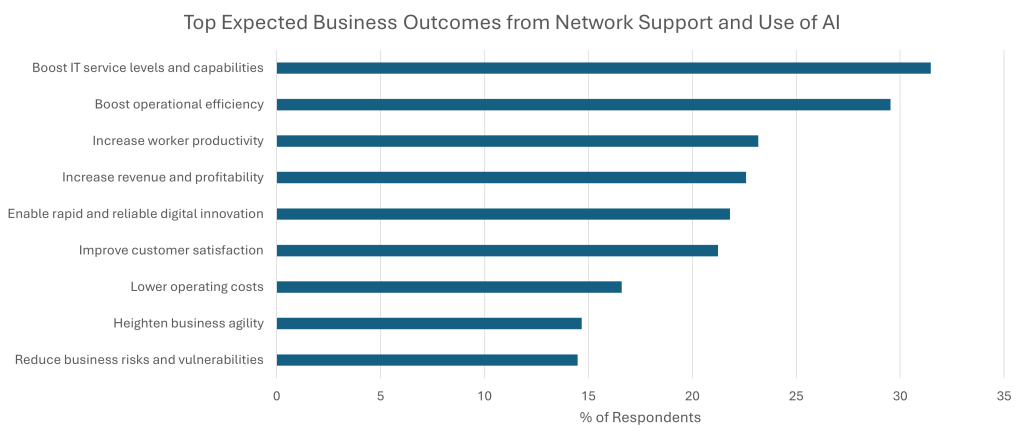
When assessing expected ROI from AI in networking, IDC survey respondents focused on elevating IT capabilities, with 31% prioritizing superior service levels and 30% focusing on operational efficiency. These outcomes ranked above worker productivity and revenue, suggesting that leaders are strategically utilizing AI to enhance foundational operational workflows. Notably, reducing operating costs ranked seventh, suggesting a focus on strategic value rather than immediate expense reduction.
Source: IDC
……………………………………………………………………………………………………
IDC Research identified specific applications—from automated configuration validation to AI-enhanced threat response—as catalysts for measurable performance gains and the organizational trust essential for broader implementation. For network executives, this phased approach represents the most strategic methodology for achieving long-term operational objectives.
“It doesn’t have to be handing the keys of your kingdom to AI to really get some benefits from these AI tools,” Butler concluded.
……………………………………………………………………………………………………………………………………………………………………………………….
References:
https://www.networkworld.com/article/4152655/ai-for-it-stalls-as-network-complexity-rises.html