

NEC
NEC exits 4G/5G base station market underscoring Japan’s weak mobile infrastructure ecosystem
Japanese telecom vendor NEC has decided to cease development of 4G and 5G radio access base stations, effectively exiting a segment now overwhelmingly controlled by only five vendors (Huawei, Ericsson, Nokia, ZTE and Samsung). Huawei, Ericsson, and Nokia collectively hold ~80% of the worldwide 4G/5G base station market, while NEC and Fujitsu together hold under 1.5% global market share. That leaves Japan’s network equipment vendors structurally disadvantaged on both scale and pricing power. The move underscores structural weaknesses in Japan’s mobile infrastructure ecosystem, particularly its inability to reach scale in a highly globalized, capex‑intensive market.

Fujitsu spun off its communications-related business, including base stations, into a new subsidiary this July. Kyocera, which had planned to enter the 5G base station market in 2027, has also abandoned development of 5G base stations. NTT DoComo, Japan’s largest mobile network operator by subscriber count and market share, previously prioritized procurement from such Japanese companies such as NEC and Fujitsu but changed tack in 2024 and stepped up purchases from Ericsson, Nokia and other foreign companies.

A wireless base station on the roof of a building in Tokyo. (Photo obtained by Nikkei)
……………………………………………………………………………………………………………………………………………………………………
Key points:
-
NEC will halt new development of 4G and 5G base stations for smartphones and other endpoint devices, while stepping back from a market where its share had already fallen to a marginal level.
-
The decision is widely viewed as a market‑driven outcome, reflecting persistent losses in a business that never achieved the scale or cost structure required to compete with leading global RAN vendors.
-
Contemporary mobile infrastructure is a globalized and capital‑intensive industry, where survival hinges on high volumes to amortize R&D, silicon, software, manufacturing, and go‑to‑market costs across multiple product generations.
-
NEC will continue R&D for 6G and “Beyond 5G” systems, aligning with Japan’s national Beyond 5G Promotion Strategy, which targets commercialization of next‑generation services around 2030.
-
The company is concentrating research talent in areas such as open and virtualized RAN (v-RAN, Near‑RT RIC, AI-driven network optimization, and integrated terrestrial–non‑terrestrial networks, which are all positioned as building blocks for 6G.
-
However, Japan’s relatively shallow 5G deployment and weak installed base constrain its ability to test dense high‑frequency networks, a prerequisite for 6G architectures that will rely on ultra‑short‑range spectrum and far denser site grids.
-
Japan’s research and IP position in 6G remains modest, with domestic players accounting for roughly 10 percent of global 6G‑related patent filings in recent surveys, trailing several major competitors.
-
Limitations in technology reserves and standards participation raise questions about whether policy roadmaps alone can close the gap without corresponding gains in commercial scale and deployment experience.
-
Japan, along with Australia, Canada, the UK, and the US, has formed the Global Coalition on Telecommunications (GCOT), which is focusing on AI, security, and next‑generation standards, and is widely interpreted as a vehicle to counter China’s growing influence in telecom infrastructure.
-
Attempts to architect future high‑speed networks primarily around geopolitical blocs risk fragmenting markets, inflating development and compliance costs, and undermining interoperability—factors that historically have worked against technically superior but commercially isolated platforms in 4G and 5G.
-
Japan lacks a sufficiently large, unified domestic mobile market to independently sustain globally competitive RAN vendors and generate the economies of scale seen in China, Europe, or the US‑centric ecosystem.
-
Political alignment and industrial policy can provide funding and coordination, but they cannot substitute for large‑scale commercial demand, broad ecosystem participation, and sustained competitiveness across cost, performance, and time‑to‑market
References:
https://www.globaltimes.cn/page/202512/1351697.shtml
Japan to support telecom infrastructure in South Pacific using Open RAN technology
Japan telecoms are launching satellite-to-phone services
SNS Telecom & IT: Private 5G Market Nears Mainstream With $5 Billion Surge
Telecom sessions at Nvidia’s 2025 AI developers GTC: March 17–21 in San Jose, CA
SK Telecom, DOCOMO, NTT and Nokia develop 6G AI-native air interface
Nikkei Asia: Huawei demands royalties from Japanese companies
NEC’s new AI technology for robotics & RAN optimization designed to improve performance
NEC Corporation has developed AI technology for robotics that enables precise handling operations on unorganized and disorderly placed items. By predicting both the areas hidden by obstacles and the results of a robot’s actions, this technology makes it possible for robots to perform tasks that were previously performed manually, thereby contributing to the improvement of productivity and work-styles.
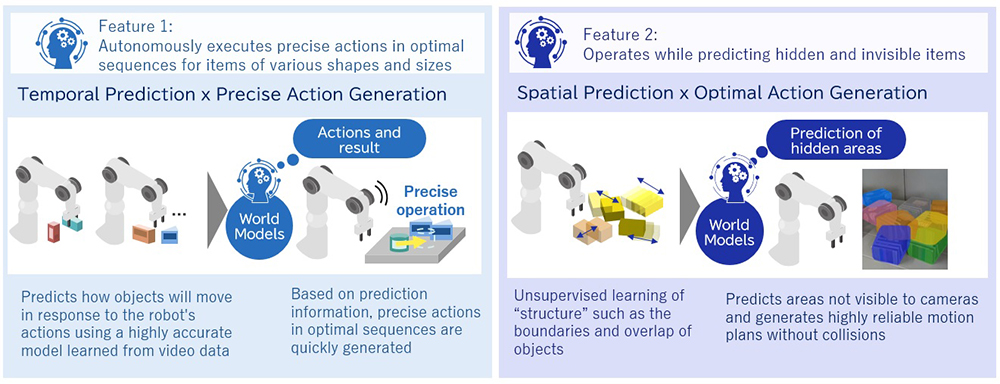
NEC has developed AI technology for robotics that consists of two technologies based on “World Models“:
“Spatiotemporal Prediction,” in which a robot precisely predicts the work environment and the results of its own actions from camera data, and
“Robot Motion Generation,” which automatically generates optimal and precise actions based on these predictions. According to NEC research, this is the world’s first technology of its kind to be applied to robot operations.
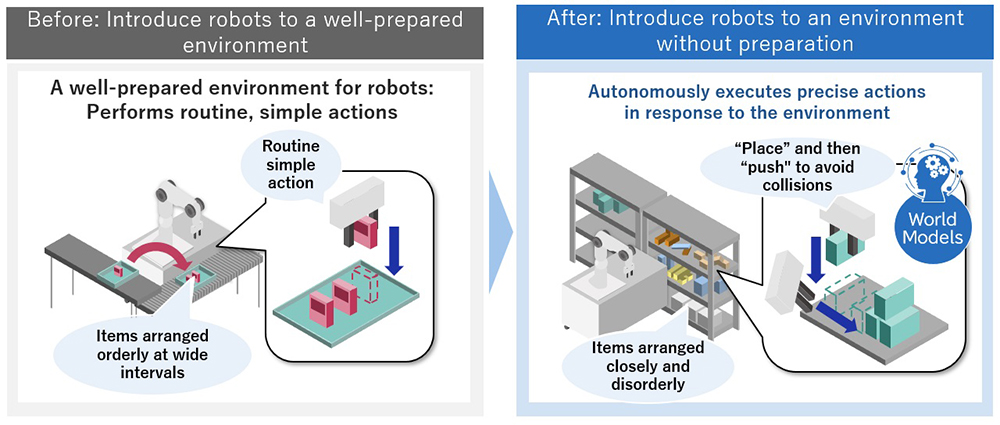
1. Autonomously executes precise actions in optimal sequences for items of various shapes and sizes:
The handling of objects performed manually at a work site are executed by a combination of various actions. For example, in packing items, people can instantly execute a combination of precise actions such as “placing and then pushing items” without hitting other objects or obstacles. In robot control that uses conventional technologies, however, actions such as “push” and “pull” are more difficult to execute with high precision than actions such as “pick up” and “place.” This is because slight differences in actions or shapes significantly influence how objects move in response to actions. In addition, as the number and types of actions to be considered increases, the combination and sequence of actions becomes more complex, which makes real-time planning a challenge.
This technology uses World Models to accurately predict the results of robot actions on objects of various shapes from video camera data, enabling robots to execute precise actions such as “push” and “pull.” Moreover, robots can autonomously and instantly execute combinations of multiple actions such as “place and push” and “pull and pick up” by generating the appropriate action sequence at real-time speed depending on the work environment.
2. Operates while predicting hidden and invisible items:
In a work environment where multiple items are closely arranged or disorderly piled up, people naturally predict the hidden areas and act accordingly, such as picking up items while avoiding interference with hidden objects. However, conventional recognition technology for robots has been difficult for practical use because it requires the preparation and learning of a large amount of teaching data showing the state of hidden objects in order to predict the hidden areas.
This new technology enables unsupervised learning that does not require labeling through the application of World Models and is able to efficiently learn prediction models of hidden object shapes. This enables robots to accurately predict a work environment from camera data and automatically generate optimal actions that do not collide with other objects or obstacles.
NEC will test this technology in logistics warehouses and other sites where much of the work is done manually by the end of 2024. By promoting social implementation of this technology in various industries with significant need for automation, NEC will contribute to improved productivity and work style reform.
………………………………………………………………………………………………………….
Separately, NEC has developed a RAN autonomous optimization technology that dynamically controls 5G Radio Access Networks (RAN) according to the status of each user terminal, dramatically improving the productivity of applications, such as the remote control of robots and vehicles. NEC will incorporate the technology into RAN Intelligent Controllers (RIC) and conduct demonstration tests using this technology by March 2025.
There is growing momentum to promote digital transformation (DX) by utilizing the latest technologies such as 5G, Artificial Intelligence (AI), and the Internet of Things (IoT) with the aim of resolving labor shortages and improving productivity.
When using these technologies for remote control of robots and vehicles, two-way communication consisting of status monitoring and control instructions for each robot/vehicle must be completed within a certain period of time.
However, if the communication latency exceeds the requirement, the operation is repeatedly suspended for safety reasons, resulting in a decrease in the operation rate and productivity. The communication delays, such as retransmission delays due to poor radio quality and queuing delays (*) due to congestion on the radio links, have been a barrier to the introduction of remote control systems.
Currently, stable communications environments have been achieved by installing high performance network equipment, providing sufficient frequency resources, increasing redundancy in coding and communication paths, and pre-configuration of RAN parameters according to the application. However, with these methods, it is difficult to widely support applications that are diversifying with the advancement of DX, and the time and cost required for implementation is also an issue.
About the RAN autonomous optimization technology:
The RAN autonomous optimization technology developed by NEC consists of AI that analyzes communication requirements and radio quality fluctuations on a per-user terminal basis, such as robots and vehicles, and AI that dynamically controls RAN parameters on a per-user terminal basis based on the results of that analysis. This AI learns from past operational records of robots and vehicles, and optimally controls RAN parameters such as modulation and coding scheme (target block error rate), radio resource allocation (resource block ratio), and maximum allowable delay (delay budget) while predicting the probability of exceeding communication latency requirements. Whereas in a typical 5G network, RAN parameters are fixed and set for the entire network, this technology dynamically controls them on a per-user terminal basis to improve application productivity.
Technology features are as follows.
1. Flexible support for a variety of applications
RAN parameters can be dynamically controlled according to the communication requirements of applications, enabling overall optimization even in environments where diverse applications are mixed.
2. O-RAN Alliance-compliant and easy to deploy
Since it can be mounted on RIC that are compliant with O-RAN Alliance standard specifications, it is easy to install or add to existing facilities.
3. Dramatic productivity gains are possible at industrial sites
Simulation results of applying this technology to a system that remotely controls multiple autonomous robots operating in factories or warehouses confirmed that the number of robot stoppages can be reduced by 98% or more compared to cases where this technology is not used.
NEC plans to incorporate the technology into RIC platforms compliant with the O-RAN Alliance standard specifications and conduct demonstration tests using this technology by March 2025.
NEC will exhibit this technology at MWC Barcelona 2024, the world’s largest mobile exhibition, which will be held from February 26 to February 29, 2024 at Fira Gran Via, Barcelona, Spain.
When using these technologies for remote control of robots and vehicles, two-way communication consisting of status monitoring and control instructions for each robot/vehicle must be completed within a certain period of time. However, if the communication latency exceeds the requirement, the operation is repeatedly suspended for safety reasons, resulting in a decrease in the operation rate and productivity. The communication delays, such as retransmission delays due to poor radio quality and queuing delays due to congestion on the radio links, have been a barrier to the introduction of remote control systems.