

Virtual RAN gets a boost from Samsung demo using Intel’s Grand Rapids/Xeon Series 6 SoC
Samsung is the fifth largest worldwide RAN equipment vendor, behind Huawei, Ericsson, Nokia and ZTE. This week, the South Korean conglomerate claimed to have reached a virtual RAN (vRAN) milestone with the completion of a commercial phone call using Granite Rapids – Intel’s Xeon 6700P-B SoC processor series. The call took place on the network of a large, undisclosed U.S. network operator, but apparently Verizon. Samsung said, “this builds upon the company’s previous achievement in 2024, when it completed the industry-first end-to-end call in a lab environment with Intel Xeon 6 SoC.”
Samsung’s cloud-native vRAN with Intel’s latest Xeon SoC ran on a single commercial off-the-shelf (COTS) server from Hewlett Packard Enterprise with a cloud platform from Wind River. This milestone, coming only a few months after the first wave of Intel Xeon 6 SoC was made commercially available, presents an innovative pathway for single-server vRAN deployments for next-generation networks.
The commercial readiness of vRAN technology promises to give network operators the ability to run RAN and AI workloads on fewer, more powerful servers.
Samsung wrote: “As operators accelerate their transition to software-driven, flexible architectures while seeking more sustainable infrastructure, the ability to run RAN and AI workloads on fewer, more powerful servers becomes critical, On a single server of Samsung’s AI-powered vRAN with enhanced processors, operators can consolidate software-driven network elements such as mobile core, radio access, transport and security, which traditionally required multiple servers, significantly simplifying the management of complex site configuration.”
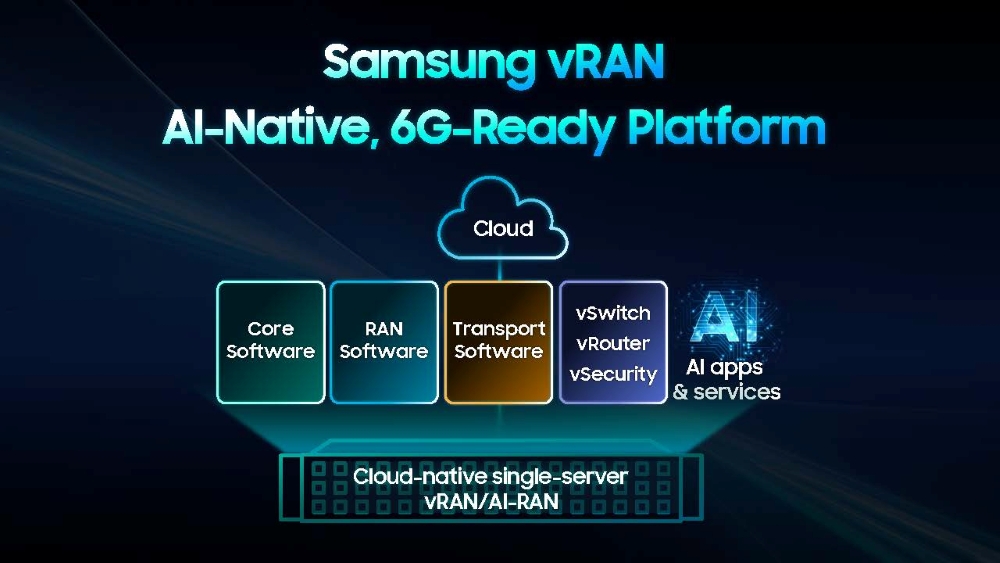
Image Credit: Samsung
“This breakthrough represents a major leap forward in network virtualization and efficiency. It confirms the real-world readiness of this latest technology under live network conditions, demonstrating that single-server vRAN deployments can meet the stringent performance and reliability standards required by leading carriers,” said June Moon, Executive Vice President, Head of R&D, Networks Business at Samsung Electronics. “We are not only deploying more sustainable, cost-effective networks, but also laying the foundation to fully utilize AI capabilities more easily and prepare for 6G with our end-to-end software-driven network solutions.”
Samsung’s vRAN leverages the latest Intel Xeon 6 SoC with Intel Advanced Matrix Extensions (Intel AMX), Intel vRAN Boost and up to 72 cores, delivering significant improvements in AI processing, memory bandwidth and energy efficiency compared to the previous generation.
“With Intel Xeon 6 SoC, featuring higher core counts and built-in acceleration for AI and vRAN, operators get the compute foundation for AI native, future ready networks,” said Cristina Rodriguez, VP and GM, Network & Edge, Intel. “This collaborative achievement with Samsung, HPE and Wind River enables greater consolidation of RAN and AI workloads, lowering power and total cost while speeding innovation.”
Samsung has been leading the deployment of vRAN solutions with major network operators worldwide and has achieved many industry breakthroughs, including the industry’s first call on a commercial network and large-scale deployments utilizing Intel Xeon processors with Intel vRAN Boost. The company continues to push the boundaries of network virtualization, working closely with ecosystem partners like Intel to deliver solutions that help operators build networks that are more efficient and sustainable.
“This successful first call is an important milestone for the industry,” said Daryl Schoolar, Analyst and Director at Recon Analytics. “By demonstrating multiple network functions running on next-generation processing technology, Samsung is showing what future networks look like — more cloud-native, more scalable and significantly more efficient. This achievement moves the industry beyond theoretical performance gains and into practical, deployable innovation that operators around the world can leverage to modernize their networks, accelerate automation and better support AI-driven use cases.”
“With Samsung’s vRAN and Intel’s Xeon 6 SoC running on a single server, Samsung expects enhanced cost savings for operators,” said a Samsung spokesperson via email to Light Reading, when asked what cost impact Granite Rapids would have. “The ability to consolidate multiple network functions including RAN, core, transport and security onto a single, high-performance COTS server reduces hardware footprint, simplifies site design and lowers power consumption.”
Vodafone is one Samsung customer that now expects to benefit from the availability of Granite Rapids. In November, Paco Pignatelli, Vodafone’s head of open RAN, told Light Reading that the new Intel platform offers “much better capacity and efficiency” than its predecessors. That was several weeks after the telco had announced plans to deploy Samsung’s virtual RAN technology in Germany and other European markets, starting in 2026.
…………………………………………………………………………………………………………………………………….
vRAN Market Assessment:
Virtual RAN still accounts for a very small share of the entire market. In 2023, data from Omdia put its market share at just 3% of the total RAN market which generates If vRAN is considered as part of the subsector for baseband RAN, its share was about 10% that year, implying baseband represents about 30% of the total expenditure on RAN products.
Hardware still dominates the RAN equipment business, but there is a rapid shift toward Commercial Off-The-Shelf (COTS) servers, particularly those using Intel’s Xeon 6 processors. Regional Dominance: North America and Asia-Pacific are expected to remain the largest markets in 2026, together accounting for over 70% of global vRAN revenue
- Dell’Oro Group:
- 2026 Stability: Predicts overall RAN revenues will remain “mostly stable” in 2026, but identifies AI-RAN, Cloud RAN, and Open RAN as favorable growth segments within that flat topline.
- Market Share: Expects vRAN to account for 5% to 10% of the total RAN market by 2026.
- Private Wireless: Forecasts that private wireless campus network RAN revenue will surpass USD 1 billion in 2026.
- Omdia:
- Growth Surge: Anticipates a doubling of vRAN’s market share by 2028. Specifically, it expects Open vRAN to reach a 16% share of the total RAN market in 2026, up from 7% in 2022.
- Automation Focus: Forecasts the Service Management and Orchestration (SMO) category to grow at a massive 99% CAGR through 2030 as operators align with O-RAN architectures.
- Research and Markets:
- Estimates the global Open RAN market size will reach between USD 5.0 billion and USD 10.0 billion by 2026, driven by aggressive greenfield deployments.
…………………………………………………………………………………………………………………………
References:
https://www.lightreading.com/5g/intel-and-samsung-add-to-pressure-on-purpose-built-5g
vRAN market disappoints – just like OpenRAN and mobile 5G
RAN silicon rethink – from purpose built products & ASICs to general purpose processors or GPUs for vRAN & AI RAN
LightCounting: Open RAN/vRAN market is pausing and regrouping
Dell’Oro: Private 5G ecosystem is evolving; vRAN gaining momentum; skepticism increasing
Heavy Reading: How network operators will deploy Open RAN and cloud native vRAN