

Direct-to-Device (D2D) satellite network comparison: Starlink V2 (Starlink Mobile) vs “Satellite Connect Europe”
Executive Summary:
1. Starlink is preparing a new Direct-to-Device (D2D) constellation to provide satellite fill-in services and has renamed their V2 D2D services as Starlink Mobile. This rebrand coincides with the introduction of their next-generation V2 satellites, which aim to provide 5G-like broadband speeds (up to 150 Mbit/s) directly to unmodified smartphones. With 650 direct-to-cell Starlink satellites active, part of a constellation of almost 10,000 Starlink satellites of various kinds, that roaming service now offers connectivity to 32 countries across six continents. Today, Starlink V1 D2D has 10 million active users a month – and the company expects to top 25 million by the end of 2026.
Where Starlink V1 delivers text and what Nicolls described as “light data,” meaning only for selected apps, Starlink V2 (Starlink Mobile) will deliver what was called “terrestrial-like connectivity.” In good conditions, “it should look and feel like you’re connected to a high-performing 5G terrestrial network.” To make that happen, V2 will need both new frequencies – the same globally-licensed S-band Starlink will use for emergency alerts – and new, much larger satellites.

Image Credit: ZUMA Press Inc/Alamy Stock Photo
………………………………………………………………………………………………………………
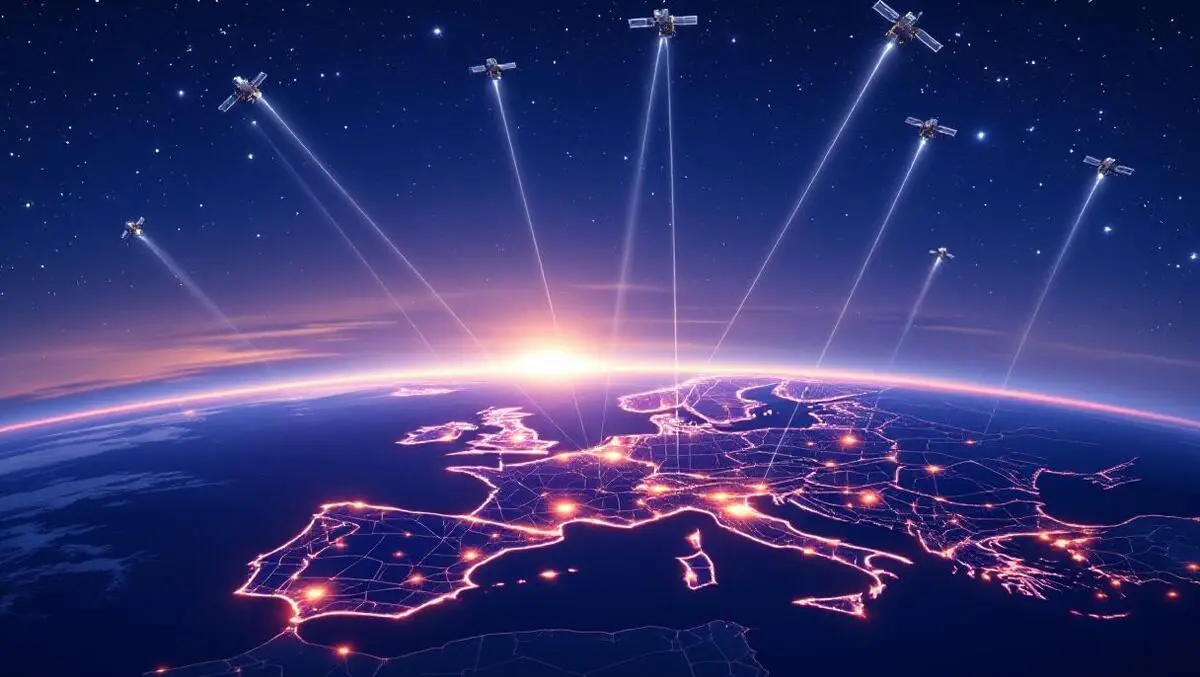
2. European operators have launched “Satellite Connect Europe“ to offer wholesale D2D services to mobile carriers. Satellite Connect Europe is actually a joint venture between AST SpaceMobile and Vodafone. It will primarily use satellites provided by AST SpaceMobile to offer direct-to-device (D2D) services in Europe. The venture is building a dedicated, sovereign European constellation, with plans to establish an operations center in Germany.
Five major mobile network operator groups will deploy D2D satellite mobile broadband services across Europe. The agreements cover CK Hutchison, Orange, Sunrise, Telefonica and Vodafone, with customer trials scheduled to start this summer (2026). The service is expected to launch around the end of 2026, with demonstrations planned in Romania before then.
Role of 3GPP NTN specifications:
Both of these initiatives are dependent on 3GPP-based non‑terrestrial networking (NTN) specs, introduced primarily in Release 17 and enhanced in Release 18 to enable direct satellite-to-device connectivity using 5G NR (new radio) and IoT (NB-IoT/eMTC) protocols. 3GPP detailed NTN specs include TR 38.821 (architecture), TS 38.101-5 (user equipment radio performance), and TS 38.104 (base station requirements), supporting LEO/GEO orbits and S/Ka-band spectrum.
-
3GPP Release 17 introduced NR‑NTN and IoT‑NTN profiles, defining waveform adaptations, timing and Doppler compensation, mobility procedures, and MSS band mappings so that satellite and terrestrial RANs interoperate under a single 5G system architecture. These NTN specs will be submitted to ITU-R WP 4B for rubber stamping as ITU-R recommendations (official standards).
-
Both the Starlink and Satellite Connect Europe/AST initiatives map their radio interfaces and mobility behavior to these NTN specifications over time, which should let future 5G devices with NTN support hand over natively between cell towers and satellites without custom stacks.
These two D2D initiatives differ in radio design, spectrum, and integration models with mobile operators which provide the actual end point connections as follows:
Starlink D2D technical details:
-
Starlink’s Direct‑to‑Cell satellites use software‑defined radios and large phased‑array antennas so each LEO satellite behaves like a moving LTE/NR macro cell in space.
-
Unlike standard Starlink Ku/Ka user terminals, the D2D layer transmits and receives in allocated terrestrial/mobile bands (roughly 800–2000 MHz) to talk directly to 3GPP LTE/NR chipsets in unmodified handsets, using TDD LTE initially.
-
The payload compensates for fast LEO motion (~550 km altitude, ~7.5 km/s) with Doppler pre‑correction and timing advance logic in the satellite SDR so that ordinary UE modems still see acceptable frequency and timing error.
-
Onboard beamforming and beam‑hopping allow very narrow spot beams and dynamic power control, which is critical to protect terrestrial networks sharing IMT spectrum and to deliver enough link budget for small handset antennas at long slant ranges.
-
Backhaul from the D2D layer uses Starlink’s existing Ku/Ka links and optical inter‑satellite links into the ground segment, so D2D traffic can be routed either to the MNO’s core via gateways or across the Starlink mesh to another region.
Service model and 3GPP spec alignment:
-
Starlink positions Direct‑to‑Cell as a “fill‑in” layer: SMS/low‑rate data first, then higher‑rate NR‑NTN services as 3GPP Release 17+ NTN features become available in commercial chipsets.
-
The network integrates at the EPC/5GC interface so MNOs can advertise satellite coverage as just another PLMN/RA, letting devices roam seamlessly between terrestrial eNB/gNBs and the Starlink NTN cells, subject to roaming and spectrum agreements.
Satellite Connect Europe D2D technology:
-
Satellite Connect Europe is a wholesale platform that exposes AST SpaceMobile’s LEO D2D satellite RAN to European MNOs, with ground stations in multiple EU markets providing regional gateways, traffic anchoring, and regulatory control within European jurisdiction.
-
AST’s constellation uses very large phased arrays in LEO to form direct 4G/5G broadband links to standard smartphones, targeting multi‑Mbps throughput per device over IMT and MSS spectrum, again without any handset hardware or software changes.
-
The ground segment is designed so that radio resource control, data handling, lawful intercept, and policy enforcement for European traffic all sit under EU‑based operational control, which is a key differentiator versus non‑European satellite operators.
-
Integration work with operators such as Telefónica and Orange focuses on core‑network interconnect, mobility management between terrestrial 4G/5G sites and satellite cells, and using D2D mainly for rural coverage and resilience in outages or disasters.
Comparison — Starlink vs Satellite Connect Europe:
References:
https://www.3gpp.org/technologies/ntn-overview
https://itbrief.co.uk/story/satellite-connect-europe-seals-five-mno-trial-deals
Non-Terrestrial Networks (NTNs): market, specifications & standards in 3GPP and ITU-R
ITU-R recommendation IMT-2020-SAT.SPECS from ITU-R WP 5B to be based on 3GPP 5G NR-NTN and IoT-NTN (from Release 17 & 18)
Starlink doubles subscriber base; expands to to 42 new countries, territories & markets
Elon Musk: Starlink could become a global mobile carrier; 2 year timeframe for new smartphones
Amazon Leo (formerly Project Kuiper) unveils satellite broadband for enterprises; Competitive analysis with Starlink
Blue Origin announces TeraWave – satellite internet rival for Starlink and Amazon Leo
From LPWAN to Hybrid Networks: Satellite and NTN as Enablers of Enterprise IoT – Part 2
Keysight Technologies Demonstrates 3GPP Rel-19 NR-NTN Connectivity in Band n252
Telecoms.com’s survey: 5G NTNs to highlight service reliability and network redundancy
China ITU filing to put ~200K satellites in low earth orbit while FCC authorizes 7.5K additional Starlink LEO satellites
NBN selects Amazon Project Kuiper over Starlink for LEO satellite internet service in Australia
GEO satellite internet from HughesNet and Viasat can’t compete with LEO Starlink in speed or latency