

IMT-2030
Oct 2026: PRELIMINARY DRAFT NEW ITU-R WP 5D REPORT: M.[IMT-2030.SUBMISSION]
Backgrounder:
At the closing plenary of the 53rd meeting of ITU-R WP 5D (on October 8, 2026 in Geneva, Switzerland), two IMT 2030 related documents were progressed and will be sent to SG 5 for approval in December 2026:
- Draft revision of Document IMT-2030/2 “Process” – Submission, evaluation process and consensus building for IMT-2030.
- [Preliminary] draft new Report ITU-R M.[IMT-2030.SUBMISSION] – Requirements, evaluation criteria and submission templates for the development of IMT-2030.
We cover the latter report in this article.
Introduction:
This ITU-R Report covers the minimum technical requirements, evaluation criteria and submission templates for the development of Recommendations and Reports on IMT-2030 (6G), such as the detailed specifications of IMT 2030, and provides:
- The service, spectrum and technical performance requirements for candidate Radio Interface Technologies (RITs)/Set of Radio Interface Technologies (SRITs) for IMT 2030;
- Evaluation guidelines including evaluation criteria and procedures to evaluate technology submissions for IMT-2030;
- Submission templates that proponents need to utilize to organize the information that is required in a submission of a candidate technology for evaluation. Proponents need to provide the required information. Details on this item is beyond the scope of this article.
–>Please see References at the bottom of this article for more information.
Scope:
This Report supports the submission and evaluation process for IMT-2030 initiated by Circular Letter 5/LCCE/115 and its Addenda. It addresses the minimum technical requirements, evaluation criteria, as well as submission templates required for a complete submission of RITs and/or SRITs for IMT 2030.
IMT-2030 minimum technical requirements:
The minimum technical requirements (also referred to as “minimum requirements” in this Report) established in this section relate to services, spectrum and technical performance aspects of IMT 2030. The intent of the requirements is to ensure that IMT-2030 technologies are able to fulfil the objectives of IMT-2030 and to set a specific level of performance that each proposed technology needs to achieve in order to be accepted within ITU-R for IMT-2030.
It is to be noted that the requirements are not intended to restrict the full range of capabilities or performance that candidate technologies for IMT 2030 might achieve, nor are they intended to describe how the IMT 2030 technologies might perform in actual deployments under operating conditions that could be different from those presented in ITU R Recommendations and Reports on IMT 2030. Furthermore, this Report is not intended to restrict the implementation details of IMT-2030 technology on the aspect of how to meet these requirements.
Also, IMT-2030 is expected to be built on overarching aspects, including sustainability, security and resilience, connecting the unconnected, and ubiquitous intelligence, which act as design principles commonly applicable to all usage scenarios as described in § 3 in Recommendation ITU-R M.2160. The proponents are encouraged to describe how the candidate RIT/SRIT incorporates these design principles in the description template in § 5.2.3.1, where applicable.
Services:
Recommendation ITU-R M.2160 – Framework and overall objectives of the future development of IMT for 2030 and beyond, envisions six usage scenarios for IMT-2030:
– Immersive communication (IC).
– Hyper reliable and low-latency communication (HRLLC).
– Massive communication (MC).
– AI and communication (AIAC).
– Integrated sensing and communication (ISAC).
– Ubiquitous connectivity (UC).
Diverse services and applications for the six usage scenarios are envisaged, as shown in Figure 1. in Recommendation ITU-R M.2160 (reproduced below).
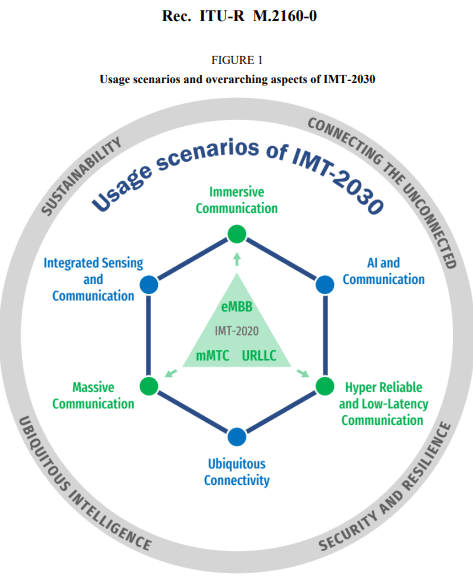
IMT-2030 RIT/SRIT shall support a wide range of services across different usage scenarios, for which the evaluation methodology is found in § 7.3.4 of Report ITU-R M.[IMT-2030.EVAL].
Spectrum:
The following frequency bands have been identified for the terrestrial component of IMT in the ITU Radio Regulations:
- 450-470 MHz (see No. 5.286AA of the Radio Regulations (RR))
- 470-698 MHz (see RR Nos. 5.295, 5.308A, 5.296A, 5.307A)
- 694/698-960 MHz (see RR Nos. 5.313A, 5.317A)
- 1 427-1 518 MHz (see RR Nos. 5.341A, 5.346, 5.341B, 5.341C, 5.346A)
- 1 710-2 025 MHz (see RR Nos. 5.384A, 5.388)
- 2 110-2 200 MHz (see RR No. 5.388)
- 2 300-2 400 MHz (see RR No. 5.384A)
- 2 500-2 690 MHz (see RR No. 5.384A)
- 3 300-3 400 MHz (see RR Nos. 5.429B, 5.429D, 5.429F)
- 3 400-3 600 MHz (see RR Nos. 5.430A, 5.431B, 5.432A, 5.432B, 5.433A)
- 3 600-3 700/3 800 MHz (see RR Nos. 5.434, 5.433B, 5.434B, 5.435B)
- 4 800-4 990 MHz (see RR Nos. 5.441A, 5.441B)
- 6 425-7 025/7 125 MHz (see RR Nos. 5.457D, 5.457E, 5.457F)
- 10-10.5 GHz (see RR No. 5.480A)
- 24.25-27.5 GHz (see RR No. 5.532AB)
- 37-43.5 GHz (see RR No. 5.550B)
- 45.5-47 GHz (see RR No. 5.553A)
- 47.2-48.2 GHz (see RR No. 5.553B)
- 66-71 GHz (see RR No. 5.559AA).
Technical performance:
Report ITU-R M.[IMT-2030.TECH PERF REQ] describes the key requirements related to the minimum technical performance for IMT 2030 candidate RIT and also provides information about the individual requirements for items and values chosen.
IMT-2030 evaluation:
Report ITU-R M.[IMT-2030.EVAL] provides guidelines for the procedure, the methodology and the criteria (technical performance, spectrum and service) to be used in evaluating the candidate IMT-2030 RITs/SRITs for a number of test environments. The evaluation procedure is designed in such a way that the overall performance of a candidate RIT/SRIT is fairly and consistently assessed on a technical basis. Candidate RITs or SRITs shall be evaluated according to the guidelines in Report ITU-R M.[IMT-2030.EVAL].
Criteria to be fulfilled by candidate RITs/SRITs: The process, the steps and the relevant timelines for the development of IMT-2030 are described in Document IMT-2030/2(Rev.1) – Submission, evaluation process and consensus building for IMT-2030. Additional specific details may be found on the ITU-R IMT-2030 web page under the link “Web page for the IMT-2030 submission and evaluation process.”
Development of candidate RITs/SRITs (Step 2):
The required criteria to be fulfilled by an RIT/SRIT are as follows:
An RIT shall fulfil the minimum requirements of at least six test environments comprising three test environments under IC, one test environment under MC, one test environment under HRLLC and one test environment under ISAC, as well as the minimum requirements of either UC or AIAC. An SRIT consists of a number of component RITs complementing and interworking with each other. Each component RIT shall fulfil the minimum requirements of at least four test environments comprising two test environments under IC, one test environment under either MC or HRLLC, and one test environment under ISAC, as well as the minimum requirements of either UC or AIAC. Together as an SRIT, it shall fulfil the minimum requirements of all seven test environments comprising the four usage scenarios IC, MC, HRLLC and ISAC, as well as the minimum requirements of either UC or AIAC.
……………………………………………………………………………………………………………………………………………………………
References:
https://www.itu.int/md/R00-SG05-CIR-0115/en
https://www.itu.int/dms_pubrec/itu-r/rec/m/R-REC-M.2160-0-202311-I!!PDF-E.pdf
https://www.itu.int/en/ITU-R/study-groups/rsg5/rwp5d/imt-2030/pages/default.aspx
ITU-R M.[IMT-2030.EVAL] & ITU-R M.[IMT-2030.SUBMISSION] reports: Evaluation & Submission Guidelines for 6G RIT/SRITs (6G)
ITU-R WP 5D Timeline for submission, evaluation process & consensus building for IMT-2030 (6G) RITs/SRITs
Perspective & Analysis of ITU-R Workshop on IMT-2030 (6G) terrestrial radio interfaces: February 10, 2027 in Geneva, Switzerland
IMT-2030 (“6G”) Minimum Technology Performance Requirements for Radio Interface Technologies
Sept 2026 3GPP meeting updates for 5G Advanced and 6G planning (with timeline for submisson to ITU-R WP 5D via ATIS)
Roles of 3GPP and ITU-R WP 5D in the IMT 2030/6G standards process
3GPP approves timelines for Release 21 which will specify 6G RAN, Core and 5G Advanced
Perspective & Analysis of ITU-R Workshop on IMT-2030 (6G) terrestrial radio interfaces: February 10, 2027 in Geneva, Switzerland
Executive Summary:
ITU-R WP 5D will hold a one-day IMT‑2030 Workshop in February 2027 during its 54th meeting (February 9-18, 2027 in Geneva, Switzerland). The tentative date of the workshop is February 10, 2027.
There will be presentations from independent evaluation groups, potential IMT-2030 terrestrial radio interface technology proponents, and WP 5D experts explaining the IMT-2030 process, requirements, and evaluation methodology and criteria.
Following the Recommendation ITU‑R M.2160, which defines the framework and overall objectives of the future development of IMT for 2030 and beyond, WP 5D has completed the following draft new Reports related to the IMT-2030 terrestrial radio interfaces:
- “Minimum requirements related to technical performance for IMT-2030 radio interface(s)” (Document 5/116).
- “Guidelines for evaluation of radio interface technologies for IMT-2030” (Document 5/119)
WP 5D is still working on the following draft new Report/revision of Document, which are expected to be completed in October 2026:
- “Requirements, evaluation criteria and submission templates for the development of IMT-2030.”
- Revision 1 of Document IMT-2030/2 on “Submission, evaluation process and consensus building for IMT-2030.”
From the 54th meeting of WP 5D in February 2027, Step 3 of the IMT-2030 developing process “Submission/Reception of the Radio Interface Technology (RIT)/Set of RIT (SRIT) proposals and acknowledgement of receipt” will start in accordance with Document IMT-2030/2(Rev.1). Therefore, in conjunction with the 54th meeting, WP 5D will be holding a workshop on IMT-2030 focusing on the terrestrial radio interfaces.
The objectives of the workshop are as follows:
- to provide information from WP 5D on the IMT-2030 development process, including minimum technical performance requirements and evaluation guidelines;
- to invite proponents of IMT-2030 RIT/SRIT to present current and future development aspects of their technologies;
- to invite registered independent evaluation groups to present information about their evaluation group and planned actions; and in particular;
- to facilitate dialogue between ITU-R WP 5D and potential proponents of technology and evaluation groups.
Further information on the invitation for submission of proposals for candidate radio interface technologies for the terrestrial components of the radio interface(s) for IMT-2030 and invitation to participate in their subsequent evaluation can be found in Add. 2 to Circular Letter 5/LCCE/115.
The IMT-2030 Workshop program can be found on the “Web page for the IMT-2030 submission and evaluation process” (under “Workshops on IMT-2030”). Parties interested in the workshop are kindly requested to check the website before the 54th WP 5D meeting, which includes further detailed information about the workshop registration.

………………………………………………………………………………………………………………………..
Perspective & Analysis:
The February 10, 2027 ITU-R workshop marks the practical launch of the IMT-2030 terrestrial radio-interface submission and evaluation phase (step 3). For the first time, candidate Radio Interface Technology (RIT) and Set of Radio Interface Technology (SRIT) will be submitted by proponents (e.g. 3GPP via ATIS).
ITU-R WP 5D will be moving from broad 6G vision-setting into a process in which proposed air interfaces must be documented, evaluated, compared, and eventually consolidated into the IMT-2030 family.
Recommendation ITU-R M.2160 established the high-level IMT-2030 framework. This workshop puts operational machinery around it. WP 5D has already completed draft reports covering minimum technical-performance requirements and radio-interface evaluation guidelines, while the remaining submission requirements, evaluation criteria, templates, and the revised IMT-2030/2 process document are expected to be completed in October 2026. That sequencing is significant: the rules and scoring framework should be substantially settled before candidates publicly explain how their technologies intend to meet them.
A standards-process checkpoint:
The agenda is structured around three constituencies whose interaction will determine the credibility of the IMT-2030 process:
-
WP 5D will explain the technical thresholds, evaluation methodology, submission procedures, IPR treatment, consensus-building process, and global-circulation steps.
-
Potential RIT/SRIT proponents will have an early opportunity to signal submission plans, technical maturity, and intended differentiators. The anticipated 20–30-minute slots imply substantive positioning rather than brief corporate announcements.
-
Independent evaluation groups will identify their participants, technical scope, modelling and simulation capabilities, and evaluation plans. Their role is central: an IMT process is more defensible when claims are reproducibly tested outside the submitting organizations.
The workshop therefore provides an early readout on a question that matters more than headline peak-rate claims: whether candidate 6G proposals can form a technically coherent, globally evaluable standard rather than a collection of regional or vendor-specific ambitions.
What to watch for:
The most revealing material is likely to be found in the gap between the performance requirements and proponent presentations. Watch for clarity on spectrum assumptions, channel models, deployment scenarios, energy efficiency, coverage, mobility, latency/reliability trade-offs, and implementation complexity. A credible candidate should explain not merely that it can meet an isolated target, but under which assumptions and with what architectural cost.
Equally important is the distinction between an RIT and an SRIT. An RIT is a candidate radio interface; an SRIT is a set of complementary radio interfaces. The SRIT construct gives the process flexibility to recognize that one uniform air interface may not be optimal across all future terrestrial operating conditions. But it also raises an interoperability and fragmentation test: any multi-component proposal must demonstrate a coherent system rationale rather than becoming a vehicle for aggregating incompatible technologies. The workshop’s dialogue between proponents and evaluators should expose how seriously that issue is being addressed.
Strategic implications:
For 3GPP and its ecosystem, the event should be viewed as an external ITU-R milestone rather than the moment when detailed specifications are invented. The commercial and technical center of gravity for a likely cellular submission will remain in the relevant standards-development work; however, ITU-R determines whether a candidate fits the global IMT-2030 framework and can achieve broad international recognition. The workshop creates a public forum for aligning those paths before formal evaluation hardens positions.
For operators and vendors, the event may reveal the balance that future IMT-2030 submissions strike between evolutionary cellular engineering and more ambitious 6G claims. Strong emphasis on measurable performance, transparent assumptions, and evaluator readiness would indicate process discipline. Conversely, presentations dominated by aspirational capabilities without testable evaluation paths would underscore that the technology is still pre-standard research rather than a mature candidate interface.
What Won’t Be Covered in this Workshop:
- IMT-2030 Frequency Arrangements are unknown. That topic can’t be discussed until after WR 27 – October 18 thru November 12, 2027 in Shanghai, China when the IMT-2030 frequencies will be specified.
- 6G core network architecture/specs will be exclusively done within 3GPP, with no ITU-R or ITU-T involvement.
…………………………………………………………………………………………………………………………………………………………..
References:
https://www.itu.int/en/ITU-R/study-groups/rsg5/rwp5d/Pages/ws-20270210.aspx
https://www.itu.int/en/ITU-R/study-groups/rsg5/rwp5d/imt-2030/pages/default.aspx
ITU-R WP 5D Timeline for submission, evaluation process & consensus building for IMT-2030 (6G) RITs/SRITs
Roles of 3GPP and ITU-R WP 5D in the IMT 2030/6G standards process
IMT-2030 (“6G”) Minimum Technology Performance Requirements for Radio Interface Technologies
ITU-R M.[IMT-2030.EVAL] & ITU-R M.[IMT-2030.SUBMISSION] reports: Evaluation & Submission Guidelines for 6G RIT/SRITs (6G)
Sept 2026 3GPP meeting updates for 5G Advanced and 6G planning (with timeline for submisson to ITU-R WP 5D via ATIS)
3GPP approves timelines for Release 21 which will specify 6G RAN, Core and 5G Advanced
ITU-R WP5D & 3GPP work schedules for development of IMT-2030 terrestrial radio interface (RIT/SRIT) recommendations
Explanation:
This post is an update of an IEEE Techblog published October 20, 2025. It also includes the 3GPP Release 21 timeline, which was previously published (see References below). This author expects that the proposed IMT 2030 RIT/SRIT specs submitted will be primarily from 3GPP (contributed to ITU-R WP5D by ATIS). However, any ITU member is invited to submit proposals.
ITU-R Working Party (WP) 5D Backgrounder:
WP 5D is responsible for the vision and overall system aspects of the terrestrial component of IMT, comprising IMT-2000, IMT-Advanced, IMT-2020 and IMT-2030; has the prime responsibility within ITU-R for issues related to the terrestrial component of IMT, including technical, operational and spectrum related issues to meet the objectives of current and future IMT systems; is the lead group for the overall maintenance of existing and the development of new Reports/Recommendations on IMT; is responsible for studies related on aspects supporting the evolving deployment of IMT including aspects such as regulatory impacts and operational matters within the purview of Study Group (SG) 5; will continue to work closely with Working Parties 4B and 4C on issues related to the satellite component of IMT; will continue to work closely with other Working Parties on issues relevant for IMT systems; for the study period between WRC-23 and WRC-27, WP 5D has the lead responsibility for the preparatory work on WRC-27 agenda item (AI) 1.7 and collaborates closely with WP 4C on agenda item 1.13 and in particular WP 5D will perform those studies on agenda item 1.13 that were assigned to WP 5D by CPM27-1.
IMT 2030 (6G) Backgrounder:
- Resolution ITU-R 65-1 on the “Principles for the process of future development of IMT-2020 and IMT-2030” outlines the essential criteria and principles that will be used in the process of developing the Recommendations and Reports for IMT-2020 and IMT-2030, including Recommendation(s) for the radio interface specification.
- Recommendation ITU-R M.2160, “Framework and overall objectives of the future development of IMT for 2030 and beyond” identifies six usage scenarios for IMT-2030 and envisions a broad variety of capabilities, tightly coupled with intended usage scenarios and applications for IMT-2030, resulting in a great diversity/variety of requirements. Recommendation ITU-R M.2160 also identifies the capabilities of IMT-2030, recognizing that they will have different relevance and applicability for the different use cases and scenarios addressed by IMT-2030, some of which are currently not foreseen. In addition, IMT-2030 can be applied in a variety of scenarios, and therefore different test environments are to be considered for evaluation purposes.
- A test environment is defined as the combination of usage scenario and geographic environment as described in Report ITU-R M.[IMT-2030.EVAL].
- IMT-2030 Minimum Technology Performance Requirements for Radio Interface Technologies is a report which outlines 20 technical performance requirements (TPR). Seven of them are new and specific to describe the 6G performances. Those IMT 2030 technical performance requirements will be used as unified requirements to evaluate the 6G radio interfaces (RITs/SRITs).
- WP 5D completed the draft IMT-2030 minimum technical performance requirements in February 2026 and the draft evaluation guidelines in June 2026. Both have been submitted to ITU-R Study Group 5 for approval in December 2026.
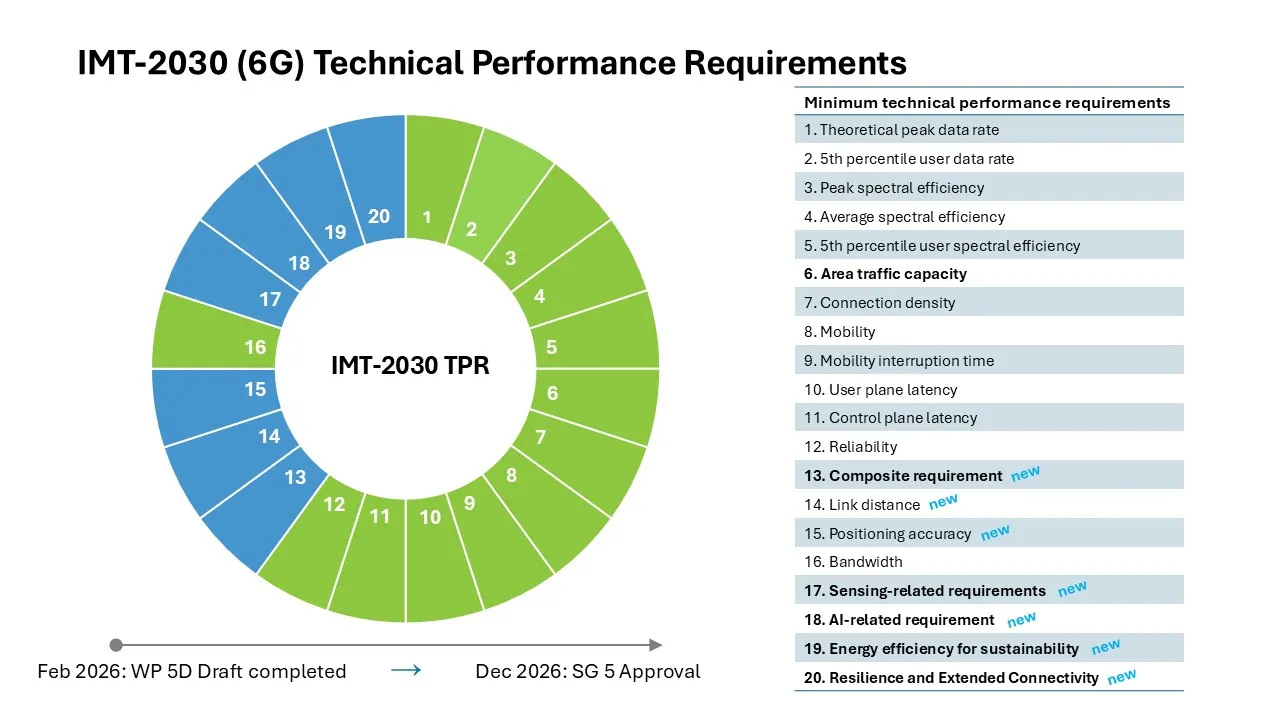
Image Credit: ITU-R WP5D
………………………………………………………………………………………………………………………………………………………………………………………………
ITU-R WP 5D Work Plan for IMT-2030 RIT/SRITs:
Submission of IMT 2030 RIT/SRIT proposals will begin at 54th meeting of Working Party (WP) 5D (currently planned for February 2027). The final deadline for submissions is 12 calendar days prior to the start of the 59th meeting of WP 5D in February 2029. The evaluation of the proposed RITs and SRITs by the independent evaluation groups and the consensus-building process will be performed throughout this time period and thereafter. The detailed schedule and development process are shown in the two figures below.
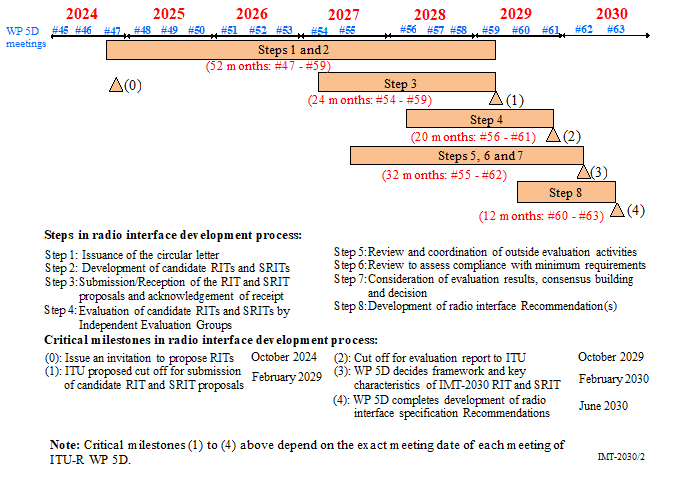 ………………………………………………………………………………………………………………………………………………………………………………
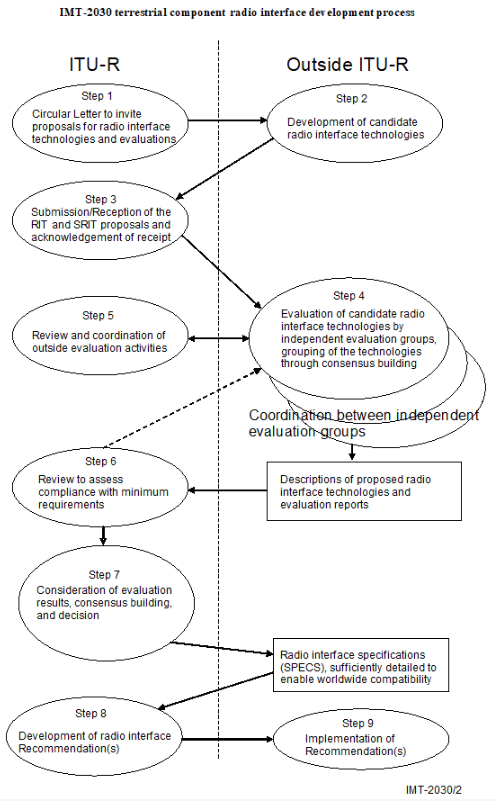
……………………………………………………………………………………………………………………………………………………………………….
Follow on Process for IMT-2030 Final Approval (author’s conjecture):
- The IMT 2030 RIT/SRITs development are scheduled to be completed at WP5D Meeting #63 in June 2030.
- At the next 5D meeting (#64), likely to be in October 2030 (but not yet scheduled), any draft revisions and specification updates will be reviewed and finalized.
- Following completion in WP 5D, the draft IMT 2030 RIT/SRITs and IMT 2030 Frequency Arrangements [1.], recommendations would proceed to ITU-R SG5 (Terrestrial Services) for adoption and then approval under the applicable ITU-R procedure. The dates and approval route remain to be confirmed. However, final approval is likely to be in November or December of 2030.
Note 1: These two IMT 2030 companion recommendations should be finalized and approved as a package (that didn’t happen with IMT 2020 because the ITU-R M.1036-7 Frequency Arrangements recommendation was approved after ITU-R M.2150 was finalized and approved).
………………………………………………………………………………………………………………………………………………………………………………………………
3GPP Release 21 (6G)Timeline:
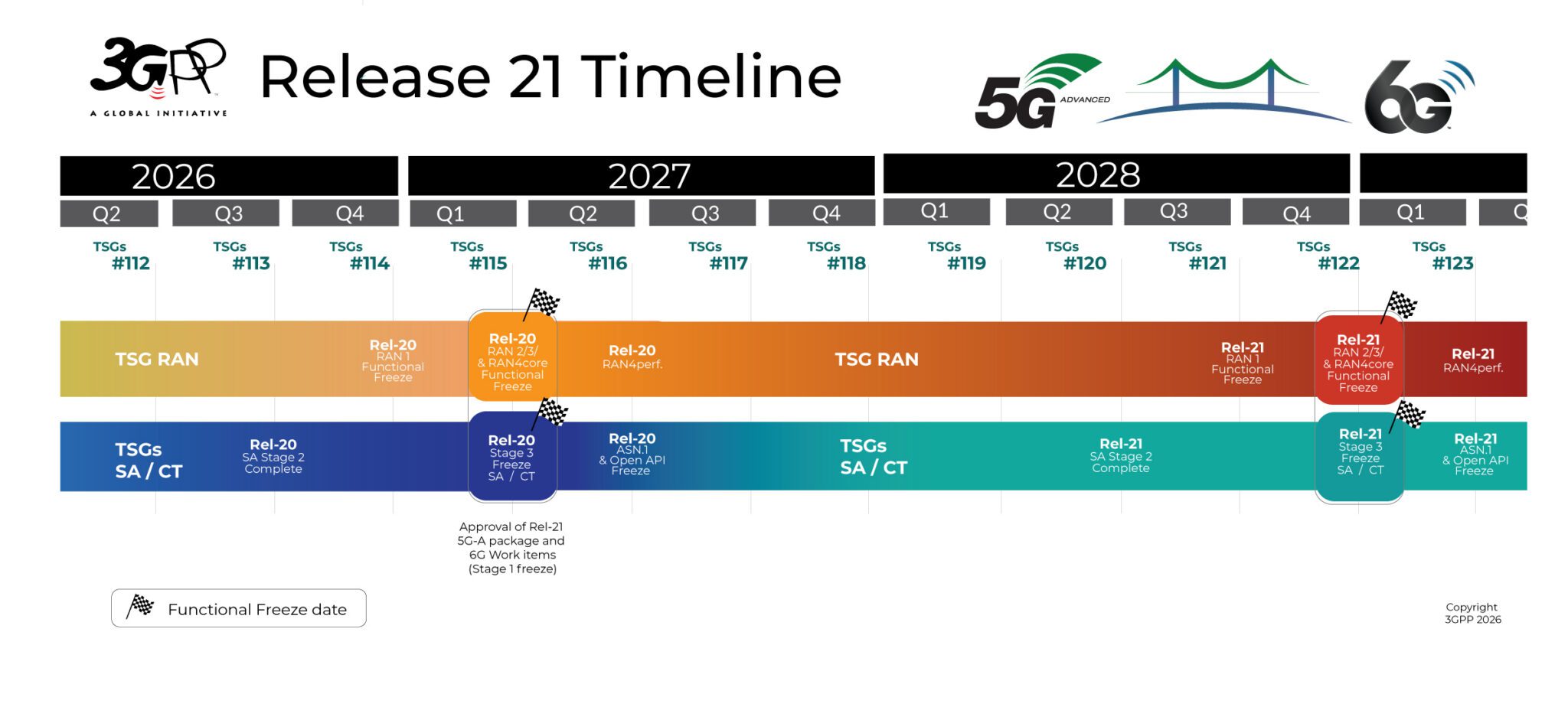
The crucial ITU-R/3GPP schedule relationship:
Here is how the ITU-R submission deadline relates to the 3GPP Release 21 freeze:.
…………………………………………………………………………………………………………………………………………………………….
References:
https://www.itu.int/en/ITU-R/study-groups/rsg5/rwp5d/imt-2030/pages/default.aspx
ITU-R WP 5D Timeline for submission, evaluation process & consensus building for IMT-2030 (6G) RITs/SRITs
Roles of 3GPP and ITU-R WP 5D in the IMT 2030/6G standards process
IMT-2030 (“6G”) Minimum Technology Performance Requirements for Radio Interface Technologies
ITU-R M.[IMT-2030.EVAL] & ITU-R M.[IMT-2030.SUBMISSION] reports: Evaluation & Submission Guidelines for 6G RIT/SRITs (6G)
Sept 2026 3GPP meeting updates for 5G Advanced and 6G planning (with timeline for submisson to ITU-R WP 5D via ATIS)
3GPP approves timelines for Release 21 which will specify 6G RAN, Core and 5G Advanced
Warning: 6G core network must not repeat the 5G SA 3GPP architecture specs vs lack of interoperable standards
FCC plans 6G spectrum auctions before IMT 2030 frequencies have been identified and without a 6G frequency arrangement standard
How NTIA “Call to Action for 6G Leadership and Security” might influence 6G/IMT-2030 standards and 3GPP specifications
Comparing AI Native mode in 6G (IMT 2030) vs AI Overlay/Add-On status in 5G (IMT 2020)
AI-Native 6G RAN in Practice: Research and Validation Insights from 6G-MIRAI-HARMONY
Warning: 6G core network must not repeat the 5G SA 3GPP architecture specs vs lack of interoperable standards
Introduction:
As the global telecom ecosystem pivots from 5G/IMT 2020 towards normative studies for IMT-2030 (6G) in 3GPP Release 20 and Release 21, the air interface (IMT 2030 RIT/SRITs forthcoming recommendation) naturally commands the spotlight. Discussions are dominated by IMT 2030 Technical Performance Requirements like sub-millisecond latencies, Integrated Sensing and Communication (ISAC), and AI-native physical layers. Yet network architects must confront a sobering historical reality: a brilliant radio access network is utterly paralyzed without a functional, universally interoperable core network.
If the telecom industry intends to realize the true commercial and operational promises of 6G, we must urgently dismantle the architectural precedent set during the 5G Standalone (SA) core (lack of) standardization cycle. By bypassing traditional global transport gatekeepers and prioritizing abstract logical modeling over concrete implementation realities, the industry traded the promise of an open, multi-vendor cloud ecosystem for a return to legacy vendor lock-in.
The ITU-T Bypass and the 5G SA Core Network Standardization Gap:
The fragmentation of the 5G SA core network can be traced directly to a structural and geopolitical power struggle.
- Historically, ITU-T Study Group 13 held the global mandate for establishing international standards for non-radio, architectural, and transport layers of all next generation networks. This governance ensured deep multi-vendor interconnectivity and data-plane uniformity across sovereign networks.
- During the development of the 5G Service-Based Architecture (SBA), 3GPP effectively insulated the core network design from ITU-T oversight. 3GPP executives told this author that they did not trust ITU-T to generate the 5G core network standards.
- Instead, the 3GPP specifications (such as TS 23.501 and TS 23.502) were kept entirely in-house and on completion were rubber-stamped by ETSI, 3GPP’s venue host. While this bypass accelerated time-to-market, it created a catastrophic standards-to-implementation gap. 3GPP defined network functions—such as the Access and Mobility Management Function (AMF), Session Management Function (SMF), and User Plane Function (UPF)—as highly abstract, logical blocks.
- While the control plane mandated modern tools like HTTP/2 and RESTful OpenAPIs, this framework merely established interface syntax. It completely omitted the exhaustive behavioral guardrails, edge-case definitions, and low-level realization mechanics required to build a production-ready, cloud-native core. That disconnect led to different network operator implementations of the 5G SA Core, depending on the vendor(s) they selected.
The Illusion of Interoperability:
The practical consequence of this abstraction is well known to any tier-1 network operator that has attempted a multi-vendor 5G SA core network deployment. On paper, the 5G SBA is modular. In reality, an operator cannot reliably procure an AMF from Vendor A, an SMF from Vendor B, and a UPF from Vendor C, connect them via standard 3GPP interfaces, and achieve a stable, carrier-grade network. The specifications are simply too loose.
Crucial underlying implementation details—such as cloud-native container orchestration pipelines, state database synchronization, database persistence layers, and hardware-accelerated UPF data planes—were left entirely outside the scope of the standard. To fill this vacuum, major infrastructure vendors engineered proprietary software logic beneath the “open” APIs. Consequently, multi-vendor core deployments required immense, custom, and cost-prohibitive systems integration efforts. For most operators, the path of least resistance was a return to single-vendor silos.
When 3GPP kept the Service-Based Architecture (SBA) work entirely in-house, they defined the network functions (like AMF, SMF, and UPF) as abstract, logical blocks rather than concrete blueprint specifications:
-
- The Interface Gap: 3GPP dictated the use of HTTP/2 and RESTful OpenAPIs for the control plane. While that sounds open, it merely defined the syntax, not the exhaustive behavior required when edge cases or multi-vendor implementations collided.
- No Implementation Blueprint: Crucial components required to construct an actual, production-ready 5G SA core—such as cloud-native container orchestration pipelines, underlying state database synchronization, database persistence layers, and low-level User Plane Function (UPF) acceleration mechanics—were entirely omitted.
The Practical Outcome: A Return to Vendor Lock-In:
Because 3GPP’s architectural specs lacked concrete realization guidelines and strict inter-vendor edge-case definitions, a major interoperability gap emerged:
- Custom Customization: An operator cannot realistically buy an AMF from Vendor A, an SMF from Vendor B, and a UPF from Vendor C, plug them together over standard 3GPP interfaces, and expect a stable network. The specs are too loose.
- The “Joint Specification” Reality: In practice, every major 5G SA core deployed requires extensive, customized, and often proprietary software engineering ironed out directly between the wireless operator and a single primary core vendor (such as Huawei, Ericsson, or Nokia).
- Network Slicing Disarray: This gap severely crippled Network Slicing. While 3GPP authored elegant logical diagrams for end-to-end network slicing, the absolute lack of unified, cross-domain transport realization standard meant that slicing remained confined to single-vendor testbeds and highly customized, non-scalable deployments for years.

Source: Siarhei Yurchanka/Alamy Stock Photo
The Warning Signs for IMT-2030:
As we look ahead to 6G and IMT 2030 recommendations, the ITU-T remains largely sidelined from mobile core network architecture. 3GPP operates as the de facto absolute authority on both the radio and the cloud core stack. If left uncorrected, the structural loop will repeat. 3GPP will deliver an idealized, highly complex, AI-driven 6G core architecture on paper, leaving actual functional implementations to be sorted out via proprietary vendor middleware.
From Google Gemini – The 6G Structural Reality: Architecture vs. Implementation:
| Architectural Layer | 5G SA Failure Mode | The Emerging 6G Risk (Release 20/21) |
|---|---|---|
| Cloud & Infrastructure | Omitted database persistence and state synchronization protocols, causing proprietary vendor lock-in at the cloud-native layer. | Identical Risk: 3GPP is treating the underlying cloud platform as a commodity runtime, assuming external IT standards will solve real-time carrier-grade orchestration. |
| Artificial Intelligence | Missing real-time data frameworks; AI additions in 5G-Advanced were largely siloed vendor plug-ins. | Algorithmic Lock-in: 6G introduces native AI Agents and Core Intelligence layers. If 3GPP fails to rigidly specify AI model interchange formats and deterministic agent-to-agent telemetry, an operator will not be able to swap out one vendor’s AI network optimization engine for another. |
| Radio Access Network (RAN) | Intended to be open, but standardizing true multi-vendor functionality was deferred to external groups like the O-RAN Alliance. | Ongoing Friction: Infrastructure giants are actively debating whether to limit new interface definitions to prevent the “integration burden” of multi-vendor deployments, while others push for mandatory lower-layer splits. |
……………………………………………………………………………………………………………………………………………………………………………………………..
Light Reading reports, that there are currently three competing 6G core architectures within 3GPP, which threatens to splinter their specs for 6G core networks. Most network operators prioritize affordable evolution, but debates over who controls device intelligence and revolutionary design risk causing divergence. Two fundamental points have emerged: how to handle or embed AI functionality and what to do with non-access stratum (NAS) signaling. NAS is the secure signaling pipeline between the device and core network, handling authentication, encryption, mobility management and session setup. Mobile architectures have relied on it as a foundational pillar since 2G (GSM), embedding it in device baseband silicon and SIM security frameworks.
Reworking NAS requires modem redesign, core security procedure overhaul and device backward-compatibility planning. Inside 3GPP SA2, the study phase has identified three candidate directions for the core network (based on AI functionalities):
- Direction 1 – Separate AI domain: A dedicated AI domain for intent handling independent of the packet-switched network, with the AMF routing NAS signaling while AI fulfillment occurs via SBI; backed by Nokia, T-Mobile USA, Verizon, NVIDIA, Deutsche Telekom, Apple, Qualcomm, Ericsson and NEC, though implementation requires complex UE AI domain client integration.
- Direction 2 – AI functionality in 6G NFs approach: Integrates AI through dedicated 6G network functions following standardized 3GPP procedures with flexible NAS routing (standalone or combined with core functions like AMF); supported by NTT DOCOMO, Samsung, LG Electronics, NEC, IIT Bombay, Vodafone, Apple and China Telecom (partly).
- Direction 3 – AI/agent-handled connectivity approach: Deeply integrates AI/agents into network procedures with dynamic coordination of capabilities and tool invocation, utilizing a signaling routing function (SRF) independent of AMF with user/control plane integration; aligned with Huawei, HiSilicon, China Mobile, ZTE, vivo, CATT, ETRI, Ewha Womans University and OPPO (partly), though it introduces high procedural disruption.
Of these three paths, the first (Direction 1, separate AI domain) has gained the most traction among Western operators and vendors (T-Mobile USA, Verizon, Deutsche Telekom, Nokia, Ericsson, NEC, NVIDIA and, to some extent, Apple). Anchoring the core to the 5G service-based architecture (SBA) interface preserves 5G core investments while letting intent handling mature alongside existing services. However, choosing a direction without standardizing the underlying AI Model Interchange Formats or Agent-to-Agent telemetry will create a brand new flavor of proprietary vendor lock-in.
Conclusions & Engineering Mandates for the 6G Core:
To prevent an amplification of the 5G SA core interoperability deficit, the global engineering community must pivot away from abstract logical modeling. If 3GPP selects an architectural path for IMT-2030 without standardizing the deep execution and semantic layers, we will simply replace legacy infrastructure silos with an unmanageable layer of proprietary AI middleware.
We must advocate for four critical shifts in our approach to 6G core network standardization:
- Mandate Behavioral, State, and Data Realization: Future core specifications must move beyond simple API syntax definitions and logical block diagrams. 3GPP must explicitly standardize end-to-end state-machine behaviors, cross-vendor error-handling conditions, and database synchronization baselines—specifically defining the realization mechanics for stateless network functions and the Unstructured Data Storage Function (UDSF) layer across multi-vendor boundaries.
- Standardize AI Semantic Frameworks and Agent Telemetry: Choosing a 6G core direction without anchoring it to open, deterministic data layers will trigger an unprecedented form of algorithmic vendor lock-in. Standards must rigidly define AI Model Interchange Formats, intent-handling taxonomies, and Agent-to-Agent telemetry protocols. If an autonomous agent invokes a tool or alters network routing dynamically, its procedural boundary conditions must be universally verifiable across competing vendor stacks.
- Bridge the Transport and Cloud-Native Infrastructure Void: 3GPP must abandon its isolationist posture and actively co-author implementation blueprints with open-source infrastructure bodies (such as the Linux Foundation’s telecom initiatives and the Cloud Native Computing Foundation). Specifications must establish standardized, open baselines for underlying container orchestration, state-data persistence, and low-level user-plane hardware acceleration using eBPF (Extended Berkeley Packet Filter) or DPDK (Data Plane Development Kit) architectures.
- Prioritize Cross-Domain Transport Mapping from Day One: Inter-operator roaming and cross-domain networking cannot be treated as downstream implementation details or left to bilateral vendor agreements. 3GPP must natively bake the mapping mechanics between mobile network slices (S-NSSAI) and IETF-defined transport network layers (such as Segment Routing over IPv6 – SRv6) directly into the initial 6G core architecture.
If 6G is to debut as a truly transformative, global platform rather than an incremental upgrade to radio spectral efficiency, we must bridge the chasm between paper standards and software reality. The architecture of the 6G core must be built from its inception for actual cloud realization, absolute multi-vendor interoperability, and rigorous operational clarity. We cannot afford another ghost in the machine.
If 6G is to be a truly transformative global platform rather than an incremental upgrade to radio efficiency, we must bridge the gap between paper standards and software reality. The architecture of the 6G core must be built for actual realization, true multi-vendor interoperability, and absolute operational clarity. We cannot afford another ghost in the machine like we had with the 5G SA core network specs.
References:
https://www.lightreading.com/6g/the-6g-core-divide
https://techblog.comsoc.org/2024/12/18/5g-network-slicing-progress-report-with-a-look-ahead-to-2025/
Building and Operating a Cloud Native 5G SA Core Network
Evaluating Gaps and Solutions to build Open 5G Core/SA networks
Omdia’s 2025 Mobile Core Network Leaders: Huawei #1 in market share; Nokia #1 for portfolio competitiveness
Telco investments in mobile core networks surge 83% in 2025-Q4, but what about ROI?
Téral Research: 5G SA core network deployments accelerate after a very slow start
Dell’Oro: RAN market stable, Mobile Core Network market +14% Y/Y with 72 5G SA core networks deployed
Sept 2026 3GPP meeting updates for 5G Advanced and 6G planning (with timeline for submisson to ITU-R WP 5D via ATIS)

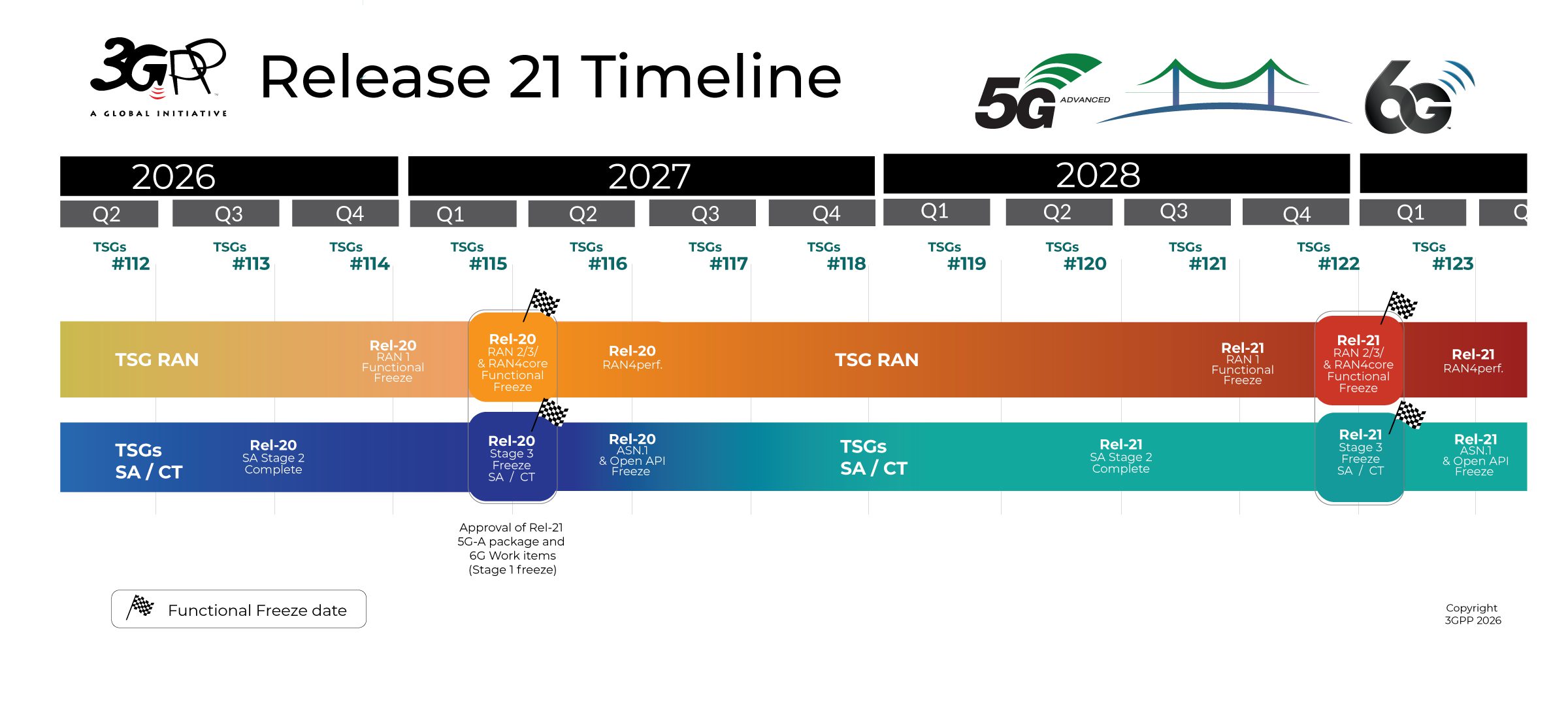
- 100% Stage 2 Freeze: The primary technical output for Release 20 was hitting the 100% completion target for Stage 2 (System Architecture). This officially locks down the architectural aspects for 5G Advanced next wave, transitioning the bulk of execution entirely to Stage 3 protocol and core implementation.
- 6G Dual Connectivity Way Forward: Delegates finalized critical deployment decisions regarding how 6G will integrate with existing infrastructure. Focus solidified around Option 1 (6G-anchored dual connectivity with 5G NR) and Option 3 (Dual stack, no RAN-level aggregation).
- Multi-RAT Spectrum Sharing (MRSS): RAN1 delivered its highly anticipated MRSS preliminary performance evaluation. This evaluates the overhead costs of operators running 5G and 6G simultaneously on the same frequencies, safeguarding migration investments.
- Use Cases and Services: Deepened studies into Integrated Sensing and Communications (ISAC), native AI/ML network applications, and ubiquitous connectivity (“anywhere to everywhere”).
- Radio Advancements: Maturation of the 6G RAN study on Scenarios and Requirements (TR 38.914), steering the industry closer to initial physical layer specifications.
……………………………………………………………………………………………………………………………………………………………….
-
- Dual Connectivity Framework: Delegates officially locked down the deployment pathways for the first phase of 6G. They established a clear consensus favoring Option 1 (6G-anchored dual connectivity with 5G NR) and Option 3 (Dual stack/independent radio lines), settling intense architectural debates on how 6G will overlay on 5G infrastructure.
- MRSS Performance Baseline: RAN1 finalized its preliminary performance evaluations for Multi-RAT Spectrum Sharing (MRSS). This technical milestone establishes the exact overhead margins required to run 5G and 6G simultaneously on legacy bands, preventing spectral efficiency loss during the transition.
- TR 38.914 Technical Alignment: The radio groups finalized the foundational baseline for the Radio Scenarios and Requirements report (TR 38.914), updating propagation channel models to explicitly match the new spectrum ranges targeted for initial Release 21 designs.
- ISAC Requirements Progression: SA2 finalized early system-level flows for Integrated Sensing and Communications (ISAC), formalizing how a 6G network will dynamically allocate base station radio energy to double as radar mapping infrastructure.
-
- Initial Framework Alignment (Mid-2027): ATIS will submit the early Release 21 architectural structures and capability definitions resulting from these choices to the 55th meeting of WP 5D. This acts as an initial informational contribution to show compliance with the IMT-2030 (6G) Framework.
- Formal Candidate Technology Submission (Late 2028 / Early 2029): Once these 2026 foundational agreements are fully written into frozen protocol code during the December 2028 Stage 3 Freeze, ATIS will package them into a formal “Candidate RIT (Radio Interface Technology)” proposal.
- The Absolute Cutoff: This complete compliance package and its accompanying technical self-evaluation will be submitted directly ahead of the 59th meeting of WP 5D in February 2029, which is the final deadline for IMT-2030 candidate evaluations.
References:
https://www.3gpp.org/news-events/3gpp-news/ran113-reports
https://portal.3gpp.org/?tbid=373&SubTB=373#/
Roles of 3GPP and ITU-R WP 5D in the IMT 2030/6G standards process
Comparing AI Native mode in 6G (IMT 2030) vs AI Overlay/Add-On status in 5G (IMT 2020)
ITU-R WP5D IMT 2030 Submission & Evaluation Guidelines vs 6G specs in 3GPP Release 20 & 21
ITU-R M.[IMT-2030.EVAL] & ITU-R M.[IMT-2030.SUBMISSION] reports: Evaluation & Submission Guidelines for 6G RIT/SRITs (6G)
ITU-R WP5D invites IMT-2030 RIT/SRIT contributions
How NTIA “Call to Action for 6G Leadership and Security” might influence 6G/IMT-2030 standards and 3GPP specifications
NGMN issues ITU-R framework for IMT-2030 vs ITU-R WP5D Timeline for RIT/SRIT Standardization
IMT-2030 (“6G”) Minimum Technology Performance Requirements for Radio Interface Technologies
IMT-2030 Technical Performance Requirements (TPR) from ITU-R WP5D
FCC plans 6G spectrum auctions before IMT 2030 frequencies have been identified and without a 6G frequency arrangement standard
Executive Summary:
Federal Communications Commission (FCC) Chairman Brendan Carr said Wednesday that a series of planned wireless-spectrum auctions could generate more than $100 billion in proceeds over the next several years. In July, the FCC voted to conduct a 2027 auction of 160 megahertz of mid-band spectrum in the Upper C-Band (3.98–4.2 GHz), creating a contiguous “super band” of over 440 megahertz.
Mr. Carr said the agency is also preparing three additional auctions targeting pipeline bands such as 1.6 GHz, 2.7 GHz, 4.4 GHz, and 7 GHz for 6G commercial use. The FCC has formally notified stakeholders of those plans and is targeting completion of all four auctions by the end of 2028.
Carr said demand for licensed spectrum extends beyond the three national mobile network operators—AT&T, Verizon, and T-Mobile, which collectively provide nearly all U.S. mobile service. He said the planned auctions could broaden participation in the wireless ecosystem and promote additional competition. “We’re seeing real response in the market in ways that we didn’t see just a couple of years ago,” Carr said.
–>We sincerely doubt that after Dish Wireless’ spectaular 5G O-RAN failure!
The FCC’s auction strategy follows several high-profile spectrum transactions. In May, the agency approved EchoStar’s $40 billion sale of wireless-spectrum assets to SpaceX, AT&T, and Verizon. It also approved Verizon’s 2024 $1 billion transaction to acquire selected spectrum assets from U.S. Cellular.
SpaceX acquired spectrum to support Starlink’s direct-to-device service and other satellite-enabled connectivity offerings. Last week, the FCC said it was advancing efforts to make additional spectrum available for space-based broadband services. The agency had previously approved SpaceX’s plan to deploy thousands of additional satellites intended to support next-generation mobile services and broadband speeds of up to 1 Gbit/s.
The Trump administration said Friday that it is laying the policy and regulatory groundwork for multiple 6G-focused spectrum auctions in 2028. The FCC is accelerating its spectrum-auction agenda in response to rapid growth in wireless demand and emerging applications, including artificial intelligence workloads, autonomous vehicles, connected sensors, and other advanced connectivity use cases.
“It’s more competition. It drives prices down for consumers. It raises money for the Treasury,” Carr said, noting that a prior auction raised funds to replace Chinese gear in U.S. networks that raised national security concerns.
The planned auctions come as mobile-data demand continues to increase, albeit at a slower rate. CTIA, the wireless-industry association, reported that U.S. consumers used 159.3 trillion MB of mobile data in 2025, a 20% increase from 2024. CTIA also said AI-related traffic is growing at roughly three times the rate of conventional wireless traffic and could account for nearly one-third of all broadband traffic by 2034.
Nokia’s 6G Spectrum Vision:
From a regulatory perspective, IMT’s identification of new spectrum in the extended mid-band will be vital for the industry, as it can enable global or regional harmonization, provide regulatory certainty for technological investments in the ecosystem, and create economies of scale for faster development and broader adoption.

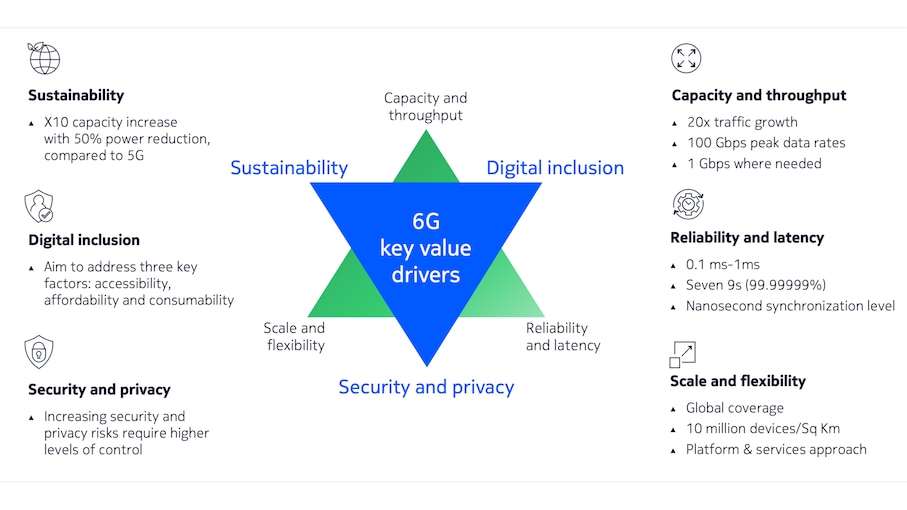
Nokia on 6G Drivers:
Analysis- What the FCC is Totally Missing:
What the FCC’s 6G auction planning appears to overlook is the international spectrum-harmonization timeline. The FCC’s accelerated 6G auction agenda risks getting ahead of the global standards and spectrum-harmonization process. Frequency bands for 6G, formally addressed by the ITU as IMT-R-2030, will not be identified at the international level until the ITU-R World Radiocommunication Conference 2027 (WRC-27) which will take place in Shanghai, China, from October 18 to November 12, 2027.
Starting at ITU-R WP 5D meeting #57, which takes place in Jan/Feb 2028, 5D will start to develop IMT-2030 frequency arrangements for the designated bands identified at WRC-27. Those frequenc arrangements are vitally important because they establish the technical basis for globally or regionally harmonized use of spectrum, including band plans and deployment approaches that support equipment interoperability, scale, and international roaming. They should greatly simplify IMT 2030 roaming between carriers that use the same 6G frequency bands.
As a result, auctioning spectrum specifically characterized as “6G” before that process is complete could force U.S. policy ahead of the eventual international framework. The FCC can prepare candidate bands, study sharing and coexistence conditions, and develop auction authority and rules in advance, but it cannot yet know which bands will ultimately receive broad international support for IMT-2030.
Importance of a 6G Frequency Arrangements Standard:
The explicit purpose of this ITU-R recommendation (international standard) is to guide administrations in selecting transmitting and receiving frequency arrangements for terrestrial IMT and to promote efficient spectrum use.
Core functions of IMT frequency arrangements:
In summary, IMT frequency arrangements do considerably more than identify whether a band uses FDD or TDD. They define the uplink and downlink frequency blocks, duplex direction, duplex separation, center gap, carrier-pairing relationships, usable sub-band segmentation, and alternative arrangements needed to translate an IMT identification into an interoperable and commercially deployable spectrum plan.
A Very Bad Omen from ITU-R WP5D – 2.8 Year Gap Between IMT 2020 Co-Recommendations M.2150-0 and M.1036-7:
One should not equate a WRC-27 IMT frequency identification with a completed 6G spectrum standard. The IMT-2020 precedent is highly instructive: after WRC-19 identified new 5G bands, ITU-R WP 5D did not complete the corresponding ITU-R M.1036 frequency arrangements recommendation on the same timetable as the IMT-2020 RIT/SRIT specification. despite being a co-requisite standard. The ITU-R M.2150-0 radio-interface recommendation (IMT 2020 RIT/SRIT) was approved and published on February 1, 2021, while the internationally agreed IMT 2020 frequency band (M.1036-7) recommendation wasn’t approved until December 13, 2023. [All versions of ITU-R M.1036 (IMT 2020 frequency arrangements) are available for download here.]
For over two and 10 months, 5G (IMT-2020 RIT/SRIT ) was actively deployed globally without a finalized, globally harmonized UN/ITU-R standard for its internationally specified frequency arrangements (specifically the mmWave bands designated by WRC-19). During that interval, the formal 5G radio-interface standard existed, but the internationally agreed spectrum-arrangements framework remained incomplete for the major new WRC-19 IMT 2020 frequency bands. The nearly three-year disconnect demonstrated that an IMT RIT/SRIT recommendation, by itself, was not a complete international 5G standardization outcome. Without settled arrangements for duplexing, spectrum segmentation, uplink/downlink operation, carrier placement, and coexistence, WRC-identified spectrum does not automatically become harmonized, deployable IMT spectrum. Let’s hope WP 5D learned a lesson from that fiasco.
–>Since ITU-R Recommendations are technically voluntary and non-binding, national regulators and regional bodies simply bypassed the ITU-R impasse to build their 5G networks. Nonetheless, several 5G deployment problems resulted:
-
- The Problem: WRC-19 had identified these bands for 5G, but because a geopolitical impasse (largely driven by the Russian Federation over existing satellite/military service protections) blocked the M.1036 frequency arrangement consensus, there was no UN-sanctioned blueprint for channel channeling plans or guard bands.
- The Impact: Outside of early adopters like the US (via the FCC), most global operators refused to touch mmWave spectrum. Capital expenditure shifted entirely to mid-band (C-band) frequencies, stalling the rollout of ultra-low latency, high-capacity 5G applications for years.
-
- The Problem: The industry treated 3GPP Release 16 and subsequent spectrum definitions as the de facto authority.
- The Impact: Rather than utilizing an internationally validated ITU framework, global network vendors and national regulators (like the FCC in the US or CEPT in Europe) executed their own domestic spectrum rules. This reduced the ITU’s role during that window from an active coordinator to a passive archivist validating rules after the networks were already built.
-
- The Problem: Without a finalized international agreement on exact band arrangements, device OEMs (Original Equipment Manufacturers) faced uncertainty about which exact block matrices and duplexing directions would become standard globally.
- The Impact: Early 5G smartphones required highly fragmented, region-specific RF front-end architectures. This slowed down the decline of 5G handset prices, particularly for phones capable of international roaming on high-frequency bands.
- The Problem: In regions like Europe, Africa, and parts of Asia, countries sit in close geographical proximity. Without M.1036 specifying standard guard bands and TDD (Time Division Duplexing) synchronization models for the newly opened frequencies, there was no international baseline for interference mitigation.
- The Impact: Neighboring nations had to negotiate messy, bilateral spectrum-sharing agreements to prevent base stations in one country from bleeding over and blinding mobile networks or satellite receivers in another
Bottom Line:
For IMT-2030, the same distinction will be decisive. WRC-27 may identify additional bands for IMT-2030, but identification alone will not produce globally usable 6G spectrum. WP 5D must subsequently develop agreed IMT-2030 frequency arrangements for those bands. Until that work is concluded, it is premature to presume that frequencies auctioned in 2028 will have internationally harmonized 6G band plans or broad device-ecosystem support. Make no mistake that detailed IMT 2030 (6G) frequency arrangements will be needed for interoperable 6G deployment.
The ITU-R IMT 2030 Frequency Arrangements recommendation, expected to be approved in late 2030 or early 2031, will provide the internationally recognized implementation alternatives for arranging that spectrum. A national regulator may still adopt a different domestic plan, but departure from that standard will likely reduce device scale, raise RF complexity, and weaken prospects for roaming and cross-border 6G compatibility.
An FCC auction in 2028 may be feasible as a U.S. domestic spectrum-policy action, but calling it a “6G auction” would be technically way premature until the relevant IMT-2030 frequency arrangements have been completed by WP 5D and internationally supported.
………………………………………………………………………………………………………………………………………………………………………………………………..
References:
https://www.itu.int/rec/R-REC-M.1036/en
https://www.nokia.com/6g/spectrum-for-6G-explained/
GSMA Vision 2040 study identifies spectrum needs during the peak 6G era of 2035–2040
ITU-R M.[IMT-2030.EVAL] & ITU-R M.[IMT-2030.SUBMISSION] reports: Evaluation & Submission Guidelines for 6G RIT/SRITs (6G)
Roles of 3GPP and ITU-R WP 5D in the IMT 2030/6G standards process
ITU-R M.2150: Detailed specifications of the radio interfaces of IMT-2020
IMT 2020.SPECS approved by ITU-R but may not meet 5G performance requirements; no 5G frequencies (revision of M.1036); 5G non-radio aspects not included
Only domestic network equipment may be used for 5G in Russia; Revision of ITU-R M.1036 urgently needed
How NTIA “Call to Action for 6G Leadership and Security” might influence 6G/IMT-2030 standards and 3GPP specifications
Introduction:
The U.S. National Telecommunications and Information Administration (NTIA) has launched the “Call to Action for 6G Leadership and Security,” a multilateral initiative uniting more than 20 like-minded governments to coordinate on a shared vision for open, interoperable, secure, and resilient 6G networks. While politically significant, the effort operates alongside—not in place of—the established technical standards ecosystem led by 3GPP and ITU-R, and its impact will hinge on closing critical supply-chain and participation gaps.
“The Call to Action for 6G Leadership and Security reflects an unprecedented level of international coordination on the future of communications technology,” said Arielle Roth, Assistant Secretary of Commerce for Communications and Information and NTIA Administrator. “Today’s action recognizes that 6G will be dramatically different from 5G, and that advancing U.S. and allied leadership requires a dramatically different playbook. By working now with trusted partners, we will ensure that next generation networks reflect our shared security interests, strengthen our competitiveness, and drive innovation. I am proud of the role NTIA has played in building this global partnership, and I look forward to seeing our shared commitments translated into meaningful action.”
 NTIA is launching this initiative alongside more than 20 partner governments spanning Europe, the Indo-Pacific, and the Western Hemisphere. Through the Call to Action, participating governments have pledged to strengthen cooperation on 6G over the next 12 months and beyond in support of security, interoperability, and resilience in next generation networks. The initiative also recognizes that trusted artificial intelligence (AI) will be central to the development and operation of secure and innovative 6G networks for the United States and its global partners.
Initiative scope and strategic alignment:
The Call to Action explicitly advances the objectives of President Trump’s December 2025 Presidential Memorandum on “Winning the 6G Race,” which frames 6G as foundational to U.S. national security, foreign policy, and economic prosperity. Participating governments commit to strengthening cooperation over the next 12 months and beyond on security, interoperability, and resilience, with an emphasis on trusted AI as central to 6G operations. The document also stresses avoiding duplication with industry-driven standards bodies while exploring constructive interfaces with private-sector stakeholders.
Initial milestones include establishing government points of contact, engaging industry and academia, identifying barriers to leadership, and exploring ways to strengthen secure and resilient supply chains.
Membership composition and notable absences:
The coalition includes the United States and key advanced-economy partners with strong mobile capabilities and intellectual property portfolios—among them Finland, Sweden, Japan, and South Korea—alongside a broader set of allies across Europe, the Indo-Pacific, and the Western Hemisphere. However, several strategically important economies are not signatories, including India, Vietnam, and Taiwan, as well as Thailand, Malaysia, and Mexico.ntia+2
-
India and Taiwan participate in various Huawei-free supply initiatives but are not part of this specific Call to Action.
-
Vietnam maintains a cautious posture toward China and has pursued domestic 5G equipment development, yet it remains outside the current framework.
These absences matter because 6G security is only as strong as its end-to-end supply chain. A credible security posture requires participation from low- to medium-cost manufacturing hubs aspiring to grow their hardware sectors—an endeavor that demands coordinated reshoring and friend-shoring at scale.
Standards reality check – 3GPP and ITU-R WP5D remain responsible:
This NTIA led alliance is a high-level political and policy forum; it does not set 6G standards or specifications. The NTIA will likely shape U.S. positions and coordinate federal input so that U.S. industry contributions to 3GPP and ITU‑R reflect national security, spectrum, and innovation priorities. In practice, NTIA’s role is policy, spectrum, and interagency coordination, while the detailed 6G standards are produced by 3GPP and then submitted to ITU‑R WP5D for IMT‑2030 approval. Technical standardization will continue to be driven by:
-
3GPP Release 21, expected to deliver the first set of 3GPP 6G technical specifications and serve as the basis for IMT-2030 submission before 2030.
-
The Release 21 timeline is to be finalized by June 2026, with ASN.1/OpenAPI freeze no earlier than March 2029 (some industry views target end-2028).
-
-
ITU-R WP5D, which is developing the IMT-2030 framework and evaluation guidelines, and has opened a submission window for candidate Radio Interface Technologies (RIT/SRIT) from February 2027 to February 2029.itu+3
IMT-2030 RIT/SRIT submissions are expected to align closely with 3GPP Release 21 outputs. The Call to Action can help smooth policy disagreements and align security priorities, but it cannot override or replace these processes; at worst, it risks adding another layer of complexity or politicization if not carefully scoped.
How NTIA interfaces with 3GPP:
-
Policy and requirements feed‑in: NTIA gathers input from industry, academia, and other agencies (e.g., via its 6G Request for Comments and the Commerce Spectrum Management Advisory Committee) to inform the U.S. government’s 6G policy and priorities. Those priorities—open, interoperable, secure, and reliable architectures; public‑safety needs; and spectrum alignment—are then reflected in U.S. positions carried into 3GPP by U.S. standards bodies and companies.
-
Standards‑body channel via ATIS: In 3GPP, the U.S. Organizational Partner is ATIS. NTIA does not sit inside 3GPP as a member, but it works with ATIS and U.S. stakeholders to ensure that federal requirements (e.g., for public safety, security, and spectrum harmonization) are represented in 3GPP work items and technical reports. For example, the FirstNet Authority (working under a congressional mandate) actively participates in 3GPP to advance public‑safety requirements into 5G‑Advanced and 6G.
-
Spectrum and R&D alignment: NTIA’s National Spectrum Strategy and federal R&D programs are designed to make sure that the bands and research directions needed for 6G are available and de‑risked before 3GPP locks in key radio and system designs. This indirectly shapes what is feasible in 3GPP Release 21 (the expected first 6G release).
How NTIA interfaces with ITU‑R WP5D (IMT‑2030):
-
U.S. administration role in ITU‑R: NTIA is the U.S. administration for ITU‑R matters. It coordinates U.S. government positions, prepares proposals, and supports U.S. delegations at ITU‑R WP5D meetings, including WP5D’s work on IMT‑2030 (6G) RIT/SRITs.
-
Requirements and evaluation framework: ITU‑R WP5D defines the IMT‑2030 framework, minimum performance requirements, and evaluation guidelines for candidate 6G radio technologies (RIT/SRIT). NTIA helps ensure that U.S. views on security, resilience, spectrum, and public‑safety are reflected in these high‑level requirements and evaluation criteria.
-
From 3GPP specs to IMT approval: 3GPP develops the actual 6G technical specifications (expected to be completed around 2028–2029 for Release 21) and, through ATIS, submits them to ITU‑R WP5D as the primary IMT‑2030 candidate. WP5D then evaluates the candidates against its requirements and, if they pass, incorporates them into ITU Recommendations. NTIA’s role here is to coordinate the U.S. position on those evaluations and the resulting Recommendations, not to write the 3GPP specs themselves.
In summary NTIA influences 6G standards indirectly—through spectrum policy, federal R&D, interagency coordination, and U.S. positions in ITU‑R—while relying on ATIS and U.S. industry to carry those priorities into 3GPP’s technical work and into ITU‑R’s IMT‑2030 process.
The new NTIA‑led Call to Action is a multilateral policy forum which could:
-
Align partner governments on shared security and interoperability principles that then inform national positions in 3GPP and ITU‑R.
-
Support supply‑chain and trusted‑AI initiatives that underpin secure 6G deployments, complementing the technical standards produced by 3GPP and approved by ITU‑R.
The initiative’s greatest value lies in creating a trusted, action-oriented forum to:
-
Coordinate on security-by-design principles, including open interfaces, interoperability, and resilience requirements that can feed into national procurement and regulatory frameworks.benton+1
-
Accelerate trusted AI integration into 6G network operations and management.ntia+1
-
Map and mitigate supply-chain vulnerabilities, especially for radio access network (RAN) components, semiconductors, and test/measurement ecosystems.
However, without bringing in pivotal manufacturing and assembly locations—particularly in South and Southeast Asia and Latin America—the alliance risks leaving the most exposed links in the 6G supply chain unaddressed.
From political alignment to measurable impact:
Given the proliferation of 6G alliances, the Call to Action must demonstrate tangible progress to remain relevant. Priority actions include:
-
Operationalize working groups within 12 months to produce concrete guidance on secure RAN architectures, AI-enabled operations, and resilience metrics.ntia+1
-
Bridge to standards work by channeling consensus positions into 3GPP and ITU-R via national standards bodies and industry coalitions, without duplicating technical workstreams.benton+1
-
Expand the circle by engaging non-signatory economies through targeted supply-chain and innovation programs, making participation economically attractive to members.
If executed with discipline, the Call to Action can reduce fragmentation, elevate security baselines, and de-risk the path to commercial 6G. If not, it may become another layer of diplomacy with limited effect on the technical and industrial realities that will define 6G.
………………………………………………………………………………………………………………………………………………………………………………………
References:
https://www.ntia.gov/press-release/2026/ntia-launches-global-call-action-6g-leadership-and-security
https://www.ntia.gov/sites/default/files/2026-07/call-to-action-for-6g-leadership-and-security.pdf
https://www.lightreading.com/6g/new-us-6g-alliance-must-show-it-can-make-a-difference
Roles of 3GPP and ITU-R WP 5D in the IMT 2030/6G standards process
IMT-2030 (“6G”) Minimum Technology Performance Requirements for Radio Interface Technologies
ITU-R M.[IMT-2030.EVAL] & ITU-R M.[IMT-2030.SUBMISSION] reports: Evaluation & Submission Guidelines for 6G RIT/SRITs (6G)
ITU-R WP5D IMT 2030 Submission & Evaluation Guidelines vs 6G specs in 3GPP Release 20 & 21
ITU-R WP 5D Timeline for submission, evaluation process & consensus building for IMT-2030 (6G) RITs/SRITs
Comparing AI Native mode in 6G (IMT 2030) vs AI Overlay/Add-On status in 5G (IMT 2020)
AI wireless and fiber optic network technologies; IMT 2030 “native AI” concept
Verizon’s 6G Innovation Forum joins a crowded list of 6G efforts that may conflict with 3GPP and ITU-R IMT-2030 work
Highlights of 3GPP Stage 1 Workshop on IMT 2030 (6G) Use Cases
Ericsson and e& (UAE) sign MoU for 6G collaboration vs ITU-R IMT-2030 framework
Analysis: Cohere’s $28M U.S. DoD FutureG ISAC contract; OTFS vs OFDM; 6G-NR/IMT 2030 RIT standards outlook
Executive Summary:
Cohere Technologies has won a $28 million U.S. government contract funded by the FutureG Office within the U.S. Department of War (previously called the Defense Department or DoD) to develop a multi-waveform RAN prototype for integrated sensing and communications (ISAC), with Cohere’s Zak-OTFS as a core waveform alongside conventional OFDM [1]. The DoD award expands on a National Science Foundation VINES Phase 2 project. It will fund the development of a sovereign, mission-first ISAC capability that leverages existing and future commercial 5G/6G infrastructure to provide persistent aerial and ground surveillance while remaining indistinguishable from ordinary cellular traffic.

Mission: The contract is intended to turn commercial cellular infrastructure into a sensing layer for detection, tracking, and response applications, especially drone defense. Cohere says the prototype will support a multi-waveform software stack, a mobile test platform, and a layered inference sensing system that converts delay-Doppler data into real-time 3D tracks with classification and confidence scoring.
Cohere is positioning OTFS [2.] via its Pulsone/Zak-OTFS technology, as the waveform that better fits high-Doppler sensing and communications than plain OFDM. The company argues that OTFS carries information in the delay-Doppler domain, which is useful when the same signal must communicate and sense moving targets such as drones. If successful, this DoD funded ISAC demo could give OTFS a stronger credibility boost with standards bodies, equipment vendors, and defense customers, even if it does not immediately make OTFS a mainstream 3GPP waveform.
……………………………………………………………………………………………………………………………………………………………………………………………………………………….
Definitions and Comparison: OFDM vs. OTFS:
Note 1. OFDM (orthogonal frequency division multiplexing) is the 1D time-frequency workhorse that dominates WiFi, 4G and 5G because it is simpler, mature, and standardized by IEEE 802.11, ITU-R, and ETSI. OFDM maps data onto orthogonal subcarriers in the frequency domain, with symbols arranged over time and frequency; it is the basis of 4G LTE and is also used in 5G NR. OTFS maps data in the delay-Doppler domain and then spreads each symbol across the time-frequency plane, so the receiver sees a more invariant coupling to the channel under high Doppler and multipath.
Note 2. OTFS (orthogonal time frequency space) modulation is best thought of as a 2D, delay-Doppler-native waveform that Cohere has championed for highly mobile and doubly selective channels. It’s main advantage over OFDM is that it can make the channel look more stable to each symbol in fast-varying, high-Doppler environments, whereas OFDM excels when channels are relatively well-behaved and implementation efficiency matters most.
| Aspect | OTFS | OFDM |
|---|---|---|
| Best channel condition | High mobility, high Doppler, strong time variation | Quasi-stationary or modestly varying channels |
| Channel view | Delay-Doppler domain, more invariant symbol coupling | Time-frequency domain, channel varies per subcarrier/time slot |
| Equalization burden | Potentially easier in challenging channels, especially with mobility | Well understood and efficient in mainstream deployments |
| Standardization | Emerging, not yet the default cellular waveform comsoc+1 | Fully embedded in 4G/5G ecosystems |
| Maturity | Less mature, more research/prototype-driven | Very mature, widely deployed |
………………………………………………………………………………………………………………………………………………………………………………………………………………………..
Quotes and Capabilities:
“ISAC is a mission-first priority for the U.S. Department of War to defend against drone swarms. Due to guidance from leadership to execute rapidly, we required a partner with the right technology ready today,” said Tom Rondeau, Principal Director for FutureG, OUSW(R&E). “As a proven innovator with a demonstrated ability to build multi-waveform platforms, Cohere Technologies offered a clear path that we could move on immediately. Their OTFS modulation carries information directly in the sensing domain, delivering massive communications and sensing performance advantages in high-Doppler environments. This solution rapidly delivers critical ISAC capabilities while building on our ‘innovate-first’ posture, demonstrating the tremendous opportunity for innovation brought by the FutureG Open Centralized Unit Distributed Unit (OCUDU) platform.”
The multi-waveform system prototype is designed to provide detection, classification, tracking, and defeat-cueing of drone threats while operating in commercial spectrum bands, making it difficult for adversaries to distinguish sensing activity from normal cellular communications. In addition to core defense applications-including battlefield awareness, border security, and critical infrastructure protection-the program will identify parallel commercial use cases such as Advanced Air Mobility, smart city traffic management, and public safety. Work under the contract will be executed in close collaboration with government technical authorities and program partners.
“This ISAC contract from DoW represents a major milestone for Cohere and for the future of dual-use wireless technology,” said Ray Dolan, Chairman and CEO of Cohere Technologies. “By combining our Pulsone Technology with conventional Orthogonal Frequency-Division Multiplexing (OFDM) in a flexible, software-defined architecture, we can deliver high-performance sensing that is affordable, scalable, and operationally invisible-exactly what is needed to counter the growing threat of sophisticated drone and Unmanned Aerial Systems (UAS).”
Key Capabilities to Be Developed Under the Program:
- A Multi-Waveform physical layer running on an open, extensible software stack that supports both traditional 4G and 5G OFDM and Pulsone Technology using the Zak-OTFS waveform.
- A Mobile Test Platform enabling bi-static and multi-static sensing configurations.
- A Layered Inference Sensing system that converts raw Delay-Doppler data into real-time 3D tracks with classification and confidence scoring.
- Realistic outdoor test environments supporting mono-static, bi-static, and multi-static sensing.
- Compliance with the FutureG OCUDU platform and Zero Trust security requirements.
“This ISAC project award validates Cohere’s long-term vision of building sovereign, future-proof wireless infrastructure that serves both national security and commercial markets,” Dolan added. “We are proud to work alongside the FutureG Office and partners to deliver technology that strengthens our nation’s ability to sense and respond in contested environments.”
Cohere and the FutureG Office are considering commercial applications like Advanced Air Mobility traffic management, smart-city applications, and public safety are all named as potential adjacent markets, continuing the dual-use framing the Pentagon has increasingly favored for next-gen wireless R&D.
………………………………………………………………………………………………………………………………………………………………………………………………………………………..
Caveats and 6G NR/IMT 2030 RIT Standards Outlook:
The public information so far is largely company-announced, so the contract details, schedule, and technical requirements should be treated as initial disclosures rather than a full program specification. Also, the award appears to fund a prototype and operational demonstration, not a guaranteed path to standards adoption or mass deployment. While it is certainly possible for OTFS to be accepted as an IMT 2030 RIT (Radio Interface Technology), 3GPPs submission (via ATIS) to ITU-R WP5D will almost surely be OFDM based version of 6G NR.
ITU-R WP 5D has published the IMT-2030 roadmap and invited RIT-candidate submissions in the 02/2027 to 02/2029 window, so the process is still open to proposals. WP 5D’s role is to define the overall radio system aspects for IMT, but it does not itself guarantee adoption of any one waveform; candidates must survive technical performance requirements, evaluation criteria, and national/industry consensus. That means OTFS can still be proposed, but it would need to show clear benefits under the evaluation framework and broad support from proponents.
To get adopted, OTFS would need to prove more than attractive simulation results. It would need implementable receiver complexity, backward-compatible deployment pathways, acceptable PAPR and synchronization behavior, and a compelling story for mass-market devices, not just high-mobility or ISAC use cases. The literature and industry commentary generally position OTFS as strongest where Doppler and sensing matter most, which helps its case but may also narrow its scope.
The most realistic 6G/IMT 2030 standards scenario is:
-
3GPP keeps OFDM-family waveforms as the baseline for 6G NR.
-
OTFS remains active in research, patents, and trial implementations.
-
OTFS is considered for targeted IMT-2030 RIT use cases such as high mobility, NTN, or integrated sensing and communications, rather than universal deployment.
Conclusions:
The U.S. government is backing Cohere’s OTFS-centered ISAC concept with real funding, and the strategic aim is to fuse communications and sensing in a way that is harder for drones or other threats to detect. For OTFS, that is a meaningful validation event, but still a prototype-stage win rather than proof of broad cellular standardization.
Cohere’s OTFS is not “better OFDM”; it is a different design point optimized for a harder channel model. OFDM remains the incumbent because it is standardized and efficient, but OTFS has a credible technical case where Doppler and channel variation are the real bottlenecks.
………………………………………………………………………………………………………………………………………………………………………………………………………………………..
About Cohere Technologies:
Cohere is the innovator of Universal Spectrum Multiplier (USM) software for 4G, 5G, and Multi-G. USM significantly improves mobile networks in any FDD and TDD spectrum band – and Pulsone™ Technology which is based on the Zak-OTFS waveform for ISAC and NTN. Pulsone is a trademark of Cohere Technologies. Cohere is headquartered in San Jose, Calif. (USA). www.cohere-tech.com
About the FutureG Office:
The FutureG Office within the Office of the Under Secretary of War for Research and Engineering is responsible for the strategic assessment and research and development of FutureG technologies to confer long-term economic, military and security advantages to the United States of America and its allies. By strengthening and developing relationships with private industry, academia, interagency and international allies and partners, the FutureG Office promotes the use of common, commercial standards for DoW operations, encourages adoption of open and interoperable technologies, and advances critical next-generation wireless network capabilities.
About the OCUDU Ecosystem Foundation:
The OCUDU Ecosystem Foundation, hosted by the Linux Foundation, is a global public-private initiative dedicated to building a commercial and research ecosystem around a production-ready, open source CU/DU stack. By fostering collaboration across the entire RAN lifecycle, from R&D to end-to-end integration, the OCUDU Ecosystem Foundation provides the reference architectures, conformance tooling, and “super blueprints” required to scale Open RAN from pilot projects to global production.
…………………………………………………………………………………………………………………………………………………………………………………………………………………………….
References:
https://www.lightreading.com/6g/us-defense-dept-backs-6g-rival-to-tech-used-by-ericsson-and-nokia
Cohere Technologies bags $28M DoW deal to turn cell sites into drone-spotting sensors
https://rt.cto.mil/ddre-rt/science-and-technology-futures/futureg-home/
Multi-G Initiative to drive Open RAN Software Interfaces and increase innovation
3GPP approves timelines for Release 21 which will specify 6G RAN, Core and 5G Advanced
At 3GPPs meeting last week in Singapore, Technical Specification Group (TSG) RAN #112 approved the full Release-21 timeline jointly proposed by the three TSG Chairs. On June 12th, more than 150 participants from the regions ICT community attended ‘3GPP 6G Standardization: From Study to Specification,’ featuring the combined technical leadership of 3GPP. Topics covered in the summit included the 3GPP Chairs’ analysis of progress this week on 5G Advanced work items and 6G studies across the TSGs. There were also expert overviews on some key topics: AI/ML, ISAC (integrated sensing and communications), Massive MIMO evolution, NTN standards cooperation and security considerations for the 3GPP 6G System.
This formally completes the first 6G study item in 3GPP and sets the stage for the third quarter this year in which 3GPP working groups must settle numerous questions, including the migration architecture that network operators have wanted a decision on for over a year. 3GPP TSG RAN Chairman Younsun Kim, PhD, Samsung, said during a joint session with the other two TSGs (SA and CT) that “no decisions were possible” on migration options, with input now hoped for at TSG RAN#113, scheduled for September 14–17, 2026 in Madrid, Spain. Vodafone warned in a 3GPP contribution titled, “Good migration option decisions in September need hardware impacting decisions now!” that the September decision point only works if the plenary stopped deferring decisions.
Some achievements at this 3GPP Singapore meeting:
- Over 590 standards delegates welcomed by our Hosts to Singapore.
- Social events and a Singapore Industry summit on 3GPP held.
- Singapore Ministry and Government visitors welcomed as guests.
- All Work Items and Study Items for 5G‑Advanced on schedule in Release‑
- 14 Study Items for 6G progressing.
- The TSG RAN Study on 6G Scenarios and requirements (TR 38.914) approved this week.
- First timeline for early 6G specifications approved (Rel-21).
3GPP’s Release 21 will comprise the first 6G specs as well as 5G-Advanced. Release 21 work items for 6G and 5G-Advanced are scheduled to be approved with a first functional freeze in March 2027 and a second freeze in June 2028, with a “checkpoint” in March 2028 for 80% of the work to be done. The stage 3 final freeze is set for December 2028. The full and final code freeze is scheduled for March 2029.
Guy Daniels wrote in a blog post titled, “Analysis of 3GPP RAN #112: Timeline locked but the migration question unanswered“:
There is a 3GPP structural oddity in the details. The March 2027 6G “package approval” is the approval of a placeholder whose RAN2/3/4 content is finalized three months later. This is deliberate concurrency, not an oversight, it’s how the 3GPP works. The normative engineering windows are equally tight: RAN1 runs Q2 2027 to Q3 2028; RAN2/3/4 run Q3 2027 to Q4 2028; six quarters each to specify a new radio generation.”
“The Scenarios and Requirements study is finished, but the political questions it deferred are not. The requirements now say what 6G must do. September begins the fight over what it will be.”
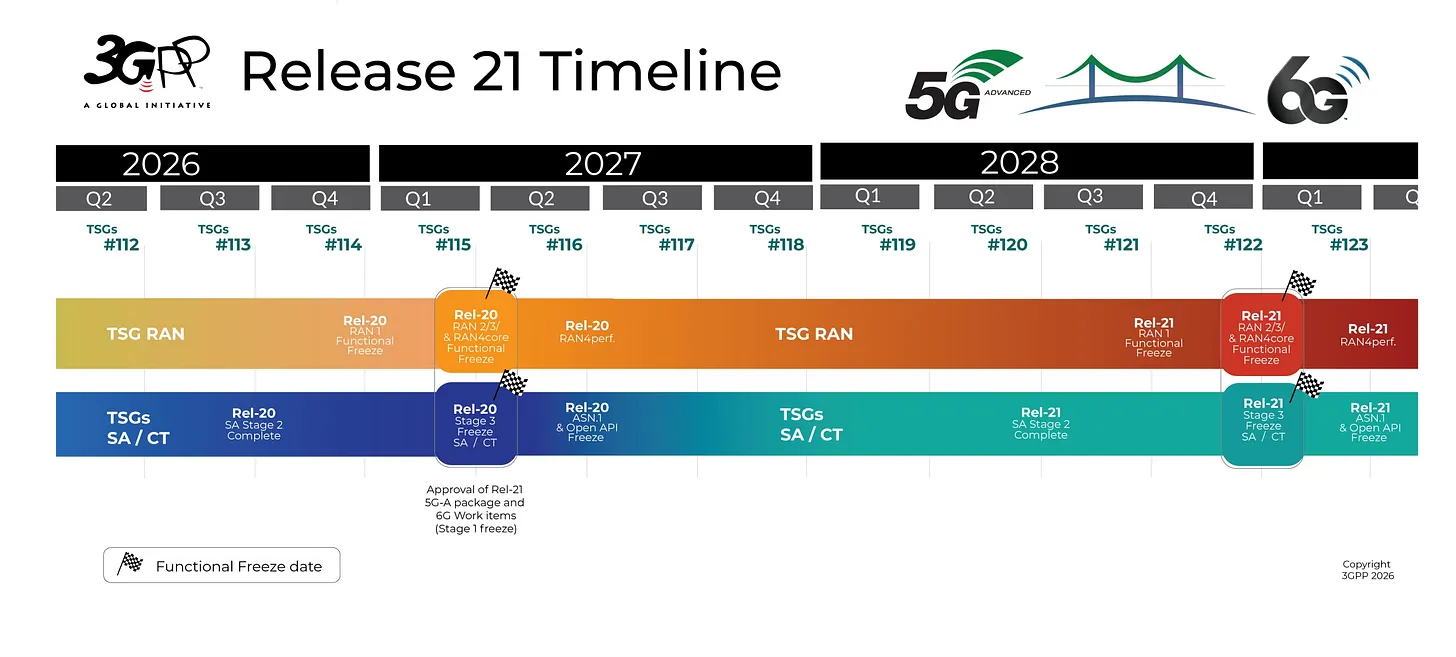
……………………………………………………………………………………………………………………………………………………………………………………………………………………………….
In a blog post summarizing last week’s plenary meeting, Ericsson said 6G standardization “is in full swing” and highlighted some of the early 6G decisions, including choices for waveform, modulation, channel coding, a basic security framework and supported bandwidths. The agreed 6G waveform is to use cyclic-prefix orthogonal frequency-division multiplexing (CP-OFDM) in the downlink. There are two options for uplink: CP-OFDM and discrete Fourier transform spread OFDM (DFT-s-OFDM). Supported bandwidths will range from 3MHz to 400MHz. 3GPP also agreed that 5G channel codes “will be largely reused” in 6G.
Here’s Ericsson’s timeline for 6G:
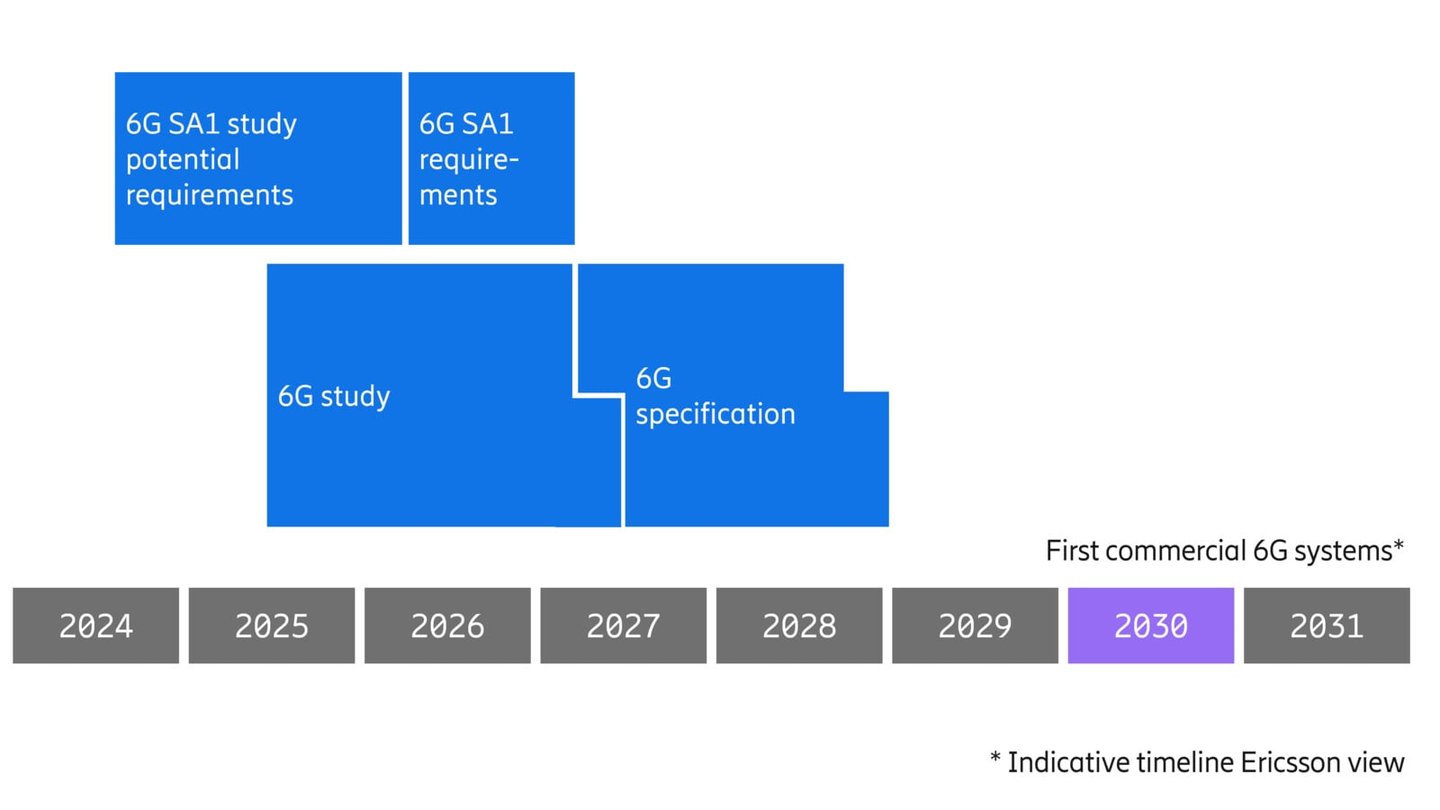
“6G is coming into focus…We are at a point now where a lot of pieces of the puzzle are starting to come together,” Gabriel Brown, senior principal analyst at Omdia, explained in a recent podcast with colleague and analyst Ruth Brown (no relation). The analysts also presented the 6G state of play at the 6G Summit hosted by ATIS’s Next G Alliance ahead of Network X Americas last month. Gabriel noted there has been a mindset shift among telcos about 6G from being “cautious” to “embracing it.” He said that the World Radiocommunication Conference next year (WRC-27) and the Summer Olympic Games in Los Angeles in 2028 will be important “checkpoints” for the anticipated early 2029 arrival of the 6G standards.
“[The LA Summer Olympics] is going to be an amazing opportunity for the U.S. ecosystem to showcase the potential of next-generation connectivity…It’s a chance to show how wireless can serve all the other industries there,” he added.
It will be important to watch for 3GPP’s September 2026 Madrid meeting output deliverables to get a sense of what functions and features might be in 6G RANs.
……………………………………………………………………………………………………………………………………………………………………………………….
6G Core Network:
The 6G core network architecture (such as signaling, network management, security, 6G specific features, and AI-native core architecture) will be defined in Release 21 Stage-2 (System & Architecture) scheduled to be completed in June 2028. Stage-3 (Protocol Specifications) is slated for December 2028 with ASN.1 & OpenAPI Freeze to be completed in March 2029.
3GPP decided NOT to liaise/contribute their 5G SA core network architecture specs to ITU-T, but ETSI rubber stamped them. Just as they did with IMT-2020 (5G), 3GPP will likely maintain exclusive development and control over all non-radio specifications for IMT-2030 (6G). Instead of formalizing them through ITU-T. 3GPP relies on its own Organizational Partners, e.g. ETSI and ATIS, to adopt the core network framework in their standards. 3GPP decided to bypass ITU-T for the 5G mobile core network, opting to develop 5G SA core network specs directly to ensure rapid, market-driven deployment.
……………………………………………………………………………………………………………………………………………………………………………………………
Addendum – 3GPP specs are NOT standards and have no legal standing:
What most, if not all, telecom trade publications (like this one) get completely wrong is that 3GPP does not produce standards, but specifications via their Releases. Those must be contributed, discussed, debated and approved by official SDOs like ITU-R and ETSI or other 3GPP members.
In the case of 5G/IMT 2020, ATIS presented all 3GPP RIT/SRIT specifications as contributions to ITU-R WP5D, which is 100% responsible for all IMT terrestrial radio interface standards (ITU-R recommendations). It should also be noted that ITU-R WP 5D has sole responsibility for IMT 2030/6G Frequency Arrangements which will be done after 6G frequencies are agreed at the ITU World Radiocommunication Conference (WRC-27),which is scheduled to take place from October 18 to November 12, 2027, in Shanghai, China.
“The 3GPP Technical Specifications and Technical Reports have, in themselves, no legal standing. They only become “official” when transposed into corresponding publications of the Partner Organizations (or the national / regional standards body acting as publisher for the Partner). At this point, the specifications are referred to as UMTS within ETSI and FOMA within ARIB/TTC.”
https://portal.etsi.org/new3g/specs/publications_partners.htm
From Qualcomm:
“3GPP Organization – Fixing three common misconceptions: 3GPP develops technical specifications, not standards. This is a subtle, but important organizational clarification. 3GPP is an engineering organization that develops technical specifications. These technical specifications are then transposed into standards by the seven regional Standards Setting Organizations (SSOs) that form the 3GPP partnership.”

https://www.qualcomm.com/news/onq/2017/08/understanding-3gpp-starting-basics
The Partnership Project is not a legal entity but is a collaborative activity between the following recognized Standards Development Organizations (SDO):
- The Association of Radio Industries and Businesses (ARIB) – Japan
- The Alliance for Telecommunications Industry Solutions (ATIS) – US
- China Communications Standards Association (CCSA) – China
- The European Telecommunications Standards Institute (ETSI) – Europe
- Telecommunications Standards Development Society (TSDSI) – India
- Telecommunications Technology Association (TTA) – South Korea
- Telecommunication Technology Committee (TTC) – Japan
The Partnership Project is entitled the “THIRD GENERATION PARTNERSHIP PROJECT” and may be known by the acronym “3GPP.”
………………………………………………………………………………………………………………………………………………………………………………………………
References:
https://www.3gpp.org/news-events/3gpp-news/tsg112#:~:text=3GPP%20plenaries
https://www.3gpp.org/news-events/3gpp-news/rel21-timeline
https://6gfutures.substack.com/p/analysis-of-3gpp-ran-112-timeline
https://www.ericsson.com/en/blog/2026/6/6g-standardization-key-milestones-and-ran-decisions
https://www.3gpp.org/about-us/legal-matters
https://portal.etsi.org/new3g/specs/publications_partners.htm
https://www.lightreading.com/6g/it-s-official-6g-specs-are-set-for-early-2029
https://www.itu.int/en/ITU-R/study-groups/rsg5/rwp5d/imt-2030/Pages/default.aspx
Roles of 3GPP and ITU-R WP 5D in the IMT 2030/6G standards process
ITU-R M.[IMT-2030.EVAL] & ITU-R M.[IMT-2030.SUBMISSION] reports: Evaluation & Submission Guidelines for 6G RIT/SRITs (6G)
IMT-2030 (“6G”) Minimum Technology Performance Requirements for Radio Interface Technologies
Comparing AI Native mode in 6G (IMT 2030) vs AI Overlay/Add-On status in 5G (IMT 2020)
Analysis: Nvidia’s rumored new 6G AI-RAN – likely features/functions and industry impact
ITU-R WP 5D Timeline for submission, evaluation process & consensus building for IMT-2030 (6G) RITs/SRITs
ITU-R WP 5D reports on: IMT-2030 (“6G”) Minimum Technology Performance Requirements; Evaluation Criteria & Methodology
AI wireless and fiber optic network technologies; IMT 2030 “native AI” concept
Highlights of 3GPP Stage 1 Workshop on IMT 2030 (6G) Use Cases
Should Peak Data Rates be specified for 5G (IMT 2020) and 6G (IMT 2030) networks?
GSMA Vision 2040 study identifies spectrum needs during the peak 6G era of 2035–2040
Highlights and Summary of the 2025 Brooklyn 6G Summit
NGMN: 6G Key Messages from a network operator point of view
Nokia and Rohde & Schwarz collaborate on AI-powered 6G receiver years before IMT 2030 RIT submissions to ITU-R WP5D
Verizon’s 6G Innovation Forum joins a crowded list of 6G efforts that may conflict with 3GPP and ITU-R IMT-2030 work
Nokia Bell Labs and KDDI Research partner for 6G energy efficiency and network resiliency
Deutsche Telekom: successful completion of the 6G-TakeOff project with “3D networks”
Market research firms Omdia and Dell’Oro: impact of 6G and AI investments on telcos
Qualcomm CEO: expect “pre-commercial” 6G devices by 2028
Ericsson and e& (UAE) sign MoU for 6G collaboration vs ITU-R IMT-2030 framework
Virtualization’s role in 5G Advanced (3GPP Release 18) and a proposed new hardware architecture
Dell’Oro: 6G RAN Capex to reach $500 billion by 2034 + Counterpoint
Dell’Oro Report Summary:
According to a recent Dell’Oro Group report, global telecom operators will spend $500 billion on 6G infrastructure over the next decade. During that same period, the overall network equipment market is projected to grow at just a 1% CAGR. Telco revenues are expected to grow at 3% over the next decade. The report’s base-case scenario envisions 6G as an evolutionary technology that builds on Massive MIMO, the existing site grid, and wider channel bandwidths to deliver step-change improvements in RAN economics.
“While the G decoupling movement is gaining momentum for all the right reasons, the most likely scenario is still that 6G will be another G, with 6G RAN capex expected to accelerate toward the end of the decade,” said Stefan Pongratz, Vice President of RAN and Telecom Capex Research at Dell’Oro Group. “At the same time, operators are in a much stronger position today from a network capacity perspective than they were during the transition from 4G to 5G. As a result, cumulative 6G RAN revenue during the first six years of the cycle is projected to be 10 to 20 percent lower than during the comparable period of the 5G cycle.”
Additional highlights from the June 2026 6G Advanced Research Report include:
- 6G RAN is expected to scale rapidly, with cumulative RAN revenue and wireless capex during the first six years projected to exceed $100 B and $500 B, respectively.
- 6G is not expected to expand the overall RAN market. Instead, the baseline scenario projects the broader RAN market to grow at a 1 percent CAGR between 2030 and 2034.
- Both Sub-7 GHz and cmWave spectrum bands are expected to play important roles in 6G deployments, although momentum behind spectrum above 7 GHz continues to build.
- Cumulative 6G RAN investments between 2029 and 2034 are projected to account for approximately half of total RAN capex during the same forecast period.
Dell’Oro Group’s 6G Advanced Research Report offers an overview of the RAN market, including tables showing total RAN revenue by technology (2G-6G) from 2000 to 2034. 6G RAN is analyzed by spectrum (Sub-7 GHz, cmWave, mmWave), by Massive MIMO, by RF Power (Macro, Micro, Pico), and by region (North America, Europe, Middle East and Africa, China, Asia Pacific Excl. China, and CALA). To purchase this report, please contact us by email at [email protected].
Editor’s Counterpoint:
We don’t agree with Stefan’s statement that “6G RAN is expected to scale rapidly,” based on the delays and failures of ITU-R’s IMT 2020 (5G) standards and 3GPPs 5G SA core network specifications.
A phased ramp-up is more likely, as early commercial launches begin at the end of 2030 and early 2031. Then slower scaling through the early 2030s as spectrum, devices, infrastructure, and business cases mature.
At this point in time, we have no idea what the IMT 2030 RIT/SRITs will be or 3GPPs 6G SA Core network functionality. ITU WP5D’s IMT-2030 work is still setting requirements and evaluation criteria, and candidate RIT submissions are only expected in the 2027–2029 window. The ITU-R also says the technical performance requirements are minimum levels for consideration and do not guarantee real-world deployment performance. That’s similar to IMT 2020/5G RITs, where ITU-R M.2410 report: minimum performance requirements were NOT met for URLLC – ultra high reliability or ultra low latency (1ms in the data plane; 10ms in the control plane).
In other words, approval creates the foundation, not instant scale. That points to a 6G RAN standards process that finishes just as first deployments begin, not one that guarantees immediate mass rollout.
-
3GPP Release 20 (2025–2026): Early 6G studies focused on requirements/architecture
-
3GPP Release 21 (2027–2028): First concrete 6G specifications, core radio/network framework
-
3GPP 6G functional freeze: December 2028
-
ITU-R IMT-2030 formal approval: December 2026 for technical performance requirements; full RIT/SRIT approval late 2030–early 2031.
This timeline confirms the Counterpoint’s “standards finish just as first deployments begin” concern—there’s no guarantee of immediate mass rollout. Furthermore, 6G SA has not yet been defined while 5G SA is still rolling out in 2026 – six years after 5G NR specs and IMT 2020 RIT standards were completed. Therefore, the 2030-2031 6G commercial launch assumption is optimistic for many markets.
What’s needed by 2030: globally harmonized work, spectrum studies across low, mid, mmWave, and sub-THz bands, and network operator/vendor roadmaps. Once those crystalize they could support fast 6G uptake in premium pockets such as dense urban zones, enterprise campuses, and fixed wireless/edge-centric use cases where the economics are strongest. That means “rapid” is plausible in targeted launches, not across entire national footprints.
6G will likely face the same structural constraints that slowed 5G: spectrum availability, device ecosystems, deployment costs, and the need to integrate with 5G-Advanced during the transition time period. Higher-band operation, especially above 100 GHz, is technically feasible but still requires mature propagation, hardware, and deployment architectures before it can scale widely. The result is usually a long coexistence period where 5G remains the coverage layer while 6G expands selectively.
The likely pattern is “launch first, scale later,” with meaningful expansion depending more on spectrum policy, device availability, and operator ROI than on the standard approval itself.
Deployment timeline:
-
2026–2027: Standards and requirements work intensifies, with 3GPP/ITU alignment still being shaped and operators pushing for realistic deployment timelines.
-
2028–2029: Pre-commercial and early pilot networks appear, especially in dense urban, enterprise, and testbed environments.
-
2030: First commercial 6G launches are widely expected by the end of 2030, but these will be selective rather than universal.
-
2031–2033: Main capex ramp and larger-scale rollout window, as more of the macro grid, transport, and edge layers are upgraded.
-
2034 and beyond: Broader geographic expansion and more mature multi-band coverage, with 6G taking on a larger share of traffic and enterprise use cases.
6G Capex Outlook:
Dell’Oro’s view that the 6G capex ramp starts around the end of 2030 (we think it will be 2031), while cumulative 6G RAN investment in 2029–2034 could account for 55% to 60% of total RAN capex in that period. A separate data-driven forecast argues global 6G capex could land somewhere in the sub-$1 trillion to about $1.5 trillion range over a decade, depending on traffic growth and spec assumptions. That is a wide band, but it is consistent with a technology transition that reuses much of the existing macro grid rather than replacing everything at once.
………………………………………………………………………………………………………………………………………………………………………………………………
Sebastian Barros wrote:
6G will deliver necessary operational improvements. It will utilize new 7GHz spectrum, improve radio performance, and lower the cost per bit for operators still recovering from the 5G capex hangover. However, consumers and enterprises do not pay a premium for faster pipes. Connectivity is now a hyper-commoditized utility.
If Telcos want to capture value in this new economy, they must stop defining their core business as “connectivity.” Telecom is a distribution business.
Networks serve as the last-mile delivery system for the global economy. In the past, the industry distributed voice, SMS, and 8K video. Today, the asset being distributed is intelligence. Hyperscalers are building massive, centralized AI data centers, but that compute power requires a physical delivery mechanism to reach users.
…………………………………………………………………………………………………………………………………………………………………………………
References:
Current 6G Trajectory is Evolutionary, According to Dell’Oro Group
Dell’Oro: RAN Market Stabilized in 2025 with 1% CAG forecast over next 5 years; Opinion on AI RAN, 5G Advanced, 6G RAN/Core risks
Market research firms Omdia and Dell’Oro: impact of 6G and AI investments on telcos
ABI Research: 6G Radio Installed Base by Region from 2029 to 2034
GSMA Vision 2040 study identifies spectrum needs during the peak 6G era of 2035–2040