

Huawei FY2025: 2.2% YoY revenue increase; strategic pivot to AI & Automotive
Image Credit: Imago/Alamy Stock Photo
……………………………………………………………………………………………….
“In 2025, Huawei’s overall performance remained steady,” said Sabrina Meng, Huawei’s Rotating Chairwoman. “I would like to thank our customers for your ongoing trust and support. Thanks also to consumers for choosing Huawei, as well as suppliers, partners, and developers around the world for working with us. “Of course, we couldn’t do any of this without the support of every Huawei employee. Thank you for your hard work, and also your families for their steadfast support.”
In 2025, Huawei’s connectivity business weathered the impact of industry investment cycles, while its computing business continued to seize opportunities in AI. The consumer business worked to overcome formidable challenges, driving the HarmonyOS ecosystem to cross a new threshold in user experience. Huawei’s digital power business continued to place quality before all else. Huawei Cloud honed its competitiveness with a focus on core services, and the company’s intelligent automotive solutions grew rapidly.
………………………………………………………………………………………….
Revenue Breakdown by Segment & Geography:
- Infrastructure & Solutions: Remains the primary anchor, contributing 42.6% of total revenue (up 2.6% YoY).
- Consumer Business: Accounted for 39.1% of revenue, maintaining a steady recovery with 1.6% YoY growth.
- Intelligent Automotive Solutions (IAS): The high-growth outlier, with revenues spiking 72.1% YoY to CNY 45bn, now representing 5.1% of the total portfolio.
- Geographic Mix: Domestic China operations generated ~70% of revenue. International footprints were led by EMEA (18.3%), followed by Asia-Pacific (5.7%) and the Americas (4.2%).
Huawei continues to maintain one of the industry’s highest reinvestment rates, allocating CNY 192.3bn ($27.9bn) to R&D—a massive 21.8% of annual revenue.
Huawei’s R&D expenditure rose 7% last year to an impressive RMB 192.3 billion (approximately $28 billion), representing nearly 22% of annual revenue.
In contrast, Ericsson—whose portfolio remains heavily centered on 5G—reduced its R&D outlay by 9% to SEK 48.9 billion (about $5.2 billion).
At 21% of sales, Ericsson’s R&D intensity was largely in line with Huawei’s. Nokia, meanwhile, outpaced both rivals in relative terms, allocating 23% of revenue—roughly €4.6 billion ($5.3 billion)—to R&D, up 7% year over year. Most of that increase stemmed from the February 2025 acquisition of optical systems vendor Infinera, which expanded Nokia’s technology base and R&D footprint.
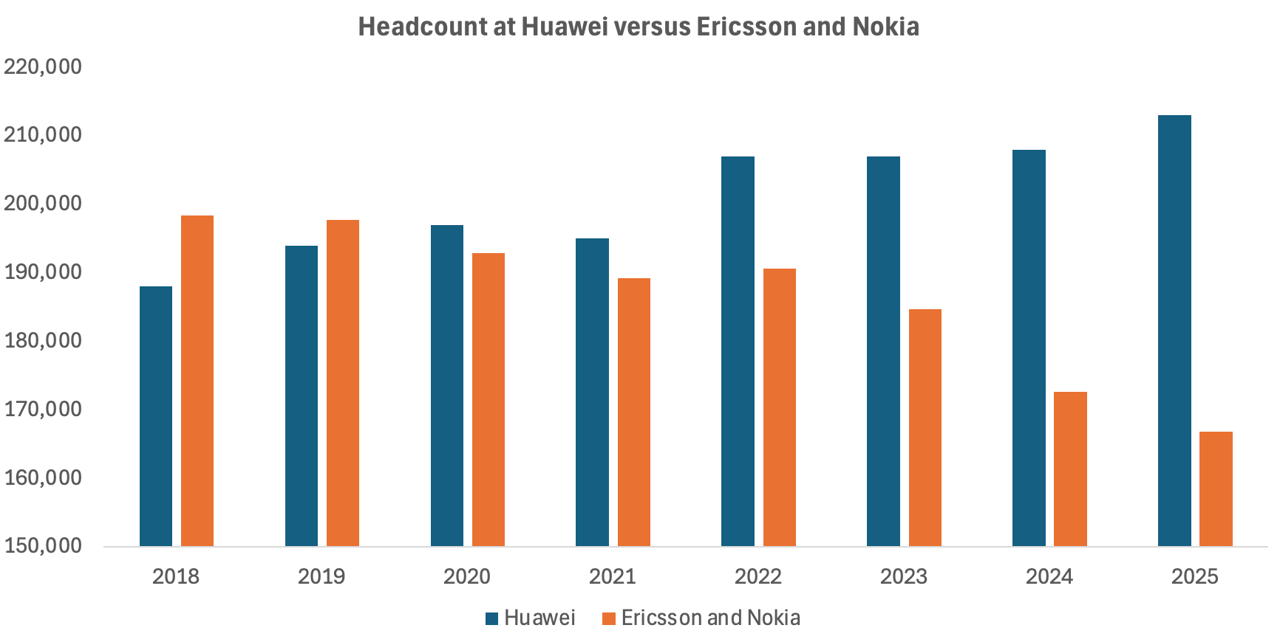
The sharper divergence lies in workforce trends. As reported by Light Reading, Ericsson and Nokia have collectively shed nearly 28,000 positions since 2022, equivalent to about 15% of their combined headcount that year. While growing automation and AI integration have arguably improved operational efficiency, the scale of these reductions also reflects a cooling investment climate among operators. With telco spending on 5G deployments tapering off, Europe’s two large network equipment vendors are continuing layoffs.
In contrast, Huawei’s workforce has continued to increase as it has pushed into new industrial sectors. Since 2021, when Huawei suffered its worst-ever sales decline, the Chinese behemoth has added about 18,000 employees to its payroll, according to annual reports. Around 5,000 of them were recruited last year, including 1,000 in R&D alone. That resulted in 213,000 employees Huawei employees in 2025.
The increased hiring boosted overall operating costs, including R&D expenditure, by 7.2%, to about RMB334 billion ($48.5 billion).
Source & Graph Credit: Light Reading
………………………………………………………………………………………….
- Full-Stack AI Integration: Embedding AI and carrier-grade security across the entire product lifecycle and network architecture.
- Strategic Domain Expansion: Increasing CapEx and R&D in connectivity, cloud, and autonomous driving.
- Ecosystem Sovereignty: Scaling the Ascend (AI), Kunpeng (Computing), and HarmonyOS ecosystems to drive vendor-agnostic collaboration and industry-wide adoption
Meng stressed, “We are moving toward a future that is full of uncertainty, so we have to remain true to our strategy and maintain strategic focus. We will translate strategy to execution, keep cultivating the developer ecosystem, and pursue high-quality development.”
References:
https://www.huawei.com/en/news/2026/3/annual-report-2025
https://www.lightreading.com/5g/huawei-sales-growth-plummeted-in-2025-as-it-gained-5-000-workers
Huawei unveils AI Centric Network roadmap, U6 GHz products, 5G Advanced strategy and SuperPoD cluster computing platforms
Huawei, Qualcomm, Samsung, and Ericsson Leading Patent Race in $15 Billion 5G Licensing Market
Huawei Cloud Review and Global Sales Partner Policies for 2026
Huawei’s Electric Vehicle Charging Technology & Top 10 Charging Trends
Huawei to Double Output of Ascend AI chips in 2026; OpenAI orders HBM chips from SK Hynix & Samsung for Stargate UAE project
Omdia on resurgence of Huawei: #1 RAN vendor in 3 out of 5 regions; RAN market has bottomed
Huawei launches CloudMatrix 384 AI System to rival Nvidia’s most advanced AI system
U.S. export controls on Nvidia H20 AI chips enables Huawei’s 910C GPU to be favored by AI tech giants in China