

CTIA: Americans used more wireless data in 2025 than in the entire 4G decade, but growth slowed from 2023-2024
Executive Summary:
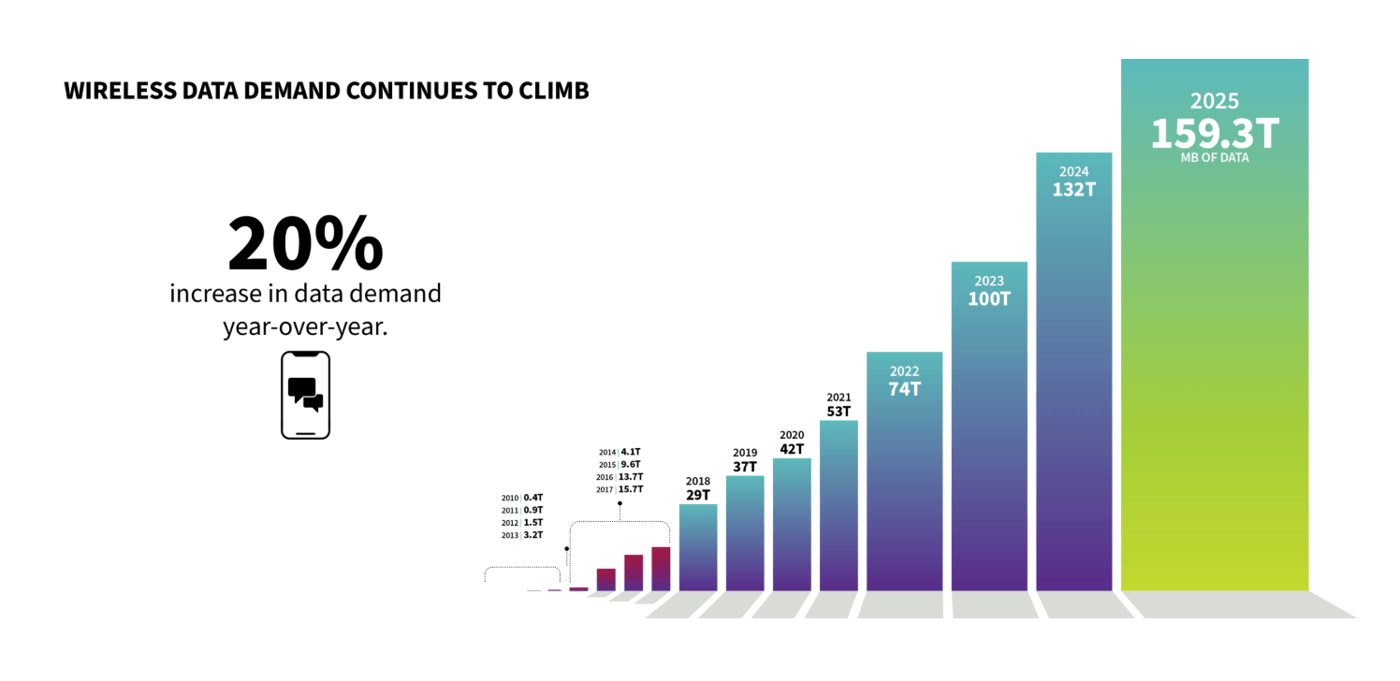
U.S. wireless data consumption reached 159.3 trillion megabytes in 2025—20% year-over-year growth and nearly 60% higher than two years prior—surpassing total usage across the entire 4G decade, according to CTIA’s 2026 Annual Survey. The results highlight accelerating demand on RAN and transport infrastructure driven by AI workloads, wearables, IoT sensors, and high-bitrate streaming. However, the 20% growth in 2025 is down from the 32% growth registered in 2024, and the 35% in 2023.
CTIA projects aggregate data demand to grow approximately 4× by 2032, with AI-related traffic expanding about 3× faster than conventional wireless flows. By 2034, AI is expected to account for nearly one-third of all broadband traffic, intensifying pressure on spectrum, backhaul, and edge compute resources.
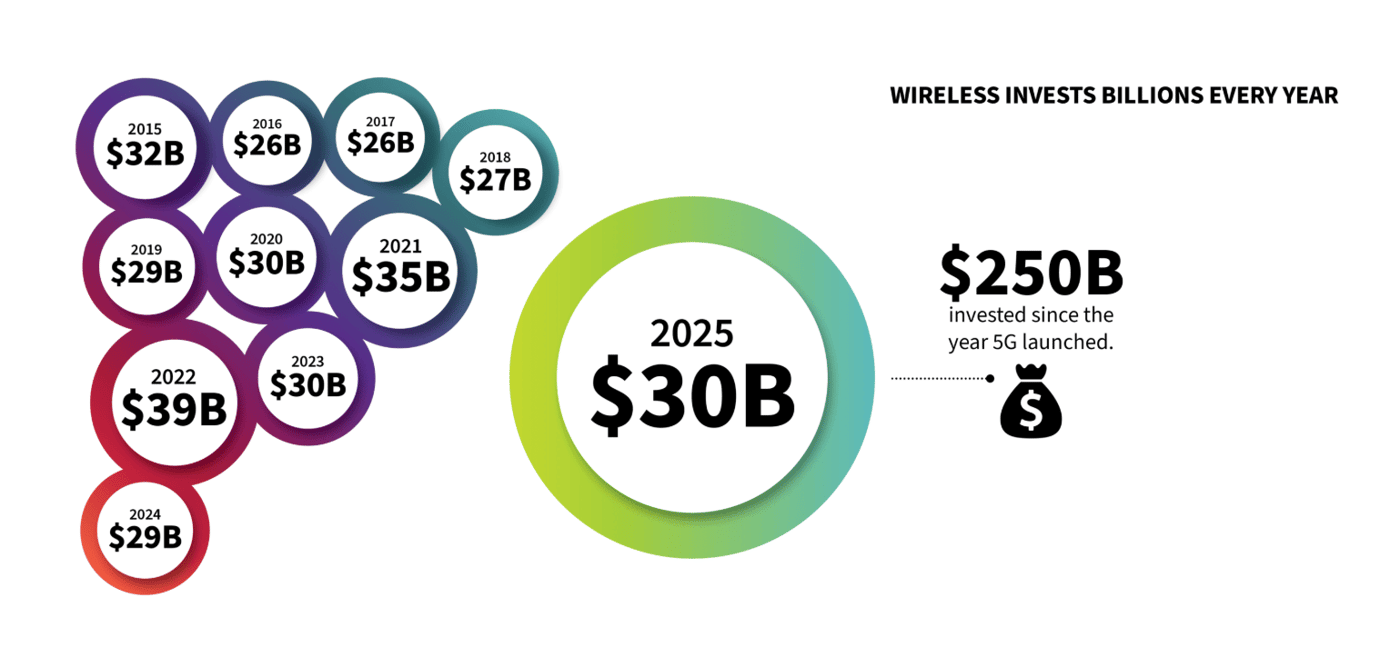
Wireless operators invested nearly $30 billion in 2025 to expand capacity and support traffic growth, bringing cumulative industry infrastructure investment above $763 billion, with roughly $250 billion deployed since 2018 (the 5G launch year). Small-cell deployments have risen nearly 120% since 2018 and now represent about 40% of all cell sites, underpinning densification, capacity gains, and improved QoS across urban and suburban markets.
The U.S. now supports more than 600 million wireless connections—about 1.8 per capita—with 46% of connected devices being non-phone endpoints such as consumer wearables and industrial IoT sensors/robotics. For the fourth consecutive year, virtually all net additions in the home broadband segment came from fixed wireless access (FWA); nearly 16 million Americans subscribe to 5G Home, including 3.9 million net new subscribers in 2025—more than double the net losses reported by cable operators over the same period.
Despite traffic growth, real prices for typical unlimited mobile data plans fell more than 10% in 2025, with price per megabyte down 21% while average speeds increased 51%, reflecting efficiency gains from 5G spectrum utilization, carrier aggregation, and network modernization.
“This continued surge in demand reflects the increasingly central role wireless plays in everyday life,” said Ajit Pai, CTIA President and CEO (FCC Chairman from 2017-to-2021). “America’s wireless providers are stepping up to the challenge, investing nearly $30 billion last year alone to expand capacity and lay the foundation for future AI-native 6G networks.”
CTIA and industry leaders frame the next generation as AI-native, requiring proactive spectrum policy to secure mid- and high-band resources (e.g., 2.7 GHz and 7 GHz) with auctions targeted by 2028 to support 6G-ready deployments. The survey’s traffic and investment trajectory underscores the need for coordinated spectrum planning, densification, and transport upgrades to sustain AI-driven growth through the 2030s.
……………………………………………………………………………………………………………………………………………………………..
6G Readiness vs. 5G Deployment Benchmarks: AI Traffic Load Perspective:
The 2026 CTIA survey shows U.S. networks are already absorbing AI-driven traffic growth (AI growing ~3× faster than baseline wireless traffic), while 5G deployment benchmarks—densification, spectrum efficiency gains, and uplink enhancements—provide the immediate capacity headroom needed before 6G’s AI-native architecture arrives in the 2029–2030 window.
Traffic Growth and AI Load Forecasts (CTIA 2026):
-
2025 data usage: 159.3 trillion MB, +20% YoY and ~60% over two years; more than the entire 4G decade.
-
AI traffic trajectory: AI-related flows are expanding ~3× faster than traditional wireless traffic and are projected to reach ~30% of all broadband traffic by 2034.
-
Aggregate demand: Total data demand is expected to grow ~4× by 2032, intensifying pressure on RAN, backhaul, and edge compute.
These CTIA figures align with independent vendor forecasts (e.g., Nokia Bell Labs) that place AI at ~30% of wide-area traffic by 2034, with symmetrical bandwidth needs and upload CAGRs near 13%—a material shift from today’s ~87:13 downlink/uplink split.
5G Deployment Benchmarks Relevant to AI Loads:
6G Readiness: Standards, Architecture, and Spectrum:
-
Standards timeline: 3GPP Release 20 (study phase) runs through 2027; Release 21 delivers first normative 6G specs with functional freezes in Dec 2028 and implementable code by Mar 2029; first commercial systems expected 2029–2030.
-
IMT-2030 framework: ITU-R finalized 20 minimum technical performance requirements across six usage scenarios, including AI & Communication and Integrated Sensing & Communication (ISAC).
-
Performance targets: Peak data rates 50–200 Gbps, user-experienced rates 300–500 Mbps+, and 1.5–3× spectral efficiency vs. IMT-2020 (5G).
-
Spectrum needs: 6G requires large, contiguous sub-8 GHz mid-band and upper mid-band blocks with 100–400 MHz channel bandwidths; industry calls for proactive policy to secure bands (e.g., 2.7/7 GHz) with auctions by 2028.
What 5G Benchmarks Cover vs. What 6G Must Add:
Practical Takeaway for Network Planners:
-
Near term (2026–2028): Lean into 5G-Advanced (Rel-19) features—AI schedulers, uplink MIMO, centralized spectrum allocation—to capture 10–30% SE gains and 20–40% uplink improvements that directly absorb AI traffic growth.
-
Mid term (2027–2029): Align spectrum strategy with 6G’s channel-bandwidth needs (100–400 MHz) and prepare transport/edge for symmetrical, low-latency AI flows; monitor 3GPP Rel-21 freezes (2028–2029).
-
Long term (2030+): Design for AI-native operations (distributed inference, ISAC, ubiquitous connectivity) as AI approaches ~30% of broadband traffic, ensuring RAN, core, and data-center interconnect scale together.
Perplexity.ai Sources: CTIA 2026 Annual Survey (Sept. 9, 2026); ITU-R IMT-2030 framework and 3GPP Release 20/21 timelines; vendor trials on 5G SA spectral efficiency and AI schedulers; industry forecasts on AI traffic share by 2034.
References:
https://www.telecoms.com/5g-6g/us-mobile-data-growth-slowed-in-2025
AI Compute Has a Switchboard Problem: Orchestration & Data Center Fabric Explained
CTIA commissioned study: U.S. running out of licensed spectrum; 5G FWA to be impacted first by network overloads
CTIA Announces 5G Security Test Bed for Commercial 5G Networks
Highlights of CTIA’s 2021 Annual Wireless Industry Survey