

Mid‑2026 U.S. Carrier Ethernet Market: VSG Leaderboard, Standards, Service Mix and RFPs
Executive Summary:
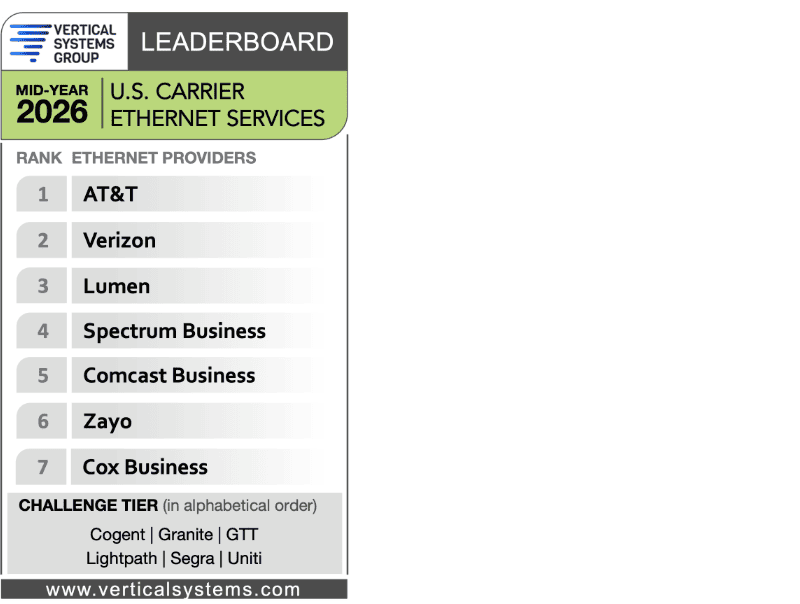
Vertical Systems Group’s (VSG’s) mid‑2026 U.S. Carrier Ethernet LEADERBOARD ranks providers by retail port share as of June 30, 2026. Seven network operators met the 4% threshold for Leaderboard status: AT&T; Verizon (including Frontier); Lumen; Spectrum Business; Comcast Business; Zayo (including Crown Castle); and Cox Business.
- Verizon’s acquisition of Frontier significantly expanded its fiber network, elevating its market position to #2 in the U.S. Carrier Ethernet rankings.
- Zayo advanced to the leaderboard after acquiring Crown Castle and plans to add 15,000 route miles by 2030, strengthening its long-haul network.
Six companies attained a Challenge Tier citation (in alphabetical order): Cogent, Granite, GTT, Lightpath, Segra, and Uniti. The Challenge Tier includes providers with between 1% and 4% share of the U.S. retail Ethernet market.
VSG’s methodology measures billable retail customer ports and segments the market into six service categories that map closely to MEF‑defined Carrier Ethernet service types: Ethernet DIA (Dedicated Internet Access), E‑Access to IP/MPLS VPN, Ethernet Private Line (EPL), Ethernet Virtual Private Line (EVPL), Metro LAN, and WAN VPLS.
U.S. Ethernet Market Analysis: Mid-2026:
- AT&T keeps its #1 rank on the Mid-Year 2026 U.S. Carrier Ethernet LEADERBOARD.
- Rankings change for four of the seven Ethernet LEADERBOARD providers.
- Verizon moves up from the #4 position to the #2 rank with its completed acquisition and integration of Frontier assets.
- As a result, Lumen dips from the #2 position to #3. Spectrum Business drops from #3 into the #4 position.
- Zayo moves up into the LEADERBOARD at the #6 position from the Challenge Tier due to its acquisition of Crown Castle, which was completed in May 2026.
- Cox Business falls into the #7 and final position. The acquisition of Cox by Spectrum’s parent company, Charter Communications, was completed in August 2026 and is not included in the mid-year results.
- The Challenge Tier for mid-2026 includes six companies: Cogent, Granite, GTT, Lightpath, Segra (including UPN) and Uniti (includes Windstream). Segra enters the Challenge Tier, moving up from the Market Player tier.
- DIA (Dedicated Internet Access) is the top Ethernet service in the U.S. based on both ports and revenue.
- Enterprise customers are shifting from lower speed Ethernet private lines to more robust SD-WAN and SASE services.
- Three LEADERBOARD wireline network operators have attained Mplify Carrier Ethernet certification: AT&T, Lumen and Verizon.
The Market Player tier includes all providers with port share below 1%. Companies in the Market Player tier include the following providers (in alphabetical order):ACD, AireSpring, Alaska Communications, Alta Fiber, American Telesis, Arelion, Armstrong Business Solutions, Astound Business, Bluebird Network (includes Everstream), Breezeline, Brightspeed, BT Global Services, Centracom, Conterra, Douglas Fast Net, DQE Communications, Epsilon, Exa Infrastructure, ExteNet Systems, Fatbeam, FiberLight, Fidium, First Digital, FirstLight, Flo Networks, Fusion Connect, GCI, GCX, Glo Fiber, Hunter Communications, Intelsat, Logix Fiber Networks, LS Networks, MetTel, Midco, Momentum Telecom, NTT, Orange Business, Pilot Fiber, PS Lightwave, Rightfiber (includes Great Plains and Ritter), Silver Star Telecom, Sparklight Business, Syringa, T-Fiber (includes MetroNet, Lumos, U.S. Internet), Tata Communications, TDS Telecom, TPx, US Signal, WOW!Business, Ziply Fiber (now owned by Bell Canada) and other companies selling retail Ethernet services in the U.S. market.
…………………………………………………………………………………………………………………………………………………………………………………………………………………………………….
Standards Context: MEF Carrier Ethernet, IEEE 802, and ITU-T:
Carrier Ethernet services are standardized by MEF (formerly the Metro Ethernet Forum), which defines service types, attributes, and performance objectives across multi‑operator domains. MEF 2.0/3.0 specifications formalize E‑Line (point‑to‑point), E‑LAN (multipoint), E‑Tree (rooted multipoint), and E‑Access (inter‑provider) services, with strict OAM, QoS, and bandwidth profile requirements.
At the physical and link layers, IEEE 802.3 Ethernet PHYs and 802.1Q VLAN tagging underpin these services, while MEF service definitions (EVCs, UNIs, ENNIs) provide the operator‑grade abstraction needed for SLAs, service multiplexing, and interconnection. In practice, “Metro Ethernet” offerings by U.S. carriers are implementations of MEF E‑Line/E‑LAN service types over diverse transport (packet optical, MPLS, IP/MPLS, or Ethernet switching fabrics), with port‑based or VLAN‑based handoffs at the customer UNI.
Metro Ethernet Service Types: What the Market Segments Map To:
Vertical’s six service segments align with canonical Carrier Ethernet service types as follows:
-
Ethernet DIA (Dedicated Internet Access): Typically delivered as an E‑Line service (EPL or EVPL) to an internet gateway, with asymmetric or symmetric bandwidth profiles and strict availability targets. DIA emphasizes internet reachability rather than private L2 connectivity, but the underlying UNI/EVC constructs remain MEF‑compliant.neosnetworks+1
-
E‑Access to IP/MPLS VPN: An inter‑provider or backhaul construct where a carrier Ethernet E‑Line/E‑Access link connects an enterprise edge or another operator to an IP/MPLS core. This maps to MEF E‑Access (inter‑carrier) with ENNI handoffs and is common for wholesale Ethernet backhaul and multi‑operator VPN aggregation.mplify+1
-
Ethernet Private Line (EPL): A port‑based, point‑to‑point E‑Line service with one EVC per UNI and near‑transparent frame delivery. EPL is the canonical “private line” for low‑latency, high‑certainty circuits between two sites, often used for data‑center interconnect or critical backhaul.
-
Ethernet Virtual Private Line (EVPL): A VLAN‑based E‑Line service that supports multiple EVCs on a single UNI via service multiplexing. EVPL enables point‑to‑point and point‑to‑multipoint topologies over shared access ports, improving port utilization and supporting multi‑service bundles (e.g., LAN + internet + VoIP) on one physical handoff.Metro LAN: A multipoint‑to‑multipoint E‑LAN service (sometimes called Ethernet Virtual Private LAN) that provides any‑to‑any Layer 2 connectivity among three or more sites. Metro LAN is the carrier analogue to VPLS and is widely used for campus interconnect, distributed enterprise LAN extension, and L2‑based application clustering.
-
WAN VPLS: A wide‑area VPLS instance delivering E‑LAN semantics across broader geographies, typically over MPLS cores. While MEF 3.0 emphasizes E‑LAN service attributes, many operators still market VPLS as the transport realization of E‑LAN for multi‑site Layer 2 domains.
The most important ITU‑T recommendations for Carrier Ethernet fall into three buckets: service definitions, OAM/fault & performance management, and protection/activation testing. Together they provide the operator‑grade framework that maps MEF service types (E‑Line, E‑LAN, E‑Tree, E‑Access) to measurable SLAs and resilient transport.itu+2
Core service definitions (what the service is):
-
G.8011/Y.1307 – Ethernet service framework
Defines the overall framework for Ethernet services (EVC/OVC/UNI/ENNI), service attributes, and OAM bindings. It is the ITU‑T umbrella that aligns with MEF service types and underpins EPL, EVPL, E‑LAN, E‑Tree, and E‑Access definitions. -
G.8011.1/Y.1307.1 – Ethernet Private Line (EPL)
Specifies EPL service attributes and parameters (port‑based, single EVC per UNI, bandwidth profiles, transfer characteristics). This is the canonical “private line” for point‑to‑point, low‑latency circuits.itu+1 -
G.8011.2/Y.1307.2 – Ethernet Virtual Private Line (EVPL)
Specifies EVPL service attributes (VLAN‑based, service multiplexing on a UNI, CIR/EIR/CBS/EBS). EVPL enables multiple services over one physical handoff while preserving SLA granularity. -
G.8011.3/Y.1307.3 – Ethernet LAN (E‑LAN)
Defines multipoint‑to‑multipoint E‑LAN service attributes (any‑to‑any L2 connectivity among ≥3 UNIs), the carrier analogue to VPLS and widely used for Metro LAN.scribd+1 -
G.8011.4/Y.1307.4 – Ethernet Virtual Private Rooted Multipoint (E‑Tree / EVPRM)
Defines rooted multipoint (E‑Tree) service attributes for hub‑and‑spoke topologies (e.g., video distribution, wholesale access). -
G.8011.5/Y.1307.5 – Ethernet Access (E‑Access)
Specifies inter‑provider Ethernet access service attributes (ENNI‑based) used for wholesale backhaul and multi‑operator service chaining
…………………………………………………………………………………………………………………………………………………………………………..
Market Implications for Network Architects:
The 2026 VSG leaderboard reflects consolidation and asset integration (e.g., Verizon’s move to #2 following Frontier integration), with cable MSOs and fiber specialists maintaining strong positions in metro and regional segments. For architects specifying Carrier Ethernet, the practical choice among EPL, EVPL, E‑LAN, and VPLS hinges on three factors: topology (P2P vs. multipoint), service multiplexing needs at the UNI, and the degree of L2 transparency versus managed L3 VPN requirements.
When drafting RFPs or architecture documents, reference:
- G.8011.x service types alongside MEF E‑Line/E‑LAN/E‑Tree/E‑Access to ensure interoperable, SLA‑backed procurement.
- MEF 2.0/3.0 service types (E‑Line/E‑LAN/E‑Access) and require conformance to MEF service attributes (bandwidth profiles, frame delay/jitter/loss, OAM).
That ensures that “Metro Ethernet” procurement aligns with deployable, interoperable, SLA‑backed services rather than vendor‑specific marketing terms.
…………………………………………………………………………………………………………………………………………….
References:
https://verticalsystems.com/2026/09/02/mid-2026-us-carrier-ethernet-leaderboard/
https://verticalsystems.com/methodology/
https://neosnetworks.com/resources/blog/epl-vs-evpl/
https://www.itbroker.com/resources/glossary/metro-ethernet-transport
Carrier Ethernet Market Assessment and MEF 3.0 Certification
AT&T Tops VSG 2022 Global Provider Carrier Managed SD-WAN Leaderboard
No Surprise: AT&T tops leaderboard of commercial fiber lit buildings for 7th year!
VSG LEADERBOARD : AT&T #1 in Fiber Lit Buildings- Year end 2020
AT&T tops VSG’s U.S. Carrier Managed SD-WAN Leaderboard for 4th year
Lumen Technologies tops Vertical Systems Group’s 2021 U.S. Wavelength Services Leaderboard