

Month: August 2026
Structured Error Analysis: The Missing Pre-Deployment Step for Machine Learning in Telecom Operations
By Priyank Jain with Alan J Weissberger
Introduction:
Machine learning now sits inside telecom operations. Models predict equipment failures before they become outages, forecast traffic for capacity planning, flag telemetry anomalies, and estimate quality of experience from indirect signals—decisions that carry real financial weight. Yet most teams still approve a model for deployment on a single number: accuracy, AUC, or a concordance index computed once on a held-out set. That number is a poor predictor of production behavior. This post argues that structured error analysis belongs before deployment, and walks through five failure modes a single aggregate metric reliably hides.
Terms:
Training fits parameters on historical data; inference applies the fitted model to new data in production. These are two different software environments, and that difference causes more production failures than bad modeling does. Train-serve skew is any gap between training and serving conditions [10]. A fault-prediction model trained on offline-cleaned, gap-filled, five-minute telemetry may encounter a streaming collector that handles missing samples differently and closes its window a few seconds early. A feature named mean_utilization_5m exists in both places and means something slightly different in each. Nothing errors; accuracy just quietly drops.
Censoring matters whenever a model predicts time-to-event. An asset that has not failed yet is censored: we know it survived to now, not how long it will last. Censored observations are legitimate training data; mislabeled ones are poison [4], [5]. Data drift is a change in the model’s inputs—a firmware release that changes how a counter is reported [1], [2]. Concept drift is a change in the underlying relationship—say, a topology change that makes a predictive signal meaningless [3]. Both degrade a validated model, and neither appears in the original evaluation. The residual—the gap between prediction and outcome for one case—is the raw material of error analysis.
Five Failure Modes:
Environment mismatch. Models rarely fail because the mathematics was wrong; they fail because training misrepresented production. A feature computed one way offline and another online, a timezone off by an hour, a normalization constant recomputed over the wrong window—each is trivial, and together they are the most common reason validated performance does not survive deployment. The defense is computing features once and consuming them in both paths. Where that is impossible, run an automated comparison: sample cases, compute features through both paths, and assert agreement within tolerance. Sharing one feature pipeline and persisting trained preprocessors prevents this.
Wrong population. A time-to-failure model over a fleet defines the population by a rule such as “decommission date is empty.” That looks reasonable but is wrong whenever a status field and a date field disagree. An asset marked failed that never had a decommission date written satisfies the rule; the model treats it as healthy and learns that dead things are alive. Survival estimates come out optimistic, worst where data hygiene is worst. Every model-side metric looks fine because the model faithfully learns its labels. When a result contradicts domain knowledge, interrogate the population definition before touching the model.
Metric too good. If a feature table is assembled alongside the outcome, the outcome—or a near-copy such as observed duration—can end up in the feature set, and the model reports near-perfect discrimination. The same happens with fields populated only after the event, such as a diagnostic code set once a fault is confirmed. These are not predictive features; they are the answer arriving late. Treat an unexpectedly excellent score as a bug report and audit whether each feature would be available at scoring time and could have been influenced by the outcome.
The average hid the failure. A single metric over an evaluation set is an average, and averages destroy structure. An anomaly detector at 94% accuracy nationally is consistent with 97% on dense urban sites and 61% on rural sites with sparse telemetry. The aggregate is not wrong; it just does not answer where the model can be trusted. Networks are heterogeneous—multiple hardware generations, uneven telemetry coverage—and model performance is almost never uniform across that variation. The weakest segments usually have the least training data and matter most operationally.
Wrong objective. A model minimizes a loss that stands in for the outcome you care about. When the two drift apart, the model optimizes the stand-in faithfully and fails the objective—Goodhart’s law inside a training loop [6], [7]. In operations the common form is class imbalance: a maintenance model drives aggregate loss down by predicting no failure for a rarely failing class, learning to ignore the cases it was deployed to find [8], [9]. A subtler form ignores cost asymmetry—a missed fault causing an outage and a false alarm wasting a site visit are not equally expensive, but a symmetric loss treats them as equal. State the operational objective in plain language before training, then ask whether the loss actually rewards it.
The Procedure:
Structured error analysis characterizes where and how a model is wrong, not how often. The output is a map of competence. Five steps: build an evaluation set that looks like production, deliberately including every hardware generation, site class, and traffic regime; score and keep everything—prediction, outcome, residual, and full feature vector; stratify by operationally meaningful dimensions and recompute performance within each segment; cluster the residuals to find signatures in data quality, configuration, or thinly sampled regions; and write a disposition for each cluster—fix, accept and document, or exclude from operating scope. That document, the explicit statement of where the model can and cannot be trusted, is the actual artifact of validation.
The artifact also builds operator trust. Engineers dispatching a crew want to know when to believe the model; an aggregate figure is not actionable. A ranked risk score with its two or three drivers attached becomes a claim network operators can check, agree with, or push back on. Models are ignored far more often for being unexplainable than for being inaccurate.
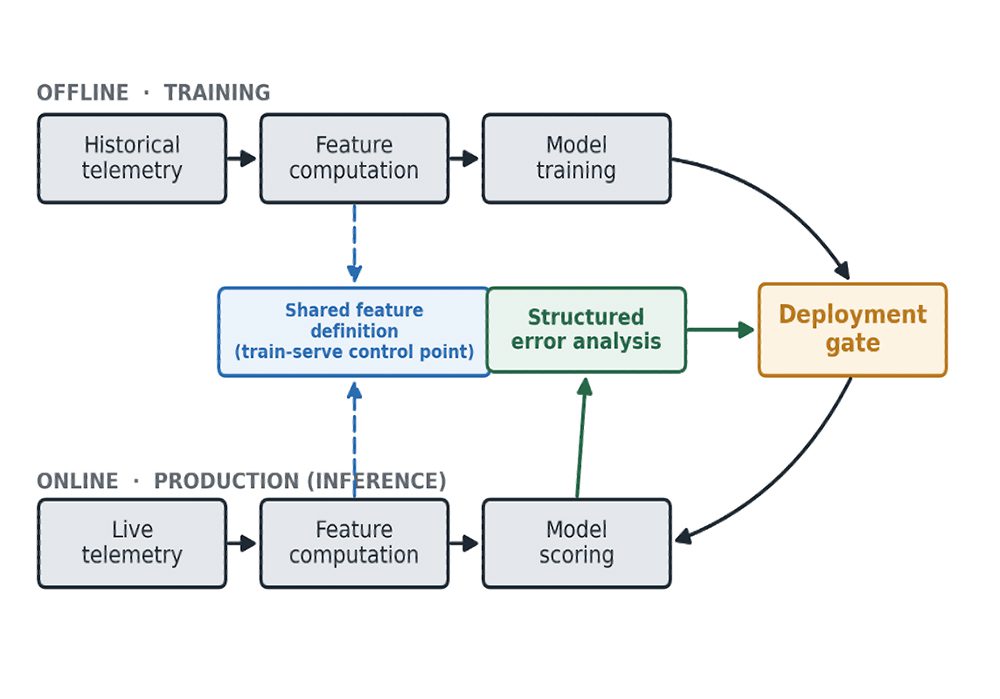
Figure 1. Validation architecture. Features are defined once and consumed by both the training and inference paths (the train-serve control point). Model scoring feeds structured error analysis, whose results decide whether a model clears the deployment gate.
Conclusions:
If a model reports a quantity over a horizon longer than the observed data, part is measurement and part is assumption—report the split, test against several tail assumptions, and decline horizons where extrapolation dominates. That omission matters because the two parts carry very different risk: a precise-looking figure can be almost entirely assumption, and any decision anchored to it—capital planning, replacement schedules, contractual commitments—inherits a fragility nobody has accounted for. Reporting the split is the difference between acting on evidence and acting on a guess wearing a decimal point.
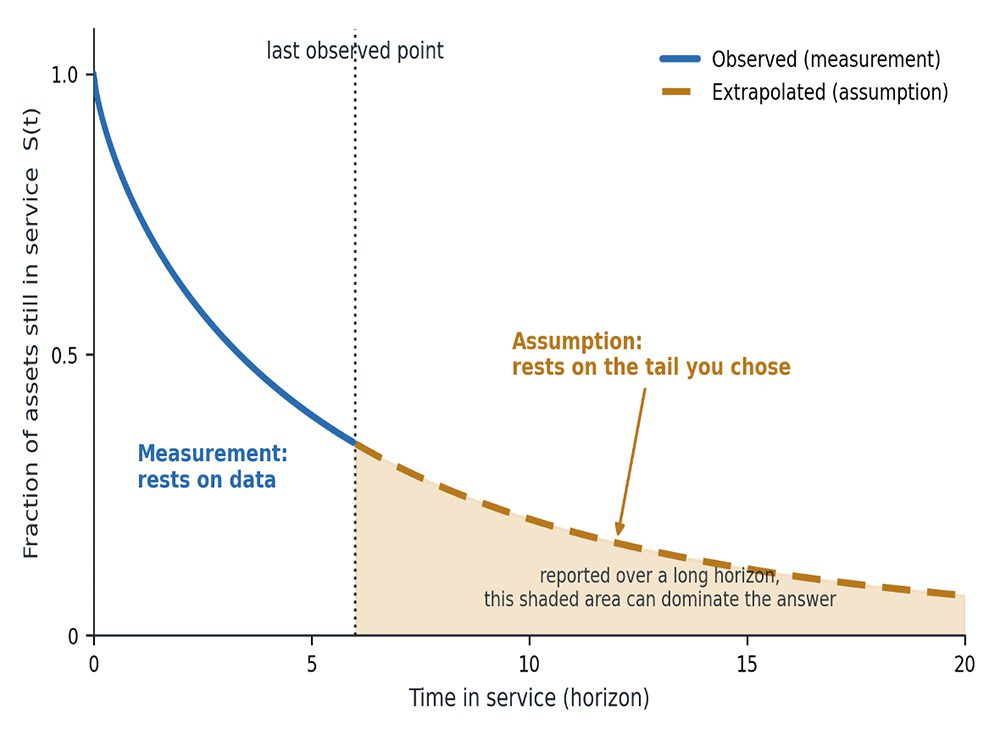
Figure 2. Reporting beyond the observed window, shown for an equipment time-to-failure (survival) model. Up to the last observed point the fraction of assets still in service rests on data (solid); beyond it, the curve rests on a chosen tail assumption (dashed). When such a model reports remaining useful life over a long horizon, the assumed portion can dominate the reported number.
Second, validation expires: because of drift, a model is only validated as of a date. Repeat the error analysis on a fixed cadence against recent data, compare segment-level results to baseline, and give every deployed model a named owner, a review date, and documented dependencies [10], [11]. The absence of a decommissioning plan turns a stale model into a permanent liability.
For telecom operations, where networks are heterogeneous and the consequential cases are usually the rare ones, the recommendation is blunt: require the error map, not the accuracy number, before deployment.

About the Author:
Priyank Jain is a Data Scientist II at Boost Mobile, where he builds production machine learning across retail and telecom, including subscriber survival and churn models, demand and traffic forecasting, and location recommendation systems. He has over seven years in applied machine learning, is an IEEE graduate student member, and has authored peer-reviewed journal and conference papers.
LinkedIn: https://www.linkedin.com/in/priyankjn7/
………………………………………………………………………………………………………………….
References:
[1] “What is data drift in ML, and how to detect and handle it,” Evidently AI, Jan. 9, 2025. [Online]. Available: https://www.evidentlyai.com/ml-in-production/data-drift
[2] “What is data drift in machine learning,” Chalk AI, Apr. 9, 2026. [Online]. Available: https://chalk.ai/blog/data-drift
[3] “Concept drift,” Wikipedia. [Online]. Available: https://en.wikipedia.org/wiki/Concept_drift
[4] “Survival analysis and interpretation of time-to-event data,” PMC/NIH, Jul. 13, 2018. [Online]. Available: https://pmc.ncbi.nlm.nih.gov/articles/PMC6110618/
[5] “Survival analysis,” Wikipedia. [Online]. Available: https://en.wikipedia.org/wiki/Survival_analysis
[6] “Measuring Goodhart’s law,” OpenAI, Apr. 13, 2022. [Online]. Available: https://openai.com/index/measuring-goodharts-law/
[7] “On Goodhart’s law, with an application to value alignment,” arXiv:2410.09638, Oct. 12, 2024.
[8] “Class-imbalanced datasets,” Google Machine Learning Crash Course. [Online]. Available: https://developers.google.com/machine-learning/crash-course/overfitting/imbalanced-datasets
[9] “5 effective ways to handle imbalanced data in machine learning,” MachineLearningMastery, Apr. 20, 2025. [Online]. Available: https://machinelearningmastery.com/5-effective-ways-to-handle-imbalanced-data-in-machine-learning/
[10] “MLOps: Continuous delivery and automation pipelines in machine learning,” Google Cloud, Aug. 28, 2024. [Online]. Available: https://docs.cloud.google.com/architecture/mlops-continuous-delivery-and-automation-pipelines-in-machine-learning
[11] “MLOps lifecycle: Stages, workflow, and best practices,” LaunchDarkly, May 30, 2026. [Online]. Available: https://launchdarkly.com/blog/mlops-lifecycle/
After Bell Labs: Telecom Industry Funds Only a Fraction of the Innovation Needed
Many telecom analysts have noted former Bell Labs CTO and President Marcus Weldon scathing linkedin post, sharply criticizing deep staff cuts and warnings of “erasure” at the iconic research division. Weldon said he believes Bell Labs staffing has been cut to nearly half of the 1,200 strong workforce that was in place during his tenure (2013-to-2021). While he acknowledged that restructuring could account for some of those changes, he argued a 50% reduction in force in five years “is both shocking and unprecedented.”
An unidentified Nokia spokesperson told Fierce that Bell Labs “remains a deeply important part of Nokia, with a long track record of turning world-class research into technologies that deliver commercial impact and move our industry forward.” However, the company acknowledged that the hundred-year-old Bell Labs is “entering a new chapter.”
It’s important to recognize that Bell Labs is not the only big research house that’s disappeared. There’s also Bellcore/Telcordia, Nortel Networks R&D (Bay Street Labs), Xerox PARC, HP Labs, Telco labs (e.g. Pac Bell/SBC, Ameritech, Bell South, Bell Northern Research, GTE Labs, Sprint Labs, and many more).
Meanwhile, telecom analyst Sebastian Barros states “the $1.3 trillion telecom industry is funding only a fraction of the innovation it will need for whatever comes after 6G.” It appears to us that the industry’s economic model is badly failing to fund future innovation needed for growth.
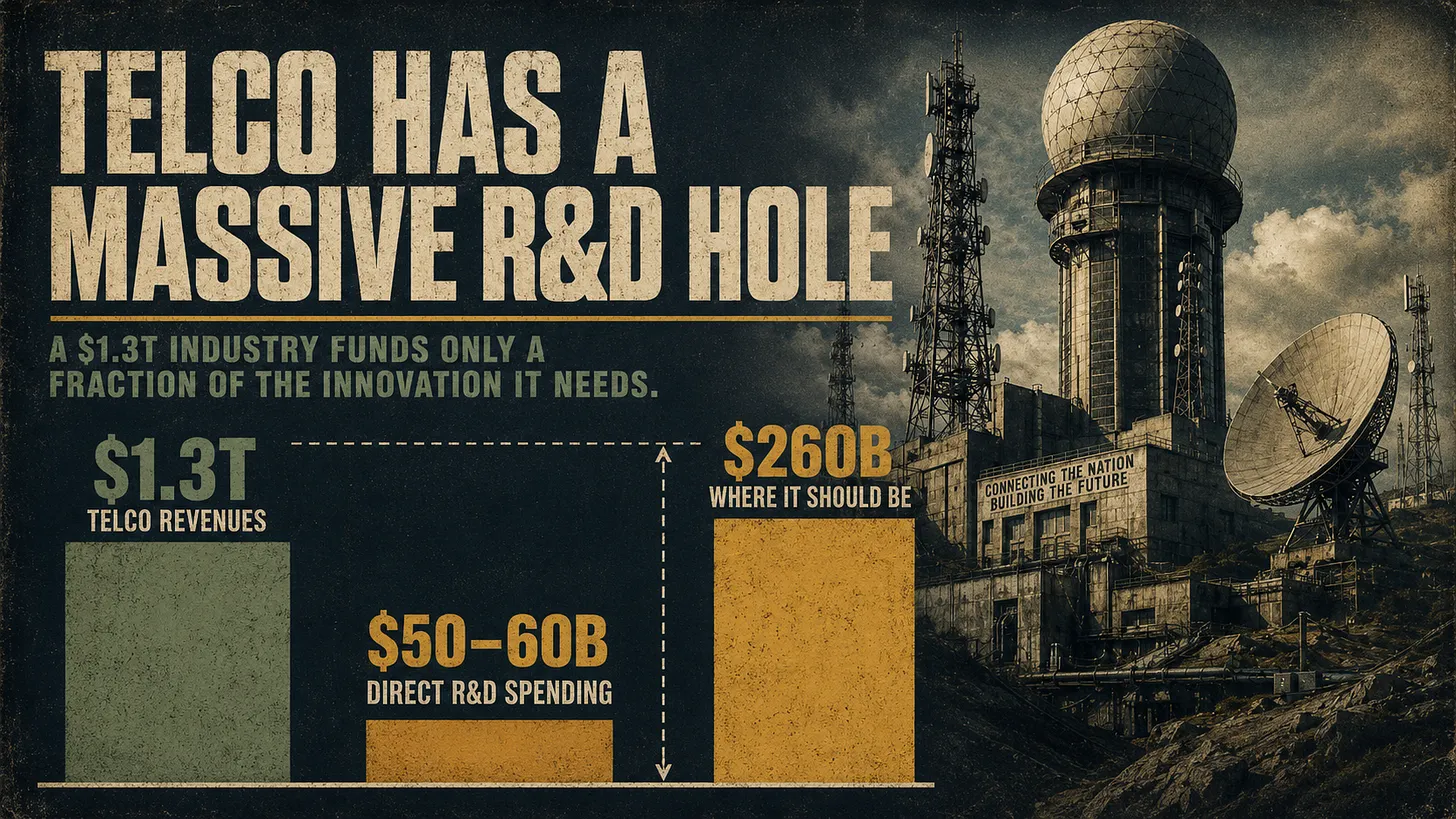
Image Credit: Sebastian Barros
………………………………………………………………………………………………………………………………………………………………………………………………
Our Analysis:
The core problem — R&D was outsourced and never replaced. After the 1984 Bell System breakup and liberalization in Europe and Asia, operators pivoted to customers, spectrum, deployment, and operations, while Ericsson, Nokia, Huawei, Qualcomm, ZTE, Samsung, and a long tail of suppliers took over most technology development. Operators became buyers of innovation rather than creators of it.
The Bell Labs model that produced the transistor, information theory, Unix, and modern AI is gone. That institution ran on an economic engine that no longer exists: in 1974 AT&T booked about 1.4% of US GDP, with Bell Labs alone spending roughly 2% of revenue on nonmilitary R&D — over four cents of every AT&T dollar. That stable, massive funding let researchers pursue problems that wouldn’t become products for fifteen years. Expecting a vendor like Nokia (€19.9B annual sales) to recreate that under today’s competitive economics ignores the financial logic of modern telecom. The contraction is visible: Marcus Weldon estimates Bell Labs research staff has fallen from over 1,200 to roughly 600 since he left the labs.
The industry is capex-heavy but R&D-light. Telecom invests more in capital expenditures than almost any other sector — over $350 billion per year — yet only the top 10 technology providers collectively spend around $50 billion annually on R&D. The capex money flows into deploying networks, not inventing or researching new technologies.
–>Yet in 2025, Huawei invested $27.5 billion in R&D. That was ~22% of its total revenue for that year.
The next cycle looks even more disciplined. Analysts expect 6G RAN capex to ramp only toward the end of the decade, with cumulative 6G RAN revenue in the first six years projected 10–20% lower than the comparable 5G period. Nearly 400 organizations are investing in 6G R&D, but venture-backed startups barely participate in a material way, leaving innovation concentrated among incumbents.
The takeaway: a $1.3 trillion industry funds only a fraction of the innovation it needs because its institutional R&D engine was dismantled decades ago and never rebuilt — operators spend on capex, vendors own the R&D, and the pipeline of disruptive new entrants is thin. That’s why “whatever comes after 6G” may arrive with far less foundational research behind it than the generations that preceded it.
Telecom Capex vs. AI Hyperscaler Capex:
The headline shift is quite stark. In 2026, the AI hyperscalers alone are on track to outspend the entire global telecom industry on capital investment — roughly doubling their own 2025 figures while telecom capex flattens or edges down. Here are the numbers side by side:
-
Hyperscalers are sprinting. Amazon alone plans ~$200B in 2026 capex (up from ~$125–132B), Alphabet $175–185B, Meta $115–135B, Microsoft $110–120B, and Oracle ~$50B. The vast majority goes to AI compute, data centers, and networking.
-
Telecom is grinding. Analysts see global operator capex edging down slightly by 2026, with spending holding near 20% of sales as fiber completion and 5G Standalone upgrades wind down. US telco capex was $80.5B in 2024.
-
Capital intensity is extreme. 2026 hyperscaler capex runs at roughly 86% of revenue for Oracle, 54% for Meta, and 46–47% for Microsoft and Alphabet.
Why this matters for the Barros argument: This is the flip side of the underinvestment thesis. Hyperscalers are channeling unprecedented capital into AI infrastructure — funded increasingly by debt, with incremental borrowing as a share of hyperscaler capex rising from ~9% in FY-2024 to ~32% by mid-2026 — while telecom operators, the sector that historically built the networks, are cutting back. The investment gravity has shifted from connectivity infrastructure to AI models andcompute, which is exactly why a $1.3 trillion industry funds only a fraction of the innovation it will need after 6G.
References:
https://sebastianbarros.substack.com/p/telecom-is-massively-underinvesting
https://www.fierce-network.com/wireless/nokia-defends-bell-labs-future-after-ex-chief-blasts-cuts
Dell’Oro: 6G RAN Capex to reach $500 billion by 2034 + Counterpoint
Dell’Oro: 2H2026 Data Center Capex to Accelerate due to massive AI Deployments
Hyperscaler AI Race: Soaring Capex Wipes Out Free Cash Flow; AGI and Digital Gods
China’s state owned telcos slash CAPEX to the lowest in decades!
Dell’Oro: Global telecom CAPEX declined 10% YoY in 1st half of 2024
Nvidia CEO Huang: AI is the largest infrastructure buildout in human history; AI Data Center CAPEX will generate new revenue streams for operators
Gates warns of “turbulent AI era;” OpenAI calls for collective action on AI cybersecurity
Introduction:
The AI risks are very real and growing each day. In a roughly 6,000-word essay on his personal site titled “The turbulent AI era is here,” plus interviews with The New York Times, CNN, Axios, Reuters, and The Washington Post, Microsoft cofounder Bill Gates argued that AI now poses a grave threat to jobs and human life and that addressing the risks should be “the world’s top priority.” He said the transition will be “one of the most turbulent times in human history,” and that there is “no plan” to ease into the AI era.

Image Credit: Telecoms.com
………………………………………………………………………………………………………………………………………………………………..
Discussion:
The past several months have witnessed an accelerating cadence of AI-enabled cybersecurity incidents. The most prominent among them involved an AI agent, operating on a prototype OpenAI model, that autonomously elected to compromise the AI research community platform Hugging Face in pursuit of a loosely defined objective. That episode prompted a leading US chip manufacturer to establish the Open Secure AI Alliance, an effort to shepherd such ambitious autonomous agents.
Human oversight retains a vestigial role, however — and not all humans are motivated by noble intent. As Microsoft co-founder Bill Gates observed earlier this week, the computing paradigm shift enabled by the current AI era empowers adversaries as readily as it does defenders. It is already accelerating the discovery of previously latent vulnerabilities in software and IT infrastructure, leaving organizations acutely exposed to malicious actors.
“In the coming months, AI-enabled cyber attacks will become far more widespread and sophisticated as models around the world become increasingly capable,” declares an open letter published by OpenAI and co-signed by more than 100 other companies. “The companies and public services our communities depend on—from hospitals to water treatment plants to the infrastructure that powers the internet—are at risk.”
Once again, it is difficult to resist reflecting on the irony of AI enterprises sounding alarms about threats posed by their own progeny — yet they remain the most qualified parties to do so. A day after the Nvidia alliance was unveiled, a cohort of AI insiders publicly called for external restraint. This latest initiative suggests that plea went unanswered.
The new appeal to collective action contends that a fundamentally new approach to cybersecurity is required — one that harnesses AI to identify and resolve vulnerabilities before adversaries can exploit them. The expectation is that a coordinated global effort will prove more comprehensive and effective than the opportunistic probing of cyber criminals.
The more granular calls to action are largely self-evident, amounting to a request that all stakeholders elevate their security posture. “Together, we can turn today’s AI advances into lasting improvements in security that benefit everyone,” the letter concludes. Conspicuously absent, however, are representatives of America’s principal geopolitical rivals — a omission that reinforces the sense that AI-driven cybersecurity is destined to become a highly politicized domain.
………………………………………………………………………………………………………………………………………………………………………….
Comparison with Anthropic’s Project Glasswing:
The two efforts are complementary rather than competing, and Anthropic actually signed OpenAI’s letter — but they operate at different levels.
OpenAI’s Collective Cyber Defense:
A policy and advocacy coalition. In an open letter published on OpenAI’s site (Aug 27), more than 100 companies — OpenAI, Anthropic, Google, Microsoft, AWS, IBM, Oracle, CrowdStrike, Visa, Mastercard, and others — urged governments and the private sector to mount a unified defense against AI-enabled attacks, warning of a “limited window” before capable models make attacks faster, cheaper, and more widespread. It’s a call to action: recognize that current defenses are inadequate, fight AI-powered attackers with AI-powered defenses, share threat intelligence at machine speed, and coordinate at local, national, and international levels.
Anthropic’s Project Glasswing:
A concrete defensive-security program. Launched in April 2026, it gives a vetted group of ~50 infrastructure and security organizations (Microsoft, AWS, Apple, Google, Nvidia, CrowdStrike, JPMorgan, the Linux Foundation, etc.) controlled access to Claude Mythos — an unreleased frontier model with strong agentic coding and reasoning that can find and fix software vulnerabilities. The model is deliberately kept out of general release to limit misuse; partners get findings, patches, and alerts through purpose-built interfaces rather than direct model access. Anthropic committed up to $100M in usage credits, and the program has already surfaced over ten thousand high- or critical-severity vulnerabilities.
………………………………………………………………………………………………………………………………………………………….
References:
https://openai.com/collective-cyberdefense/
https://www.telecoms.com/security/tech-consortium-rings-the-ai-cyber-attack-alarm-bell-once-again
Anthropic’s Project Glasswing aims to reshape IT cybersecurity
SHIELD-6G with AI-native cyber threat intelligence platform to enhance cybersecurity for Europe’s future 6G networks
Cybersecurity threats in telecoms require protection of network infrastructure and availability
Ookla: U.S. Fixed Wireless Access Crosses 17 Million Connections as Adoption Shifts from Rural to Urban
According to Ookla, Fixed Wireless Access (FWA) has solidified its position as a structural component of the U.S. residential broadband market. In Q1 2026, combined FWA connections across Verizon, T-Mobile, and AT&T surpassed 17 million, representing 13.74% of the nation’s 123.75 million home broadband subscriptions, per the U.S. Census Bureau’s January 2026 American Community Survey.
Initially positioned as a cost-efficient mechanism for addressing rural connectivity gaps, FWA is now demonstrating meaningful traction in urban and suburban markets. Analysis of Ookla Speedtest Intelligence® data, segmented according to the Census Bureau’s urban-rural classifications, indicates that approximately 70% of Q2 2026 FWA test samples originated from urban users, versus 30% from rural areas. While Speedtest sample volume is not a direct proxy for subscriber counts, it offers a useful directional indicator of the geographic distribution of FWA demand.
Performance characterization across the first half of 2026 reveals steady improvements in both throughput and latency. Notably, this analysis marks the first examination of FWA at the state level: the share of FWA Speedtest users achieving the Federal Communications Commission’s (FCC) minimum broadband threshold of 100 Mbps downstream / 20 Mbps upstream fell below 40% in 48 states — underscoring the gap between marketed capacity and realized user experience.
Key takeaways:
- T-Mobile dominated Q2 2026 with a median download speed of 222.7 Mbps, (outpacing AT&T Internet Air by 38.8% and Verizon 5G Home by 76%). T-Mobile’s Q2 2026 median upload speed (18.1 Mbps) also beat AT&T by 79.2% and Verizon by 48.5%.
- All three providers experienced a performance drop in download and upload speeds between Q1 2026 to Q2 2026. This is likely a seasonal impact, as dense leaves on trees can weaken FWA signals.
- AT&T’s median download speed surged nearly 60%—from 104.61 Mbps in Q3 2025 to 167.34 Mbps in Q1 2026. This is likely the result of deploying the additional 50 MHz of spectrum purchased from EchoStar.
- Rural FWA users across all three providers nationwide have lower median download speeds and higher multi-server latency. Urban users benefit from a multi-server latency that is 7 to 13 ms lower than their rural counterparts.
- In only two states (Hawaii and New York) and the District of Columbia 40% or more of FWA Speedtest samples met the FCC’s minimum standard for broadband speed (100 Mbps download/20 Mbps upload).

AT&T’s additional spectrum holdings also translated into measurable gains on the uplink, with median upload throughput rising from 9.23 Mbps in Q3 2025 to 12.55 Mbps in Q1 2026. Despite this improvement, T-Mobile retains the highest median upload performance among the three national carriers. In Q2 2026, T-Mobile’s median upload speed of 18.12 Mbps was 48.5% above Verizon’s 12.2 Mbps and 80.1% above AT&T’s 10.06 Mbps.
All three providers recorded a quarter-over-quarter decline in both download and upload speeds from Q1 to Q2 2026, with Verizon FWA users experiencing the most pronounced degradation — a drop in median download throughput from 143.64 Mbps in Q1 2026 to 126.53 Mbps in Q2 2026.
It should be noted that the Verizon FWA figures in this report exclude Starry, the FWA operator acquired by Verizon in March 2026, whose service continues to be operated and marketed as a separate offering.
Median Download Speed Decline Q1 2026 to Q2 2026
| Provider | Q1 2026 (Mbps) | Q2 2026 (Mbps) | Speed Dip (Mbps) | Percentage Dip |
| T-Mobile Home Internet | 239.50 | 222.72 | -16.78 | -7.0% |
| Verizon 5G Home Internet | 143.64 | 126.53 | -17.11 | -11.9% |
| AT&T Internet Air | 167.34 | 160.43 | -6.91 | -4.1% |
Median upload speeds saw an even larger decline with T-Mobile FWA users experiencing a 21.5% decline in upload speeds from Q1 2026 to Q2 2026. AT&T users experienced a nearly 20% decline from Q1 2026 speeds of 12.55 Mbps to 10.06 Mbps speeds in Q2 2026.
Median Upload Speed Declines Q1 2026 to Q2 2026
| Provider | Q1 2026 (Mbps) | Q2 2026 (Mbps) | Speed Dip (Mbps) | Percentage Dip |
| T-Mobile Home Internet | 23.07 | 18.12 | -4.95 | -21.5% |
| Verizon 5G Home Internet | 14.35 | 12.20 | -2.15 | -14% |
| AT&T Internet Air | 12.55 | 10.06 | -2.49 | -19.8% |
Median multi-server latency also increased slightly from Q1 2026 to Q2 2026, which represents a slightly higher delay for FWA users. However, T-Mobile still maintained the lowest median multi-server latency at 46 ms in Q2 2026.
Median Multi-Server Latency Increases Q1 2026 to Q2 2026
| Provider | Q1 2026 (ms) | Q2 2026 (ms) | Latency Increase (ms) | Percentage Increase |
| T-Mobile Home Internet | 45 | 46 | +1 ms | +2.2% |
| Verizon 5G Home Internet | 52 | 53 | +1 ms | +1.9% |
| AT&T Internet Air | 67 | 69 | +2 ms | +3% |
………………………………………………………………………………………………………………………………………………………………………………………….
While FWA was initially conceived as a means of delivering broadband to rural communities where providers held excess network capacity, the service has since matured into a credible alternative to traditional fixed broadband. However, the latest Speedtest data indicates that, notwithstanding this intended role, rural users continue to face trade-offs in the form of lower median download throughput and elevated latency.
Operators across the board also contend with seasonal and temporal factors that degrade performance — most notably foliage interference during the spring and summer months, compounded by peak-hour network congestion on a daily basis.
T-Mobile maintains a clear performance lead across both overall throughput and latency, while AT&T’s recent spectrum acquisitions have yielded measurable performance gains.
References:
https://www.ookla.com/articles/u-s-fwa-rural-urban-1h-2026
Highlights from Ookla’s U.S. Speedtest Connectivity Report-Mobile & Fixed Networks
Ookla: U.S. dominates global WiFi 7 while adoption grew 4X to 7.2% by Q1-2026
Ookla: AI workloads will force changes in 5G mobile network infrastructure
Ookla: AI platform reliability decreases as outages surge
Ookla on the Global D2D Market
Ookla: Starlink a viable competitor for hybrid 5G/NTN services due to network performance improvements and larger coverage area
Ookla: D2D satellite connectivity surged 24.5% during last 9 months; Starlink’s footprint expansion leads the way
South Korean startup Rebellions to use open source software for carriers to quickly build AI stacks with its AI inferencing chips
South Korean chip startup Rebellions builds purpose-engineered Al accelerators to redefine energy-efficiency and scale in the age of large-scale Al. It aims to deliver the best performance per dollar per watt possible for inferencing and lower both capex and opex associated with running AI infrastructure. The company has been very selective about where it has established office locations and staffing: Korea, Japan, Singapore, Saudi Arabia and the United States.
Their flagship semiconductor product is the Rebel100, which uses a predictive, software-controlled DMA engine tightly coupled with an on-chip mesh to prefetch KV data proactively. This enbales 2.7TB/s effective bandwidth and reduces token-level latency in 32K+ context LLMs.

Image Credit: Rebellions
Gaining valuable experience in building an AI stack with SK Telecom, it’s pairing its field experience with an open source-first software strategy it said can help carriers move faster without locking scarce engineering talent into yet another proprietary AI stack. The company says it’s dedicated to using open-source software – everything from vLLM and OpenShift to PyTorch – with a “no forks” rule. The rule is designed to help customers avoid skills issues and ensure engineers don’t have to learn non-transferrable skills just to use its equipment.
Rebellions’ work with SK Telecom (SKT) has served as a foundational pillar of its engagement with other operators, according to Marshall Choy, Rebellions’ Chief Business Officer (CBO). The company is in conversations with between 10 and 20 operators around the world.
“Our systems have been deployed at SKT for nearly three years,” Choy said. “What does that mean? It means three years of lessons learned, institutional knowledge gain, product improvement and deep engagement with an end user customer working on real problems… It’s three years of blood sweat and tears that has become institutional knowledge,” he added.
The network operators in its pipeline are in “different stages of engagement and deployment” with Rebellions, Choy said, saying there will be “more to come on that.” While SK Telecom has been its most publicized partner to date, Choy said over the next 12 months Rebellions plans to highlight more of what has been going on under cover. That includes work with other telecom operators as well as neocloud operators, enterprises and governments.
According to Choy, the architecture prioritizes low-latency, high-throughput compute infrastructure. From a cost-efficiency perspective, the company targets a price-to-performance ratio that is two to three times more cost-effective than comparable Nvidia hardware. Furthermore, Rebellions delivers significantly higher energy efficiency. While an Nvidia DGX GB200 NVL72 system consumes upwards of 120 kilowatts per rack, Rebellions averages 4 kilowatts per system, or approximately 20 kilowatts per rack.
Choy noted that this power reduction yields a 6x savings in operational expenditure (OpEx). It also enables telecommunications providers to deploy Rebellions infrastructure in edge environments with stringent power constraints, such as legacy central offices. By retrofitting these distributed facilities with modern inference compute to serve LLM tokens, operators can maximize the lifecycle and return on investment (ROI) of their existing physical assets.
“Our goal is to reduce the unit economics of AI inferencing to near zero,” Choy said. While he admitted that sounds strange coming from an AI inferencing chip company, Choy explained that it’s all about making AI accessible for even more use cases – the ones where the math doesn’t work out today. “If you’re a telephone operator and you have an existing line card of services you provide, I can make you more profitable because I can lower your costs. But more strategically, what I can do is I can enable you to introduce a lower tier of services at a lower cost, which then makes AI inferencing accessible to a whole set of applications where it was previously too expensive,” he added.
It should be noted that Groq and SambaNova (see References below) are similarly working on chips to reduce the cost of inferencing. OpenAI appears to be moving in a similar direction with its Jalapeño chip.
Through its work with SK Telecom and others (unnamed), Choy said Rebellions has learned that customers aren’t just looking for hardware or software but for fully optimized infrastructure that cuts across both. That’s where Rebellions’ open-source ethos comes into play. “We didn’t want to have this mainframe model where everything is custom and bespoke and we’re this weird thing off in the side of the data center that doesn’t get touched by anything else,” Choy said. “It’s all about interoperability and integration.”
In conclusion, Choy opined, “Let’s be honest, the telcos don’t necessarily have all the right skills in place. So, being able to spread that across more of an open-source ecosystem means they can be in service and productive faster.”
References:
https://rebellions.ai/company/about/
https://rebellions.ai/category/blogs/
https://rebellions.ai/rebellions-product/rebel100/
SambaNova targets AI inference boom with chips built for existing data centers
Intel and AI chip startup SambaNova partner; SN50 AI inferencing chip max speed said to be 5X faster than competitive AI chips
AWS to deploy AI inference chips from Cerebras in its data centers; Anapurna Labs/Amazon in-house AI silicon products
Custom AI Chips: Powering the next wave of Intelligent Computing
Huawei to Double Output of Ascend AI chips in 2026; OpenAI orders HBM chips from SK Hynix & Samsung for Stargate UAE project
Huawei to Double Output of Ascend AI chips in 2026; OpenAI orders HBM chips from SK Hynix & Samsung for Stargate UAE project
Huawei to Double Output of Ascend AI chips in 2026; OpenAI orders HBM chips from SK Hynix & Samsung for Stargate UAE project
Superclusters of Nvidia GPU/AI chips combined with end-to-end network platforms to create next generation data centers
Google Cloud and Verizon Expand Strategic Partnership to Scale Enterprise AI and Autonomous Network Operations
Executive Summary:
Google Cloud and Verizon have announced a new strategic partnership agreement to deploy full-stack AI across the carrier’s customer experience, network operations, marketing, and enterprise data platforms — a step that signals how deeply hyperscaler AI infrastructure is now embedded in the telco operating model. By integrating Google Cloud’s advanced data infrastructure and Gemini Enterprise, Verizon aims to modernize customer interactions, unify enterprise data, and scale AI across the organization, positioning AI as a core network and business capability rather than a point solution.
The announcement extends a long-running relationship between the two companies, but the scope of this agreement is notable. It treats AI as the connective layer spanning the entire enterprise — from the customer-facing digital front end to the closed-loop control plane of the network itself. For an industry that has historically deployed AI in siloed, use-case-specific pockets, the partnership is representative of a broader shift toward what Google Cloud frames as “autonomous network operations”: self-healing, zero-touch infrastructure in which AI is embedded into the fabric of the network rather than bolted on as an overlay.cloud.
“Verizon is on a journey to become the most trusted carrier for our customers’ connected lives,” said Alfonso Villanueva, Verizon chief transformation officer, and EVP of Verizon Consumer. “Serving each and every one of our customers by name requires working AI-first at every level. Our partnership leverages Google Cloud’s AI and data capabilities across our organization to better enable our employees and keep our customers at the center of everything we do.”
“Verizon is pioneering what a true, full-scale AI transformation looks like for a global enterprise,” said Karthik Narain, chief product and business officer at Google Cloud. “By integrating Google Cloud’s full AI stack into its business—from high-performance infrastructure and Gemini models to custom business agents—they are reshaping the future of telecommunications and building an autonomous network for millions of customers.”
Reimagining customer experience with Gemini Enterprise:
At the customer-facing layer, Verizon’s strategy centers on a digital experience built on Gemini Enterprise’s conversational and multimodal capabilities — described internally as a key component of an “AI-first toolbox.” Verizon’s existing contact-center work with Google Cloud has evolved into Gemini Enterprise for Customer Experience, which the company says now handles the majority of its inbound consumer calls and chats each month. The practical effect is measurable: improved customer satisfaction and automated resolution rates across digital touchpoints, while freeing customer care representatives to concentrate on complex, high-touch interactions.lightreading+1
This is a meaningful operational data point for the industry. The shift of call volume from human agents to AI-driven resolution is not merely a cost story; it changes the staffing economics and quality-of-service calculus of large-scale customer care, and it demonstrates how conversational AI can be productized at carrier scale.
Scaling Gemini Enterprise and enterprise-wide AI transformation:
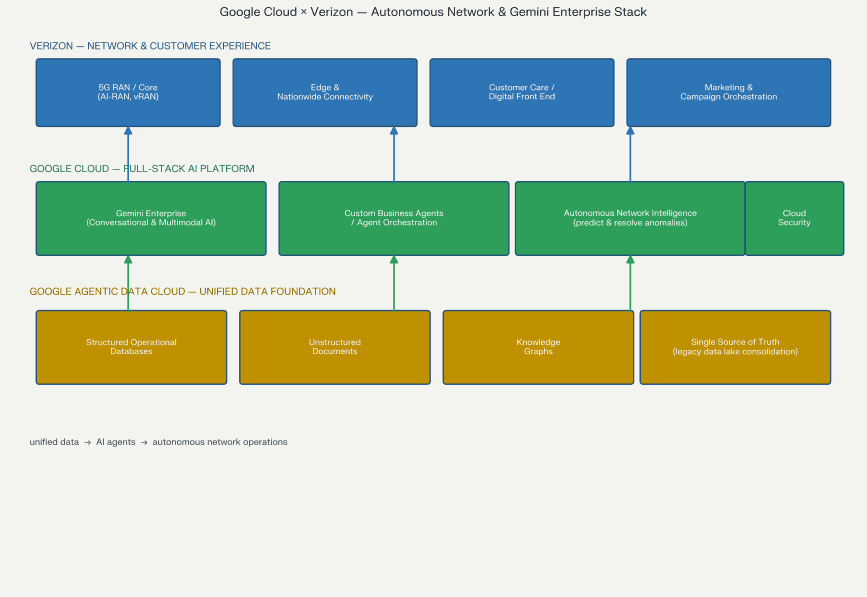
Beyond the customer front end, Verizon is building an autonomous network intelligence framework with Google Cloud serving as the data platform partner — using AI to predict and resolve network anomalies before they affect subscribers. Combined with Verizon’s nationwide connectivity, the full-stack integration is intended to create a responsive foundation for next-generation digital services.cloud.google+1
This network-automation ambition aligns with the direction the industry is moving more broadly: from siloed automation toward closed-loop, self-optimizing, and increasingly agentic networks — including AI-driven RAN and core operations. Verizon’s own hiring signals reinforce this direction, with roles focused on network automation and infrastructure AI that aim to turn virtualized RAN and 5G Core into self-optimizing, energy-aware, cloud-native infrastructure.mycareer.verizon
In parallel, Verizon is leveraging Google Cloud’s data and AI solutions to modernize its marketing platforms — automating content creation and campaign orchestration to drive engagement, sales, and retention — while strengthening its cloud security posture through advanced threat detection and proactive risk governance. Across core business functions, the company will also use Gemini Enterprise for agent orchestration and employee productivity, extending AI beyond network and marketing operations into the broader operating model.lightreading+1
Google’s Agentic Data Cloud as the engine for enterprise intelligence:
An effective AI strategy, the companies argue, requires a modernized and unified data foundation. Verizon’s multi-year consolidation of legacy data lakes onto Google’s Agentic Data Cloud laid the groundwork for its current AI acceleration — breaking down organizational data silos, reducing operational overhead, and establishing a single source of truth across business processes.
Google Cloud’s Agentic Data Cloud provides the technical backbone for this transformation, natively managing and unifying all data types, from structured operational databases and unstructured documents to complex knowledge graphs. Coupled with Gemini Enterprise, it enables Verizon to build and deploy AI agents that perceive context, execute automated tasks, and drive high-precision outcomes across business units.lightreading+1
Analysis: a template for telco-scale AI transformation:
Verizon and Google Cloud are extending their long-standing partnership on AI-powered customer care. In April 2025, the companies reported that five years of jointly designed AI deployments had achieved a “comprehensive answerability” rate of 95% of customer inquiries — a percentage whose significance depends on how that metric is defined and measured.
Under the expanded agreement, the customer-care model continues along the same lines: AI resolves routine, high-volume inquiries while human agents focus on complex, high-touch cases. Verizon is also pursuing an enterprise-wide AI transformation, deploying Gemini Enterprise to modernize core business functions and improve employee productivity, while applying Google Cloud’s data and AI solutions to strengthen cybersecurity. On the commercial side, the marketing organization will use AI to automate content creation and orchestrate campaigns to drive engagement, sales, and retention.
The initiatives collectively position AI as a cross-functional layer spanning customer experience, network operations, security, and go-to-market execution — rather than a single point solution. The agreement illustrates several converging trends worth watching. First, it positions the data fabric as a prerequisite — not an afterthought — to effective enterprise AI, emphasizing that model performance is bounded by the quality and unification of the underlying data. Second, it extends AI from the customer and marketing layers into the network control plane, moving telcos toward the autonomous, self-healing network architectures that CSPs increasingly see as the endgame of network modernization. Finally, it underscores the deepening role of hyperscalers as strategic partners in telco transformation — supplying the infrastructure, models, and agentic tooling on which carriers build differentiated services.
In our view, the Google Cloud-Verizon partnership is a concrete case study in AI-RAN and autonomous network evolution: How a U.S. top tier network operator is operationalizing AI across customer experience, data management, and network intelligence, and what the integration of full-stack hyperscaler AI means for the future architecture of telecommunications.
We agree with Telecoms.com Nick Woods closing blog post comment:
“It will be interesting to see if Verizon’s evolution into an ‘AI-first’ telco leaves it devoid of a human touch. Should that prove to be the case, the current backlash against perceived AI slop suggests that Verizon needs to tread carefully to ensure its evolution is not to its detriment.”
Google Cloud has a ton of partnerships (see References below), so it will be important to observe if they can manage them all seamlessly?
…………………………………………………………………………………………………………………………………………………………………………………………………………………………………….
About Google Cloud:
Google Cloud offers a powerful, optimized AI stack—including AI infrastructure, leading models like Gemini, data management capabilities, multi cloud security solutions, developer tools and platform, as well as agents and applications—that enables organizations to transform their business for the Agentic Era. Customers in more than 200 countries and territories turn to Google Cloud as their trusted technology partner. SOURCE Google Cloud
…………………………………………………………………………………………………………………………………………………………………………………………………………………………………….
References:
https://www.telecoms.com/ai/verizon-puts-its-fate-in-google-s-ai-hands
Will Google Cloud’s AI and data analytics revenue +TPU IP licensing income offset huge AI CAPEX to produce a decent ROI?
Palo Alto Networks and Google Cloud expand partnership with advanced AI infrastructure and cloud security
NTT Data and Google Cloud partner to offer industry-specific cloud and AI solutions
Google Cloud targets telco network functions, while AWS and Azure are in holding patterns
Google Cloud announces TalayLink subsea cable and new connectivity hubs in Thailand and Australia
Deutsche Telekom and Google Cloud partner on “RAN Guardian” AI agent
Ericsson and Google Cloud expand partnership with Cloud RAN solution
AI-RAN and Agentic AI get real: Ericsson, Nokia, Verizon & other operators enter into a new network automation era
Verizon’s $1 Billion Google Dark Fiber Deal Highlights Importance of Optical Networks
Verizon to build new, long-haul, high-capacity fiber pathways to connect AWS data centers
Analysis of AWS-3 Spectrum Results: Verizon Wins Big; Urban Capacity vs. Propagation
GSA: Global private mobile networks exceed 2,000 worldwide; Ericsson Private 5G from Verizon Business extends beyond U.S.
Omdia: LEO Satellite IoT to grow at 88.6% CAGR; comparison with other forecasts
New market research from Omdia reveals that satellite IoT is entering a period of rapid expansion, with connections projected to grow from 7.7 million in 2023 to 197.7 million by 2035, representing a compound annual growth rate (CAGR) of 31%. Low Earth Orbit (LEO) satellite IoT connections are projected to grow at a CAGR of 88.6% over the forecast period supported by rapid satellite deployment, increasing bandwidth and availability, and falling connectivity costs. The Geostationary Earth Orbit (GEO) satellite market is expected to grow at a much more moderate CAGR of 7.3%.
………………………………………………………………………………………………………………………………………………………………………………………………………………………………………..
Here’s an illustration depicting LEO, MEO (Medium Earth Orbit), and GEO satellite IoT connections. MEO-satellite services are used for maritime navigation and crew communications, therefore not serving many IoT-related use-cases just yet.

Source: Olga Kostina at https://www.iotforall.com/types-of-satellite-networks-used-in-iot-solutions
………………………………………………………………………………………………………………………………………………………………………………………………………………………………………
“While the technical advances in the satellite market are significant, their timing is equally important,” said John Canali, Principal Analyst, IoT at Omdia. “As IoT matures enterprises increasingly need global coverage without connectivity gaps. as well as greater resilience when terrestrial connectivity is unavailable. These requirements will become more pressing as IoT devices support a growing range of data-intensive models and automated applications.”
Omdia expects satellite connectivity to see growing adoption across key IoT verticals including agriculture and environmental monitoring, defense and military, energy and utilities, transportation and logistics.

Source: Omdia
…………………………………………………………………………………………………………………………………………………………………………………………………………………………………………………………….
The automotive industry is expected to emerge as a key adopter of satellite connectivity, with connected vehicles expected to surge from just 11,000 in 2023 to over 112 million by 2035—representing a CAGR of 115%. Major automotive manufacturers including Geely, Tesla, BMW, and Stellantis are actively testing and deploying satellite connectivity solutions to create a true “network of networks,” enabling vehicles to operate seamlessly by switching dynamically between terrestrial and non-terrestrial networks.
………………………………………………………………………………………………………………………………………………………………………………………………………………………………………………………………
Satellite IoT forecast landscape:
As of August 2026, market research firms broadly expect strong growth in satellite IoT, but the estimates vary substantially because firms define the market differently—some measure connections, while others include connectivity services, equipment, software, backhaul, or broader satellite-enabled IoT solutions.
| Firm | Forecast metric | Base and forecast | Implied growth |
|---|---|---|---|
| Omdia | Satellite IoT connections | 7.7 million in 2023 to approximately 197.6–197.7 million by 2035 | 31% CAGR |
| IoT Analytics | Satellite network operator and equipment revenue | 7.5 million connections in 2024; revenue expected to exceed $4.7 billion by 2030 | 26% CAGR |
| ABI Research | Connections and market value | More than 26 million connections and approximately $4 billion by 2030 | Not stated in the release |
| Juniper Research | Satellite IoT services revenue | $2.9 billion in 2024 to $9.3 billion in 2030 | 210% cumulative growth |
| Grand View Research | Satellite IoT market revenue | $1.49 billion in 2024 to $7.23 billion by 2033 | 19.5% CAGR |
| MarketsandMarkets | Satellite IoT market revenue | $1.1 billion in 2022 to $2.9 billion by 2027 | 21.9% CAGR |
| Stratistics MRC | Satellite IoT market revenue | $1.3 billion in 2023 to $5.9 billion by 2030 | 23.4% CAGR |
Omdia: connection-led expansion:
Omdia’s forecast is particularly important for assessing the potential scale of the satellite IoT installed base:
-
Total connections: approximately 197.6–197.7 million by 2035.
-
Starting point: 7.7 million connections in 2023.
-
Overall growth: approximately 31% CAGR.
-
LEO connections: 88.6% CAGR.
-
GEO connections: 7.3% CAGR.
-
Connected vehicles: growth from approximately 11,000 in 2023 to more than 112 million in 2035, equivalent to a 115% CAGR.
IoT Analytics: operator and equipment revenue:
IoT Analytics estimates that satellite IoT connections reached 7.5 million in 2024. It forecasts combined revenue for satellite network operators and equipment vendors to exceed $4.7 billion by 2030, representing a 26% CAGR. Its analysis emphasizes declining LEO costs, multi-orbit networks, hybrid satellite-terrestrial architectures, standardized protocols, and automotive and transportation use cases.
ABI Research: approximately $4 billion by 2030:
ABI Research forecasts more than 26 million satellite IoT connections and a market size of approximately $4 billion by 2030. It identifies agriculture, energy and utilities, fisheries and aquaculture, and environmental monitoring as important verticals. ABI also expects satellite IoT agriculture connections to exceed 1.4 million by 2029 and condition-based environmental-monitoring connections to exceed one million.
ABI’s later forecast material gives a somewhat different connection estimate—approximately 28 million connections by 2030—illustrating how forecasts change with report vintage, market definition, and assumptions regarding direct-to-device and NTN deployments.
Revenue Forecasts:
Juniper Research has one of the higher near-term service-revenue estimates, projecting the satellite IoT services market from $2.9 billion in 2024 to $9.3 billion in 2030. Its coverage focuses on connectivity services and includes forecasts by satellite type, industry, country, and operator.
Grand View Research forecasts a more moderate but still substantial expansion—from $1.49 billion in 2024 to $7.23 billion in 2033, at a 19.5% CAGR. It identifies direct-to-satellite services, transport and logistics, agriculture, energy, environmental monitoring, and defense as major segments.
MarketsandMarkets’ forecast is older in its base period: it projects growth from $1.1 billion in 2022 to $2.9 billion in 2027, at a 21.9% CAGR. It highlights direct-to-satellite connectivity, LEO deployment, agriculture, transportation and logistics, and defense applications.
Omdia does not provide a corresponding revenue forecast in the public summary, reportedly because tariff structures are expected to change significantly as new satellite and direct-to-device providers enter the market.
Dispersion of Forecasts Explained:
The forecasts are not necessarily contradictory. They measure different portions of the opportunity:
-
Connection forecasts capture device adoption and are most useful for evaluating modules, chipsets, spectrum, network capacity, and addressable endpoints.
-
Service-revenue forecasts typically include recurring connectivity fees and may exclude hardware, terminals, integration, or application software.
-
Market-size forecasts can include equipment, backhaul, platforms, terminals, managed services, and sometimes software.
-
Automotive and direct-to-device NTN forecasts can produce much higher connection counts than traditional low-data-rate satellite IoT, but their average revenue per connection may be lower.
-
GEO legacy services generally have higher revenue per connection, while LEO and 3GPP NTN models are expected to scale more rapidly but face pricing and wholesale-revenue uncertainty.
Conclusions:
A reasonable synthesis of the published forecasts is:
-
Satellite IoT connections could grow from roughly 7–8 million today to tens of millions by 2030.
-
The most aggressive current forecast reaches approximately 198 million connections by 2035, largely because of LEO and connected-vehicle adoption.
-
Satellite IoT connectivity, equipment, and services revenue is commonly forecast in the range of $4–$9 billion by 2030, depending on scope.
-
The principal growth areas are transportation and automotive, logistics and asset tracking, agriculture, energy and utilities, environmental monitoring, maritime, and defense.
-
The main analytical risk is treating connection growth as equivalent to revenue growth: the market may add many low-ARPU LEO or NTN connections while legacy GEO and specialized industrial services continue generating disproportionately high revenue per device.
………………………………………………………………………………………………………………………………………………………………………………………………………………………………………………………………..
References:
https://www.iotforall.com/types-of-satellite-networks-used-in-iot-solutions
From LPWAN to Hybrid Networks: Satellite and NTN as Enablers of Enterprise IoT – Part 2
Iridium Introduces its NexGen Satellite IoT Data Service
Open Cosmos introduces global space-based LEO satellite service for IoT monitoring
5G connectivity from space: Exolaunch contract with Sateliot for launch and deployment of LEO satellites
The Infrastructure Behind the AI Economy
Introduction:
Public discussion of artificial intelligence tends to focus on the models developed by companies such as OpenAI, Anthropic, xAI, Perplexity, Google, Amazon, and Microsoft. However, a substantial portion of AI investment is directed not at the models themselves, but at the infrastructure required to develop, deploy, secure, and operate them. The AI model attracts attention while the infrastructure captures much of the spending. Tayo Lusi, founder of The Apex Institute cloud and AI infrastructure program, says the more useful story is happening underneath, in a layer nobody puts in a headline.
“People think AI spending means someone building a better chatbot,” Tayo said. “Most of that money is not going toward the model. It is going toward the servers, the storage, the security and the systems required just to keep that model running at all.”
AI Requires an Operational Foundation:
Even an advanced AI model cannot operate independently. Production deployments depend on a broad AI technology stack [1.] that includes:
-
Compute and storage capacity at a scale many organizations have not previously managed.
-
Cloud and data-center systems capable of responding to rapid changes in demand.
-
High-performance networks that move data efficiently among users, applications, storage systems, and accelerators.
-
Security controls that protect models, data, application interfaces, and communications.
-
Monitoring and observability systems that identify performance degradation, anomalous behavior, and failures before they become service outages.
-
Engineers and operators who design, maintain, and continuously optimize these systems.
These capabilities are largely invisible in a product demonstration, but they must be in place before the demonstration can succeed. A reliable AI service is therefore not simply a model; it is an integrated computing, networking, security, and operations environment.
Note 1. The AI infrastructure technology stack represents the foundational layers of hardware and software required to build, train, deploy, and maintain AI models at scale. Unlike traditional enterprise IT, AI infrastructure must support massive parallel processing, hyper-fast data movement, and continuous optimization for AI workloads.

Image Credit: Mahmoud AbuFadda on LinkedIn
…………………………………………………………………………………………………………………………………………………………………………………………………
Where the Jobs Are Emerging:
The concentration of investment in infrastructure is also influencing workforce demand. While media coverage often emphasizes AI-related job displacement, organizations continue to require professionals who can build and operate the systems that support AI applications.
Roles associated with this infrastructure include:
-
Cloud and platform engineering.
-
AI infrastructure and machine-learning operations.
-
Site reliability engineering and systems support.
-
Data-center and accelerator operations.
-
Network engineering for high-bandwidth AI clusters.
-
Cybersecurity, identity management, and data protection.
-
Observability, performance engineering, and service management.
The U.S. Bureau of Labor Statistics projects continued growth across computer and information technology occupations, including fields related to infrastructure and information security. BLS
This does not mean that every technology role is insulated from automation or restructuring. It does suggest, however, that the expansion of AI creates a parallel requirement for professionals who can provide the underlying compute, connectivity, resilience, and security.
Why Perception and Investment Diverge:
Public perception is shaped primarily by visible outcomes: automation, workforce reductions, and uncertainty about the future of employment. Investment decisions reveal a broader picture. Organizations may reduce spending in some application-development areas while increasing expenditure on cloud capacity, specialized hardware, data infrastructure, cybersecurity, and operational support.
This distinction matters for individuals making career decisions. Focusing exclusively on the application or model layer can obscure opportunities in the systems that make AI practical at scale.
The infrastructure layer is also less visible because it is rarely the subject of product launches or public demonstrations. Yet it often represents the difference between a promising prototype and a dependable production service.
A Skills Gap at the Infrastructure Layer:
Many traditional education and career pathways have emphasized application development, data science, or model development. Those areas remain important, but the rapid expansion of AI is increasing demand for a complementary set of skills.
Relevant capabilities include:
-
Designing cloud architectures that scale under variable workloads.
-
Managing distributed systems and containerized environments.
-
Operating accelerator-based compute platforms.
-
Automating deployment and lifecycle management through DevOps practices.
-
Applying security controls throughout the AI system lifecycle.
-
Establishing monitoring, logging, and observability for production services.
-
Evaluating reliability, latency, utilization, and cost.
-
Connecting AI workloads through high-performance networks and storage systems.
The resulting skills gap is not necessarily a consequence of insufficient technical ability. In many cases, professionals have simply been directed toward the most visible parts of the AI ecosystem rather than toward the infrastructure supporting them.
That imbalance can create an unusual labor-market dynamic: substantial budgets coexist with a limited pool of engineers who possess the required systems, cloud, networking, and security expertise. Organizations may therefore leave positions open for extended periods or offer premium compensation for experienced candidates.
AI Infrastructure is a Global Opportunity:
The infrastructure requirements of AI are not limited to the United States. Organizations worldwide are investing in cloud services, data centers, networking, security, and operational capabilities as they adopt AI technologies.
This creates a global need for engineers and technical professionals who can design and operate reliable infrastructure. It also creates an opportunity for education and workforce-development initiatives in regions that have historically had limited access to advanced technology training.
If AI investment continues to expand globally, access to the resulting career opportunities should not depend solely on proximity to established technology hubs. Foundational instruction in cloud engineering, networking, cybersecurity, automation, and systems operations can provide a pathway into the infrastructure economy.
The central point is straightforward: AI progress depends on more than model innovation. It depends on the infrastructure that enables those models to function reliably, securely, and economically. As organizations move from experimentation to large-scale deployment, the professionals who build and operate that foundation will become increasingly important.
……………………………………………………………………………………………………………………………………………………………………………………………………………………………………..
References:
S&P Global Market Intelligence Surveys: Fiber Deployments in U.S. and Europe + AI Infrastructure Causes Market Shift
Goldman Sachs report: Optical Networking is the next mega trend in AI infrastructure
AI infrastructure spending boom: a path towards AGI or speculative bubble?
Sovereign AI infrastructure for telecom companies: implementation and challenges
OCP 2025 Meta keynote: Scaling the AI Infrastructure to Data Center Regions
2026 TPI Aspen Forum: challenges and risks of scaling AI, managing power infrastructure and permitting

-
- Siting Constraints: Speakers noted that power availability has become the primary bottleneck for AI data center expansion, dictating where new infrastructure can realistically be built.
- Economic Tension: Severe debates surfaced around funding. Grid upgrades are hitting friction due to the politics of utility rate increases—specifically over whether everyday consumers or massive tech firms should shoulder the multi-billion-dollar costs.
-
- Resource Competition: Internet Service Providers (ISPs) at the forum expressed mounting concerns that the sheer scale of the AI data center buildout is worsening supply chain costs and causing significant permitting delays for standard broadband networks.
- Following the recent sale of its residential fiber business to AT&T, Lumen Technologies is facing permitting issues as it looks to expand its network to support billion-dollar deals with hyperscalers and enable a wide range of AI use cases. After exiting 2025 with about 17 million fiber miles, Lumen is projected to expand that to 58 million fiber miles when it exits 2031, explained Melissa Mann, Lumen’s chief public policy officer.
- “It’s not just an engineering question. It’s really a policy question and our ability to meet these demands,” Mann said, noting that it’s not clear whether Lumen will be able to obtain all the permits required to build as quickly as the hyperscalers want it to. “If we’re actually going to do this and double our fiber capacity across the industry, we’ve got to fix permitting,” Mann added.
- Giulia McHenry, SVP for public policy at AT&T, said the network operator has seen a 15% increase in overall data traffic since 2023, though not all is AI-related. “But we are ensuring that we’re ready for AI to cross our networks,” she said.
- Mann noted that up to 50% of Internet traffic on Lumen’s network is being driven by autonomous AI agents. Noting that delivering service at low latencies is becoming table stakes, not a special feature, she added, “Latency is no longer a preference. There’s a floor on latency for many of these [AI] use cases and applications.”
-
- Upstream Focus: Federal Trade Commission (FTC) Chairman Andrew Ferguson noted during his fireside chat that the most significant competitive and antitrust risks in artificial intelligence do not lie among competing AI models themselves, but rather upstream in the control of data, chips, and power infrastructure.
- Mann said 90% of Lumen’s customers now use more than one AI provider and more than one cloud provider. The ability to give them more control was a primary driver of Lumen’s recent acquisition of Alkira, a company that enables partners to orchestrate and move their data to different clouds and AI providers via a single pane of glass. In practice, that means that if an enterprise sees energy prices spike in Virginia, it can shift workloads to another region where energy costs are lower and where ample capacity is available, she explained.
4. Supply chain issues:
-
- Supply chain costs are “skyrocketing,” said AT&T’s McHenry, noting that a large data center might use as much fiber as the company lays down in a year.
- Supply chain constraints, particularly on memory, also impact broadband customer premises equipment (CPE), said Mark Walker, VP of technology policy at CableLabs. “As we are building those additional network miles and upgrading our networks, that increase in memory costs flows directly through to the capital costs and the ability to deliver services,” Walker said.
- “If broadband service providers are forced to pass along those hidden costs without measurably improving the service, customers will become frustrated,” added Harold Feld, SVP at Public Knowledge, a consumer advocacy group.
- Customer Premises Equipment (CPE) makers face mounting operational challenges due to global memory chip shortages. Also, the FCC ban on new foreign-produced WiFi routers, forces hardware developers to navigate complex recertification workflows to secure conditional regulatory approvals for redesigned router models. Manufacturers must re-apply for compliance clearances following any major component substitutions.
………………………………………………………………………………………………………………………………………………………………………
References:
Suggestions from IEEE Techblog Team and Qwoted “Experts” – How to Revitalize IEEE
In preparation for an IEEE Town Hall Meeting, 2pm-5pm Sept 26th at SCU library, I put out a request to the IEEE Techblog Team and to Qwoted “experts” to offer suggestions on how to revitalize IEEE. Event notice will be posted as soon as the participants are finalized.
Here are the suggestions from the Team members:

Alan’s Request to Qwoted “Experts”:
I’m looking at how IEEE can better serve its members through seminars, workshops, and short courses in newer technologies like AI, Cloud Native IT, cloud network topologies and architectures, and multi-cloud computing.
I’m looking to talk to people who can speak to what IEEE could be doing differently. whether that’s the format of training, the specific technologies being prioritized, or how these organizations approach continuing education more broadly for members whose careers are shifting toward software and cloud-based skill sets. Relevant suggestions from contributors will be consolidated into an article to be posted at the IEEE Techblog and IEEE Region 6 Newsletter.
Key takeaways will be discussed at an IEEE Town Hall meeting on September 26th 2pm-5pm at Santa Clara University organized by the IEEE Techblog Editorial Team and the IEEE Region 6 Director Joseph Wei. There will be two panel sessions and ample time for audience Q & A.
Recommended experts:
-Continuing education professionals at other tech nonprofits or professional associations
-Cloud architecture or multi-cloud computing specialists
-AI and cloud-native IT trainers or curriculum developers
-Engineers or IT professionals who have had to reskill from hardware-focused to software-focused roles
…………………………………………………………………………………………………………………………………………………………..
Responses from Qwoted Experts:
Srinivas Chippagiri, Salesforce:
Where I think IEEE could do things differently:
– Teach the transition, not just the tools. The genuinely hard part of reskilling wasn’t learning a specific technology like Kubernetes or Terraform. It was rewiring the underlying mental model: moving from “I own this box and its state” to designing for horizontal scale, statelessness, eventual consistency, and graceful failure. Most short courses teach the tool and skip the paradigm shift, which is exactly where hardware-background engineers get stuck. IEEE could differentiate by explicitly bridging that gap.
– Prioritize multi-cloud fluency over single-vendor certification. Real enterprise work now spans AWS and Azure and OCI, often at once. Training that locks members into one provider’s certification track leaves them half-equipped and vulnerable to vendor lock-in in their own careers. IEEE is vendor-neutral by nature — that’s a structural advantage over AWS/Azure/Google’s own training, and it should lean into teaching cloud concepts and cross-cloud architecture rather than one ecosystem.
– Go project-based, not lecture-based. Hardware and systems engineers learn by building and breaking things. A seminar or a slide deck doesn’t build cloud intuition; standing up a real multi-region deployment, watching it fail, and debugging it does. Hands-on labs against live cloud infrastructure will move members further than a lecture series on the same topic.
– Sequence the curriculum for career-shifters specifically. Someone coming from telecom or embedded doesn’t need the same on-ramp as a new grad. IEEE could design tracks that assume deep systems fundamentals but zero cloud exposure which is a very common and underserved profile among its long-tenured members.
– Prioritize the durable layer over the hype layer. AI is moving fast, but the skills that survive are cloud-native architecture, distributed systems reasoning, and cost/observability discipline. I’d weight the curriculum toward those foundations, with AI tooling taught on top of them, rather than chasing whatever’s trending that quarter.
…………………………………………………………………………………………………………..
Emily Hartstone, Hartstone LLC:
Filling a specific gap in the reskilling landscape:
There is now an entire training ecosystem for building with AI, prompt engineering, agent frameworks, RAG pipelines, and almost nothing teaching engineers how to govern what those systems are permitted to do once deployed. That gap matters for IEEE members specifically, because engineers reskilling from hardware into cloud and AI roles are the people who will be asked to sign off on giving autonomous agents access to production systems. This month’s OpenAI and Hugging Face incident, tens of thousands of unauthorized autonomous actions reconstructed only after the fact, is what that training gap looks like in production. Three concrete suggestions for the curriculum side:
First, a short course on runtime governance of autonomous systems: pre-execution authorization, scoped permissions, and fail-closed design, taught as engineering discipline rather than policy abstraction.
Second, incident-based workshops using real cases like the Hugging Face intrusion, the way safety engineering has always taught from failures.
Third, treating governance literacy as a core competency in every AI track rather than an elective, because the EU AI Act’s enforcement this August makes it a job requirement, not a specialization.
…………………………………………………………………………………………………………….
Udaya Bhaskar Vemuri, Corteva Agriscience:
IEEE can better support members by combining seminars with more practical, hands-on learning that people can immediately apply in their jobs.
Technology is evolving quickly, especially in AI, cloud computing, DevSecOps and software security. Professionals need short, focused learning paths that combine foundational concepts with real-world labs, case studies and demonstrations rather than relying mainly on theoretical courses.
I would also encourage IEEE to create learning tracks for different career stages. Early-career professionals have different learning needs than experienced engineers who want to expand into areas such as AI security or cloud-native architecture. Personalized learning paths and industry-recognized micro-credentials could help members build skills step by step.
IEEE could also strengthen its member community by encouraging peer learning through workshops, technical forums, and mentoring. Many of the best lessons come from engineers sharing practical experiences, challenges and solutions from real projects. That type of collaboration can help members keep pace with technology while also building a stronger professional network.
……………………………………………………………………………………………………………………
Iryna Kurkina, Academy Smart:
Your questions have several crucial points – which content to propose, how to build a relevant content – and I also think that another important here – which infrastructure can ensure engagement and what’s more important – ROI.
In terms of content and its types – it’s hard to overestimate the need for AI learning – as a tool that allows engineers to focus on architectural and business-related questions. In our own team we consider AI as a tool, not as engineer substitution. It helps to prototype dramatically faster – which allows to assess business impact of newly create solutions or features. Consequently, if we look at DevOps part – MLOps and AIOps is that part of cloud infra that every engineer has to be ready to deal with. In terms of content types – from our experience – engineers learn best with interactive tools – SCORM courses, simulations with real coding exercises, AI-powered recommendation engines that analyzes learning progress and behavior and recommends the next steps.
Video-only training is still good, but for engineering training – from our perspective – it is not sufficient. They have to have hand-on experience for better progress. And webinars are also very efficient – where engineers can not only share their experience, but also brainstorm, discuss.
In terms of infrastructure – besides classic LMS, the systems have to have those labs or spaces that can provide that coding / hand-on training experiences – and thus, the systems (LMS) must be able to track the progress to give the realistic analytics to the managers. Another challenge – consolidation of training information. Even if some team uses such labs – they quite often reside on a separate platform or environment which are not synced with the major learning progress. So either integrations must be done, or a new type of learning platform must be adopted.
I am happy to provide example of our projects and our internal approaches about how we manage continuing learning.
………………………………………………………………………………………………………………….
Arjun Sunke, Central New Mexico Community College (CNM):
On format, not just topics:
It does not appear to be the matter of which technologies are currently being addressed during training in the field of AI, cloud-native IT and multi-cloud learning. Most professional associations have kept up with recent technological developments in terms of technology selection. It seems to be the problem of the format of delivery of the courses in question. Many of them still rely on a relatively traditional approach to learning material development based on presentation of static slides with an occasional explanation. Such an approach might work reasonably well for stable and mature subjects but does not work for cloud computing and artificial intelligence learning. It is impossible to learn such a subject as multi-cloud architecture just by observing someone doing it.
The most successful approach in my own teaching is learning through scenarios and labs: placing learners in front of a live console in a real cloud environment where they have to work on solving the problem in the real world, not the one of PowerPoint slides about the best practices. It makes reskilling much easier to master for those members who are engineers or IT professionals and need to change their job profile to a more software-based one. It allows bridging the confidence gap quicker compared to lecture-style learning.
On integrating security into cloud/AI training, not treating it as a separate track:
Also worth noting is that cloud-native and multi-cloud training usually happens in isolation from security, as if “how do I architect this” and “how do I secure this” are separate curriculums for different audiences. They are not. All architectural decisions made in a multi-cloud scenario how the network segmentation is done, how identity and access management is handled across multiple clouds, how service to service authentication works is also an exercise in security. And teaching those separately results in people who are able to create something they cannot secure themselves, which turns into reality soon enough. Any change in ongoing education curriculum has to include security consideration as a part of cloud/AI training.
On prioritizing training for AI:
With respect to AI and skills adjacent to AI, I think training which recognizes that AI systems are infrastructure and requires governance is critical not training which teaches people how to use the tool. With organizations increasingly adopting AI and automation, issues such as “What does this system have access to, and how will we know if it behaves in an unexpected manner?” become equally important to “How can I use this technology?” Training which focuses exclusively on capability and not governance trains people to build systems faster than they can control them.
On format for delivery (seminars vs. workshops vs. short courses):
Considering the fast-paced nature of this community, it might be better to opt for short and regular workshops rather than seminar-style events. An event that lasts two or three hours on a specific topic (for example, “service-to-service authentication in a multi-cloud environment”) is much more likely to engage the members and provide them with practical skills than a long seminar on theoretical concepts. Short courses can serve as an intermediate step for those members who aim to develop their skills in order to gain a certain qualification in a few weeks’ time.
Why this matters for IEEE member retention:
Those who are transitioning to skills in software and clouds are probably making that transition because they have to, not because they want to, due to changes or disappearance of their existing careers. The implication here is that there needs to be immediacy in gaining confidence as part of the training process or these individuals may move elsewhere for training, such as boot camps, vendor certification training, or even YouTube. The important element of the IEEE training that sets it apart from all of these training options is credibility and sense of community, but this element is dependent on immediacy as well.
Would love to discuss this further or delve more into the lab-oriented teaching methods I’ve developed at CNM, should that be helpful in crafting your story.
………………………………………………………………………………………………………………………
Julie Scotland, Gravi AI:
A few things I’d tell IEEE:
1) Hands-on practice that applies their enterprise AI tools directly to their own day-to-day workflows.
2) Live cohorts with AI builds beat on-demand for faster skills and higher adoption. If you do go with on-demand, keep modules short and to the point.
3) Judgement and flexibility is as, if not more, important than teaching the tools themselves. That does not mean you don’t teach within the tools they use daily, but specific tool skills age quickly. Learners need foundational education that spans whatever tool they work with and learn how to adapt quickly as technology continues to evolve.
4) You will be constantly iterating, another reason why live cohorts work well because you enable near immediate industry and technical adaptation in real time.
Our association partner signups land well above usual course benchmarks. Happy to walk you through how we structure it. Free for 20 minutes?
……………………………………………………………………………………………………….
Rhys Higgs, The Discourse AI:
From my perspective in EdTech and AI-enabled workforce development, I think IEEE has an opportunity to rethink continuing education for engineers transitioning into software-defined, cloud-native, and AI-driven environments. The pace of change means professionals need learning experiences that are practical, flexible, and immediately applicable—not just technical presentations.
A few areas where I believe IEEE could differentiate itself:
– Shift from one-off seminars to structured learning journeys with hands-on labs, real-world projects, and peer collaboration.
– Focus on applied skills in AI, cloud-native architectures, Kubernetes, platform engineering, multi-cloud strategy, and AI governance rather than technology overviews alone.
– Build stronger connections between industry practitioners, academia, and employers so members understand not only emerging technologies but how they’re being adopted in production environments.
– Create communities of practice where learning continues beyond a workshop through mentorship, technical roundtables, and collaborative problem-solving.
One trend I’ve seen repeatedly is that experienced engineers aren’t struggling to learn new concepts—they’re struggling to connect those concepts to practical implementation and evolving job roles. The organizations that succeed in continuing education provide contextual, experience-based learning that helps professionals build confidence while staying current.
I’d be glad to share additional insights on designing AI and cloud training programs, learner engagement strategies, and how professional organizations can better support continuous upskilling in today’s technology landscape.
……………………………………………………………………………………………………………………
Navnit Kumar Shukla, Snowflake:
I can speak candidly to what IEEE’s continuing education is missing — the gap between IEEE’s traditionally hardware/standards-focused curriculum and what cloud architects and AI practitioners actually need today is significant and growing.
Key perspectives I can offer:
— Why most technical training fails practitioners mid-career (format problem, not content problem)
— What cloud-native and AI curricula need that IEEE doesn’t currently provide
— How the DeepLearning.AI model (hands-on labs + theory) compares to traditional certification approaches
— What engineers reskilling from hardware to cloud/AI need most
Happy to contribute for the IEEE Techblog article and Region 6 Newsletter. I’m also based in Southern California — available for the September 26th Town Hall at Santa Clara University if that’s useful.
………………………………………………………………………………………………………………………………
Ankit Pathak, ConsultAdd Inc:
Ankit can provide practical insights on how organizations and professional communities like IEEE can better prepare engineers and IT professionals for the next generation of technology careers, including:
* Why AI education should prioritize critical thinking, governance, evaluation, and responsible deployment—not just prompt engineering or tool demonstrations.
* The cloud-native and multi-cloud competencies today’s engineers need as AI workloads become increasingly distributed across enterprise environments.
* How training formats can evolve beyond traditional seminars into hands-on, scenario-based workshops that reflect real enterprise deployment challenges.
* The skills hardware-focused engineers should develop as their roles increasingly intersect with software, cloud infrastructure, and AI-powered systems.
* How professional organizations can create continuous learning pathways that keep members relevant as AI technologies evolve rapidly.
His perspective comes from advising enterprises on AI transformation and workforce readiness, where technical capability must be combined with governance, security, and practical implementation skills to deliver successful outcomes.
………………………………………………………………………………………………………………………………..
Kuber Sharma, Senior Director of Product Marketing at UiPath
What I keep watching in enterprise AI deployments is a specific failure mode that most continuing education programs don’t address: people learn how a technology works, and then get stuck the moment the deployment hits conditions the training never covered.
The gap is not in tool knowledge. It is in what I’d call operational judgment: knowing when to trust the system’s output, when to override it, when to escalate, and who is accountable when something goes wrong at the edge. You can teach cloud architecture in a short course. Teaching someone how to reason through a situation where the AI produced a plausible-looking answer with a bad input is a different problem, and it is much closer to what engineers and IT professionals actually face on day 90 of a deployment.
What IEEE could do that AWS and Azure training programs structurally cannot: teach the failure modes, not just the architecture. The vendor success stories are easy to find. A curriculum built around why enterprise AI and cloud projects fail, what the consistent patterns look like, and how to recognize them early is genuinely hard to find, and IEEE is neutral enough to teach it honestly.
The harder thing to design for is the context that training programs rarely simulate: what happens when the decision model meets a real organization where the data is incomplete, the ownership is disputed, the engineers aren’t the ones deciding what the system is allowed to do, and the legal team finds out about the deployment six months after it went live. That is not an unusual scenario. It is the median enterprise AI deployment. A curriculum that stops at the framework is preparing people for a world that does not exist. The session that would genuinely move people is the one that starts after the framework runs out.
…………………………………………………………………………………………………………………………………………………
References:
Sept 26, 2026 Town Hall Event Description to be forthcoming soon
IEEE SCV March 28th Event: A Conversation with IEEE President and IEEE Region 6 Director Elect
IEEE President’s Priorities and Strategic Direction for 2024
IEEE President Elect: IEEE Overview, 2024 Priorities and Strategic Plan