

50G PON
Analysis: Broadcom’s end-to-end 50G PON Edge AI portfolio with WiFi 8 support
Broadcom has announced the BCM68850, a 50G ITU-T PON home gateway system-on-chip (SoC) that integrates a neural processing unit (NPU) and provides native support for emerging Wi-Fi 8 (IEEE 802.11bn) capabilities. The device extends the evolution of broadband access silicon toward higher-capacity passive optical network (PON) standards while maintaining alignment with next-generation in-home wireless technologies. Broadcom is currently sampling the BCM68850 and BCM55050 to its early access customers and partners. Please contact your local Broadcom sales representative for samples and pricing.
The integration of NPU functionality within the gateway reflects an architectural trend toward distributing compute resources closer to the network edge. This enables localized processing of AI-driven workloads within customer premises equipment (CPE), which can reduce upstream bandwidth demand and improve responsiveness for latency-sensitive applications.
Migration to 50G PON, as defined within ongoing ITU-T standardization efforts (e.g., Higher Speed PON), provides increased access capacity and improved latency characteristics relative to earlier generations such as XGS-PON. These enhancements support more deterministic service delivery, particularly in environments where traffic patterns are becoming increasingly burst-oriented and driven by compute-intensive applications.
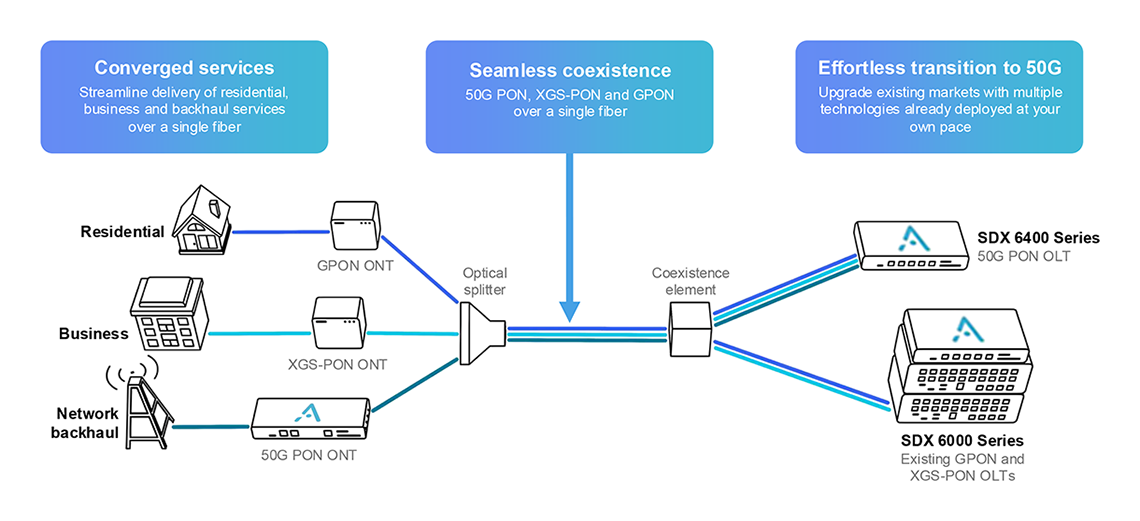
Image Credit: ADTRAN
…………………………………………………………………………………………………………………………………………………………………………………………………………………………..
In residential networks, traffic is expected to increasingly consist of short-duration, high-throughput bursts associated with edge processing, real-time analytics, and interactive services. A 50G PON gateway can accommodate these patterns by transmitting high-density payloads over sub-millisecond intervals, after which shared channel resources are rapidly released for other users. This behavior contributes to improved utilization efficiency on shared fiber infrastructure.
Low-latency and low-jitter performance are important for emerging application classes, including distributed AI inference, synchronized edge workloads, and multi-stream ultra-high-definition media. These requirements extend across both the access network and the in-home wireless domain, reinforcing the need for coordinated evolution of PON and Wi-Fi technologies.
From a deployment perspective, introduction of 50G-capable CPE provides operators with additional capacity headroom and supports alignment with future service requirements. Coupled with advancements in IEEE 802.11bn, this approach enables continued scaling of residential broadband performance while maintaining consistency across access and local network segments.
BCM68850 – 50G PON Edge AI Gateway SoC:
The BCM68850 is a standalone 50G PON Gateway SoC that provides an industry-standard ITU-T path for operators to future-proof their networks. The device features:
- High-Performance Application Engine: A dedicated CPU for third-party and operator applications leveraging industry available middleware.
- Integrated Neural Engine: A dedicated NPU that accelerates Edge AI inference, reducing cloud latency and enhancing data privacy by keeping sensitive information on premises.
- Symmetric 50G Performance: Delivers full 50G throughput to meet the insatiable appetite for reliable, multi-gigabit bandwidth.
- Wi-Fi 8 Ready: Native compatibility with Wi-Fi 8 standards to ensure the highest reliability and real-world consistency at the broadband edge.
- Intelligent Self-Healing: Enables operators to implement real-time anomaly detection and predictive bandwidth optimization, reducing OpEx and improving ARPU.
- Advanced Security: Incorporates enhanced security algorithms, including Post-Quantum Cryptography (PQC).
“The BCM68850 is a defining milestone for global fiber networks; we are reshaping the broadband edge as the central intelligence hub of the home,” said Philip Radtke, vice president of product marketing for Broadcom’s Wireless and Broadband Communications Division. “This flagship SoC joins our established lineup of NPU-accelerated fiber, cable, set-top box, and Wi-Fi solutions, ensuring operators can efficiently deploy edge-intelligent broadband regardless of the access medium and extend that intelligence all the way to the edge.”
“With ever increasing consumer and enterprise demand for bandwidth and ultra-reliable connectivity, operators are upgrading the Central Office and End Points with 50G PON capability. Next-generation solutions such as Broadcom’s BCM68850 SoC are critical to unlocking the value of this investment by future-proofing the network edge and ensuring high service levels at every node and premise,” said Jaimie Lenderman, practice leader for Optical, IP, and Broadband Infrastructure market research at Omdia.”By establishing a true end-to-end 50G pipe, operators can deliver the massive capacity and deterministic low latency required to support the rigors of the imminent Wi-Fi 8 deployment cycle.”
This end-to-end 50G offering completes the path from Broadcom’s BCM68660 OLT to the edge, providing a seamless and technically robust ecosystem comprising the BCM55050 ONT or the BCM68850 CPE gateway. This architecture introduces a new level of efficiency by optimizing CPU and memory resources for the AI era, ensuring that the home gateway can handle the massive data pipes required for the next decade of digital innovation.
About Broadcom:
Broadcom Inc. (NASDAQ: AVGO) is a technology leader that designs, develops, and supplies semiconductors and infrastructure software for global organizations’ complex, mission-critical needs. Broadcom combines long-term R&D investment with superb execution to deliver the best technology, at scale. Broadcom is a Delaware corporation headquartered in Palo Alto, CA. For more information, visit www.broadcom.com.
Broadcom, the pulse logo, and Connecting Everything are among the trademarks of Broadcom. The term “Broadcom” refers to Broadcom Inc., and/or its subsidiaries. Other trademarks are the property of their respective owners.
References:
https://www.broadcom.com/company/news/product-releases/64341
2026 Fiber Connect Keynote: “The Future of Fiber Optics: AI and the Quantum”
Nokia and Google Fiber trial 50G PON – first in the U.S.
HKT is first to deploy 50G PON technology in Hong Kong
Türk Telekom and ZTE trial 50G PON, but commercial deployment is not imminent
Ooredoo Qatar is first operator in the world to deploy 50G PON
Highlights of FiberConnect 2024: PON-related products dominate
Fiber Connect 2023: Telcos vs Cablecos; fiber symmetric speeds vs. DOCSIS 4.0?
Highlights of FiberConnect 2024: PON-related products dominate
The Fiber Broadband Association’s flagship conference, FiberConnect 2024, concluded July 31, 2024, in Nashville, Tennessee. It featuring 275 speakers and 286 exhibitors in the Expo Hall, with about half the attendees from operators and half representing vendors. The show provided a great opportunity to gauge the pulse of the fiber based broadband industry in North America.

HKT is first to deploy 50G PON technology in Hong Kong
HKT [1.] has become the first telecommunication service provider in Hong Kong to adopt the latest 50G PON technology, as the telco prepares to ramp up the delivery of applications that require ultra-high-speed broadband Internet connections for both home and commercial customers.
Note 1. HKT Limited is a company incorporated in the Cayman Islands with limited liability.
50G fiber based broadband offers a significant step up in speed, with a specification download speed of up to 50Gbps. Paired with the latest Wi-Fi 7 technology, the remarkable increase in bandwidth supports smooth simultaneous multi-device connectivity of all kinds for users both at home and in a commercial setting. Latency also improves by a substantial 27% on average compared to that of a 10G fiber network. [The above latency is only applicable to designated servers. Network latency in other areas will vary depending on the operational load of individual servers as well as network traffic.]
Bruce Lam, CEO, Consumer, HKT, said, “NETVIGATOR has always been at the forefront of the market. We are delighted to become the first telecommunication service provider in Hong Kong to adopt 50G PON technology. With the development of smart homes, demand for high-speed multi-device connections has been increasing to cater for activities such as 8K video streaming, large video file transfer and sharing at home, online gaming and even real-time financial market monitoring and trading. We will continue to explore cutting-edge technologies to meet our customers’ future connectivity needs.”
Steve Ng, Managing Director, Commercial Group, HKT, said, “HKT Enterprise Solutions has consistently provided diverse digital solutions for our commercial customers. As AI and cloud applications become ubiquitous, enterprise customers’ demand for bandwidth, speed and low latency have continued to elevate.
For example, employees need to use cloud services, collaboration tools, and AI solutions within the office environment. Schools are actively implementing e-learning and remote teaching. Large-scale events such as exhibitions and concerts generate high demands for live streaming or AR/VR experience solutions. Through this latest technology, we are preparing ourselves for the network needs of different customers.”
By applying the innovative 50G PON technology HKT is able to further enhance the performance of its existing fiber network with ease. Currently, HKT’s 10G fiber broadband network covers over 2.4 million households across 50,000 residential buildings, as well as 8,000 commercial buildings in Hong Kong.
About HKT:
HKT is a technology, media, and telecommunication leader with more than 150 years of history in Hong Kong. As the city’s true 5G provider, HKT connects businesses and people locally and globally.
Our end-to-end enterprise solutions make us a market leading digital transformation partner of choice for businesses, whereas our comprehensive connectivity and smart living offerings enrich people’s lives and cater for their diverse needs for work, entertainment, education, well-being, and even a sustainable low-carbon lifestyle. Together with our digital ventures which support digital economy development and help connect Hong Kong to the world as an international financial centre, HKT endeavours to contribute to smart city development and help our community tech forward.
For more information, please visit www.hkt.com.
References:
Ooredoo Qatar is first operator in the world to deploy 50G PON
Türk Telekom and ZTE trial 50G PON, but commercial deployment is not imminent
Dell’Oro: XGS, 25G, and Early 50G PON Rollouts to Fuel Broadband Spending
Ooredoo Qatar is first operator in the world to deploy 50G PON
Ooredoo Qatar announced that it has become the first operator in the world to deploy 50G PON (Passive Optical Network) connectivity, the 50 Gbps-capable fiber-based access connection for consumers. According to Ooredoo, the 50G PON technology, which has been adopted as an ITU standard, delivers fiber-based access connections with speeds of up to 50 Gbps on a single connection.
The 50G-PON system capitalizes on fundamental advances in the optical transceiver components working in conjunction with enhanced error correction and coding. It also introduces key innovations in activation procedures, contention-based operation, and expanded cryptographic features. With these improved capabilities, the 50G-PON system is ready to meet the new, and demanding, requirements of emerging services.
This new technology enables consumers to use high-bandwidth latency-sensitive applications such as 8k-interactive video applications, online collaboration and coordination solutions, 3D cloud design, high-graphic/high-quality AI applications, etc.
Dell’Oro Group believes total 50G-PON equipment revenue will increase from less than $3M in 2023 to $1.5B in 2027. Much more significant growth is expected after 2027, as operators begin to evolve their 10Gbps PON networks to next-generation technologies.

Sheikh Ali Bin Jabor Al Thani, Chief Executive Officer, Ooredoo Qatar, said: “We’re proud to be the first operator globally capable of deploying such powerful technology, which aligns perfectly with our overarching aim of upgrading our customers’ worlds. We have long had a strategic commitment to partnering with global leaders in technology and innovation, enabling us to leverage both our expertise and experience and our partners’ capabilities. This latest launch is an excellent example of the benefits we, and our customers, enjoy as a result of such partnerships. We look forward to further enhancing our offering as technology develops ever further in the years to come.”
Ooredoo’s 50G PON technology can meet the bandwidth requirements of both consumers and enterprises. Initial deployment will be for B2B customers and areas that require high-speed connectivity, with roll-out to consumers – for 8k content and AR/VR gaming, as an example – to follow.
ITU-T standards for 50G PON:
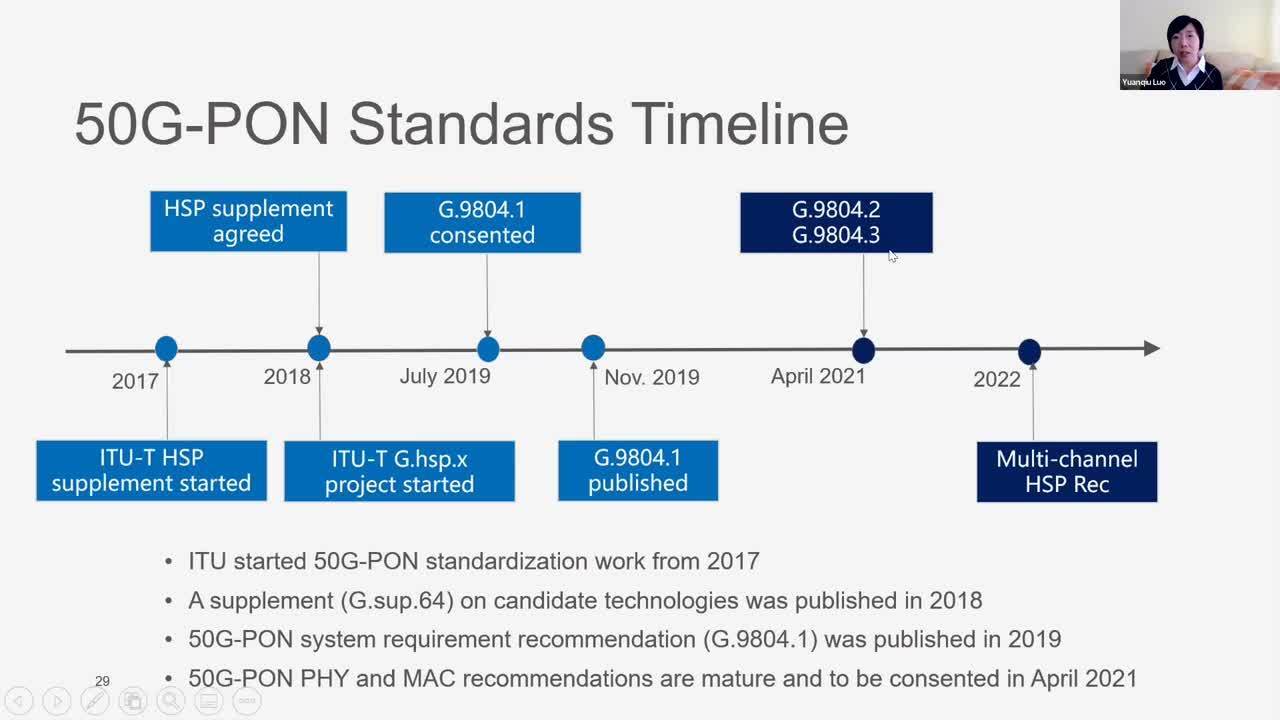
In April 2021, the ITU-T reached a major mile-stone, consenting the first three Recommendations defining a 50G PON system:
- General Requirements (G.9804.1): The legacy features linked to deployed fiber infra-structure are complemented by support for new services requiring high capacity, efficiency, low latency, and security. Coexistence with, and migration from, the installed PON systems are essential.
- Common Transmission Convergence Layer (ComTC) specification (G.9804.2): This is defined in a line rate agnostic way and thus applicable to future single-wavelength time-division multiplexing (TDM) and multi-wavelength time-and-wavelength-divi-sion multiplexing (TWDM) PON systems.
- The single-wavelength 50G-PON PMD (G.9804.3) specification is the first in the HS-PON PMD family.
References:
https://ieeexplore.ieee.org/document/9743347