

Broadband Forum
Broadband Forum Advances Subscriber Session Steering for Dynamic BNG Resource Optimization
Attribution:
Ken Pyle, Broadband Forum Marketing Director, provided the author with references which he used to write this article. ChatGPT helped with organizing the piece AFTER the author completed his own diligent research.
Introduction:
As broadband networks evolve toward disaggregated, cloud-native architectures, service providers need more flexible ways to manage subscriber sessions and allocate network resources. Traditional broadband architectures typically associate subscribers with specific Broadband Network Gateways (BNGs), limiting operators’ ability to dynamically balance traffic, optimize resource utilization, or respond to changing service requirements.
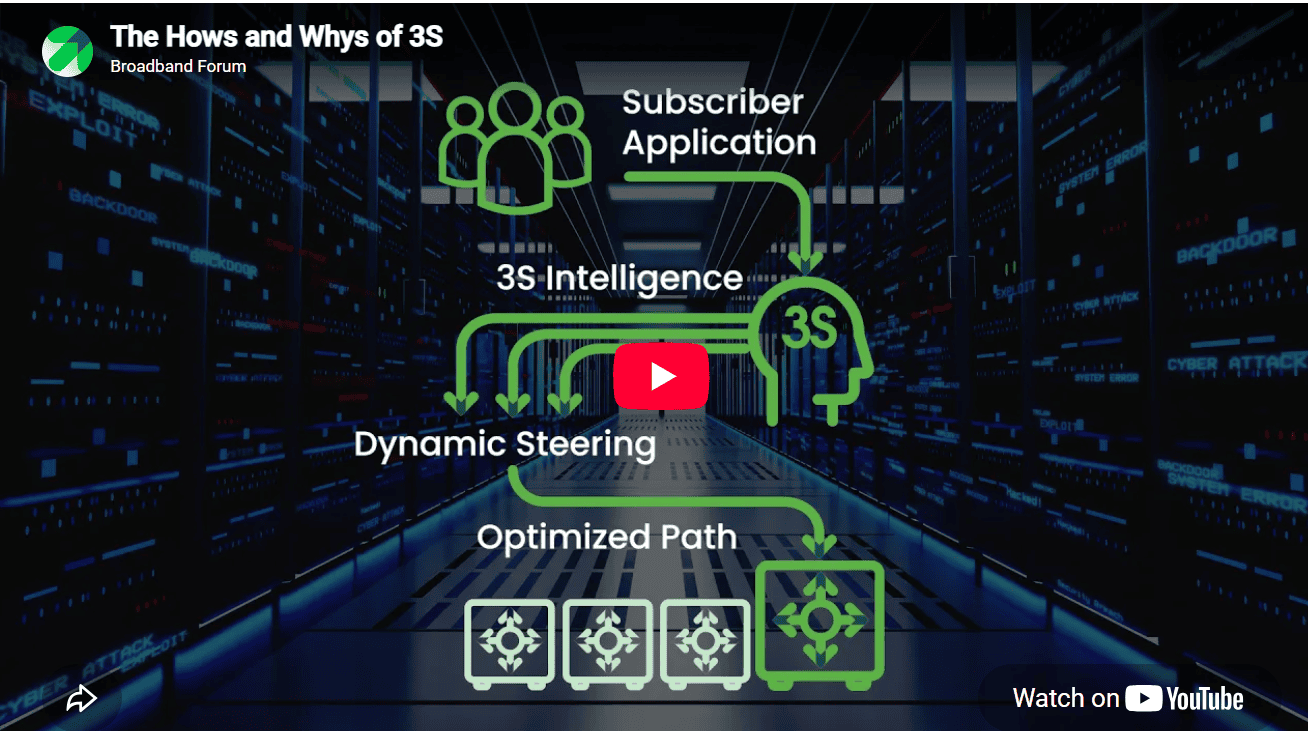
The Broadband Forum (BBF) is addressing this challenge through Subscriber Session Steering (3S), an architecture that enables service providers to dynamically select and manage the network gateways serving individual subscribers or groups of subscribers. The objective is to optimize network performance, improve resource utilization, reduce energy consumption, and support differentiated broadband services without interrupting active subscriber sessions.
At its November 2–5, 2026 Fall Member Meeting in Denver, CO the Broadband Forum’s Network Architecture Work Area approved WT-474, Subscriber Session Steering, and advanced it to Final Ballot. Publication as Technical Report TR-474 is expected before year-end 2026.
Subscriber Session Steering Explained:
Subscriber Session Steering provides dynamic, policy-driven selection and management of subscriber sessions across available service gateways. These include BNGs and Access Gateway Functions (AGFs).
Unlike static subscriber-to-gateway assignments, 3S enables individual subscribers or entire subscriber groups to be moved between network resources based on traffic load, service requirements, Quality of Service (QoS), network availability, maintenance needs, and energy consumption.
The architecture is designed to perform these changes without interrupting ongoing subscriber sessions.
Two important functional elements are:
- User Plane Selection Function (UPSF): Determines the appropriate BNG user-plane instance for a subscriber or subscriber group based on network conditions and service-provider policies. It provides the selection and coordination function for subscriber-session placement.
- Traffic Steering Function (TSF): Implements the traffic redirection needed to move subscriber sessions and associated traffic flows to the selected user-plane instance. The TSF can be deployed at different network locations, including within an Optical Line Terminal (OLT).
Together, these functions enable dynamic binding of subscriber sessions to available BNG user planes. This is particularly relevant to Control and User Plane Separation (CUPS), which allows BNG control-plane functions to manage multiple independently deployed user-plane instances.
The architecture also supports cloud-native BNG implementations in which user-plane functions can be deployed, scaled, consolidated, or deactivated as network demand changes.
2024 Broadband Forum Innovation Demonstration: Multi-Vendor Subscriber Session Steering:
The technical feasibility and operational benefits of 3S were demonstrated during the Broadband Forum’s November 2024 Innovation Demonstrations, involving three vendors: Adtran, BISDN, and OutSys.
The demonstration combined disaggregated BNG architecture, cloud-native user planes, traffic steering, and Quality of Experience (QoE) monitoring to dynamically optimize network resource utilization.
Key contributions included:
- BISDN: Supplied BISDN Linux, an open-source network operating system running on the aggregation switch, and the UPSF based on the Broadband Forum’s Open Broadband Subscriber Session Steering (OB-STEER) project. Its BNG micro-user planes were cloud-native and deployable in Kubernetes-based x86 infrastructure.
- Adtran: Integrated the TSF into its SDX 6330 PON OLT. Under UPSF direction, the TSF dynamically redirected subscriber sessions and associated traffic flows between BNG user-plane instances. Locating traffic steering in the OLT enables redirection closer to the access network, including when an OLT uplink or aggregation switch fails.
- OutSys: Provided Quality of Experience Delivered (QED) probes and reflectors, based on Broadband Forum TR-452, to monitor service quality across BNG user planes. Its QED Analyzer, integrated into Nokia’s Altiplano framework, used network measurements and subscriber counts to support closed-loop resource optimization.
The demonstration illustrated an energy-saving scenario. When traffic and subscriber counts on a particular BNG user plane fell below a predefined threshold, and measured service quality remained satisfactory, the automation system moved active subscribers to another user plane. The underutilized instance could then be shut down.
This approach reduces the number of running BNG micro-user planes and their associated energy consumption in x86-based Kubernetes clusters while maintaining acceptable subscriber service quality.
The demonstration also showed the resilience benefits of OLT-based steering. If an uplink or aggregation switch fails, subscriber traffic can be redirected through another OLT uplink toward a different network path.
Importantly, the demonstration brought together components from three vendors using Broadband Forum standards and Open Broadband software, illustrating the potential for multi-vendor implementations.
WT-474: The New Subscriber Session Steering Technical Report:
The Broadband Forum’s WT-474 project formalizes the 3S architecture and its operational requirements. According to the Forum’s September 2026 technical overview, TR-474 will define:
- Subscriber Session Steering use cases.
- The overall 3S architecture and functional requirements.
- Operational workflows for dynamic subscriber-session selection and movement.
- Informational models describing the entities and relationships involved.
- Data models needed to support implementation and management of the architecture.
The specification addresses the selection, balancing, and management of subscriber-session mappings to service gateways. It is intended to support dynamic network optimization based on access conditions, service requirements, and operational events.
An important aspect is the ability to steer individual subscribers or groups of subscribers without interrupting active sessions. This supports service-aware network resource allocation rather than treating all broadband subscribers identically.
The forthcoming TR-474 [1.] is also designed to work independently or in conjunction with other Broadband Forum disaggregation and cloud specifications.
The related Open Broadband OB-STEER project provides reference software implementations of key architectural components, including UPSF-related functions. Its purpose is to support rapid prototyping, evaluation of specification changes, and potential interoperability testing as commercial implementations emerge.
Note 1. At the Fall 2026 BBF Member Meeting, WT-474 was approved and sent out for Final Ballot. TR-474 is expected to be approved before the end of 2026. Once approved, it will be sent to ITU-T for consideration as a new recommendation.
Broadband Industry Significance:
Subscriber Session Steering extends broadband network resource management beyond conventional load balancing. Its significance spans several areas:
Energy efficiency: Operators can consolidate subscriber sessions onto fewer active BNG user-plane instances during periods of lower demand, allowing underutilized resources to be deactivated. This can reduce power consumption in cloud-native broadband infrastructure.
QoS and differentiated services: Subscribers can be assigned to network gateways and paths that better match their service requirements. High-value customers and latency-sensitive applications, including gaming and cloud services, can potentially be directed toward higher-capability network resources.
Wholesale and open-access broadband: 3S enables a Broadband Service Provider’s subscribers to be moved to different portions of a wholesale network. This flexibility can support more efficient use of shared infrastructure and new wholesale service models.
Network resilience and maintenance: Subscriber sessions can be redirected in response to equipment failures, network congestion, or planned maintenance. Dynamic placement also provides opportunities for predictive maintenance and more flexible network upgrades.
Cloud-native and disaggregated BNGs: By supporting dynamic subscriber placement across independently deployed user planes, 3S complements CUPS and cloud-native BNG architectures. Operators gain greater flexibility in scaling network functions and utilizing distributed computing resources.
Multi-vendor interoperability: Standardized architecture, requirements, workflows, and information and data models provide a common basis for implementations from different suppliers. The 2024 demonstration involving Adtran, BISDN, and OutSys provided an early example of how these components can work together.
…………………………………………………………………………………………………………………………………………………………………………………………………………………………..
From Broadband Forum Marketing Director Ken Pyle:
“Another important point is that 3S enables an access provider to automate and adapt the path to wholesale handoffs while preserving a clear operational boundary: subscriber steering is managed locally, while the wholesale partner controls service termination beyond the handoff.”
……………………………………………………………………………………………………………………………………………………………………………………………
Conclusions:
The Broadband Forum’s Subscriber Session Steering initiative addresses an important requirement for the next generation of broadband networks: dynamically matching subscriber sessions to available network resources according to service needs, network conditions, and operational objectives.
By formalizing the 3S architecture in TR-474, the Broadband Forum is establishing a framework for more flexible BNG resource allocation, energy-efficient operations, improved resilience, and differentiated broadband services.
The 2024 multi-vendor demonstration showed how UPSF, OLT-based traffic steering, cloud-native BNG user planes, and QoE monitoring can work together to achieve these objectives. The forthcoming TR-474 will provide the technical requirements, architecture, workflows, and models needed to advance this approach toward interoperable industry implementations.
…………………………………………………………………………………………………………………………………………………………………………
References:
https://www.broadband-forum.org/events/fall-2026-member-meeting-roundup
Broadband Forum new work areas to enable broadband services & apps
Broadband Forum SDN/NFV Work Area launches four new projects at Bangkok Q4-2023 meeting
Broadband Forum and LAN Laboratory Expand Certification Program to include XGS-PON
Broadband Forum’s vBG network spec targeted at SD-WANs; led by ONUG
Inside TM Forum’s Catalyst project “Living Networks – Phase III”
Broadband Forum new work areas to enable broadband services & apps
The Broadband Forum has realigned its work areas to ensure every new project and specification focuses on enabling services-led and intelligent broadband that provides the applications and services most demanded by users.
The Forum’s five work areas will cover topics including access networks, connected users and subscriber networks, network architecture, cloud and autonomous networks, and most importantly service requirements helping to direct that work. They will be supported by an advisory group providing the necessary expertise to produce high-quality YANG data models and management specifications.
The work areas and advisory group will be led by directors from Adtran, Calix, China Mobile, Deutsche Telekom, Huawei, Nokia, QA Cafe, Vantiva, and Vodafone.
Overview of the New Work Areas:
- Access Work Area – Focuses on delivering multi-vendor interoperability for last-mile broadband deployments across fiber, copper, and wireless networks.
- Connected User Work Area – Develops specifications for the deployment, management, and consumption of services by end-users.
- Network Architecture Work Area – Develops the architecture and nodal requirements for end-to-end broadband deployments across traditional and converged networks to ensure the best possible quality of experience for users.
- Provider Cloud Work Area – Develops frameworks and specifications to enable broadband services and networks to utilize cloud-based deployment approaches, including automation and autonomous systems that leverage machine learning and AI.
- Service Requirements Work Area – Defines user-centric, actionable service requirements and specifications for subscriber, access, and Broadband Service Providers’ (BSPs’) core networks.
The first official meetings of the new work areas will take place at the Broadband Forum’s Spring Meeting in Hong Kong on March 11-14, 2025.
Quotes:
“The broadband industry’s focus remains firmly on delivering a richer, more tailored broadband experience for the end-user rather than fast speeds alone,” said Broadband Forum CEO Craig Thomas. “Our new work areas reflect this, giving members from across the globe the opportunity to come together and develop the most relevant readily-adoptable broadband specifications. The intention is to simplify the organization and how our members can integrate in standards work to deliver a more effective and services driven broadband user experience. We invite companies, small and large, to join our efforts.”
Manual Paul (BBF Board President, Service Requirements Work Area Director, and Squad Lead Network Convergence at Deutsche Telekom) from his blog post about the importance of this new Work Area aligning with the Services-led focus of the Broadband Forum:
“Broadband Forum’s Service Requirements Work Area has been established to identify user needs and the technical innovation required to address them, to ultimately help BSPs deliver greater value to their customers. Aligned with the Broadband Forum’s strong focus on services-led broadband, the work area aims to guide the industry in driving innovation and adapting to evolving needs – such as a move away from the speed-first approach and place greater focus on QoE.”
At the bottom of that post, there is a link to the webinar that he led where he talks about the Service Requirements Work Area
………………………………………………………………………………………………………………….
About the Broadband Forum:
The Broadband Forum is an industry-driven global standards development organization helping operators, application providers, and vendors deliver better, services-led broadband.
As the industry-recognized center of competence, the Broadband Forum provides an accessible, efficient, and effective community where all broadband stakeholders can collaborate on, develop, and promote open standards and open software. This provides the basis for deployable solutions for the global broadband industry.
The forum publishes interoperable standards and open software, has launched certification programs, and promotes industry education. These best practices and models can be adopted to help realize an effective broadband ecosystem that drives a thriving, services-led broadband industry based on global collaboration, open standards, and open source, maximizing value for all stakeholders.
For more information, visit https://www.broadband-forum.org/
References:
2025.02.19 – Broadband Forum renews commitment to services-led broadband with new work areas
Bridging the gap between user needs and technical innovation for services-led broadband
https://broadband-forum.org/download/2025_02_18_BBF%20Service%20Requirements%20WA_webinar.pdf
https://wiki.broadband-forum.org/display/RESOURCES/Broadband+Forum+Published+Resources
Broadband Forum SDN/NFV Work Area launches four new projects at Bangkok Q4-2023 meeting
Broadband Forum and LAN Laboratory Expand Certification Program to include XGS-PON