

Month: November 2026
ATIS Proposes Wireless Physical-Layer Foundation Models for AI-Native 6G Networks
Disclaimer: ChatGPT was used extensively to read and summarize the 25 page ATIS Whitepaper described in this article.
………………………………………………………………………………………………………………………………………………………………………….
Introduction:
The Alliance for Telecommunications Industry Solutions (ATIS) has introduced Wireless Physical Layer Foundation Models (WPFMs), a proposed approach to applying artificial intelligence directly to radio-frequency (RF) signals and wireless channel measurements. The objective is to develop reusable AI models that learn characteristics of the radio environment and apply that knowledge to multiple physical-layer communications, sensing, and signal-processing functions.
The ATIS white paper, Wireless Physical Layer Foundation Models for Advanced Communication, Sensing, and Neuro-Symbolic Decision-Making, describes how these models could improve wireless signal interpretation, channel estimation, interference detection, beam management, localization, and joint communications and sensing (JCAS). It is a promising direction for AI in telecommunications because it moves beyond network management, orchestration, and application-layer intelligence. Instead, WPFMs seek to apply foundation-model techniques to the underlying radio signals and propagation characteristics that determine wireless network performance.
“Future wireless networks will need to do more than respond to changing conditions. They will need to understand their environments and make increasingly complex decisions,” said ATIS President and CEO Susan Miller. “This research explores how a shared foundation for AI could help wireless networks operate more efficiently, adapt more effectively, and make decisions that can be better understood and trusted.”
“Learning from large amounts of unlabeled wireless signal data means Wireless Physical Layer Foundation Models need less labelled data for each new task,” said Lead Researcher for the WPFM Jaron Fontaine, imec – IDLab Ghent – Ghent University. “Combined with neuro-symbolic reasoning, they can help networks reason about changing conditions and make decisions that are easier to explain.”
Source: ATIS Whitepaper
The white paper highlights the potential for WPFMs to support more integrated and intelligent wireless systems that can move beyond individual AI capabilities as the industry advances toward 6G. It also identifies opportunities for further research and industry collaboration. This ATIS proposal is particularly relevant to the evolution of 5G-Advanced (3GPP Releases 18-20) [1.] and future 6G wireless networks under the ITU-R IMT-2030 framework. That’s where increasingly complex spectrum environments, higher frequencies, massive antenna arrays, mobility, and integrated sensing will create additional demands on physical-layer signal processing.
Note 1. The latest ITU-R M.2150-3 recommendation (IMT 2020 RIT/SRITs), approved in February 2026, officially incorporates the initial 5G-Advanced baseline from 3GPP Release 18.
…………………………………………………………………………………………………………………………………………………………………………………………………………………………
From Task-Specific Wireless AI to Foundation Models:
Today’s wireless AI implementations typically employ specialized machine-learning models for individual tasks. Examples include modulation recognition, spectrum sensing, interference detection, channel-state information (CSI) compression, beam management, localization, and RF sensing.
Although deep learning has improved the ability to recognize complex signal patterns, these models often remain dependent on particular datasets, hardware platforms, operating conditions, and wireless environments. A model trained for one application may not generalize effectively to another.
ATIS proposes using a foundation-model architecture to address this fragmentation. WPFMs would be pre-trained on large, diverse collections of wireless RF data, primarily using self-supervised learning. This allows models to learn underlying signal and channel characteristics from unlabeled data, reducing the need for extensive manually labeled datasets for each downstream application. It’s important to note that some of the functions depicted are proposed future capabilities, not demonstrated implementations. Figure 1. below provides a useful overview of the WPFM concept and its relationship to wireless physical-layer intelligence.
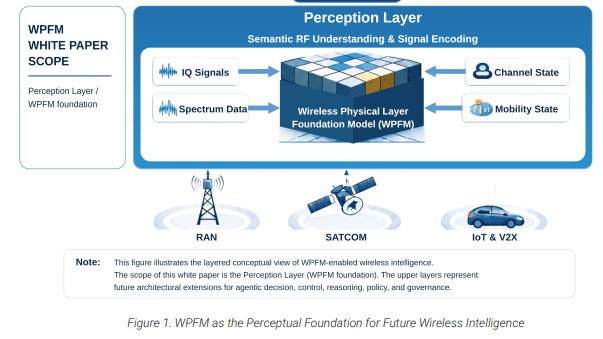
The resulting representations could subsequently be fine-tuned or adapted for different wireless tasks. The RF data used for training and inference can include:
- Raw in-phase and quadrature (I/Q) samples representing complex wireless signals.
- Channel-state information (CSI) and channel impulse response (CIR) measurements.
- Spectrograms and other time-frequency representations.
- Doppler signatures and Fast Fourier Transform (FFT)-based features.
- Contextual metadata, including sampling rate, center frequency, antenna identity, timing, and hardware platform.
Source: ATIS Whitepaper
…………………………………………………………………………………………………………………………………………………………………………………………………………………….
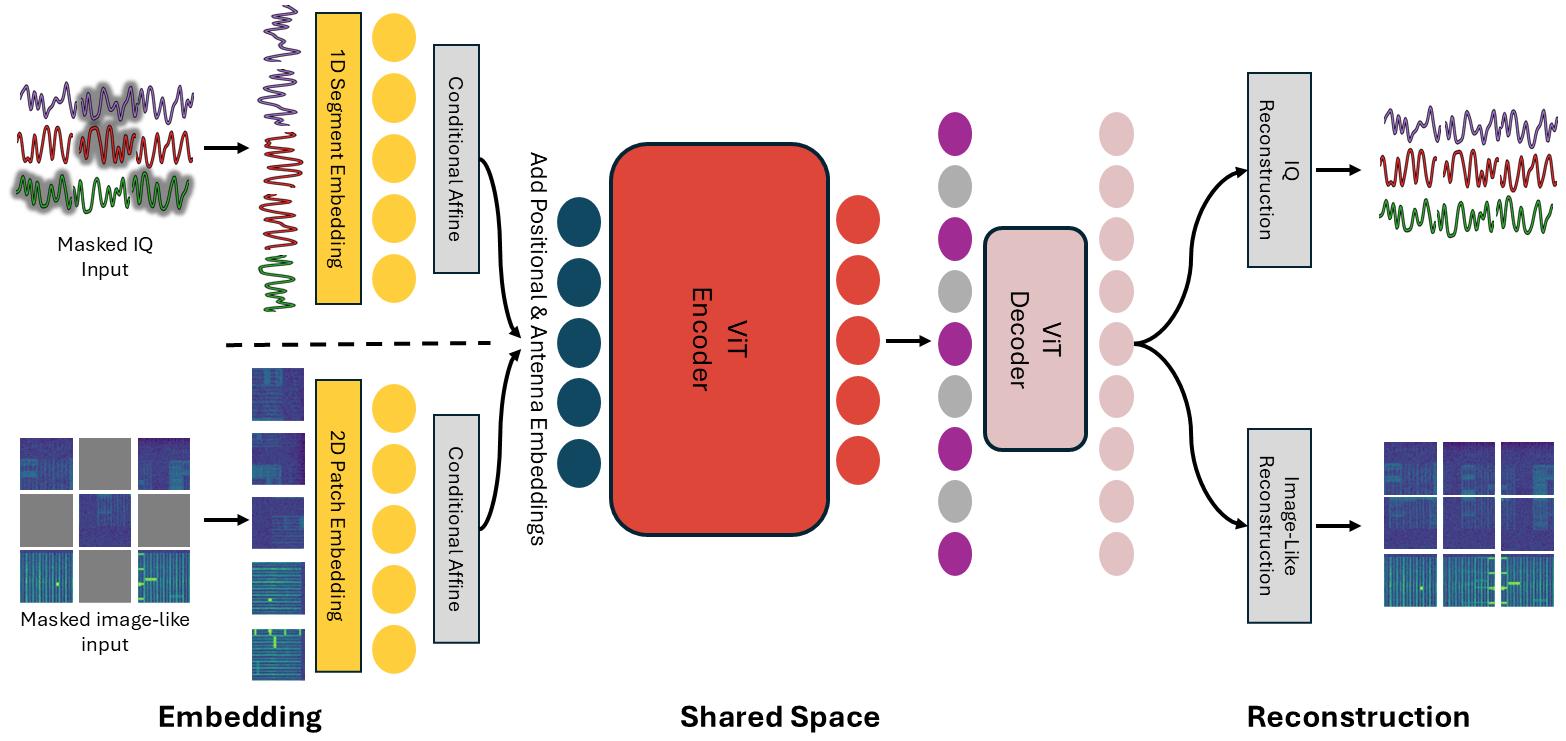
The white paper describes a multimodal architecture that maps different RF data types into a common latent representation. That’s shown in the illustration below.
Transformer-based models are one candidate architecture because of their ability to capture relationships across time, frequency, and spatial dimensions. An important design consideration is preserving the physical meaning of RF observations. Timing, frequency shifts, antenna configurations, and propagation characteristics cannot simply be treated as interchangeable numerical inputs. The model must retain sufficient information about the underlying radio conditions to support accurate interpretation.
Source: ATIS Whitepaper
…………………………………………………………………………………………………………………………………………………………………………………………………………………………
Potential Applications in Wireless Networks:
ATIS identifies several areas where a shared RF representation could support multiple wireless applications.
Radio resource management: WPFMs could provide reusable information about channel quality, mobility, interference, and network loading. This information could help optimize physical resource block (PRB) allocation, scheduling, and handover decisions.
Spectrum management and interference detection: By learning RF characteristics across different bands, waveforms, and wireless technologies, WPFMs could help identify unfamiliar signals, detect interference, and improve spectrum awareness.
Channel prediction and localization: Shared representations of propagation conditions and channel behavior could support channel prediction, positioning, and localization across changing environments.
Joint communication and sensing (JCAS): WPFMs could help extract information about motion, occupancy, object presence, and environmental conditions while simultaneously supporting wireless communications. The paper also discusses applications involving passive RF sensing.
Industrial IoT and connected vehicles: Potential applications include detecting anomalies in industrial wireless environments, supporting cooperative vehicle perception, and improving wireless performance under changing propagation conditions.
These are proposed applications, not demonstrated commercial capabilities. ATIS explicitly describes the performance improvements in its use-case tables as illustrative evaluation targets rather than experimentally validated results.
…………………………………………………………………………………………………………………………………………………………………………………………………………………………
Massive MIMO, Phased-Array Beamforming and Beam Management:
Massive multiple-input multiple-output (MIMO) systems use large antenna arrays to serve multiple users and improve spectral efficiency through spatial multiplexing and directional transmission. Massive MIMO is already deployed in sub-6 GHz cellular networks, while at millimeter-wave and higher frequencies, electronically steered phased-array antennas are particularly important because they concentrate RF energy into narrow beams to compensate for higher propagation losses.
Managing these beams requires continual estimation of channel conditions, selection of appropriate beam directions, and adaptation to user mobility, blockage, and changing multipath propagation. Conventional beam-training and beam-search procedures can introduce signaling overhead and latency, particularly in highly dynamic environments.
A Wireless Physical Layer Foundation Model could learn relationships among channel-state information (CSI), channel impulse responses (CIR), Doppler measurements, antenna configurations, and observed RF signal characteristics. These learned representations could help predict beam quality, identify alternative propagation paths, and recommend beam adjustments before an existing connection deteriorates.
For massive MIMO, this intelligence could also assist with antenna-array configuration, spatial channel characterization, and user-specific beam selection. Potential benefits include reduced beam-training overhead, more efficient spatial resource utilization, improved link reliability, and faster adaptation to changing radio conditions.
These applications are especially relevant to 5G-Advanced and future 6G systems employing large antenna arrays, higher-frequency spectrum, and increasingly sophisticated beamforming techniques. However, the practical value of WPFMs will depend on demonstrating improvements in beam-selection accuracy, processing latency, and overall radio performance compared with conventional channel estimation and beam-management algorithms.
…………………………………………………………………………………………………………………………………………………………………………………………………………………………
O-RAN: A Potential Deployment Architecture:
Although O-RAN [2.] has not delivered on its original promise of broad, plug-and-play multi-vendor RAN interoperability, its disaggregated architecture remains a potentially relevant environment for WPFMs. That’s because its disaggregated architecture distributes RAN intelligence across functions operating at different timescales.
ATIS proposes that shared RF representations could be made available to O-RAN’s RAN Intelligent Controller (RIC) applications, including:
- Non-real-time RIC rApps: Applications operating on longer timescales could use WPFM-derived information for network optimization, planning, and policy-related functions.
- Near-real-time RIC xApps: Applications could use shared RF information to support more adaptive RAN optimization and resource-management decisions.
Note 2. O-RAN refers to the O-RAN ALLIANCE’s architecture and specifications for OpenRAN.
The potential benefit is that different RAN applications, including those developed by different vendors, could work from a common representation of radio conditions rather than each independently collecting, processing, and interpreting similar RF data. However, the white paper does not define a standardized WPFM interface or establish how these representations would be exchanged among multi-vendor RAN components. Such interoperability remains an important research and development requirement.
…………………………………………………………………………………………………………………………………………………………………………………………………………………………
Neuro-Symbolic AI: Adding Reasoning and Operational Constraints:
One of the more interesting aspects of the ATIS proposal is its integration of WPFMs with neuro-symbolic AI.
A neural foundation model can recognize RF patterns, estimate network conditions, identify anomalies, and predict changes in the radio environment. However, pattern recognition alone does not establish whether a proposed network action is appropriate under operator policies, spectrum regulations, protocol requirements, or physical constraints.
Neuro-symbolic AI combines neural-network learning with explicit rules, knowledge representations, and logical reasoning.
In the proposed architecture, a WPFM provides the perceptual foundation. A separate reasoning layer evaluates its outputs against operational policies and constraints before a network-control function executes an action.
For example, a WPFM might identify deteriorating channel conditions and propose a beam change or resource-block reallocation. The neuro-symbolic reasoning layer could then evaluate the proposal against interference conditions, quality-of-service requirements, spectrum constraints, and network-slicing priorities.
This separation is important: the WPFM is not intended to independently control the network. Instead, its learned representations and predictions become inputs to a broader perception-reasoning-action process.
ATIS also discusses a future agentic architecture in which multiple AI agents and tools coordinate network decisions. However, the development of such neuro-symbolic and agentic architectures is explicitly identified as future work beyond the scope of the current white paper.
…………………………………………………………………………………………………………………………………………………………………………………………………………………………
Major Technical Challenges Remain:
Despite the potential advantages, substantial engineering work is necessary before WPFMs can become practical components of operational wireless networks.
Real-time performance and computational requirements: Wireless physical-layer functions often operate under stringent latency constraints. ATIS illustrates a possible model hierarchy ranging from large models with tens of millions of parameters for offline pre-training to lightweight models intended for edge and device-level operation. Its illustrative latency targets range from approximately 100 milliseconds for large models to less than one millisecond for ultra-lightweight models. These are proposed deployment trade-offs, not measured performance results.
Generalization across wireless environments: A model must operate reliably across different frequency bands, propagation conditions, antenna configurations, hardware platforms, mobility conditions, and terrestrial and non-terrestrial networks. Performance in one environment does not guarantee comparable results elsewhere.
RF datasets and training: Developing sufficiently large and diverse datasets is difficult. Data quality, hardware diversity, synchronization, metadata consistency, and representation of uncommon but operationally important RF conditions all affect model performance. Synthetic data, ray tracing, and digital twins may supplement real-world RF measurements, but simulation-to-reality transfer must be demonstrated.
Neuro-symbolic integration: Translating high-dimensional RF representations into explicit knowledge and rules without losing important signal information is a significant challenge. The combined neural and symbolic processing must also satisfy wireless latency and throughput requirements.
Multi-vendor interoperability: Independently developed WPFMs could generate incompatible internal representations or embeddings. Standardized interfaces, semantic alignment, model provenance, data governance, and interoperability testing will be necessary if multiple vendors are to share and use these models.
Validation and benchmarking: The industry currently lacks standardized multi-task benchmarks for WPFMs. Demonstrating improvements against conventional task-specific models under realistic RF conditions will be essential to establishing their practical value.
…………………………………………………………………………………………………………………………………………………………………………………………………………………………
Conclusions:
ATIS’s Wireless Physical Layer Foundation Model proposal represents a promising direction for AI in telecommunications. Rather than adding another collection of task-specific AI applications to wireless networks, it seeks to establish a reusable understanding of the physical radio environment that can support communications, sensing, localization, and RAN optimization.
The proposed combination of shared RF representations and neuro-symbolic reasoning could eventually provide a foundation for more adaptive and explainable wireless-network operations.
However, the distinction between a proposed architecture and a deployable technology is important. ATIS has outlined a research framework and potential applications; it has not announced a commercially available WPFM, demonstrated operational network deployment, or established a new 3GPP wireless standard.
The key questions are whether these models can generalize across real-world RF environments, meet stringent physical-layer latency and computational requirements, interoperate across vendors, and demonstrate measurable improvements over existing specialized AI models.
For the telecommunications industry, the significance of WPFMs will ultimately depend not on the foundation-model concept itself, but on whether a shared AI understanding of the radio environment can deliver measurable improvements in wireless network performance, efficiency, and operational reliability.
……………………………………………………………………………………………………………………………………………………………………………………………………………………..
References:
ATIS Introduces Wireless Physical Layer Foundation Models for Next-Generation Wireless Intelligence
ITU-R M.2150-3: https://www.itu.int/rec/R-REC-M.2150-3-202602-I/en
AI-Native 6G RAN in Practice: Research and Validation Insights from 6G-MIRAI-HARMONY
T-Mobile’s Strategy of Deploying Multi-Vendor AI-RAN on “Kinetic Edge” using AWS Pillars
AI-RAN Push: NVIDIA, Nokia, and Operators Drive Towards Distributed Compute Platforms
Deutsche Telekom: Device-to-Cloud AI Traffic Won’t Force RAN Upgrades or Increase CAPEX
Analysis: Nvidia–MediaTek Deepen AI Platform Collaboration -What it Means for AI RAN & DCI
Ericsson leads SK Telecom AI RAN vs. NVIDIA’s GPU centric AI RAN Alliance
Analysis: Nokia’s new AI-RAN platform and Standalone AI-RAN node with Nvidia GPUs
Dell’Oro: AI RAN revenue forecast: $35B from 2026-to-2030; 3 types of AI RAN explained
Dell’Oro: AI RAN to account for 1/3 of RAN market by 2029; AI RAN Alliance membership increases but few telcos have joined
AI-Era Cloud Network Transformation: A Reference Architecture and Implementation Roadmap
AI-RAN and Agentic AI get real: Ericsson, Nokia, Verizon & other operators enter into a new network automation era
Federated Wireless Spectrum AI: Advancing CBRS Efficiency Through AI-Driven RAN Optimization
Analysis: Nvidia’s rumored new 6G AI-RAN – likely features/functions and industry impact
AT&T and Ericsson boost Cloud RAN performance with AI-native software running on Intel Xeon 6 SoC