

T-Mobile US announces new broadband wireless and fiber targets, 5G-A with agentic AI and live voice call translation
T-Mobile US (the “Un-carrier”) today announced new targets of 15 million 5G broadband customers by 2030, a 25% increase from its previous target of 12 million by the end of 2028, driven by increased spectral efficiency, better CPE technology, increased eligibility including to business customers with complementary usage profiles, and broadened product offerings to continue to meet evolving customer needs. T-Mobile is also leveraging its scale and nationwide 5G Advanced network to expand into new growth areas, including advertising, financial services, and long-term opportunities in edge and physical AI. The top rated U.S. wireless telco is also expecting between 3 and 4 million T-Fiber customers by 2030.
“T-Mobile is raising the bar on what customers, stockholders, and the industry can expect from the Un-carrier. T-Mobile has an unmatched combination of the Best Network, Best Value, and Best Customer Experiences — hallmarks of our unique Un-carrier differentiation — paired with our industry-leading portfolio of assets,” said T-Mobile CEO Srini Gopalan.
“This is why customers bring their connectivity relationship to T-Mobile. Looking ahead, we see an extraordinary runway to further expand this differentiation — through sustained momentum in network perception, digital and AI-driven transformation, and our future-forward innovation in areas like 6G and advanced AI. With this foundation, I’m confident that the future has never been brighter.”
Here are 2 of many impressive slides from T-Mo’s investor presentation referenced below:
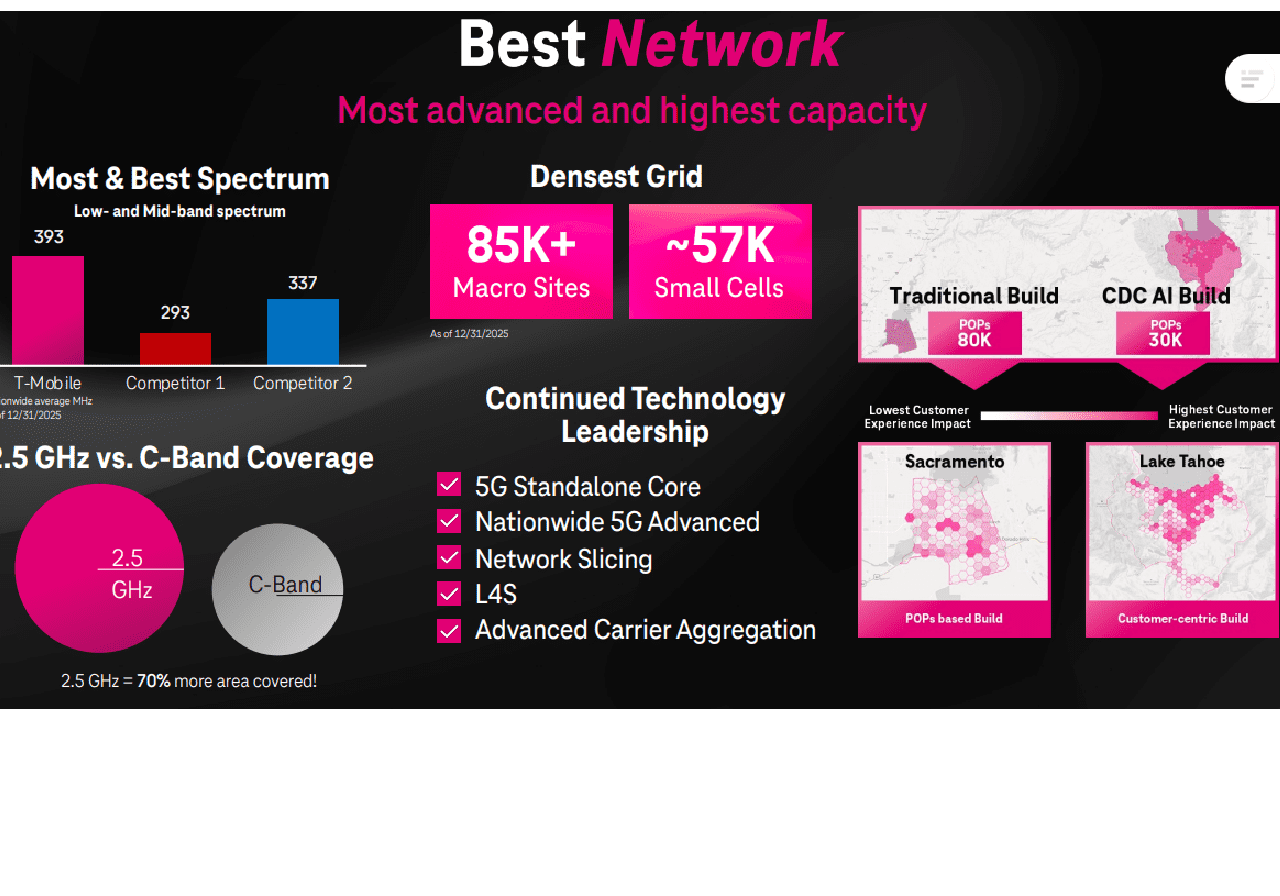
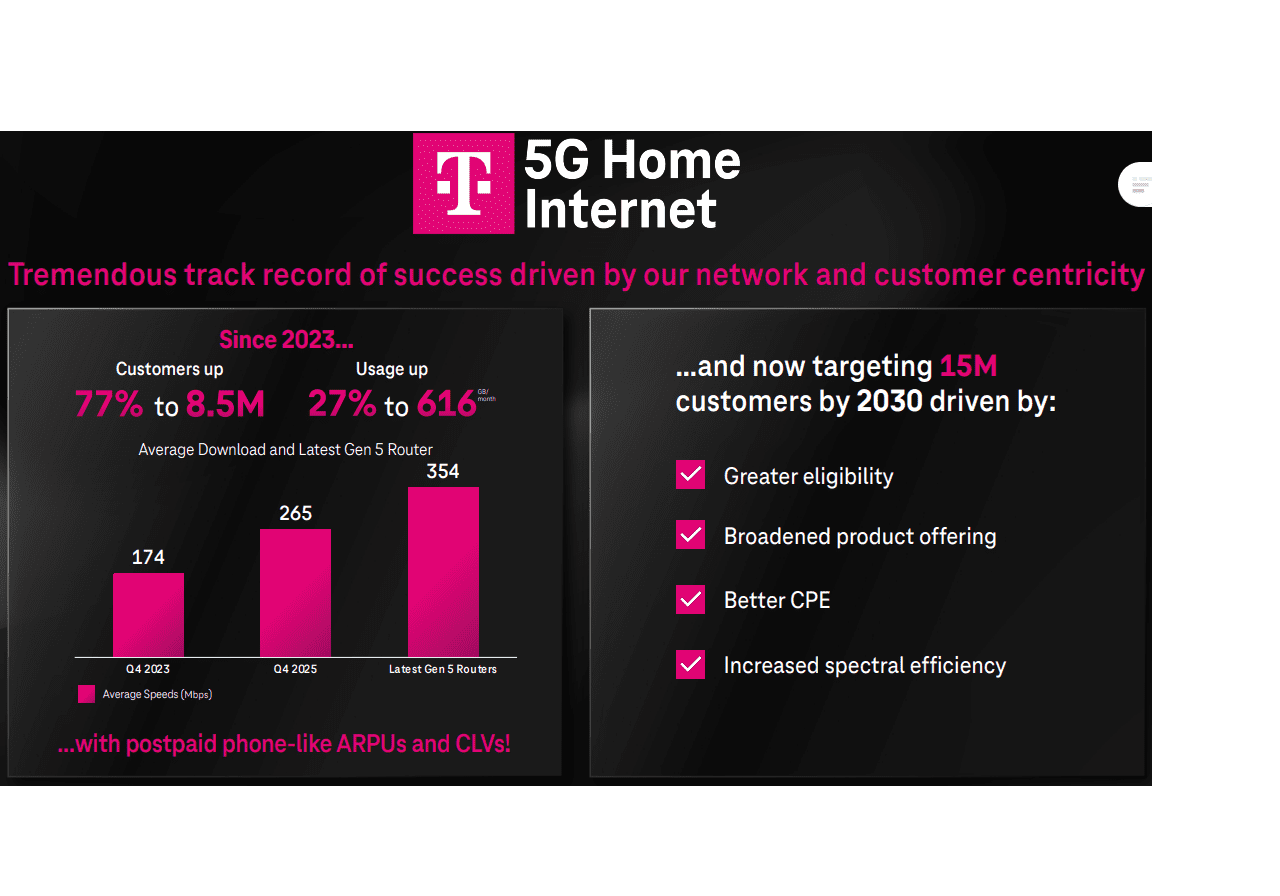
The Un-carrier also plans to launch real-time and agentic AI services directly into its 5G-Advanced (5G-A) network by the end of 2026. This initiative, which began with a beta program in early 2026 for postpaid customers, allows for AI-driven features to function natively within the network, meaning users do not need to download specific apps or upgrade their hardware. This 5G-A offering will include live voice call translation in over 50 languages. By integrating AI directly into the 5G-A infrastructure (RAN, core network, and management layers), T-Mobile is enabling features that work on any eligible device, not just smartphones.
New 5G-A Agentic AI Highlights:
- The initial application is a “Live Translation” feature for voice calls, allowing for real-time translation in over 50 languages.
- “Agentic” AI and Automation: The network will use AI to enhance operational efficiency, including predictive optimization and dynamic resource allocation.
- The 5G-Advanced deployment also supports increased data speeds (up to 6.3 Gbps in tests), low-latency applications like XR and cloud gaming, and enhanced location services.
- The forthcoming capability will permit features to be active with only one participant needing to be on the 5G-A network.
- Infrastructure Partners: T-Mobile is collaborating with partners including NVIDIA, Ericsson, and Nokia to build an AI-RAN (Radio Access Network) framework. Telecompaper Telecompaper +3 This move is part of a broader strategy to transition from 5G to 5G-Advanced, with a focus on delivering “intent-driven” AI services and laying the groundwork for 6G (IMT 2030).
……………………………………………………………………………………………………………………………………….
References:
https://www.t-mobile.com/how-mobile-works/innovation/5g-advanced
https://www.t-mobile.com/news/business/t-mobile-capital-markets-day-update-feb-2026
https://www.t-mobile.com/benefits/live-translation
2 thoughts on “T-Mobile US announces new broadband wireless and fiber targets, 5G-A with agentic AI and live voice call translation”
Leave a Reply to IEEE Member Cancel Reply

T-Mobile also unveiled a new artificial-intelligence initiative on Wednesday. The company said it was integrating an agentic AI platform into its wireless network that would enable live translation for users having conversations on its 5G network. The stock has dropped 22% over the past year, slumping as investors fret that the price war between T-Mobile and its rivals AT&T and Verizon will pressure the company’s earnings.
From Light Reading:
T-Mobile counts on FWA and fiber broadband to boost customer and service revenue growth with switch to customer account reporting. T-Mobile said it now expects to have 15 million FWA customers by 2030, up from 8.5 million at the end of December 2025, and noted the guidance is “very conservative.” Previous guidance was for 12 million by 2028.
T-Mobile CEO Srini Gopalan extolled FWA as a 5G success story in that the carrier has grown a new service from a standing start several years ago using fallow capacity in the network to deliver incremental service revenues and expected “more upside” to come.
Complementing FWA in its broadband strategy, T-Mobile also updated targets for its relatively new T-Fiber business built through joint ventures with Lumos and Metronet. These businesses are expected to expand their fiber footprint to 12 million to 15 million homes passed with 3 million to 4 million customers by 2030.
T-Mobile does not disclose the size of its current fiber footprint, which would indicate the pace of its fiber build rate. By the end of the decade, T-Mobile said its combined FWA and fiber broadband customer base would be 18 million to 19 million customers and network coverage would be more than 50 million homes passed. Gopalan hailed the growth that started at zero just seven years ago as an achievement, although the carrier is playing catch-up with it main rivals that have much larger broadband bases.
Gopalan reiterated previous comments that the carrier is still open to “looking at more assets” to expand its fiber footprint but “they need to be at the right price.”
T-Mobile doesn’t talk about convergence of fixed and mobile subscribers like AT&T and Verizon do, with those operators increasingly looking to bundling to reduce churn and keep customers for longer. However, T-Mobile’s broadband strategy is starting to look more like its rivals and it was flagged as a contributor for growing average revenue per account (ARPA), T-Mobile’s new customer revenue metric.
From the beginning of this year, T-Mobile is no longer counting individual subscribers, or postpaid phone adds, and instead will report postpaid accounts, which have multiple lines or services. The carrier has roughly 2.5 million subscribers per account.
“Broadband is an important element of how we get to ARPA expansion. We’re the most bundled in terms of successful ability to take customers and then sell our broadband product into it, or have broadband-only customers get introduced to the power of the T-Mobile network and then expand their products up there,” said T-Mobile CFO Peter Osvaldik.
In the fourth quarter, T-Mobile added of 495,000 FWA 5G broadband customers, which was less than 506,000 adds in Q3 but up from 428,000 in Q4 last year.
T-Mobile reported total service revenue increased 10% year-over-year to $18.7 billion in Q4. Net income dropped 29.5% to $2.1 billion, due to $293 million of severance and costs related to the “workforce transformation and reinvestment initiative” in 2025.
https://www.lightreading.com/5g/t-mobile-says-fwa-is-here-to-stay-and-eyes-more-fiber-m-a