

ITU-R M.[IMT-2030.EVAL] & ITU-R M.[IMT-2030.SUBMISSION] reports: Evaluation & Submission Guidelines for 6G RIT/SRITs (6G)
Backgrounder:
As stated for years in IEEE Techblog posts, ITU-R Working Party 5D (WP 5D) is responsible for all International Mobile Telecommunications (IMT) terrestrial radio interface technology (RIT/SRIT) reports and standards, e.g. 3G, 4G, 5G (IMT 2020) and 6G (IMT 2030).
5D has developed the minimum technical performance requirements and the evaluation criteria for IMT 2020 (5G) and will do so now for IMT 2030 (6G) along with other reports and standards described in this article
While any ITU member can propose IMT 2030 RIT/SRIT candidate standards, it is expected that they will principally come from 3GPP which contributes their specs to 5D via ATIS.
Standards for the non-radio aspects of 5G (e.g. core network, security, network slicing, etc) and 6G were supposed to be promulgated by ITU-T, but 3GPP (which develops those specifications) years ago decided NOT to liaise their specs with ITU-T.
–>Please see References at the bottom of this article for more information.
…………………………………………………………………………………………………………………………………………….
ITU-R M.[IMT-2030.EVAL] – 6G RIT/SRIT Evaluation Criteria:
The 5D WG Technology aspects/SWG Evaluation is working on a report which will provide guidelines for the procedure, the methodology and the criteria (technical, spectrum and service) to be used in evaluating the candidate IMT-2030 radio interface technologies (RITs) or Set of RITs (SRITs) for a number of test environments. These test environments are chosen to closely simulate more stringent radio operating environments.
The evaluation procedure is designed in such a way that the overall performance of the candidate RITs/SRITs may be fairly and equally assessed on a technical basis. It ensures that the overall IMT-2030 objectives are met. This Report provides, for proponents, developers of candidate RITs/SRITs and independent evaluation groups, the common evaluation methodology and evaluation configurations to evaluate the candidate RITs/SRITs and system aspects impacting the radio performance.
–>This report is scheduled to be finalized at the WP 5D Meeting No. 52 (Geneva, 27 May-5 June 2026).
………………………………………………………………………………………………………………………………………………
ITU-R M.[IMT-2030.SUBMISSION] – 6G RIT/SRIT Submission Guidelines:
The draft new 5D Report ITU-R M.[IMT-2030.SUBMISSION], originating from the 5D July 2025 meeting, defines the submission guidelines, templates, and evaluation methodology for 6G Radio Interface Technologies (RITs/SRITs). The report focuses on enabling technology proposals for IMT-2030 which are to be submitted from February 2027 to February 2029 for 5D evaluation and approval.
- Submission & Evaluation Guidelines: The report serves as the official guide for submitting candidate Radio Interface Technologies (RITs) or Sets of Radio Interface Technologies (SRITs) for IMT-2030.
- Structure: It is modeled after earlier reports like M.2411 (for 5G), defining the evaluation criteria, procedures, and templates for 6G technologies.
- Technical Requirements: It outlines minimum performance requirements (MPRs) for 6G, including advanced capabilities like artificial intelligence, energy efficiency, and joint requirements.
- Timeline: The report is central to the 2027-2030 timeline, aiming for the first submissions at the 54th WP 5D meeting (Feb 2027) and final submission by early 2029.
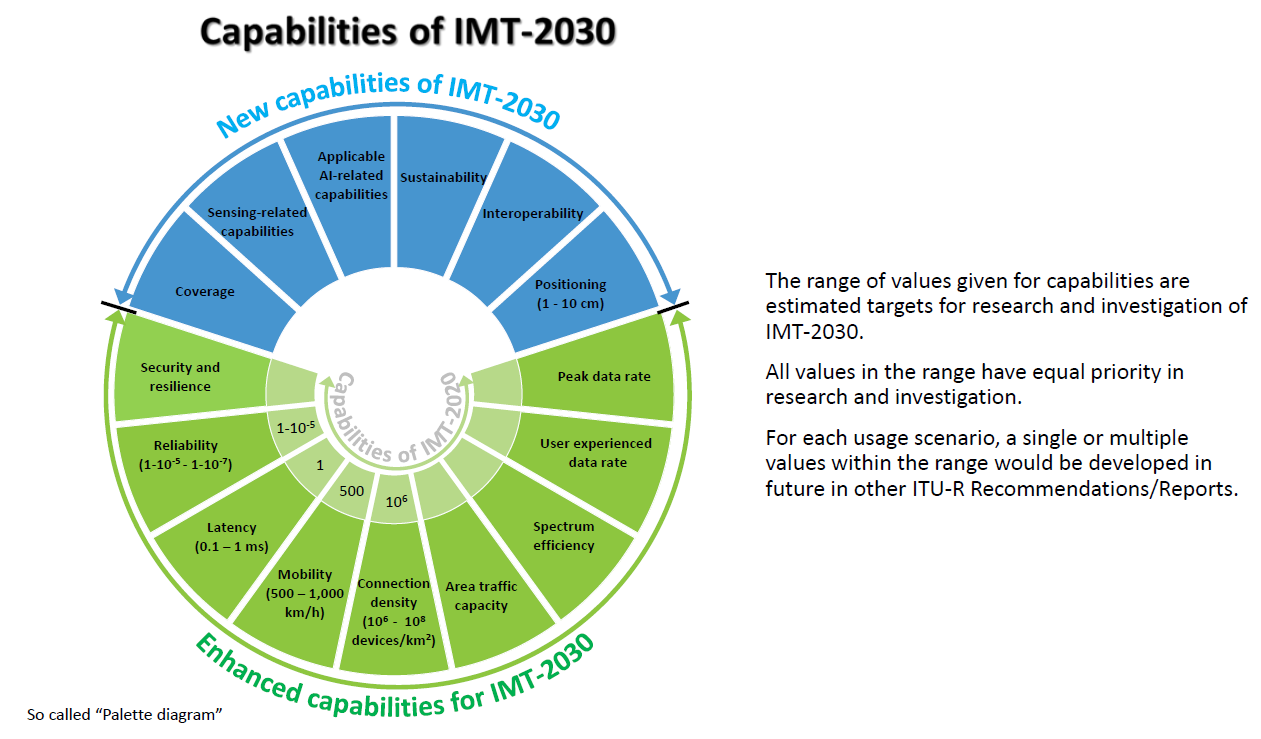
- Context: It aligns with the ITU-R M.2160 framework (the “6G Vision”), which encompasses six usage scenarios: immersive communication, hyper-reliable low-latency communication, massive communication, ubiquitous connectivity, AI-integrated communication, and integrated sensing and communication.

WP 5D Workplan for IMT 2030 RIT/SRITs:
As previously noted, 5D will accept and evaluate IMT 2030 candidate RIT/SRIT submissions starting at 54th meeting of WP 5D, currently planned for February 2027. The final deadline for submissions is 12 calendar days prior to the start of the 59th meeting of WP 5D in February 2029. The evaluation of the proposed RITs/SRITs by the independent evaluation groups and the consensus-building process will be performed throughout this two year time period and thereafter. Subsequent calendar schedules will be decided according to the submissions of proposals to 5D.
WP 5D meetings in 2030 will focus on the final stages of evaluating, adopting, and approving 6G technology submissions, aiming for approval of the final IMT-2030 recommendation in late 2030. The 5D tentative meeting schedule for 2030:
- Meeting No. 62 (February 2030): 1 Finalize Addendum 6 to Circular Letter taking into account the draft new Report ITU-R M.[IMT-2030. OUTCOME]. 2 Review and update the work plan, if necessary.
- Meeting No. 63 (June 2030): 1 Develop and finalize Addendum 7 to Circular Letter taking into account completion of the draft new Recommendation ITU-R M.[IMT 2030.SPECS].
- Meeting No. 63 (October 2030): Finalize standards before potential approval by ITU-R SG 5 in November 2030 or early 2031.
References:
ITU-R WP 5D Meeting Reports (TIES access required)
https://www.itu.int/en/events/Pages/Calendar-Events.aspx?sector=ITU-R&group=R23-WP5D
https://www.itu.int/en/ITU-R/study-groups/rsg5/rwp5d/imt-2030/pages/default.aspx
https://www.itu.int/en/ITU-R/study-groups/rsg5/rwp5d/imt-2030/Pages/submission-eval.aspx
Roles of 3GPP and ITU-R WP 5D in the IMT 2030/6G standards process
ITU-R WP 5D Timeline for submission, evaluation process & consensus building for IMT-2030 (6G) RITs/SRITs
ITU-R WP5D IMT 2030 Submission & Evaluation Guidelines vs 6G specs in 3GPP Release 20 & 21
Highlights of 3GPP Stage 1 Workshop on IMT 2030 (6G) Use Cases
ITU-R WP 5D reports on: IMT-2030 (“6G”) Minimum Technology Performance Requirements; Evaluation Criteria & Methodology
ITU-R: IMT-2030 (6G) Backgrounder and Envisioned Capabilities
Verizon’s 6G Innovation Forum joins a crowded list of 6G efforts that may conflict with 3GPP and ITU-R IMT-2030 work
Ericsson and e& (UAE) sign MoU for 6G collaboration vs ITU-R IMT-2030 framework
ITU-R WP5D invites IMT-2030 RIT/SRIT contributions
NGMN issues ITU-R framework for IMT-2030 vs ITU-R WP5D Timeline for RIT/SRIT Standardization
IMT-2030 Technical Performance Requirements (TPR) from ITU-R WP5D
Should Peak Data Rates be specified for 5G (IMT 2020) and 6G (IMT 2030) networks?
2 thoughts on “ITU-R M.[IMT-2030.EVAL] & ITU-R M.[IMT-2030.SUBMISSION] reports: Evaluation & Submission Guidelines for 6G RIT/SRITs (6G)”
Leave a Reply to IEEE Member Cancel Reply

The EU’s Radio Spectrum Policy Group (RSPG) has just published a report on Europe’s 6G spectrum roadmap and concluded that 6G (IMT 2030) can be rolled out in frequency bands that have already been harmonized for what it terms as electronic communications services (ECS), specifically wireless broadband (WBB) which is also known as mobile broadband (MBB).
-Low bands below 1 GHz: 700 MHz, 800 MHz, 900 MHz, in order to enable nationwide and indoor 6G coverage.
-Mid bands: 1500 MHz, 1800 MHz, 2 GHz, 2.6 GHz, 3.6 GHz, in order to possibly support and supplement the roll-out of high capacity 6G networks in suburban and urban areas.
-High bands: 26 GHz, 42 GHz, in order to enable very high-capacity hotspot 6G coverage.
The upper 6 GHz band, which in November the RSPG recommended be reserved for 6G, is expected to be the primary band suitable for the introduction of 6G in Europe by 2030, which makes sense given it wouldn’t require refarming on the part of operators.
“This can contribute to fulfil the mobile industry and operators’ demands of additional 200 MHz per operator in mid band spectrum to provide coverage and capacity in suburban and urban areas utilising existing base station sites,” the RSPG said.
https://www.telecoms.com/5g-6g/eu-says-there-is-already-enough-spectrum-to-launch-6g-by-2030
The International Telecommunication Union (ITU) has released a new framework to guide the evolution of global optical connectivity in the age of artificial intelligence (AI).
The framework – International Optical Networks towards 2030 and Beyond (ION-2030) – was developed by ITU-T Study Group 15, the expert group responsible for standards on networks, technologies, and infrastructures for transport, access, and home.
ION-2030 sets out a strategic vision for how optical networks should evolve to meet the demands of 6G mobile networks (IMT-2030), AI, data centres, broadband access, home networking, and integrated sensing and communication (ISAC).
The framework emphasizes the mutual empowerment of AI and optical networking, positioning both as drivers of the next wave of digital transformation.
Mutual empowerment of AI and optical connectivity
AI technologies are reshaping how optical networks are designed, managed, and optimized. Using digital twins, multimodal learning, and autonomous control, AI-enabled operations can enhance network reliability, reduce energy use, and anticipate service needs.
Conversely, optical networks enable AI by providing the high-capacity, low-latency, and deterministic connectivity needed for distributed AI training, real-time inference, and data exchange between cloud and edge. ION-2030 captures this two-way relationship – recognizing optical infrastructure as part of the foundation of the global AI ecosystem.
Key capabilities and architecture
The ION-2030 framework envisions a service-oriented architecture combining high performance with intelligence and sustainability. It highlights four principal advances:
Terabit-per-second connectivity and sub-millisecond latency to support emerging digital services.
Integrated sensing, computing, and AI agents within optical layers for real-time awareness and automation.
Energy-efficient and quantum-resilient designs to ensure long-term security and sustainability.
End-to-end service optimization across multiple network domains and layers.
Ongoing works on application-specific technical supplements – such as GSTR.ION-aiDC (for data centres), G.sup.ION-aiBB (for broadband access), and G.sup.ION-aiHome (for home networking) – will extend the ION-2030 framework to different application environments.
Standards collaboration
ION-2030 promotes cross-sector collaboration both within ITU and with other standards bodies, including the 3rd Generation Partnership Project (3GPP), Broadband Forum, European Telecommunication Standards Institute (ETSI), Institute of Electrical and Electronics Engineers (IEEE), International Electrotechnical Commission (IEC), Internet Engineering Task Force (IETF), and Optical Internetworking Forum (IOIF). It also supports joint efforts with ITU’s Radiocommunication Sector (ITU-R) and ITU-T Study Group 13 (Future networks) to align optical transport with evolving IMT-2030 and future network architectures.
This coordinated approach ensures that the optical layer – the backbone of the digital world – continues to evolve in step with the needs of AI, cloud, and ubiquitous broadband.
https://www.itu.int/hub/2026/02/ion-2030-enabling-the-intelligent-optical-network-era/