

WRC 27
6G Architecture and Economics: Core Network Evolution, AI Integration and Business Case
Introduction:
As the telecom industry moves closer to defining 6G features, functions, radio interfaces, and core network architecture, the questions become more demanding: What must change? Who will pay for it? How much of the investment in 5G can be preserved? Discussions at the recent RCR Wireless 6G Forum exposed the tension between introducing new capabilities and protecting operator investment. Although participants described broad support for an evolutionary approach, migration paths and the extent of architectural change remain unresolved.
Keysight’s Stephen Douglas described a standalone 6G architecture with a dedicated core [1.] from the outset, with potential initial commercial systems in mid-to-late 2029. That represents a prospective deployment timeline—not an agreed architecture or guaranteed commercial launch. Ericsson’s Marie Hogan outlined a different emphasis: standalone-style operation from day one, but with an evolutionary core that reuses components of the 5G standalone core while adding new functionality. Ericsson also advocates reusing existing spectrum and introducing a new air interface to deliver improved radio performance. These positions illustrate why “standalone 6G” does not, by itself, establish how much existing infrastructure operators would need to replace.
Note 1. 3GPP has sole responsibility for defining the 6G Core Network Architecture and associated specifications, which will surely be rubber stamped by ETSI (their host entity). Just like in IMT 2020/5G, ITU-T will not publish any IMT 2030 (6G) non-radio standards/recommendations.

Image: 123rf
…………………………………………………………………………………………………………………………………………………………………………………………………………………………………
The role of AI in the 6G core network remains equally unsettled in 3GPP. Approaches under discussion include incorporating AI into network functions, establishing a separate AI domain, and adopting more extensive agent-based architectures. These alternatives imply different requirements for interfaces, control, observability, and interoperability. Consensus is developing, but the 6G core architecture and its network functions have not been agreed.
Traffic forecasts are not investment cases:
Network operators are understandably wary of another capital-investment cycle without a clear path to acceptable returns, following the substantial investment required for 5G. As BT’s Rana Kamill cautioned, “Technology adoption doesn’t guarantee business success by default.” For 6G, commercial requirements must guide technology development from the outset, rather than serve as an after-the-fact justification. The industry should not repeat the mistake of treating a technical capability—such as ultra-reliable low-latency communications (URLLC)—as a business case in itself.
In the lead-up to 5G deployment, network equipment vendors and operators heavily promoted 5G/IMT-2020 URLLC as the foundation for new latency-critical applications, presenting prospective capabilities as commercially imminent. Yet when Release 16 was frozen in 2020, the relevant URLLC RAN enhancements remained incomplete and their targeted performance had not been validated, as documented in our contemporaneous reporting. The lesson for 6G/IMT-2030 is clear: proponents must demonstrate both the required performance across the complete service path and a commercially viable customer proposition—not treat a radio-interface target or a staged demonstration as proof of either.
Ericsson argues that AI-enabled devices and applications will increase uplink demand and eventually require capabilities beyond those of 5G and 5G-Advanced. However, the reported figures are not directly comparable. RCR’s headline describes a sixfold increase, while the article quotes Hogan forecasting a threefold increase followed by a further threefold increase. Separately, the Ericsson Mobility Report presents scenarios projecting twofold, threefold, or fivefold uplink traffic growth by 2031, depending on AI-device adoption and usage. These figures should not be combined into a single settled forecast.
The scale and timing of AI-driven uplink growth therefore remain uncertain. The incremental investment case for 6G depends on where that demand materializes, which capacity, latency, and other performance requirements it imposes, and whether 5G-Advanced can satisfy those requirements more economically.
The vitally important operator 6G investment question is therefore not simply whether AI agents, connected sensors, and physical AI systems generate more traffic. It is which workloads require additional uplink capacity, tighter latency bounds, or new network functionality—and whether those requirements can be met economically through 5G-Advanced rather than a generational replacement. Ericsson itself acknowledges that substantial scope remains to evolve 5G SA and 5G-Advanced before 6G becomes available.
Téral on 6G Standards (ITU-R & 3GPP):
Stéphane Téral, founder and chief analyst at Téral Research, told RCR Wireless 6G Forum 2026 that broad support for an evolutionary 6G does not amount to an agreement on its implementation. He expects continued use of OFDM and 5G channel-coding schemes, helping preserve ecosystem scale and device affordability. However, spectrum choices (from ITU-R- NOT 3GPP) and 5G-to-6G migration paths—including overlay and dual-connectivity options—remain unresolved. The takeaway: agreement on continuity is not yet an agreed deployment blueprint.
Téral also challenged the assumption that 6G requires a dedicated new core (3GPP responsibility), arguing that existing 5G network functions could be sufficient. He identified competing approaches to AI integration: a separate AI domain, AI embedded in network functions, and network-integrated AI agents. Importantly, he distinguished AI-based network optimization, already used for more than a decade, from the requirements of a new mobile generation. The architectural test should therefore be what demonstrably requires 6G—not simply what incorporates AI.
Geopolitical competition adds another obstacle to consensus. “6G leadership is a proxy for future economic and military superiority,” Téral said, warning that competing national and industry priorities could fracture the global standard. Spectrum harmonization, with ITU-R’s WRC-27 an important milestone, remains part of that challenge. His warning highlights the tension between preserving a globally interoperable, affordable ecosystem and pursuing national technological advantage.
His strongest commercial challenge concerned sensing applications: “I see many use cases, but I just don’t see the money, because somebody has to pay for it.” Potential applications, including agricultural weather sensing, do not establish paying customers or sustainable operator returns. The central takeaway is that 6G needs more than technical consensus: proposals must identify what existing infrastructure can be retained, which capabilities justify additional investment, and who will pay for the resulting services. Efficiency gains and new service revenues are distinct economic propositions; neither should be assumed from technical feasibility alone.
Use cases must identify paying customers:
Integrated sensing and communications (ISAC) illustrates the distinction between technical opportunity and commercial demand. AT&T and Ericsson have published a white paper on ISAC, but the fundamental monetization question remains. As cellular industry analyst Stéphane Téral put it at the forum: “I see many use cases, but I just don’t see the money, because somebody has to pay for it.” Identifying a sensing application does not establish who will purchase the service, what they will pay, or whether operator revenue will justify deployment and operating costs.
Incremental improvements can still have economic value: greater capacity, improved spectrum efficiency, and lower operating costs may justify investment without a new “killer application.” But those benefits must be quantified, and claims of new service revenue require a separate commercial case. Hogan acknowledged that distinction, arguing that 6G must deliver measurable monetization or efficiency benefits rather than merely a new generation indicator on a handset.
Conclusions:
The burden of proof rests with each proposed 6G architectural change: what requirement cannot be met economically by 5G-Advanced, what deployed assets can be retained, and what measurable benefit justifies the transition? Capacity expansion and operating-cost reductions can support investment without a “killer application,” but they should not be conflated with new service revenue. A credible 6G strategy must establish those economic cases separately.
The crucial test will be use cases and economics: which business and/or residential customer problems require 6G, what existing assets can be retained, and whether incremental revenue or cost savings justify the transition. The lesson for 6G is not to confuse technical deployment with commercial success. Architecture proposals, traffic forecasts, and application demonstrations must ultimately support a credible investment case—not substitute for one.
References:
https://rcrwireless.com/20261016/6g/6g-standards-teral
https://www.business.att.com/content/dam/attbusiness/briefs/att-ericsson-isac-whitepaper.pdf
Warning: 6G core network must not repeat the 5G SA 3GPP architecture specs vs lack of interoperable standards
Sept 2026 3GPP meeting updates for 5G Advanced and 6G planning (with timeline for submisson to ITU-R WP 5D via ATIS)
Roles of 3GPP and ITU-R WP 5D in the IMT 2030/6G standards process
3GPP approves timelines for Release 21 which will specify 6G RAN, Core and 5G Advanced
Dell’Oro: RAN Market Stabilized in 2025 with 1% CAG forecast over next 5 years; Opinion on AI RAN, 5G Advanced, 6G RAN/Core risks
SK Telecom, Intel develop low-latency technology for 6G core network
IMT-2030/6G Spectrum Sharing: The Roles of WRC-27, NTIA and ITU-R WP 5D
IMT-2030/6G Spectrum Sharing: The Roles of WRC-27, NTIA and ITU-R WP 5D
Introduction:
Spectrum sharing is emerging as a core requirement for IMT 2030/6G, as policymakers and operators seek additional capacity in bands already supporting federal, satellite and other incumbent services. A “Spectrum and Test Strategy for the 6G Era” panel was held online as part of the 3rd edition of RCR’s 6G Forum on October 6, 2026. Panelists included representatives from the National Telecommunications and Information Administration (NTIA), AT&T, LitePoint and the Dynamic Spectrum Alliance highlighted the implications for spectrum access, interference management, equipment testing and migration from IMT 2020/5G. Internationally, ITU-R WP5D is a focal point for IMT 2030 spectrum sharing along with WRC-27 (both are described below).
The approach aligns with Recommendation ITU-R M.2160, the framework for IMT-2030, which identifies spectrum-sharing technologies and enhanced coexistence techniques as areas for continued development. The challenge extends beyond identifying additional frequencies: the industry must establish technically viable operating conditions that protect incumbents while supporting commercially useful mobile deployments.
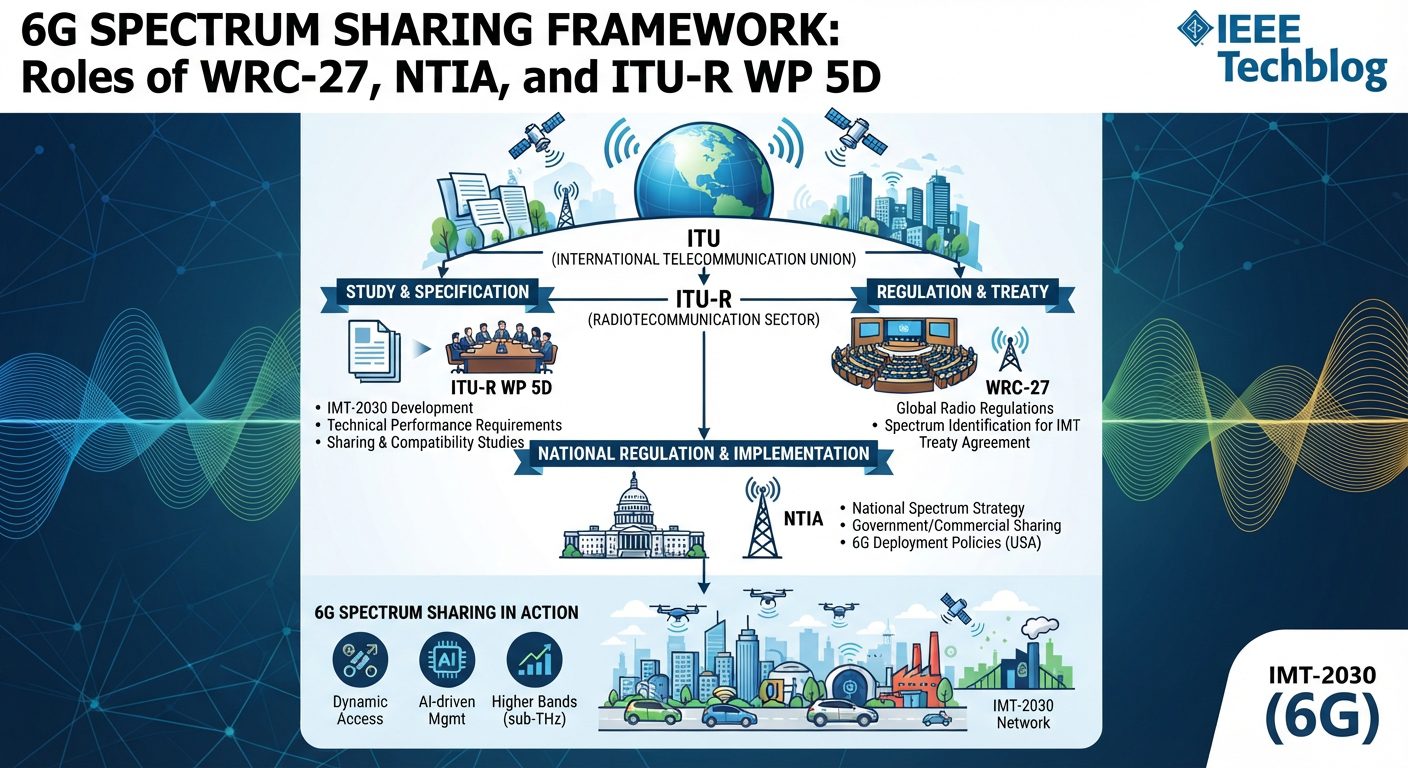
Image Credit: Google Gemini
…………………………………………………………………………………………………………………………………………………………………………………………U.S. Spectrum Pipeline – reallocation does not necessarily mean clearance:
In the United States, NTIA has a congressional mandate to identify 500 MHz of federal spectrum for commercial use within five years of the 2025 legislation. The broader legislative spectrum pipeline calls for 800 MHz by 2034. NTIA’s work includes studies of spectrum in the 1.6 GHz, 2.7 GHz, 4.4 GHz and 7 GHz ranges. Derek Khlopin, NTIA’s deputy associate administrator for spectrum, cautioned that identifying spectrum for commercial use does not necessarily mean incumbent systems can be cleared immediately.
Some federal systems could remain in affected bands “for a significant amount of time,” requiring continued sharing or other protection measures. “There will be more sharing necessary because the demands certainly aren’t stopping, not just from the mobile community, but from other spectrum users as well on the commercial side,” Khlopin said.
He described the likely outcome as “a bit of a mixed bag”: some systems could relocate, while others would remain under arrangements such as static exclusion zones or dynamic spectrum access. He cited the Citizens Broadband Radio Service (CBRS) as a “great model,” and suggested that better spectrum-use data and AI-based scheduling tools could improve sharing efficiency.
……………………………………………………………………………………………………………………………………………………………………………………………..
ITU-R and WRC-27: Establishing the conditions for additional IMT spectrum:
The international counterpart to these national studies is the ITU Radiocommunication Sector’s (ITU-R) preparatory work for the World Radiocommunication Conference 2027 (WRC-27).
Agenda item 1.7, under Resolution 256 (WRC-23), addresses sharing and compatibility studies and the development of technical conditions for International Mobile Telecommunications (IMT) in three frequency ranges: 4.4–4.8 GHz; 7.125–8.4 GHz, or portions thereof; 14.8–15.35 GHz.
The studies must account for existing primary services in both the candidate bands and adjacent spectrum. ITU-R Working Party 5D is the responsible group, working with other relevant ITU-R working groups.
These are candidate bands under study, not spectrum already cleared or guaranteed for 6G. Resolution 256 also specifies regional differences in the scope of potential IMT identification. Notably, the 4.4–4.8 GHz identification studies concern Regions 1 and 3, rather than Region 2, which includes the United States. The US domestic spectrum process and WRC-27 therefore overlap, but their frequency ranges and regulatory scope are not identical.ucc+1
The connection to the panel’s discussion is direct: sharing and incumbent protection are central to determining whether—and under what conditions—additional spectrum can support IMT. WRC-27’s agenda item 1.7 concerns those spectrum conditions, rather than the detailed design of the 6G air interface.
ITU-R WP 5D Spectrum Sharing Projects:
ITU-R Working Party 5D (WP 5D) is actively conducting spectrum sharing and compatibility studies for IMT-2030 (6G) across candidate frequency bands. WP 5D’s role is technical and preparatory: it develops Conference Preparatory Meeting (CPM) texts, technical sharing studies, compatibility analyses, and draft regulatory methods (working towards CPM reports extending through late 2026/2027). Here are the relevant 5D projects under World Radiocommunication Conference 2027 (WRC-27) agenda items:
- Agenda Item 1.7 (AI 1.7): WP 5D has received numerous sharing and compatibility studies for candidate bands, developing working documents and resolving technical criteria (such as power flux-density [PFD] calculations).
- Agenda Item 1.3/1.13 and related studies: WP 5D studies regulatory and technical parameters to protect the terrestrial components of IMT, collaborating jointly with other groups like WP 4C (satellite services).
- Technical & Evaluation Frameworks: WP 5D finalized key deliverables including draft reports on technical performance requirements (Report ITU-R M.[IMT-2030.TECH PERF REQ]) and submission/evaluation guidelines ahead of candidate Radio Interface Technology (RIT/SRIT) submissions kicking off in early 2027.
ITU-R Member States and regional telecommunication organizations (such as APT, CEPT, CITEL, ATU, Arab Spectrum Management Group) use WP 5D’s technical sharing and compatibility studies as the factual baseline to negotiate and submit Common Proposals (CPs) and national positions to WRC-27.
Separately, IMT-2030 candidate Radio Interface Technologies (RITs/SRITs) will begin being submitted to WP 5D starting around February 2027 (via proponents like 3GPP via ATIS). However, 5D will be tasked with generating IMT 2030 Frequency Arrangements after WRC-27 specifies the associated frequency bands.
………………………………………………………………………………………………………………………………………………………………………………………………………….
Interference management and the expanding test matrix:
For operators, access to shared spectrum must translate into sufficiently predictable network performance. Khushboo Kalyani, product marketing manager at LitePoint, said regulators and standards bodies need to define interference conditions—including transmit-power limits, unwanted emissions, waveform characteristics and frequency offsets—so equipment manufacturers and test vendors can evaluate devices against a consistent set of requirements
“There could be 100 different real-world situations that a device comes through. You essentially cannot test against that,” she said. The practical alternative is to select representative test cases that characterize device performance under shared-spectrum and interference conditions
The challenge will intensify as 6G introduces additional frequency bands, sharing arrangements, modulation schemes and antenna configurations. Kalyani warned that these variables could substantially expand the test matrix, lengthening development cycles and increasing manufacturing test costs.
“You’re essentially now going to be testing a combination of combinations,” she said. She expects the industry to concentrate on practical subsets of scenarios rather than attempt exhaustive testing of every configuration.
MRSS: A potentially more efficient migration mechanism than DSS:
The panel also examined a separate form of sharing: coexistence between successive generations of cellular radio access technology within an operator’s spectrum.
Milap Majmundar, AVP, emerging network, spectrum technologies and standards at AT&T Labs, said multi-radio access technology spectrum sharing (MRSS) between 5G and 6G could avoid some of the inefficiencies associated with LTE/5G dynamic spectrum sharing (DSS).
DSS incurred overhead from LTE control channels and the need to accommodate LTE’s cell-specific reference signals. By comparison, “[New Radio/NR] does not have these fixed common reference signals,” he said. NR’s leaner signal structure provides a more favorable starting point for intergenerational spectrum sharing.lightreading+1
“I’m actually quite optimistic that we will be able to make, as an industry, 5G/6G MRSS to be much more efficient than what we had with 4G/5G DSS,” Majmundar said.
MRSS could enable operators to introduce 6G in existing 5G spectrum, leveraging established coverage rather than relying exclusively on new upper-midband deployments. However, its eventual efficiency, equipment-upgrade requirements and carrier-aggregation capabilities remain important implementation questions. MRSS addresses migration within cellular networks; it does not replace the incumbent-sharing and compatibility work required to open additional bands.itu+1
Upper 6 GHz: Diverging national approaches:
Martha Suarez, president of the Dynamic Spectrum Alliance, argued that planning for the next generation of connectivity should also account for Wi-Fi and non-terrestrial networks.
“I agree with the concept that 6G should have sharing as part of the concept itself. I think it’s harder now to find exclusive bands for everything,” she said, adding that spectrum could support different applications according to deployment conditions and local requirements
Suarez pointed to the United Kingdom’s proposed upper-6 GHz framework as an example of how priority access and sharing could coexist.
Under the proposal described by Ofcom, 6.425–6.585 GHz would be prioritized for Wi-Fi, while 6.585–7.125 GHz would be prioritized for mobile. An automated frequency coordination (AFC) system would support controlled Wi-Fi access to the mobile-priority portion, including in locations where mobile networks are not deployed and before mobile services enter the band. This is more specific than unrestricted access whenever a channel appears idle: sharing would operate under defined technical conditions and coordination controls.
Suarez said such arrangements could balance investment certainty with more intensive spectrum use. “Those models could also be considered,” she said. The United States has taken a different approach, permitting unlicensed operation across 5.925–7.125 GHz, subject to the applicable device-class and incumbent-protection rules. Suarez endorsed that policy and encouraged other countries to consider its benefits.lightreading+1 and they think that they will need part of the upper 6GHz band for future networks. But we are encouraging them to have some type of sharing,” Suarez said.
The upper-6 GHz debate should not be conflated with WRC-27 agenda item 1.7: that item’s 7 GHz candidate range begins at 7.125 GHz, immediately above the upper-6 GHz band. National decisions on mobile/Wi-Fi coexistence and ITU-R studies of additional IMT spectrum are related elements of future spectrum planning, but they concern distinct frequency ranges and regulatory processes.
……………………………………………………………………………………………………………………………………………………………………………………………………
References:
https://apt.int/sites/default/files/file_tag/2026/03/WP_5D_UPDATES.pdf
https://www.lightreading.com/6g/6g-faces-a-spectrum-sharing-future
https://www.ericsson.com/en/6g/spectrum
Oct 2026: PRELIMINARY DRAFT NEW ITU-R WP 5D REPORT: M.[IMT-2030.SUBMISSION]
ITU-R M.[IMT-2030.EVAL] & ITU-R M.[IMT-2030.SUBMISSION] reports: Evaluation & Submission Guidelines for 6G RIT/SRITs (6G)
ITU-R WP 5D Timeline for submission, evaluation process & consensus building for IMT-2030 (6G) RITs/SRITs
Perspective & Analysis of ITU-R Workshop on IMT-2030 (6G) terrestrial radio interfaces: February 10, 2027 in Geneva, Switzerland
IMT-2030 (“6G”) Minimum Technology Performance Requirements for Radio Interface Technologies
Sept 2026 3GPP meeting updates for 5G Advanced and 6G planning (with timeline for submisson to ITU-R WP 5D via ATIS)
Roles of 3GPP and ITU-R WP 5D in the IMT 2030/6G standards process
3GPP approves timelines for Release 21 which will specify 6G RAN, Core and 5G Advanced
Oct 2026: PRELIMINARY DRAFT NEW ITU-R WP 5D REPORT: M.[IMT-2030.SUBMISSION]
Backgrounder:
At the closing plenary of the 53rd meeting of ITU-R WP 5D (on October 8, 2026 in Geneva, Switzerland), two IMT 2030 related documents were progressed and will be sent to SG 5 for approval in December 2026:
- Draft revision of Document IMT-2030/2 “Process” – Submission, evaluation process and consensus building for IMT-2030.
- [Preliminary] draft new Report ITU-R M.[IMT-2030.SUBMISSION] – Requirements, evaluation criteria and submission templates for the development of IMT-2030.
We cover the latter report in this article.
Introduction:
This ITU-R Report covers the minimum technical requirements, evaluation criteria and submission templates for the development of Recommendations and Reports on IMT-2030 (6G), such as the detailed specifications of IMT 2030, and provides:
- The service, spectrum and technical performance requirements for candidate Radio Interface Technologies (RITs)/Set of Radio Interface Technologies (SRITs) for IMT 2030;
- Evaluation guidelines including evaluation criteria and procedures to evaluate technology submissions for IMT-2030;
- Submission templates that proponents need to utilize to organize the information that is required in a submission of a candidate technology for evaluation. Proponents need to provide the required information. Details on this item is beyond the scope of this article.
–>Please see References at the bottom of this article for more information.
Scope:
This Report supports the submission and evaluation process for IMT-2030 initiated by Circular Letter 5/LCCE/115 and its Addenda. It addresses the minimum technical requirements, evaluation criteria, as well as submission templates required for a complete submission of RITs and/or SRITs for IMT 2030.
IMT-2030 minimum technical requirements:
The minimum technical requirements (also referred to as “minimum requirements” in this Report) established in this section relate to services, spectrum and technical performance aspects of IMT 2030. The intent of the requirements is to ensure that IMT-2030 technologies are able to fulfil the objectives of IMT-2030 and to set a specific level of performance that each proposed technology needs to achieve in order to be accepted within ITU-R for IMT-2030.
It is to be noted that the requirements are not intended to restrict the full range of capabilities or performance that candidate technologies for IMT 2030 might achieve, nor are they intended to describe how the IMT 2030 technologies might perform in actual deployments under operating conditions that could be different from those presented in ITU R Recommendations and Reports on IMT 2030. Furthermore, this Report is not intended to restrict the implementation details of IMT-2030 technology on the aspect of how to meet these requirements.
Also, IMT-2030 is expected to be built on overarching aspects, including sustainability, security and resilience, connecting the unconnected, and ubiquitous intelligence, which act as design principles commonly applicable to all usage scenarios as described in § 3 in Recommendation ITU-R M.2160. The proponents are encouraged to describe how the candidate RIT/SRIT incorporates these design principles in the description template in § 5.2.3.1, where applicable.
Services:
Recommendation ITU-R M.2160 – Framework and overall objectives of the future development of IMT for 2030 and beyond, envisions six usage scenarios for IMT-2030:
– Immersive communication (IC).
– Hyper reliable and low-latency communication (HRLLC).
– Massive communication (MC).
– AI and communication (AIAC).
– Integrated sensing and communication (ISAC).
– Ubiquitous connectivity (UC).
Diverse services and applications for the six usage scenarios are envisaged, as shown in Figure 1. in Recommendation ITU-R M.2160 (reproduced below).
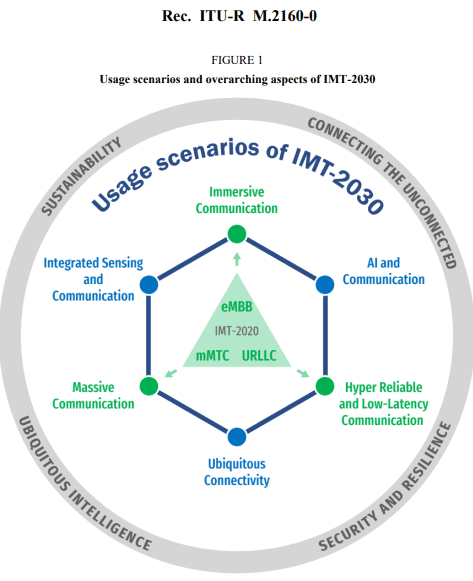
IMT-2030 RIT/SRIT shall support a wide range of services across different usage scenarios, for which the evaluation methodology is found in § 7.3.4 of Report ITU-R M.[IMT-2030.EVAL].
Spectrum:
The following frequency bands have been identified for the terrestrial component of IMT in the ITU Radio Regulations:
- 450-470 MHz (see No. 5.286AA of the Radio Regulations (RR))
- 470-698 MHz (see RR Nos. 5.295, 5.308A, 5.296A, 5.307A)
- 694/698-960 MHz (see RR Nos. 5.313A, 5.317A)
- 1 427-1 518 MHz (see RR Nos. 5.341A, 5.346, 5.341B, 5.341C, 5.346A)
- 1 710-2 025 MHz (see RR Nos. 5.384A, 5.388)
- 2 110-2 200 MHz (see RR No. 5.388)
- 2 300-2 400 MHz (see RR No. 5.384A)
- 2 500-2 690 MHz (see RR No. 5.384A)
- 3 300-3 400 MHz (see RR Nos. 5.429B, 5.429D, 5.429F)
- 3 400-3 600 MHz (see RR Nos. 5.430A, 5.431B, 5.432A, 5.432B, 5.433A)
- 3 600-3 700/3 800 MHz (see RR Nos. 5.434, 5.433B, 5.434B, 5.435B)
- 4 800-4 990 MHz (see RR Nos. 5.441A, 5.441B)
- 6 425-7 025/7 125 MHz (see RR Nos. 5.457D, 5.457E, 5.457F)
- 10-10.5 GHz (see RR No. 5.480A)
- 24.25-27.5 GHz (see RR No. 5.532AB)
- 37-43.5 GHz (see RR No. 5.550B)
- 45.5-47 GHz (see RR No. 5.553A)
- 47.2-48.2 GHz (see RR No. 5.553B)
- 66-71 GHz (see RR No. 5.559AA).
Technical performance:
Report ITU-R M.[IMT-2030.TECH PERF REQ] describes the key requirements related to the minimum technical performance for IMT 2030 candidate RIT and also provides information about the individual requirements for items and values chosen.
IMT-2030 evaluation:
Report ITU-R M.[IMT-2030.EVAL] provides guidelines for the procedure, the methodology and the criteria (technical performance, spectrum and service) to be used in evaluating the candidate IMT-2030 RITs/SRITs for a number of test environments. The evaluation procedure is designed in such a way that the overall performance of a candidate RIT/SRIT is fairly and consistently assessed on a technical basis. Candidate RITs or SRITs shall be evaluated according to the guidelines in Report ITU-R M.[IMT-2030.EVAL].
Criteria to be fulfilled by candidate RITs/SRITs: The process, the steps and the relevant timelines for the development of IMT-2030 are described in Document IMT-2030/2(Rev.1) – Submission, evaluation process and consensus building for IMT-2030. Additional specific details may be found on the ITU-R IMT-2030 web page under the link “Web page for the IMT-2030 submission and evaluation process.”
Development of candidate RITs/SRITs (Step 2):
The required criteria to be fulfilled by an RIT/SRIT are as follows:
An RIT shall fulfil the minimum requirements of at least six test environments comprising three test environments under IC, one test environment under MC, one test environment under HRLLC and one test environment under ISAC, as well as the minimum requirements of either UC or AIAC. An SRIT consists of a number of component RITs complementing and interworking with each other. Each component RIT shall fulfil the minimum requirements of at least four test environments comprising two test environments under IC, one test environment under either MC or HRLLC, and one test environment under ISAC, as well as the minimum requirements of either UC or AIAC. Together as an SRIT, it shall fulfil the minimum requirements of all seven test environments comprising the four usage scenarios IC, MC, HRLLC and ISAC, as well as the minimum requirements of either UC or AIAC.
……………………………………………………………………………………………………………………………………………………………
References:
https://www.itu.int/md/R00-SG05-CIR-0115/en
https://www.itu.int/dms_pubrec/itu-r/rec/m/R-REC-M.2160-0-202311-I!!PDF-E.pdf
https://www.itu.int/en/ITU-R/study-groups/rsg5/rwp5d/imt-2030/pages/default.aspx
ITU-R M.[IMT-2030.EVAL] & ITU-R M.[IMT-2030.SUBMISSION] reports: Evaluation & Submission Guidelines for 6G RIT/SRITs (6G)
ITU-R WP 5D Timeline for submission, evaluation process & consensus building for IMT-2030 (6G) RITs/SRITs
Perspective & Analysis of ITU-R Workshop on IMT-2030 (6G) terrestrial radio interfaces: February 10, 2027 in Geneva, Switzerland
IMT-2030 (“6G”) Minimum Technology Performance Requirements for Radio Interface Technologies
Sept 2026 3GPP meeting updates for 5G Advanced and 6G planning (with timeline for submisson to ITU-R WP 5D via ATIS)
Roles of 3GPP and ITU-R WP 5D in the IMT 2030/6G standards process
3GPP approves timelines for Release 21 which will specify 6G RAN, Core and 5G Advanced
ITU-R M.[IMT-2030.EVAL] & ITU-R M.[IMT-2030.SUBMISSION] reports: Evaluation & Submission Guidelines for 6G RIT/SRITs (6G)
Backgrounder:
As stated for years in IEEE Techblog posts, ITU-R Working Party 5D (WP 5D) is responsible for all International Mobile Telecommunications (IMT) terrestrial radio interface technology (RIT/SRIT) reports and standards, e.g. 3G, 4G, 5G (IMT 2020) and 6G (IMT 2030).
5D has developed the minimum technical performance requirements and the evaluation criteria for IMT 2020 (5G) and will do so now for IMT 2030 (6G) along with other reports and standards described in this article
While any ITU member can propose IMT 2030 RIT/SRIT candidate standards, it is expected that they will principally come from 3GPP which contributes their specs to 5D via ATIS.
Standards for the non-radio aspects of 5G (e.g. core network, security, network slicing, etc) and 6G were supposed to be promulgated by ITU-T, but 3GPP (which develops those specifications) years ago decided NOT to liaise their specs with ITU-T.
–>Please see References at the bottom of this article for more information.
…………………………………………………………………………………………………………………………………………….
ITU-R M.[IMT-2030.EVAL] – 6G RIT/SRIT Evaluation Criteria:
The 5D WG Technology aspects/SWG Evaluation is working on a report which will provide guidelines for the procedure, the methodology and the criteria (technical, spectrum and service) to be used in evaluating the candidate IMT-2030 radio interface technologies (RITs) or Set of RITs (SRITs) for a number of test environments. These test environments are chosen to closely simulate more stringent radio operating environments.
The evaluation procedure is designed in such a way that the overall performance of the candidate RITs/SRITs may be fairly and equally assessed on a technical basis. It ensures that the overall IMT-2030 objectives are met. This Report provides, for proponents, developers of candidate RITs/SRITs and independent evaluation groups, the common evaluation methodology and evaluation configurations to evaluate the candidate RITs/SRITs and system aspects impacting the radio performance.
–>This report is scheduled to be finalized at the WP 5D Meeting No. 52 (Geneva, 27 May-5 June 2026).
………………………………………………………………………………………………………………………………………………
ITU-R M.[IMT-2030.SUBMISSION] – 6G RIT/SRIT Submission Guidelines:
The draft new 5D Report ITU-R M.[IMT-2030.SUBMISSION], originating from the 5D July 2025 meeting, defines the submission guidelines, templates, and evaluation methodology for 6G Radio Interface Technologies (RITs/SRITs). The report focuses on enabling technology proposals for IMT-2030 which are to be submitted from February 2027 to February 2029 for 5D evaluation and approval.
- Submission & Evaluation Guidelines: The report serves as the official guide for submitting candidate Radio Interface Technologies (RITs) or Sets of Radio Interface Technologies (SRITs) for IMT-2030.
- Structure: It is modeled after earlier reports like M.2411 (for 5G), defining the evaluation criteria, procedures, and templates for 6G technologies.
- Technical Requirements: It outlines minimum performance requirements (MPRs) for 6G, including advanced capabilities like artificial intelligence, energy efficiency, and joint requirements.
- Timeline: The report is central to the 2027-2030 timeline, aiming for the first submissions at the 54th WP 5D meeting (Feb 2027) and final submission by early 2029.
- Context: It aligns with the ITU-R M.2160 framework (the “6G Vision”), which encompasses six usage scenarios: immersive communication, hyper-reliable low-latency communication, massive communication, ubiquitous connectivity, AI-integrated communication, and integrated sensing and communication.

WP 5D Workplan for IMT 2030 RIT/SRITs:
As previously noted, 5D will accept and evaluate IMT 2030 candidate RIT/SRIT submissions starting at 54th meeting of WP 5D, currently planned for February 2027. The final deadline for submissions is 12 calendar days prior to the start of the 59th meeting of WP 5D in February 2029. The evaluation of the proposed RITs/SRITs by the independent evaluation groups and the consensus-building process will be performed throughout this two year time period and thereafter. Subsequent calendar schedules will be decided according to the submissions of proposals to 5D.
WP 5D meetings in 2030 will focus on the final stages of evaluating, adopting, and approving 6G technology submissions, aiming for approval of the final IMT-2030 recommendation in late 2030. The 5D tentative meeting schedule for 2030:
- Meeting No. 62 (February 2030): 1 Finalize Addendum 6 to Circular Letter taking into account the draft new Report ITU-R M.[IMT-2030. OUTCOME]. 2 Review and update the work plan, if necessary.
- Meeting No. 63 (June 2030): 1 Develop and finalize Addendum 7 to Circular Letter taking into account completion of the draft new Recommendation ITU-R M.[IMT 2030.SPECS].
- Meeting No. 63 (October 2030): Finalize standards before potential approval by ITU-R SG 5 in November 2030 or early 2031.
References:
ITU-R WP 5D Meeting Reports (TIES access required)
https://www.itu.int/en/events/Pages/Calendar-Events.aspx?sector=ITU-R&group=R23-WP5D
https://www.itu.int/en/ITU-R/study-groups/rsg5/rwp5d/imt-2030/pages/default.aspx
https://www.itu.int/en/ITU-R/study-groups/rsg5/rwp5d/imt-2030/Pages/submission-eval.aspx
Roles of 3GPP and ITU-R WP 5D in the IMT 2030/6G standards process
ITU-R WP 5D Timeline for submission, evaluation process & consensus building for IMT-2030 (6G) RITs/SRITs
ITU-R WP5D IMT 2030 Submission & Evaluation Guidelines vs 6G specs in 3GPP Release 20 & 21
Highlights of 3GPP Stage 1 Workshop on IMT 2030 (6G) Use Cases
ITU-R WP 5D reports on: IMT-2030 (“6G”) Minimum Technology Performance Requirements; Evaluation Criteria & Methodology
ITU-R: IMT-2030 (6G) Backgrounder and Envisioned Capabilities
Verizon’s 6G Innovation Forum joins a crowded list of 6G efforts that may conflict with 3GPP and ITU-R IMT-2030 work
Ericsson and e& (UAE) sign MoU for 6G collaboration vs ITU-R IMT-2030 framework
ITU-R WP5D invites IMT-2030 RIT/SRIT contributions
NGMN issues ITU-R framework for IMT-2030 vs ITU-R WP5D Timeline for RIT/SRIT Standardization
IMT-2030 Technical Performance Requirements (TPR) from ITU-R WP5D
Should Peak Data Rates be specified for 5G (IMT 2020) and 6G (IMT 2030) networks?