

Open Cosmos introduces global space-based LEO satellite service for IoT monitoring
Founded in 2015, UK headquartered Open Cosmos has introduced a new integrated satellite service that combines broadband, earth observation, and IoT capabilities to help organizations monitor critical infrastructure, protect environmental assets, and respond more rapidly to events. The company says the offering is unique in combining global IoT connectivity with real-time Earth observation data to deliver contextual intelligence for governments and institutions.
The service is built on Open Cosmos’ multi-layer satellite architecture, which the company describes as a trilogy of secure broadband connectivity, Earth observation, and IoT. The constellation includes the newly launched Connected Cosmos Low Earth Orbit (LEO) connectivity backbone [1.] and the Open Constellation Earth observation layer [2]. Each satellite carries an IoT payload, integrating functions that are typically deployed as separate systems.
Note 1. Connected Cosmos is a new LEO constellation providing sovereign and secure communications for businesses and government bodies worldwide. It ensures that critical data remains secure, trusted, and immediately usable—even when terrestrial infrastructure is compromised. It uses Optical Inter-Satellite-Links to route data between satellites, physically bypassing subsea cables. Built to withstand interference from jamming and cyber attacks, it’s designed to cut through a contested orbital field for modern critical operations.
Note 2. The Open Constellation is a mutualized satellite infrastructure, created to enable organizations to share the data generated by satellites for improved access to information on our planet. Using this shared capacity reduces overall costs and increases access to better quality, more frequent data. With more satellites in orbit, more areas can be covered more frequently, giving partners of the Open Constellation a greater global coverage.
Open Cosmos Ecosystem:
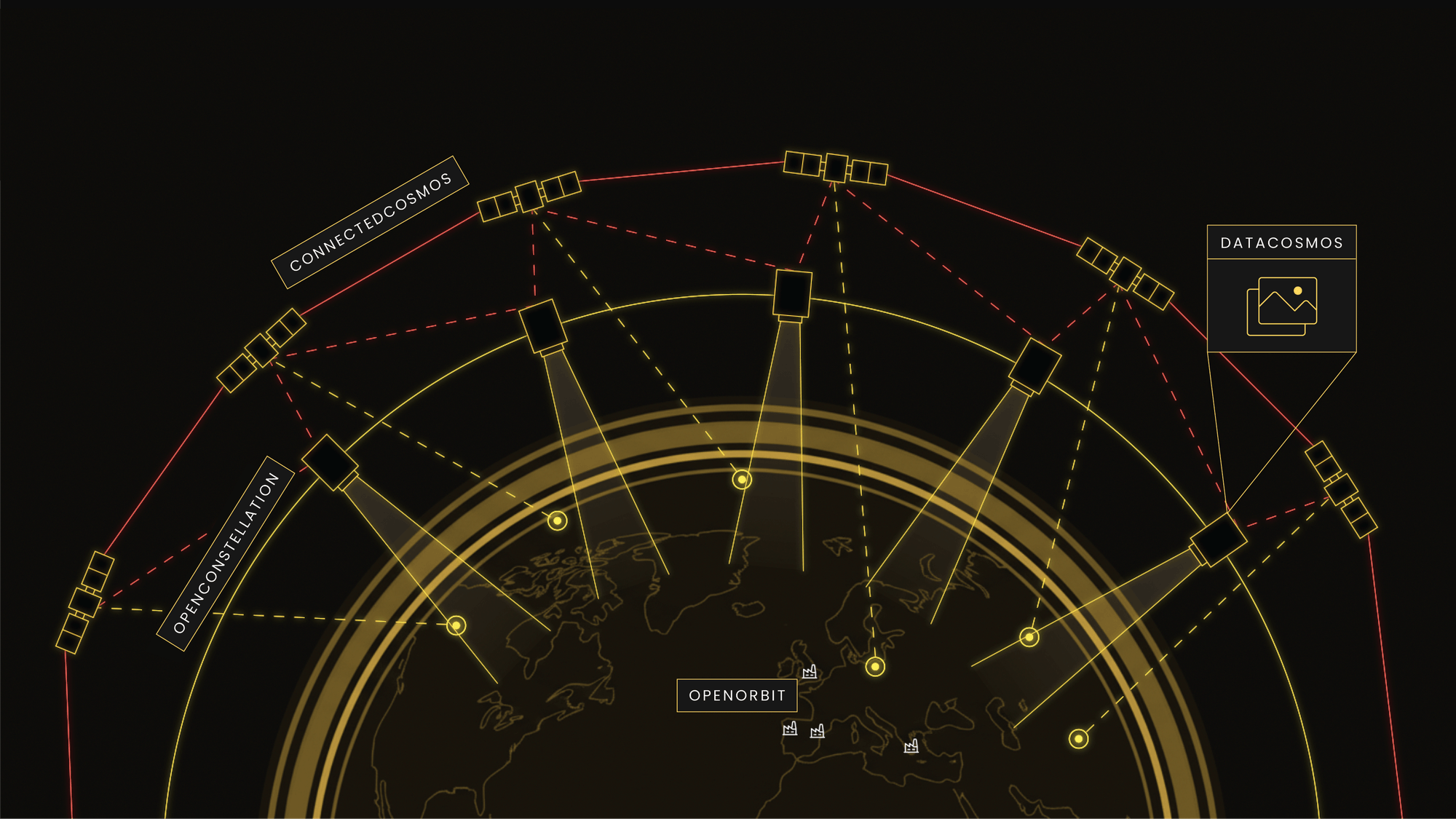
Image Credit: Open Cosmos
…………………………………………………………………………………………………………………………………………………………………………
The company says this approach is intended to “address the traditionally siloed nature of space-based data services, dramatically accelerating data delivery times and maximizing operational awareness, which will monitor environmental change and support disaster response across the globe – even in the most remote regions.”
Open Cosmos says the result is faster detection of events and a better understanding of what is happening on the ground. Potential applications include monitoring widely distributed assets, overseeing critical infrastructure such as energy, utility, and rail networks, protecting oceans, tracking wildfires, and observing offshore conditions. In this model, imagery and sensor data are combined so that users can not only see that a change has occurred, but also understand the context behind it.
“Our mission at Open Cosmos has always been focused on solving real world issues through space-based services,” said Danielle Edwards, VP for IoT at Open Cosmos. “This is an essential and critical technology service for governments, enterprises and institutions across the globe, helping to monitor and solve real world problems, with the innovative use of technology in space.
“Our existing Earth observation satellites already carry IoT payloads, so we have the experience to integrate further through our ConnectedCosmos LEO constellation, with each satellite being designed and made to carry IoT capabilities. Our aim is to provide a multitude of payload types within a single constellation to give our customers a completely bespoke and unique service.
“We won’t be just providing the data from a sensor; we will provide the visual imagery to explain why that data is changing. As demand for global monitoring and connected infrastructure continues to grow, our integrated approach represents a new model for space-enabled intelligence.”
At MWC earlier this month, Carlos Zamora, VP of Satcom Solutions at Open Cosmos, said the company is not positioning the LEO broadband service as a direct-to-device play.
Zamora elaborated:
“First of all we’re not going direct to device with the broadband. We’re not here to compete with Starlink or Kuiper or of all of these systems – we’re not here to bring internet to the to the masses. We’re here to bring a global secure connectivity to governments, commercial [customers] and actually anyone that is worried about their data resiliency and sovereignty. But we do have IoT capabilities that commercial and other customers could use. So the architecture is also fundamentally different. What we’re selling is a network, not a link in space, but actually a network. And I think what makes the difference beyond just connectivity, which is already a differentiator, is the fact that we can start fusing all of our offerings together. And this is not just about moving bits from one place to another, it is giving you the possibility of accessing a space infrastructure that can give you access to real time Earth observation, to real time computing capabilities in orbit, and basically creating a network of assets that can increase your situational awareness and give you access to a global intelligence backbone.”
Open Cosmos is effectively positioning the platform as a secure, multi-sensor space infrastructure layer rather than a consumer broadband network. The focus is on government, enterprise, and institutional customers that need connectivity, resilience, and situational awareness tied to Earth observation and IoT data.
………………………………………………………………………………………………………………………………………………………………………………….
References:
https://www.open-cosmos.com/leo-satellite-network-connectivity
https://www.open-cosmos.com/news/open-cosmos-earth-observation-iot-real-time-data
https://www.telecoms.com/satellite/open-cosmos-launches-earth-observation-and-iot-satellite-service
Enterprise IoT and the Transformation of UK Telecom Business Models – Part 1
From LPWAN to Hybrid Networks: Satellite and NTN as Enablers of Enterprise IoT – Part 2
Semtech LoRa® PHY technology enables Amazon Sidewalk to expand while supporting fixed and mobile IoT endpoints
ITU-R recommendation IMT-2020-SAT.SPECS from ITU-R WP 5B to be based on 3GPP 5G NR-NTN and IoT-NTN (from Release 17 & 18)
CEA-Leti RF Chip Enables Ultralow-Power IoT Connectivity For Remote Devices Via Astrocast’s Nanosatellite Network
One thought on “Open Cosmos introduces global space-based LEO satellite service for IoT monitoring”
Leave a Reply
Open Cosmos’ platform represents the world’s largest and most advanced integrated data ecosystem, powered by the company’s unique multi-layer satellite architecture – a trilogy of broadband secure connectivity, Earth observation, and IoT. It will enable organisations to monitor, understand, and respond to events on Earth with unprecedented speed and insight.
Across the entire Open Cosmos constellation – including the newly launched ConnectedCosmos Low Earth Orbit (LEO) connectivity backbone and Open Constellation Earth observation layer – every single satellite will carry an integrated IoT payload. Usually these are separate systems, with data being connected/integrated on the ground, but with Open Cosmos, the satellites can observe, communicate, and trigger actions in one integrated system. In doing this, Open Cosmos is addressing the traditionally siloed nature of space-based data services, dramatically accelerating data delivery times and maximising operational awareness, which will monitor environmental change and support disaster response across the globe – even in the most remote regions.
By combining ground IoT sensor data with rapid satellite imagery, governments and industries can detect events as they happen and quickly understand what is taking place on the ground, whether that is managing widely distributed assets, overseeing critical infrastructure and operational sites such as energy, utility and rail networks, protecting oceans, tracking wildfires or monitoring offshore conditions.
Today, operational awareness across many IoT services remains limited. While users may receive data on site status and alerts indicating that an issue has occurred, they often lack the visibility needed to understand the scale, context or urgency of the problem.
Danielle Edwards, VP for IoT at Open Cosmos says: “Our mission at Open Cosmos has always been focused on solving real world issues through space-based services. This is an essential and critical technology service for governments, enterprises and institutions across the globe, helping to monitor and solve real world problems, with the innovative use of technology in space.
“Our existing Earth observation satellites already carry IoT payloads, so we have the experience to integrate further through our ConnectedCosmos LEO constellation, with each satellite being designed and made to carry IoT capabilities. Our aim is to provide a multitude of payload types within a single constellation to give our customers a completely bespoke and unique service.
“We won’t be just providing the data from a sensor; we will provide the visual imagery to explain why that data is changing. As demand for global monitoring and connected infrastructure continues to grow, our integrated approach represents a new model for space-enabled intelligence.”
Open Cosmos is already working with a number of partners and early adopters across government and industry to explore applications of the new capability. The packaged data products are tailored to each customer’s requirement with maximum flexibility. Pricing will vary depending on the scale and requirements of individual deployments. The Open Cosmos IoT offering will provide more competitive rates and speeds than existing services but add value through this multi-layered data analytic approach.
https://www.satelliteevolution.com/post/open-cosmos-announces-global-space-based-iot-service-for-real-time-intelligence