

Amazon Leo plans to deploy 5,105 D2D to interoperate with Apple devices
Executive Summary:
Amazon Leo, the #1 competitor to SpaceX’s Starlink for LEO satellite internet, is proposing a new Direct to Device (D2D) constellation comprising 5,105 low-Earth orbit (LEO) satellites that will work in concert with satellites Amazon is acquiring from Globalstar.
Amazon Leo has disclosed additional technical and regulatory detail on its proposed global direct‑to‑device (D2D) low Earth orbit (LEO) constellation, envisioned to comprise 5,105 satellites and to operate in conjunction with D2D capacity obtained via Amazon’s planned acquisition of Globalstar.
System architecture and spectrum use:
According to an FCC application filed by Kuiper Systems LLC on Saturday, July 25, the Amazon Leo D2D system is designed to leverage Mobile‑Satellite Service (MSS) spectrum as well as selected terrestrial mobile bands to deliver “ubiquitous global coverage.” The constellation will employ D2D‑optimized spacecraft using service links in the 1.6–2.4 GHz range, supported by feeder links and TT&C in Ka‑ and V‑band. Outside the US, Amazon plans to utilize additional available L‑band and S‑band allocations for service links to expand geographic reach and regulatory flexibility.
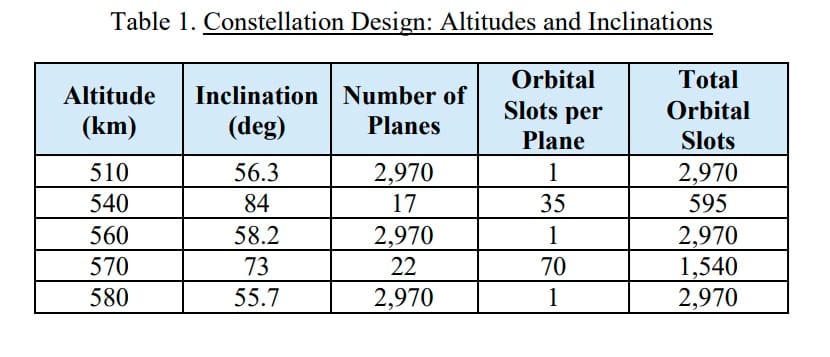
In a Monday technical blog post, Amazon Leo outlined a five‑shell orbital architecture, with three mid‑latitude shells designed to serve densely populated regions and two high‑latitude shells to extend coverage into remote geographies, including polar areas. Amazon reiterated that the D2D constellation is being engineered to interoperate with Apple devices (including iPhone and Apple Watch) and to complement its Kuiper broadband network, which is expected to enter commercial service later this year.
Integration with Globalstar and optical ISLs:
The Amazon Leo D2D constellation will incorporate optical inter‑satellite links (OISLs) to integrate the new D2D system with existing Amazon Leo satellite infrastructure and to “work in close concert” with the Globalstar MSS constellation in the 1.6–2.4 GHz band, assuming timely closing of the transaction. Amazon states that it will mitigate inter‑system interference between the Amazon Leo D2D system and Globalstar’s HIBLEO‑4, HIBLEO‑X, and planned C‑3 MSS operations via unified global network management and coordinated controls.
The proposed $11.5 billion Amazon–Globalstar deal remains under active regulatory review. Amazon Leo has previously indicated that its own D2D constellation is targeted for launch around 2028, positioning the system as a smartphone‑ and device‑centric coverage layer beyond the reach of terrestrial radio access networks and as a competitor or complement to emerging D2D offerings from SpaceX, AST SpaceMobile, and others. Amazon has highlighted canonical D2D use cases, including emergency messaging, in‑vehicle connectivity, and a broad range of IoT applications.
The potential role of Amazon’s D2D platform within the new US rural‑coverage D2D joint venture formed by AT&T, T‑Mobile, and Verizon remains unspecified.
Satellite lifecycle, deorbiting, and debris mitigation:
Each Amazon Leo D2D satellite is designed with a nominal operational life of six to eight years, contingent on orbital shell parameters. Amazon plans active end‑of‑life management and deorbiting, reserving approximately 40% of each satellite’s propellant for “disposal operations” to support controlled removal from orbit.
The FCC filing also provides additional detail on collision‑risk management and debris‑mitigation strategies. To reduce the probability of fragmentation events, Amazon has engineered propellant tanks to leak rather than burst under most failure modes, including micrometeoroid and orbital‑debris impacts, and has characterized tank behavior under high‑velocity impact conditions. The constellation will be monitored on a 24/7 basis for conjunction and collision risk, and each satellite will be equipped with onboard propulsion and maneuvering capability to perform collision‑avoidance maneuvers with respect to other spacecraft and tracked objects.
References:
https://www.lightreading.com/satellite/amazon-leo-files-plan-to-deploy-5-105-d2d-satellites
One thought on “Amazon Leo plans to deploy 5,105 D2D to interoperate with Apple devices”
Leave a Reply

Telcos, Meet Your Friendly Neighborhood LeoMan:
Amazon Leo is presenting itself as the satellite partner telcos wanted Starlink to remain. Its new D2D architecture is ambitious. Whether it can produce meaningful operator revenue remains unanswered.
Amazon has now filed to launch up to 5,105 satellites dedicated to direct-to-device connectivity, with deployment starting in 2028. These satellites would operate across five orbital shells, use Globalstar’s L-band and S-band spectrum to reach compatible phones, process signals in orbit, route traffic through optical links, and connect to terrestrial gateways via Ka-band and V-band. The system is designed to support voice, messaging, data, emergency services and IoT, not just the occasional SOS message.
The commercial pieces are also becoming clearer. Amazon is paying $11.6 billion for Globalstar, acquiring its spectrum, satellite infrastructure, regulatory authorizations and existing relationship with Apple. Amazon Leo already has more than 390 broadband satellites in orbit, partnerships with Vodafone, NBN, DirecTV and Herotel, and plans to combine D2D with fixed broadband, mobile backhaul, enterprise connectivity and AWS.
The timing could not be better. Telecom operators are increasingly concerned that Starlink may move from satellite partner to direct competitor, taking a larger share of the mobile, broadband and enterprise revenue pool. Amazon has clearly identified the opening. Its message is carefully designed for the telecom industry: Starlink may want your customers. Amazon Leo wants to help you serve them…