

Amazon Leo
Amazon Leo plans to deploy 5,105 D2D to interoperate with Apple devices
Executive Summary:
Amazon Leo, the #1 competitor to SpaceX’s Starlink for LEO satellite internet, is proposing a new Direct to Device (D2D) constellation comprising 5,105 low-Earth orbit (LEO) satellites that will work in concert with satellites Amazon is acquiring from Globalstar.
Amazon Leo has disclosed additional technical and regulatory detail on its proposed global direct‑to‑device (D2D) low Earth orbit (LEO) constellation, envisioned to comprise 5,105 satellites and to operate in conjunction with D2D capacity obtained via Amazon’s planned acquisition of Globalstar.
System architecture and spectrum use:
According to an FCC application filed by Kuiper Systems LLC on Saturday, July 25, the Amazon Leo D2D system is designed to leverage Mobile‑Satellite Service (MSS) spectrum as well as selected terrestrial mobile bands to deliver “ubiquitous global coverage.” The constellation will employ D2D‑optimized spacecraft using service links in the 1.6–2.4 GHz range, supported by feeder links and TT&C in Ka‑ and V‑band. Outside the US, Amazon plans to utilize additional available L‑band and S‑band allocations for service links to expand geographic reach and regulatory flexibility.
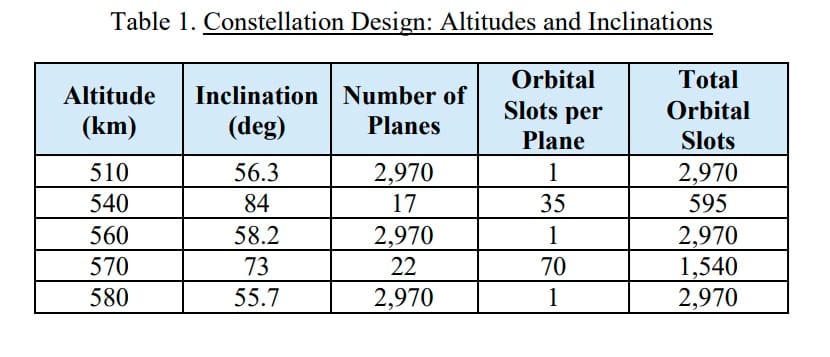
In a Monday technical blog post, Amazon Leo outlined a five‑shell orbital architecture, with three mid‑latitude shells designed to serve densely populated regions and two high‑latitude shells to extend coverage into remote geographies, including polar areas. Amazon reiterated that the D2D constellation is being engineered to interoperate with Apple devices (including iPhone and Apple Watch) and to complement its Kuiper broadband network, which is expected to enter commercial service later this year.
Integration with Globalstar and optical ISLs:
The Amazon Leo D2D constellation will incorporate optical inter‑satellite links (OISLs) to integrate the new D2D system with existing Amazon Leo satellite infrastructure and to “work in close concert” with the Globalstar MSS constellation in the 1.6–2.4 GHz band, assuming timely closing of the transaction. Amazon states that it will mitigate inter‑system interference between the Amazon Leo D2D system and Globalstar’s HIBLEO‑4, HIBLEO‑X, and planned C‑3 MSS operations via unified global network management and coordinated controls.
The proposed $11.5 billion Amazon–Globalstar deal remains under active regulatory review. Amazon Leo has previously indicated that its own D2D constellation is targeted for launch around 2028, positioning the system as a smartphone‑ and device‑centric coverage layer beyond the reach of terrestrial radio access networks and as a competitor or complement to emerging D2D offerings from SpaceX, AST SpaceMobile, and others. Amazon has highlighted canonical D2D use cases, including emergency messaging, in‑vehicle connectivity, and a broad range of IoT applications.
The potential role of Amazon’s D2D platform within the new US rural‑coverage D2D joint venture formed by AT&T, T‑Mobile, and Verizon remains unspecified.
Satellite lifecycle, deorbiting, and debris mitigation:
Each Amazon Leo D2D satellite is designed with a nominal operational life of six to eight years, contingent on orbital shell parameters. Amazon plans active end‑of‑life management and deorbiting, reserving approximately 40% of each satellite’s propellant for “disposal operations” to support controlled removal from orbit.
The FCC filing also provides additional detail on collision‑risk management and debris‑mitigation strategies. To reduce the probability of fragmentation events, Amazon has engineered propellant tanks to leak rather than burst under most failure modes, including micrometeoroid and orbital‑debris impacts, and has characterized tank behavior under high‑velocity impact conditions. The constellation will be monitored on a 24/7 basis for conjunction and collision risk, and each satellite will be equipped with onboard propulsion and maneuvering capability to perform collision‑avoidance maneuvers with respect to other spacecraft and tracked objects.
References:
https://www.lightreading.com/satellite/amazon-leo-files-plan-to-deploy-5-105-d2d-satellites
Analysis: Amazon <- Globalstar - a strategic move for D2D and spectrum parity
Overview:
Amazon said today that it will acquire Globalstar in an $11.57 billion deal, bolstering its fledgling satellite internet business as it tries to catch up with Elon Musk’s Starlink.
Amazon is accelerating its Project Kuiper deployment, aiming to launch approximately 3,200 Low Earth Orbit (LEO) satellites by 2029. To meet regulatory milestones, nearly 50% of the constellation must be operational by the July deadline, with commercial satellite broadband services slated for a soft launch later this year.
The acquisition of Globalstar augments Amazon’s Direct-to-Device (D2D) connectivity offerings. Globalstar’s current architecture is optimized for low-bandwidth, high-reliability mobile links that bypass traditional terrestrial RAN infrastructure. This capability is vital for ubiquitous emergency services and IoT connectivity in non-terrestrial network (NTN) white spaces. Through this deal, Amazon expects to operationalize its own D2D offerings by 2028.
IMPORTANT: It should be noted that ONLY 3GPP is developing the standards for NTNs – ITU-R and ETSI SDOs are simply rubber stamp SDOs for 3GPP NTN specs.
“There are billions of customers out there living, traveling, and operating in places beyond the reach of existing networks, and we started Amazon Leo to help bridge that divide,” said Panos Panay, Senior Vice President of Devices & Services, Amazon. “By combining Globalstar’s proven expertise and strong foundation with Amazon’s customer-obsession and innovation, customers can expect faster, more reliable service in more places—keeping them connected to the people and things that matter most. We’re excited to support Apple users through the Leo D2D system, and look forward to working with mobile network partners to help extend coverage to every corner of the planet,” Panay added.

The Competitive Landscape: Starlink vs. Kuiper:
SpaceX’s Starlink currently maintains a significant lead with over 9 million global subscribers. While Starlink’s core business remains high-throughput fixed wireless via proprietary user terminals, it is aggressively pursuing D2D through spectrum-sharing partnerships with Mobile Network Operators (MNOs) like T-Mobile.
Industry analysts suggest that acquiring Globalstar is a “spectrum play.” Armand Musey of Summit Ridge Group noted that the deal allows Amazon to secure a critical spectrum position and potentially leapfrog Starlink in D2D deployment timelines. Furthermore, Amazon’s proposed data center constellation is engineered for a massive scaling of network capacity, intended to exceed current LEO benchmarks.
“Amazon has been falling behind Starlink on satellite broadband. Acquiring Globalstar allows them to catch up on their D2D spectrum position, and leap ahead on D2D deployment,” said Armand Musey, president & founder of Summit Ridge Group.
Amazon LEO’s proposed data center constellation would dwarf Starlink’s current network by several magnitudes:

The Apple-Globalstar Ecosystem:
Crucially, Globalstar’s existing partnership with Apple remains intact. Globalstar currently provides the L-band connectivity powering Apple’s Emergency SOS and Find My features. Amazon has confirmed it will honor these agreements, maintaining the 2024 framework where Apple invested $1.5 billion for a 20% equity stake to expand the constellation to 54 satellites. See References below.
Market Consolidation and Valuations:
The move follows a broader trend of sector consolidation as players seek the scale required to compete with SpaceX’s vertical integration and launch frequency.
- Deal Metrics: Amazon’s acquisition values Globalstar at approximately $10.8 billion ($90/share), representing a 31% premium over the pre-announcement close.
- Regulatory Path: The merger is expected to close in 2025, pending FCC approval and the achievement of specific deployment KPIs. FCC Chair Brendan Carr indicated the agency remains “open-minded” regarding the consolidation.
Author’s Opinion & Analysis (aided by perplexity.ai):
Amazon’s Globalstar acquisition is a strong strategic move towards D2D, but it is more a spectrum-and-regulatory shortcut than a pure technology leap. The telecom significance is that Amazon is buying not just satellites, but licensed Mobile Satellite Spectrum (MSS), operational know-how, and an immediate path into direct-to-device connectivity that would otherwise take years to assemble.
From a telecom perspective, the key asset is spectrum parity. Globalstar holds licensed MSS spectrum in the L/S-band ranges used for satellite mobile services, and that spectrum is hard to replicate because the FCC has previously rejected or constrained new entrants in those bands. That makes the deal valuable less as a fleet expansion play and more as a way to secure a legally usable radio layer for D2D, which is not at all guaranteed.
Amazon’s stated plan is to combine Globalstar’s spectrum and MSS operations with Amazon Leo to deliver D2D services beginning in 2028, with claims of higher spectrum efficiency than legacy direct-to-cell systems. In telecom terms, that implies Amazon wants to move from “coverage extension” into a more integrated NTN architecture that can support voice, text, and eventually data services at scale. That’s certainly a tall order!
Against Starlink, this is a defensive and offensive move all at the same time. Starlink already has a lead in satellite scale and has commercialized carrier partnerships like T-Mobile’s direct-to-cell offering, so Amazon’s problem has been less launch capacity than spectrum and service readiness. Buying Globalstar narrows that gap by giving Amazon a ready-made regulatory and spectrum base instead of forcing it to negotiate every D2D pathway from scratch.
Against carriers, the move is more nuanced. Amazon is not simply disintermediating mobile operators; its own materials describe D2D as a way to help MNOs extend voice, text, and data beyond terrestrial reach. That suggests a wholesale or partner model, but the long-term competitive risk is obvious: if Amazon owns the satellite layer and the device/service stack, carriers may become optional distribution partners rather than network gatekeepers.
The phrase “spectrum parity” is the real strategic clue. In telecom, constellation size matters, but spectrum rights determine whether a constellation can actually deliver service with usable link budgets, device compatibility, and regulatory clearance. Globalstar’s spectrum therefore acts like a license to compete, not just a frequency block.
This also helps explain why the deal is strategically defensive for Amazon. Without Globalstar, Amazon would face a slower, less certain path through band planning, interference disputes, and NTNspecific regulatory work, especially in crowded MSS allocations. In that sense, the acquisition is a classic telecom play: buy scarce spectrum, then scale the network around it.
The biggest near-term risk to this deal is regulatory. The transaction will need FCC and likely antitrust review, and Amazon will also have to navigate the Apple/Globalstar relationship because Globalstar powers Apple’s Emergency SOS service. That creates both transition risk and potential bargaining leverage for Apple, which could complicate service continuity and deal terms.
Technically, D2D is still constrained by small link budgets, handset antenna limits, and the need to prioritize messaging and emergency services before richer data use cases. Even if Amazon claims better spectrum efficiency, the first commercially meaningful services will likely remain low-throughput, coverage-oriented offerings rather than full terrestrial substitutes. So the real competition is not “satellite internet for phones” in the consumer broadband sense, but who controls the premium coverage layer for dead zones, emergency service, enterprise continuity, and carrier augmentation.
In conclusion, Amazon is making a category-defining infrastructure purchase, not just a corporate acquisition. If approved, it gives Amazon a credible D2D spectrum position, reduces its regulatory latency, and turns Amazon Leo into a more complete and highly competitive NTN platform and D2D service provider.
……………………………………………………………………………………………………………………….
References:
https://www.aboutamazon.com/news/company-news/amazon-globalstar-apple
Amazon Leo (formerly Project Kuiper) unveils satellite broadband for enterprises; Competitive analysis with Starlink
Blue Origin announces TeraWave – satellite internet rival for Starlink and Amazon Leo
NBN selects Amazon Project Kuiper over Starlink for LEO satellite internet service in Australia
Amazon launches first Project Kuiper satellites in direct competition with SpaceX/Starlink
Emergency SOS: Apple iPhones to be able to send/receive texts via Globalstar LEO satellites in November
FCC proposes regulatory framework for space-mobile network operator collaboration
AT&T deal with AST SpaceMobile to provide wireless service from space
Starlink Direct to Cell service (via Entel) is coming to Chile and Peru be end of 2024
Starlink’s Direct to Cell service for existing LTE phones “wherever you can see the sky”
Amazon Leo (formerly Project Kuiper) unveils satellite broadband for enterprises; Competitive analysis with Starlink
Amazon Leo (formerly Project Kuiper) has now disclosed its enterprise-focused hardware, services, and capabilities, and launching a new preview program for select enterprise customers to begin testing Amazon Leo services ahead of a wider commercial rollout in 2026. With more than 150 satellites in orbit and initial network testing underway, Amazon Leo aims to provide high-speed internet service to those beyond the reach of existing networks, including the millions of businesses, government entities, and organizations operating in places without reliable connectivity.
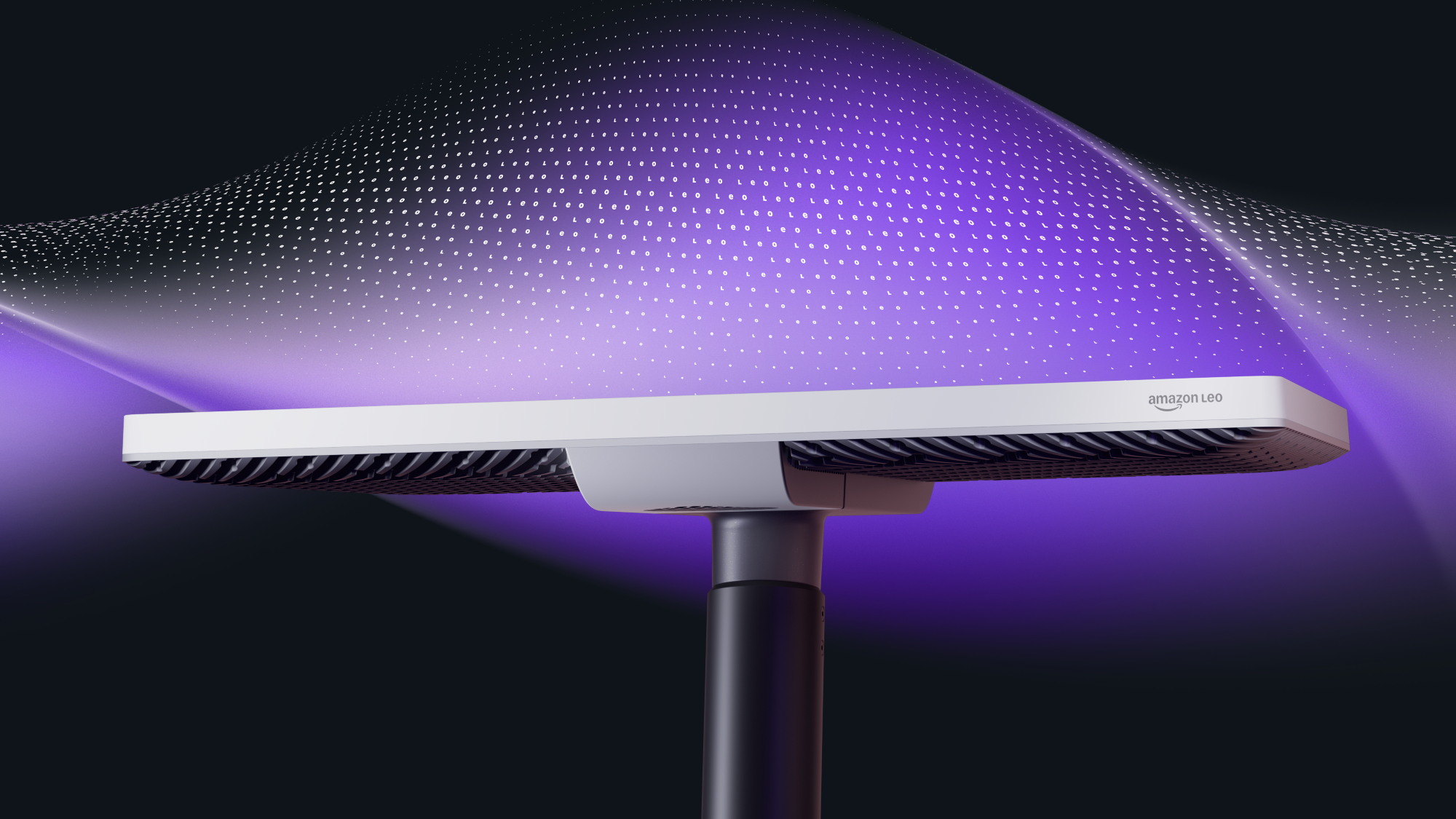
Amazon revealed the final production design of Amazon Leo Ultra, an advanced, enterprise-grade terminal that delivers best-in-class performance for demanding private and public sector applications. The full-duplex phased array antenna (see photo below) provides download speeds of up to 1 Gbps and upload speeds up to 400 Mbps, making it the fastest commercial phased array antenna in production.

- The standard customer terminal for most users is the Leo Pro, offering downlink speeds of up to 400 Mbps in an 11”x11” package, and the Leo Nano is a 7×7” model that delivers downlink speeds up to 100 Mbps.
- For the Leo Pro and Leo Nano customer terminals, Amazon overlaid transmit and receive phased array antennas to deliver high performance while reducing size—the first time that had been done in the Ka-band.
- Leo Ultra is the most powerful antenna in their lineup, specifically designed for demanding enterprise applications. It features advanced networking capabilities, including simultaneous upload and download capabilities and seamless integration with existing enterprise network infrastructure. The transmit and receive antennas are side by side to maximize performance and allow for full duplex operation, which means the antenna can simultaneously transmit and receive data at high speeds. Leo Ultra is engineered for the elements with a durable, weather-resistant design that can withstand high-and low temperatures, precipitation, and strong winds. Its sleek and integrated design eliminates moving parts while enabling rapid installation and reliable operation across a wide range of locations.
Amazon Leo will offer enterprise-grade features including easy-to-use network management tools, advanced encryption across the network, and 24/7 priority customer support. The service is designed to support critical business applications including real-time data processing, remote operations management, and secure communications for teams working in field locations. It also connects directly to Amazon Web Services (AWS), as well as other cloud and on-premise networks, allowing customers to securely move data from remote assets to private networks without touching the public internet. Amazon Leo will offer two primary private networking solutions:
- Direct to AWS: With Direct to AWS (D2A), AWS customers can connect directly to their cloud workloads using an AWS Transit Gateway or AWS Direct Connect Gateway through a point-and-click interface on the Amazon Leo web console, simplifying network management and lowering latency.
- Private Network Interconnect: Enterprises and telecommunications providers can also establish private network interconnects (PNI) at major colocation facilities to connect remote locations directly to their data center or core network, enabling Private Networking in days rather than the weeks or months typically required to deploy traditional private circuits.
………………………………………………………………………………………………………………………………………………………………………….
Quotes:
“Amazon Leo represents a massive opportunity for businesses operating in challenging environments,” said Chris Weber, vice president of consumer and enterprise business for Amazon Leo. “From our satellite and network design to our portfolio of high-performance phased array antennas, we’ve designed Amazon Leo to meet the needs of some of the most complex business and government customers out there, and we’re excited to provide them with the tools they need to transform their operations, no matter where they are in the world.”
An anonymous Amazon Leo spokesperson told Fierce Network, “We have a broad mix of customers, some of whom are also customers of AWS. We’ll expand service to more customers, including residential users, as we add coverage and capacity to the network in 2026. We’ll share details as we get closer to general availability.”
“We’ve made a ton of progress already this year with six successful missions sending more than 150 satellites to orbit; our next mission is coming up on December 15 to deploy another 27 satellites; and we’re processing satellites for the next missions after that. We need more satellites up before we can offer 24-hour coverage, and we expect to accelerate deployment in the coming months as we begin launching on new heavy-lift rockets like Vulcan, New Glenn and Ariane 6 that can carry more satellites per launch,” said the spokesperson.
………………………………………………………………………………………………………………………………………………………………………….
| Feature | Starlink (SpaceX) | Amazon Leo (Amazon) |
|---|---|---|
| Current Status | Fully operational, with a large, established customer base. | In an “enterprise preview” phase with select businesses; commercial rollout expected in 2026. |
| Satellites in Orbit | Over 9,000 satellites currently deployed. | Over 150 satellites currently deployed, with a goal of over 3,000. |
| Target Audience | Broad focus on consumers, rural users, businesses, aviation, and maritime. | Initial focus on enterprise, government, and telecom providers, with consumer service planned for later. |
| Max Speeds | Current median speeds around 200 Mbps for residential, higher for business plans (up to 400 Mbps+ with certain hardware). | Promises up to 1 Gbps download speeds with its enterprise-grade Leo Ultra antenna. |
| Differentiation | Known for its broad availability and relatively low-cost consumer hardware. | Emphasizes seamless integration with Amazon Web Services (AWS) and enhanced private networking features for business customers. |
- Technological Rivalry: The competition is fueled by a high-profile rivalry between founders Elon Musk (SpaceX) and Jeff Bezos (Amazon), whose separate space ventures also compete.
- Market Growth: The entry of Amazon Leo is expected to drive innovation and provide customers with more options, potentially driving down prices and improving services across the industry.
References:
https://www.aboutamazon.com/news/amazon-leo/amazon-leo-satellite-internet-ultra-pro
https://www.fierce-network.com/broadband/amazon-leo-previews-its-satellite-broadband-enterprises
NBN selects Amazon Project Kuiper over Starlink for LEO satellite internet service in Australia
Amazon launches first Project Kuiper satellites in direct competition with SpaceX/Starlink
Vodafone and Amazon’s Project Kuiper to extend 4G/5G in Africa and Europe
Amazon to Spend Billions on 38 Space Launches for Project Kuiper
Verizon partners with Amazon Project Kuiper to offer FWA in unconnected and underserved areas
FCC grants Amazon’s Kuiper license for NGSO satellite constellation for internet services
GEO satellite internet from HughesNet and Viasat can’t compete with LEO Starlink in speed or latency
Elon Musk: Starlink could become a global mobile carrier; 2 year timeframe for new smartphones
FCC: More competition for Starlink; freeing up spectrum for satellite broadband service