

D2D Direct to Device
SpaceX Moves to Acquire Nationwide 800 MHz Spectrum for Starlink Mobile D2D Service
Introduction:
SpaceX announced an agreement on Thursday to acquire Grain Management’s nationwide 800 MHz spectrum portfolio, expanding the spectrum resources available for its Starlink Mobile direct satellite-to-device (D2D) service [1.]. The transaction would give SpaceX a low-band complement to its existing global 2 GHz mid-band spectrum holdings and strengthen its position as a potential competitor to established U.S. wireless operators. The agreement covers 100% of Space X’s nationwide 800 MHz spectrum portfolio. Financial terms were not disclosed, and the acquisition remains subject to Federal Communications Commission (FCC) approval.
Note 1. Starlink’s satellite connectivity plans extend beyond cellphones to broader direct-to-device end points. IoT support is explicitly part of its published roadmap; smartwatch support has yet to be confirmed for general capability. Starlink’s “Direct to Cell” branding describes a cellular satellite-access system, not a smartphone-only endpoint strategy. Starlink’s official Direct to Cell page states:
“In addition to expanding mobile coverage, Direct to Cell will enable ubiquitous Internet of Things (IoT) connectivity outside of terrestrial coverage, connecting millions of devices across critical global industries.”
………………………………………………………………………………………………………………………………………………………………
Low-band spectrum complements 2 GHz capacity:
The acquisition would add a coverage layer to Starlink Mobile’s spectrum strategy. While its existing 2 GHz spectrum is intended to support higher-bandwidth services, the 800 MHz portfolio would provide more favorable propagation characteristics, including improved penetration through obstacles such as foliage and building materials.
Those characteristics could help address signal attenuation—a significant constraint for satellite-to-smartphone connectivity. However, favorable low-band propagation should not be equated with assured indoor service; the announcement does not establish the coverage or performance that Starlink Mobile would deliver inside buildings.
The acquisition could expand SpaceX’s ability to provide mobile coverage from orbit, but it does not establish that the company intends to dispense with terrestrial infrastructure.
Regulatory approval and competitive implications:
Separately, the FCC approved Starlink Mobile’s Gen2 constellation application this week, according to the supplied Reuters report. That authorization permits SpaceX to launch 15,000 satellites optimized for operation in the 2 GHz band globally. The constellation authorization and the proposed 800 MHz acquisition are distinct regulatory matters: approval of the former does not constitute approval of the spectrum transaction.
Shares of T-Mobile US, Verizon and AT&T each fell more than 5% in extended trading today. The declines reflected investor concerns that SpaceX’s expansion into mobile connectivity could intensify price competition and pressure incumbent operators’ market share in the mature U.S. wireless market.
The strategic significance is the combination of additional low-band spectrum and an expanded satellite constellation. Whether those assets translate into a competitive alternative to terrestrial mobile networks will depend on regulatory approval and the coverage, capacity and service performance SpaceX ultimately delivers.
Technical implications: propagation, capacity and handset compatibility:
The engineering significance of the acquisition extends beyond improved signal penetration. Satellite-to-smartphone services must accommodate propagation distances far greater than those in terrestrial cellular networks, while maintaining reliable communication with ordinary handsets. Operating frequency, satellite altitude, antenna design and beam geometry therefore jointly determine the achievable coverage and service performance. Lower-frequency spectrum offers a useful propagation advantage, but it does not eliminate those system-level constraints.
Capacity is a separate issue. The description of 800 MHz as a coverage layer and 2 GHz as a capacity layer is a useful shorthand—not an intrinsic division between the two frequency bands. Available bandwidth and the ability to form and reuse satellite spot beams matter alongside propagation. Narrower beams can improve spatial isolation and help manage satellite-link impairments, but they require larger antennas; maintaining coverage with smaller beam footprints can also require more beams or additional satellites. Consequently, nationwide spectrum holdings should not be confused with nationwide terrestrial-equivalent capacity.
Satellite operation requires more than a compatible frequency band:
Direct-to-device systems must compensate for the propagation delay and Doppler shift associated with rapidly moving low-Earth-orbit satellites. In systems serving unmodified LTE smartphones, the network performs that compensation. Residual timing and frequency errors vary across the satellite beam and can disrupt initial access, while longer round-trip delays can reduce the efficiency of retransmission protocols. Low-band spectrum does not remove these protocol constraints.ericsson
Handset compatibility also requires a distinction between two approaches. Satellite systems using a conventional LTE air interface can serve existing smartphones in supported terrestrial cellular bands. By contrast, 3GPP Release 17 NR-NTN introduces satellite-specific capabilities, including handset-based timing and frequency compensation using the device’s location and satellite orbital information. These capabilities require compatible chipsets and devices; support for an 800 MHz cellular band alone does not establish support for NR-NTN. The spectrum acquisition therefore should not be characterized as a 5G NTN deployment without disclosure of the intended air interface and device requirements.ericsson
Nationwide spectrum helps—but does not eliminate interference constraints:
Nationwide exclusive access to terrestrial mobile spectrum can simplify satellite deployment by reducing domestic co-channel coexistence problems. However, satellite beams do not stop at national borders. Operations still require interference controls and coordination to protect terrestrial systems in neighboring countries. Depending on the authorization and deployment model, those controls can include geographic exclusion zones and restrictions on satellite transmission parameters.
Indoor Coverage is Highly Unlikely:
Improved propagation is an engineering advantage; reliable indoor service remains a performance claim that needs supporting specifications or measurements. The technical evidence instead emphasizes the interdependence of frequency, antenna design, satellite geometry and protocol behavior.
………………………………………………………………………………………………………………………………………………
Grain Management Backgrounder:
“For nearly twenty years, we have built Grain to see opportunity where others see complexity,” said David Grain, Founder and Chief Executive Officer of Grain Management. “Our spectrum expertise allows us to connect the strategic value of these assets with the technologies and operators that can realize their potential. This agreement with SpaceX brings that capability to bear at extraordinary scale, with the potential to change where and how Americans connect.”
Grain combines deep sector experience, strategic insight, and capital to unlock spectrum value, advance its productive use, and help operators meet evolving connectivity needs. Grain’s acquisition of the nationwide 800 MHz portfolio from T-Mobile in August 2026 extends that approach – the firm acquired the portfolio in exchange for cash and Grain’s 600MHz spectrum, then pursued multiple use cases that would expand connectivity for American consumers and create value for the industry, Grain’s investors, and the people whose futures they support.
“Spectrum is a finite resource with an expanding role in the economy,” Grain added. “As terrestrial and space-based networks converge, we see a new horizon globally for our spectrum strategy, building on our experience to address larger industry challenges and help shape the next generation of connectivity.”
…………………………………………………………………………………………………………………………………………………………
Separately, Space X today signed a fleet-wide deal with American Airlines to equip over 1,000 mainline aircraft with Starlink internet access. Starlink will bring fast, reliable Wi-Fi to customers throughout their journey, making it easier to stay connected from gate to gate. Whether responding to emails, catching up on messages, streaming favorite shows, browsing the web or keeping the family entertained, customers can enjoy a seamless online experience in the air.
“Our customers have told us that dependable connectivity can make a meaningful difference in how they spend their time in the air,” said American’s Chief Customer Officer Heather Garboden. “Whether they are livestreaming a favorite show, gaming, collaborating in real time on an important work deal, scrolling social media or online shopping, Starlink will give our customers countless options to make the most of their time while traveling. Just as importantly, it provides the foundation for future innovations that will further enhance the customer experience.”
“We’re thrilled to bring Starlink across American’s mainline fleet,” said Lauren Dreyer, Vice President of Starlink Business Operations at SpaceX. “Customers will have fast, reliable internet from gate to gate, whether they are streaming, working, or staying connected to family and friends throughout their travel.”
……………………………………………………………………………………………………………………………………………….
References:
Starlink Mobile: NTN–Terrestrial Convergence, Network Capacity, and the Limits of Disruption
FT: SpaceX considering Starlink Direct-to-Consumer mobile service & terrestrial cellular network infrastructure in the U.S.
Ookla: Starlink a viable competitor for hybrid 5G/NTN services due to network performance improvements and larger coverage area
Ookla: D2D satellite connectivity surged 24.5% during last 9 months; Starlink’s footprint expansion leads the way
US Mobile’s new bundle combines its multi-network mobile service with Starlink residential internet
Direct-to-Device (D2D) satellite network comparison: Starlink V2 (Starlink Mobile) vs “Satellite Connect Europe”
Blue Origin announces TeraWave – satellite internet rival for Starlink and Amazon Leo
China ITU filing to put ~200K satellites in low earth orbit while FCC authorizes 7.5K additional Starlink LEO satellites
Starlink doubles subscriber base; expands to to 42 new countries, territories & markets
Amazon Leo (formerly Project Kuiper) unveils satellite broadband for enterprises; Competitive analysis with Starlink
European network operators in talks to form consortium to bid for EU satellite spectrum and provide D2M service
Introduction:
Four of Europe’s largest mobile network operators—Deutsche Telekom, Orange, Vodafone Group, and Telefónica—are in preliminary discussions to form a consortium that would jointly bid for EU-reserved satellite spectrum and launch a direct-to-mobile (D2M) service, according to a Bloomberg report cited by Reuters and other news outlets.
The EU’s planned 2 GHz mobile-satellite service (MSS) assignment is being structured as a three-way split of the band—one-third for government/IRIS² use, one-third reserved for EU-controlled commercial operators, and one-third open to international bidders.
3GPP Release 17 and Release 18 provide the standardized radio and protocol baseline for direct-to-mobile (D2M) integration in bands n255/n256 (and n254). Those specs are not yet approved ITU-R SG 4 (WP 4b & 4c) recommendations.
The EU’s planned 2 GHz mobile-satellite service (MSS) assignment is being structured as a three-way split of the band—one-third for government/IRIS² use, one-third reserved for EU-controlled commercial operators, and one-third open to international bidders—while 3GPP Release 17 and Release 18 provide the standardized radio and protocol baseline for direct-to-mobile (D2M) integration in bands n255/n256 (and n254).

Parabolic antenna and satellite dishes in Girona, Spain. Photographer: Angel Garcia/Bloomberg
………………………………………………………………………………………………………………………………………………………………..
Key data points:
Amazon Leo plans to deploy 5,105 D2D to interoperate with Apple devices
Executive Summary:
Amazon Leo, the #1 competitor to SpaceX’s Starlink for LEO satellite internet, is proposing a new Direct to Device (D2D) constellation comprising 5,105 low-Earth orbit (LEO) satellites that will work in concert with satellites Amazon is acquiring from Globalstar.
Amazon Leo has disclosed additional technical and regulatory detail on its proposed global direct‑to‑device (D2D) low Earth orbit (LEO) constellation, envisioned to comprise 5,105 satellites and to operate in conjunction with D2D capacity obtained via Amazon’s planned acquisition of Globalstar.
System architecture and spectrum use:
According to an FCC application filed by Kuiper Systems LLC on Saturday, July 25, the Amazon Leo D2D system is designed to leverage Mobile‑Satellite Service (MSS) spectrum as well as selected terrestrial mobile bands to deliver “ubiquitous global coverage.” The constellation will employ D2D‑optimized spacecraft using service links in the 1.6–2.4 GHz range, supported by feeder links and TT&C in Ka‑ and V‑band. Outside the US, Amazon plans to utilize additional available L‑band and S‑band allocations for service links to expand geographic reach and regulatory flexibility.
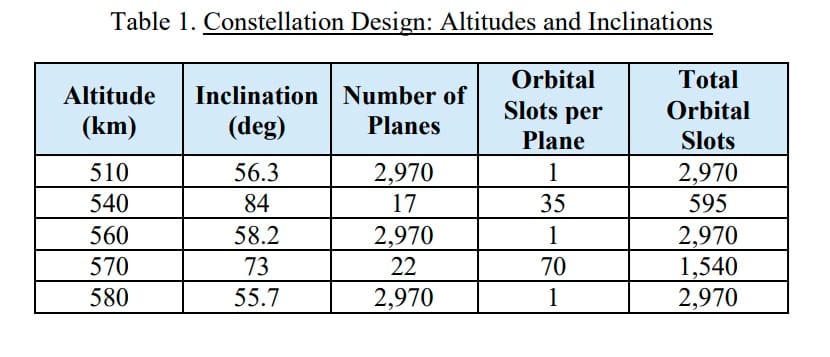
In a Monday technical blog post, Amazon Leo outlined a five‑shell orbital architecture, with three mid‑latitude shells designed to serve densely populated regions and two high‑latitude shells to extend coverage into remote geographies, including polar areas. Amazon reiterated that the D2D constellation is being engineered to interoperate with Apple devices (including iPhone and Apple Watch) and to complement its Kuiper broadband network, which is expected to enter commercial service later this year.
Integration with Globalstar and optical ISLs:
The Amazon Leo D2D constellation will incorporate optical inter‑satellite links (OISLs) to integrate the new D2D system with existing Amazon Leo satellite infrastructure and to “work in close concert” with the Globalstar MSS constellation in the 1.6–2.4 GHz band, assuming timely closing of the transaction. Amazon states that it will mitigate inter‑system interference between the Amazon Leo D2D system and Globalstar’s HIBLEO‑4, HIBLEO‑X, and planned C‑3 MSS operations via unified global network management and coordinated controls.
The proposed $11.5 billion Amazon–Globalstar deal remains under active regulatory review. Amazon Leo has previously indicated that its own D2D constellation is targeted for launch around 2028, positioning the system as a smartphone‑ and device‑centric coverage layer beyond the reach of terrestrial radio access networks and as a competitor or complement to emerging D2D offerings from SpaceX, AST SpaceMobile, and others. Amazon has highlighted canonical D2D use cases, including emergency messaging, in‑vehicle connectivity, and a broad range of IoT applications.
The potential role of Amazon’s D2D platform within the new US rural‑coverage D2D joint venture formed by AT&T, T‑Mobile, and Verizon remains unspecified.
Satellite lifecycle, deorbiting, and debris mitigation:
Each Amazon Leo D2D satellite is designed with a nominal operational life of six to eight years, contingent on orbital shell parameters. Amazon plans active end‑of‑life management and deorbiting, reserving approximately 40% of each satellite’s propellant for “disposal operations” to support controlled removal from orbit.
The FCC filing also provides additional detail on collision‑risk management and debris‑mitigation strategies. To reduce the probability of fragmentation events, Amazon has engineered propellant tanks to leak rather than burst under most failure modes, including micrometeoroid and orbital‑debris impacts, and has characterized tank behavior under high‑velocity impact conditions. The constellation will be monitored on a 24/7 basis for conjunction and collision risk, and each satellite will be equipped with onboard propulsion and maneuvering capability to perform collision‑avoidance maneuvers with respect to other spacecraft and tracked objects.
References:
https://www.lightreading.com/satellite/amazon-leo-files-plan-to-deploy-5-105-d2d-satellites
European Consortium 5G NTN transmission paves the way for standards based direct to device (D2D) connectivity
Executive Summary:
Satellite connectivity advanced meaningfully this past week as the European Trantor consortium reported the first 5G NTN transmission over a Hispasat satellite on July 8th. This is an important step because it moves NTN from proof-of-concept demonstrations toward a standards-based implementation path aligned with 3GPP’s non-terrestrial network work. In telecom terms, interoperability is the real gating factor: NTN only becomes architecturally relevant if it can integrate cleanly with 3GPP-defined access, mobility, and service procedures rather than remaining a proprietary satellite overlay.
From a technical perspective, the signal here is that NTN is evolving beyond its initial role as satellite backhaul for remote coverage and into direct-to-device (D2D) access using standard cellular devices and network functions. That transition brings a new set of engineering challenges: synchronization and timing, mobility management, spectrum coordination, terminal power efficiency, and seamless handover between terrestrial and non-terrestrial domains. The “pre-6G” label is appropriate because these developments point to a converged terrestrial-plus-space access architecture, not a standalone satellite niche.
Sanford Bernstein’s warning that direct-to-device satellite can increase competitive pressure on terrestrial network operators is credible because it erodes one of the incumbents’ traditional advantages: exclusive control over wide-area coverage. If NTN systems can support messaging, emergency connectivity, and eventually broader mobile services, then operators face substitution pressure in segments where they historically monetized coverage gaps, roaming resilience, and service continuity. This does not displace terrestrial networks, but it does reduce the ability of carriers to price certain coverage and resilience attributes as premium differentiators.
The most likely industry response is partnership rather than confrontation. Mobile operators will probably position NTN as a complementary resilience layer for coverage extension, disaster recovery, IoT continuity, and premium service tiers, rather than as a replacement for terrestrial RAN investment. At the same time, vendors and standards bodies will continue pushing multi-orbit, multi-band, and multi-vendor interoperability as the condition for commercial viability. For editorial purposes, the key question is whether NTN matures as an operator-integrated extension of the mobile network or as an adjacent service layer that partially bypasses terrestrial incumbents.
3GPP Evolution to 6G:
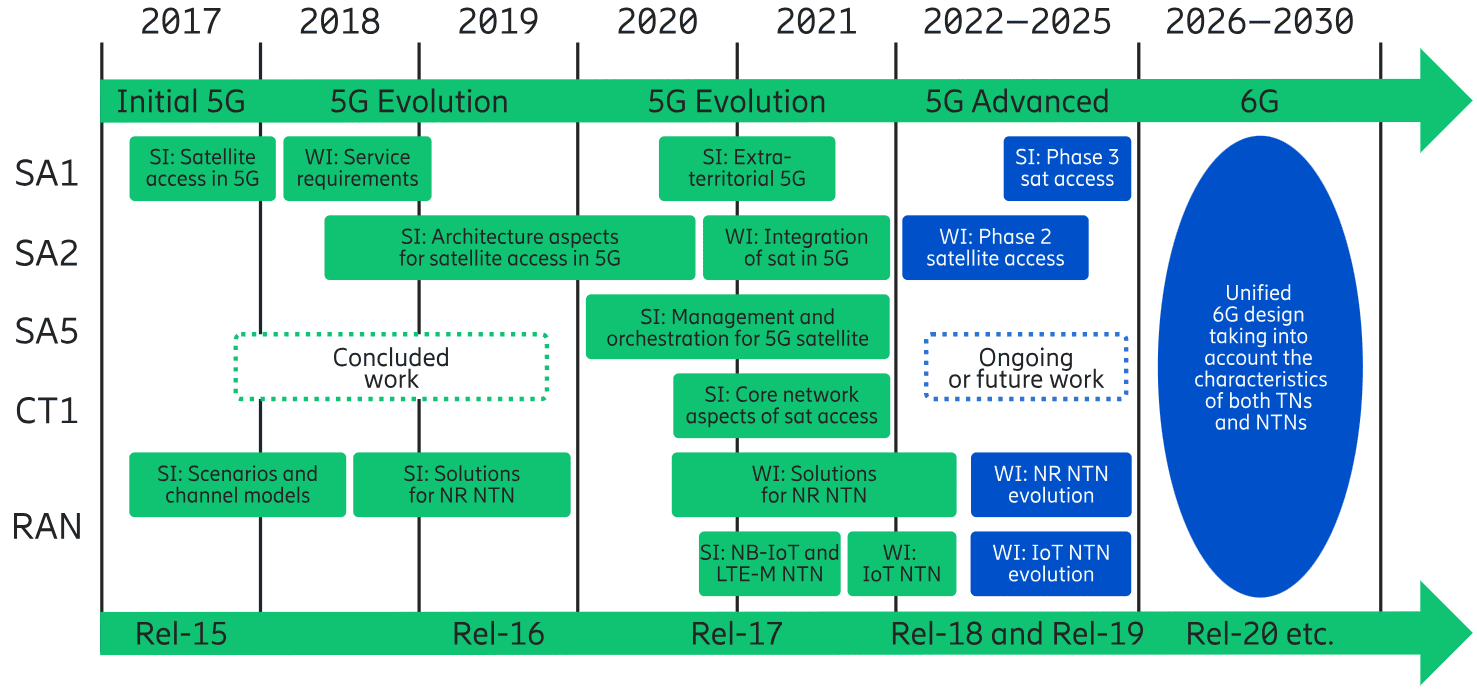
Image Credit: Ericsson
………………………………………………………………………………………………………………………………………………………………………………………………
Key Technology Takeaways:
-
The first 5G NTN transmission over a Hispasat satellite marks a meaningful step from lab validation to standards-aligned deployment.
-
3GPP NTN work in Release 19 is the key enabler because interoperability, not just link feasibility, will determine commercial viability.
- ITU-R SWG 4B1 – Satellites in Next Generation Access Technologies will likely rubber stamp 3GPP NTN specifications which will then become ITU-R recommendations.
-
NTN is evolving from satellite backhaul for remote coverage into direct device access for standard cellular endpoints.
-
The hardest technical problems are shifting toward timing, mobility, spectrum coordination, device power efficiency, and seamless terrestrial/non-terrestrial handover.
-
“Pre-6G” is the right framing because NTN is becoming part of a hybrid terrestrial-plus-space access architecture.
-
Direct-to-device satellite services can pressure terrestrial operators by reducing their exclusive control over last-mile coverage and resilience.
-
The most likely carrier strategy is partnership and bundling, using NTN for coverage extension, disaster recovery, and IoT continuity rather than full substitution.
-
Multi-orbit, multi-band, and multi-vendor interoperability will be essential if NTN is to become a durable commercial platform.
……………………………………………………………………………………………………………………………………………………………………………………………………………
References:
https://www.3gpp.org/technologies/ntn-overview
https://www.ericsson.com/en/blog/2024/10/ntn-payload-architecture
Tutorial: LEO Satellite Internet connectivity, D2D, and major providers
Satellite Orbits:
Satellite connectivity operates across three orbital tiers:
- Geostationary (GEO) satellites have been the dominant platform for decades, powering telecommunications, TV broadcasting, weather forecasting, military surveillance, rural internet, and satellite phones. Positioned 36,000 kilometres above the equator, a single GEO satellite covers nearly a third of the planet, but the distance creates a 500–700 millisecond signal delay that makes video calls and real-time services impractical. Each satellite is roughly the size of a school bus and requires its own rocket launch.
- Medium Earth Orbit (MEO) satellites sit between 2,000 and 36,000 kilometres above Earth’s surface, with a latency of 70–120 milliseconds. The satellites range from car-sized to van-sized, with a few deployable per launch. MEO satellites are used for GPS and other global navigation systems but have never played a significant role in consumer connectivity.
- Low Earth Orbit (LEO) satellites sit at just 300 to 2,000 kilometres above Earth’s surface, bringing latency down to 20–50 milliseconds — on par with home broadband. Their small, flat-panel design, roughly the size of a dining table, allows dozens to be stacked into a single rocket, significantly lowering the cost per satellite. Modern LEO constellations also link satellites directly via laser, forming a mesh network in space. Instead of every signal bouncing through a fixed ground gateway, data travels between satellites and descends at the nearest point, allowing LEO signals to reach oceans, disaster zones, and remote communities that no ground infrastructure will ever serve.
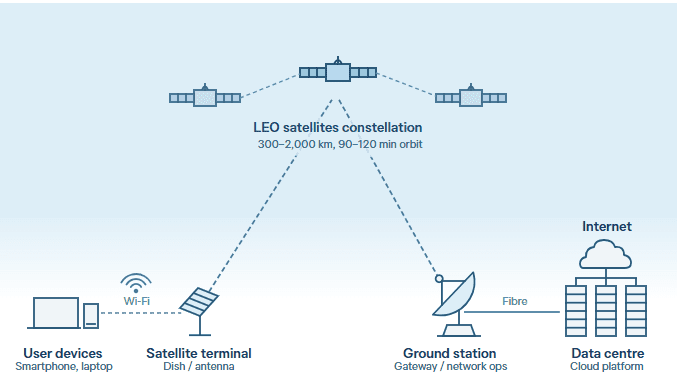
LEO satellites sit between 300 and 2,000 kilometres above Earth, completing an orbit every 90 to 120 minutes and covering different parts of the globe as they move. They communicate with ground stations or through inter-satellite links that relay data between satellites. Supporting infrastructure includes gateway stations, network operation centers, and data centers that manage satellite movements, route traffic, and maintain service reliability. For users, accessing LEO services requires a small satellite terminal — typically a dish — with power and a subscription plan. As shown in the figure below, users connect to a local Wi-Fi network linked to the dish. Data is transmitted to LEO satellites, relayed to a ground station, and then routed through fiber-optic networks to data centers or cloud platforms. The process is reversed for the return signal, completing the connection in milliseconds.
Importantly, LEO satellites are revolutionizing Direct-to-Device (D2D) communications by acting as cell towers in space, allowing standard, unmodified smartphones and IoT sensors to connect seamlessly without terrestrial infrastructure. By utilizing standard mobile-carrier spectrums or dedicated satellite bands, these fast-moving satellites bypass localized coverage gaps to provide ubiquitous, text, voice, and data services in remote, rural, and maritime areas, as well as critical backup during disasters.
LEO satellite internet functional block diagram:
………………………………………………………………………………………………………………………………………………………………………………………………………………………………………………………………………………….
Regulatory approval is central to LEO satellite deployment. Providers must typically obtain spectrum licenses, comply with national rules for ground infrastructure, and secure approval for service provision. Requirements vary widely across jurisdictions — from registration to multi-stage authorization processes. Competition from incumbent internet service providers may constrain market entry and expansion. As a result, services may be restricted or delayed even where technical coverage exists.
LEO connectivity also has practical limitations. Terminals require an unobstructed view of the sky, making installation easier in open areas but more difficult in dense urban environments where buildings or trees block the signal. Tropical downpours, heavy rain, or storms can cause signal attenuation and reduce throughput. Compared with terrestrial systems such as fibre-optic or mobile networks, LEO services may deliver less consistent performance, particularly in urban areas, and speeds can drop during peak demand.
Providers of LEO satellite connectivity:
The global space economy is projected to reach US$1.8 trillion by 2035, driven largely by LEO constellations. However, value creation is likely to be concentrated among a small number of providers controlling key parts of the value chain, Financial barriers to entry remain significant, varying depending on mission scope and technical ambition. Amazon Leo (formerly Project Kuiper) will cost more than US$10 billion, while full deployment of SpaceX’s Starlink is estimated at US $20–30 billion.
A mix of private and state-backed operators is developing LEO constellations with different strategies in satellite numbers, coverage, and target markets. Chinese-backed LEO operators GuoWang and Qianfan represent a strategic shift, both advancing rapidly towards full operation with a dual mandate of serving domestic communications and extending broadband connectivity across the Indo-Pacific and beyond. Their emergence could reshape strategic choices for governments in the region.
Where LEO satellite delivers:
LEO satellites are not a universal solution to connectivity gaps, nor a replacement for terrestrial networks. In most countries, fibre-optic and mobile infrastructure will remain the primary source of broadband connectivity. Their value lies in specific contexts: serving remote communities beyond the economic reach of terrestrial investment; providing resilient backup when ground networks fail; and supporting connectivity where no viable alternative exists.
LEO satellites are increasingly used to enhance resilience in countries with extensive fiber-optic networks or high exposure to natural disasters. They can provide automatic failover — near instantaneous transition to a standby system — during submarine cable outages, power failures, or other disruptions, maintaining communications and supporting emergency response. In December 2024, earthquakes in Vanuatu disrupted contact with national disaster authorities until Starlink was activated. In April 2025, a blackout in Spain and Portugal cut power to thousands of mobile towers, halving terrestrial network capacity — Starlink maintained connectivity via ground stations in Italy.
The main advantage is network independence: LEO satellites operate separately from terrestrial infrastructure and continue functioning when ground systems fail. Integrating LEO satellites into national disaster frameworks, rather than relying on ad hoc deployment, would maximize resilience.
………………………………………………………………………………………………………………………………………………………………………………………………………………….
References:
https://www.telecoms.com/satellite/satellite-disruption-how-leo-and-d2d-are-impacting-telecoms
Analyst firms wide forecasts for the LEO satellite direct-to-device (D2D) market
Analysis: SpaceX FCC filing to launch up to 1M LEO satellites for solar powered AI data centers in space
Blue Origin announces TeraWave – satellite internet rival for Starlink and Amazon Leo
Open Cosmos introduces global space-based LEO satellite service for IoT monitoring
China ITU filing to put ~200K satellites in low earth orbit while FCC authorizes 7.5K additional Starlink LEO satellites
Amazon Leo (formerly Project Kuiper) unveils satellite broadband for enterprises; Competitive analysis with Starlink
GEO satellite internet from HughesNet and Viasat can’t compete with LEO Starlink in speed or latency
Ookla on the Global D2D Market
Direct-to-device (D2D) satellite connectivity is emerging as a practical extension of non-terrestrial networks (NTNs), enabling standard smartphones to communicate directly with satellite systems without specialized user equipment. Within the 3GPP ecosystem, NTN capabilities were standardized (3GPP specs become standards by being rubber stamped by ETSI and ITU-R) beginning with 3GPP Release 17, establishing a framework for satellite-terrestrial interoperability and expanding the potential reach of mobile broadband beyond the footprint of terrestrial radio access networks.
D2D services could reduce persistent coverage gaps, especially in rural, maritime, and other underserved environments where terrestrial deployment is constrained by economics or geography. However, commercially available services today remain limited, with most deployments focused on messaging and other low-throughput applications rather than full mobile broadband.
From a market perspective, D2D and NTN have broad implications for mobile network operators (MNOs), satellite operators, equipment vendors, and regulators. That strategic importance helps explain why companies such as Apple, Amazon, SpaceX, and AST SpaceMobile are investing in this segment, alongside broader ecosystem activity around 3GPP-based NTN architectures.

Image Credit: Ookla
Ookla® has contributed to the discussion with a high-resolution poster showing global Speedtest® usage data for D2D services, along with a detailed market study on the D2D landscape. The analysis is based on Android devices that register with D2D-capable satellite systems from Starlink, Skylo, and Lynk, providing an early empirical view of how NTN-based connectivity is being used in practice.
Looking ahead, continued investment in larger satellite constellations and additional spectrum holdings should improve D2D capacity, coverage, and service robustness. As the technology matures, the industry is likely to move from narrowband messaging toward richer data services, with 3GPP NTN providing the standardization path for broader ecosystem scale-up.
For mobile network operators, the long-term effect could be a rebalancing of investment priorities at the edge of network coverage, particularly in sparsely populated regions. That may reduce the incentive for some rural tower builds and alter the demand outlook for parts of the RAN infrastructure supply chain.
Looking ahead, continued investment in next-generation satellite constellations, coupled with expanded spectrum access, is expected to enhance D2D performance and capacity. Key players—including Starlink, AST SpaceMobile, and Amazon’s Project Kuiper—are targeting higher data rates and broader service capabilities, with the objective of extending beyond narrowband messaging to support more data-intensive applications.
For MNOs, the evolution of D2D introduces potential shifts in network planning and capital allocation, particularly at the margins of coverage. Satellite-based augmentation could reduce the economic rationale for terrestrial infrastructure deployment in sparsely populated areas, with downstream implications for tower companies and certain segments of the radio access network (RAN) supply chain.
From a policy perspective, D2D also has the potential to reshape universal service frameworks and coverage obligations. Regulators seeking to expand connectivity may increasingly incorporate NTN-based solutions into their policy toolkits, prompting a reassessment of long-standing assumptions regarding the role of terrestrial infrastructure in achieving nationwide coverage. In that sense, D2D is not just a satellite story. It is becoming a broader telecom architecture shaped by 3GPP specifications and the convergence of terrestrial and non-terrestrial mobile networks.
References:
Analyst firms wide forecasts for the LEO satellite direct-to-device (D2D) market
Ookla: D2D satellite connectivity surged 24.5% during last 9 months; Starlink’s footprint expansion leads the way
Ookla: Starlink a viable competitor for hybrid 5G/NTN services due to network performance improvements and larger coverage area
GSA: 5G Non Terrestrial Networks, 5G SA and 5G Advanced gain momentum
Analysis: Amazon <- Globalstar – a strategic move for D2D and spectrum parity
Direct-to-Device (D2D) satellite network comparison: Starlink V2 (Starlink Mobile) vs “Satellite Connect Europe”
Deutsche Telekom selects Iridium for NB-IoT direct-to-device (D2D) connectivity
Standards are the key requirement for telco/satellite integration: D2D and satellite-based mobile backhaul
MTN Consulting: Satellite network operators to focus on Direct-to-device (D2D), Internet of Things (IoT), and cloud-based services
Analyst firms wide forecasts for the LEO satellite direct-to-device (D2D) market
LEO satellite direct-to-device (D2D) technology looks promising. Telecom analyst firms see D2D as a fast-growing but still early-stage market, with forecasts ranging from roughly 22% to 49% revenue CAGR depending on scope and whether they are measuring total D2D services or smartphone satellite D2D specifically. But that’s not happening now. T-Mobile chief Srini Gopalan, who said the service so far had generated “a lot less usage” than anticipated.
The most common near-term view is that basic D2D will add modest operator revenue at first, but the long-term market could become multi-billion-dollar as broadband and richer services mature. Here are a few analyst forecasts:
- MarketsandMarkets projects the D2D market to rise from USD 0.57 billion in 2025 to USD 2.64 billion by 2030, a 35.6% CAGR.
- Mordor Intelligence projects the direct-to-device satellite connectivity market from USD 4.08 billion in 2025 to USD 13.80 billion by 2031, a 22.37% CAGR.
- Omdia forecasts smartphone satellite D2D revenue to reach USD 11.99 billion by 2030, with a 49.4% revenue CAGR from 2026 to 2030.
- Counterpoint Research expects 46% of all smartphones shipped by 2030 to be D2D-capable. That implies D2D is moving from a niche satellite feature toward a mainstream handset capability, driven by chipset integration and broader device support.
- Juniper Research thinks the number of monthly active users will top 150 million by 2031. The analyst firm suggests a temporary access model, similar to roaming or travel eSIMs, where consumers purchase access in a particular area for a set period. Juniper thinks connectivity alone won’t be enough to attract consumers. It believes operators will have to bundle the satellite service into rewards programs or roaming access.
- Analysys Mason expects operators launching D2D in 2026 to see about a 1% annual revenue uplift from basic services alone, with much larger upside once broadband D2D becomes available.
- TelecomTV reports a similar view from Analyst Brad Grivner, who says D2D could give MNOs around a 1% annual revenue uplift and also improve retention and upsell opportunities.
The spread in forecasts mostly reflects different definitions of the market, different start dates, and whether the analyst counts only current narrowband services or also future broadband D2D. In practical terms, the consensus is that D2D will start as a coverage and messaging feature, then evolve into a broader connectivity platform as device support and satellite capacity scale.
Analysts consistently point to 3GPP NTN standardization (rubber stamped by ETSI and ITU-R), more satellite-ready smartphones, and large-scale LEO deployments as the main catalysts. They also emphasize emergency messaging, rural coverage, IoT, industrial connectivity, and enterprise resilience as the first meaningful demand pools. D2D market growth is being driven by a mix of coverage gaps, new device support, and expanding enterprise use cases. The strongest themes across analyst and industry reports are universal connectivity, IoT demand, LEO satellite buildout, and 3GPP NTN standardization.

Image Credit: Digital Regulation Platform
…………………………………………………………………………………………………………………………………………………………..
Main D2D growth drivers:
-
Coverage expansion. Analysts say D2D is filling a major gap in rural, remote, maritime, and disaster-prone areas where terrestrial networks are weak or unavailable.
-
3GPP NTN standards. Standardized non-terrestrial networking is making satellite connectivity more practical for mainstream devices and accelerating ecosystem adoption.
-
LEO constellation growth. More low-Earth-orbit satellites, along with falling launch costs and better satellite economics, are increasing capacity and improving latency.
-
Smartphone integration. As more phones become satellite-capable, D2D can move beyond niche emergency features into broader consumer usage.
-
Enterprise IoT demand. Logistics, mining, agriculture, utilities, and energy firms want reliable connectivity for remote assets, monitoring, and worker safety.
-
Disaster resilience. Climate-related outages and emergency-response needs are pushing governments and operators toward backup connectivity solutions.
-
Carrier-satellite partnerships. Cooperation between MNOs and satellite operators is speeding commercialization and helping services reach scale.
The D2Dmarket is still starting with messaging, emergency connectivity, and narrowband IoT, but analysts expect growth to broaden as device support and satellite capacity improve. In short, D2D grows fastest where it solves a clear pain point: no coverage, weak resilience, or expensive remote connectivity.
…………………………………………………………………………………………………………………………………………………………………………………………..
References:
https://www.lightreading.com/satellite/making-the-most-of-satellite-d2d
Ookla: D2D satellite connectivity surged 24.5% during last 9 months; Starlink’s footprint expansion leads the way
Ookla: Starlink a viable competitor for hybrid 5G/NTN services due to network performance improvements and larger coverage area
GSA: 5G Non Terrestrial Networks, 5G SA and 5G Advanced gain momentum
Analysis: Amazon <- Globalstar – a strategic move for D2D and spectrum parity
Direct-to-Device (D2D) satellite network comparison: Starlink V2 (Starlink Mobile) vs “Satellite Connect Europe”
Deutsche Telekom selects Iridium for NB-IoT direct-to-device (D2D) connectivity
Standards are the key requirement for telco/satellite integration: D2D and satellite-based mobile backhaul
MTN Consulting: Satellite network operators to focus on Direct-to-device (D2D), Internet of Things (IoT), and cloud-based services
Analysis: AT&T 1Q-2026 results: increased fiber penetration, FWA momentum, D2D deals, and mobile/home internet bundles
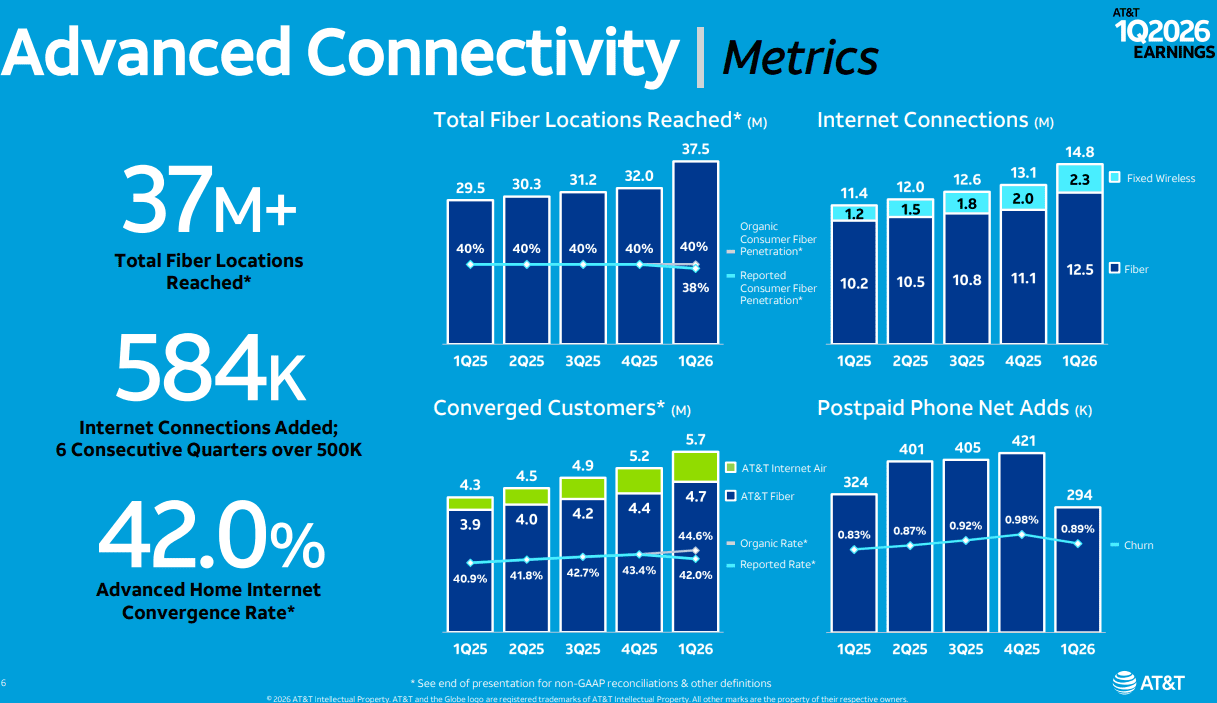
AT&T reported first-quarter results today, achieving its fastest-ever year-over-year organic growth in its advanced connectivity convergence rate, with nearly 45% of advanced home internet subscribers also choosing AT&T wireless. Customers are increasingly purchasing their internet and wireless together from AT&T, highlighting the strength of the company’s differentiated, investment-led strategy to drive converged advanced connectivity at scale.
“We saw our best first quarter ever for Advanced Connectivity internet customer net additions, demonstrating the solid foundation of assets we have built,” said John Stankey, AT&T Chairman and CEO. “We’re uniquely positioned to deliver more of what customers want — fiber and 5G all from one provider on the nation’s largest advanced converged network, backed by the AT&T Guarantee. The actions we’ve taken this quarter are evidence of how we are improving the customer value proposition, scaling faster, and accelerating growth.”
AT&T reported $31.5 billion in consolidated operating revenues, representing a 2.9% year-over-year (YoY) increase and outperforming Street estimates of $31.22 billion. This growth was largely driven by the Advanced Connectivity segment, which generated $22.15 billion in consumer revenues, up from $20.97 billion in the prior-year period.
- Wireless Performance: Mobility services posted mostly flat $16.94 billion in revenue, compared to $16.65 billion in Q1 2025.
- Legacy Decommissioning: Legacy revenues fell 25.3% YoY to $1.8 billion. The aggressive copper-to-fiber migration continues, with 85% of wire centers now approved for legacy service cessation.
- Strategic Sunsetting: 30% of these wire centers are slated for total decommissioning by late 2026, coinciding with the loss of 270,000 DSL subscribers this quarter.
The shift toward high-speed, durable connectivity is evidenced by the growth of AT&T’s Fiber and Fixed Wireless Access (FWA) portfolios.
- Fiber Penetration: AT&T recorded 292,000 fiber net additions, bringing the total subscriber base to 12.5 million. The current passings stand at 37.5 million locations, with 32.7 million owned/operated and 4.8 million via joint ventures (JVs).
- FWA Momentum: AT&T Internet Air added 239,000 customers in the quarter (up from 181,000 in Q1 2025), reaching a total of 1.73 million subscribers.
- Roadmap to 60 Million: AT&T remains on track to reach 60 million fiber locations by 2030 through organic expansion, the Gigapower JV, and open-access agreements.
AT&T is evolving its “NetworkCo” model to optimize capital intensity and market reach.
- Lumen Asset Integration: Recently acquired fiber assets from Lumen will be transferred into a JV structure. CFO Pascal Desroches expects to finalize an agreement with an equity partner for these assets in 2H 2026.
- Convergence and “One Connect”: The “One Connect” platform is the cornerstone of AT&T’s converged strategy.
- Bundle Adoption: 42% of advanced home internet customers (5.68 million) also subscribe to mobile services.
- Fiber-Mobile Synergy: Among fiber-specific customers, the mobility bundle penetration rate is 40.2% (4.74 million).
- The “One Connect” Roadmap: CEO John Stankey views the platform as an iterative engine, beginning with BYOD (Bring Your Own Device) and eventually expanding into tailored family plans.
“We made further progress at positioning AT&T as the preferred provider for connecting consumers and businesses to the internet. We closed our transaction with Lumen, ahead of schedule, adding 1.1 million fiber customers, and over 4 million fiber locations. We’re pleased with the progress we’re making as we integrate these assets in several major metro areas and position the business for faster growth. Early indicators are positive. We now offer fiber services throughout our distribution channels in these areas, which has driven sales activity well above pre-transaction trends. We’re executing the steps to scale engineering, construction and service delivery in the acquired geographies, expected as we move into the back half of the year, will achieve steady improvement in fiber and wireless customer growth in these areas. When we focus on customers needs and invest in the experience and products they want, we find success, and in the first quarter, we gave customers more reasons to choose AT&T. We expanded the AT&T guarantee to cover internet Air and launched a new flagship app to deliver a simple digital-first experience to customers.
We also launched AT&T OneConnect, which enables customers to easily connect all their eligible devices at home and on the go, and eliminates the need to buy internet access twice. We refreshed our Unlimited Your Way plans to deliver more value. All these moves are based on a consistent set of principles that drive our approach to serving customers the way they want to be served, with offers that deliver simplicity, value and choice and converged connectivity.
After years of industry-leading investments in our fiber and wireless network, we believe that we have now established a structural advantage that others will not catch. We reached more than 90 million customer locations across the country with our advanced internet services, over either fiber or 5G. We believe this provides us with more scalable reach and converged connectivity than any of our peers, including a meaningful scale and performance advantage in fiber. This is an advantage we’re growing as we ramp our deployment at a faster pace than anyone else. Today, we reach over 37 million customer locations with fiber, and we’re on track to reach 60 million plus locations by the end of the decade.”
NTNs and D2D:
Regarding its choice of AST SpaceMobile for direct-to-device (D2D) connectivity for its smartphones, Stankey said, “I think it’s natural that we work with LEO partners that have the capabilities to solve that problem, to integrate those offerings into our services,” Stankey said Tuesday on AT&T’s Q1 2026 earnings call. “My goal would be that I have a good, strong wholesale relationship, and it may not just be with one of them. It may be with more than one of them.”
Besides AST SpaceMobile, Stankey said he expects SpaceX/Starlink to have a “robust direct-to-device capability,” as well as Amazon Leo and potentially a fourth NTN satellite internet company. SpaceX is developing a next-generation D2D offering with spectrum it’s acquiring from EchoStar, and Amazon plans to introduce a new D2D offering in 2028 amid its recent deal to acquire Globalstar. AT&T has a deal with Amazon Leo to connect business customers that are out of reach of terrestrial wireless and wireline networks, but it has not yet signed a D2D-specific deal with Amazon’s satellite and services unit.

Market Analysis – The Fiber Coverage Gap:
Despite strong growth, analysts remain cautious regarding AT&T’s convergence ceiling. With fiber currently available in only about 20% of the U.S., the primary concern is whether AT&T can maintain competitive parity in non-fiber regions.
- Potential Underperformance Risk: In markets where AT&T relies on legacy copper or wholesale third-party access, it may struggle to match the churn reduction and ARPU (Average Revenue Per User) lift seen in its “Fiber + Wireless” footprint.
- Mitigation Strategy: The success of the “60-million-locations fiber by 2030” roadmap which is the primary driver of AT&Ts increased spending. Also, the scaling of Internet Air as a “bridge” technology will be critical in preventing regional underperformance.
- 2026 Milestone: AT&T expects to exceed 40 million total fiber locations by the end of 2026.
- Build Cadence: The company is targeting an organic deployment pace of 4 million new locations per year by the end of 2026. After 2026, this rate is projected to increase to approximately 5 million additional spots annually.
- Funding Mechanism: To support this acceleration, AT&T plans to reinvest $3.5 billion in cost savings specifically into the fiber build-out over the 2026–2027 period.
- “There’s no path for AT&T to have a fiber footprint that will cover more than a third of the country. Will AT&T be consigned to losing share in the other two thirds?” MoffettNathanson analyst Craig Moffett asked in a research note to clients posted after AT&T’s earnings call.
Despite the high CapEx, AT&T CFO Pascal Desroches reaffirmed that the company remains on track to deliver $18 billion+ in free cash flow (FCF) for 2026.
………………………………………………………………………………………………………………………………………………………………………
References:
https://www.lightreading.com/satellite/at-t-might-look-beyond-ast-spacemobile-for-d2d
Analysis: AT&T’s $250B network investment to advance U.S. connectivity
AT&T and AWS to deliver last mile connectivity for AI workloads; AT&T Geo Modeler™ AI simulation tool
AT&T and Ericsson boost Cloud RAN performance with AI-native software running on Intel Xeon 6 SoC
AT&T’s convergence strategy is working as per its 3Q 2025 earnings report
AT&T deploys nationwide 5G SA while Verizon lags and T-Mobile leads
AT&T to buy spectrum licenses from EchoStar for $23 billion
AT&T grows fiber revenue 19%, 261K net fiber adds and 29.5M locations passed by its fiber optic network
Ookla: D2D satellite connectivity surged 24.5% during last 9 months; Starlink’s footprint expansion leads the way
Introduction:
Direct-to-device (D2D) satellite connectivity, primarily driven by Starlink deployments, continues to accelerate despite nascent market maturity. Ookla’s latest analysis reveals that while global D2D connections surged 24.5% from July 2025 to March 2026—spurred by Starlink’s expansion into Chile, Ukraine, Peru, and the UK—penetration among mobile subscribers remains under 1.5% in leading markets.
Starlink dominates D2D traffic, accounting for the bulk of connections alongside contributions from Skylo and Lynk Global. Initial use cases center on non-terrestrial network (NTN) extensions for SMS and geolocation in coverage gaps, with next-gen systems eyeing 5G NR integration via acquired spectrum like EchoStar’s holdings. Regional growth offset US/Canada dips, potentially tied to T-Mobile and Rogers introducing D2D surcharges amid seasonal patterns.

Image Credit: Ookla
Market Share Breakdown:

Adoption Barriers:
Terrestrial networks already blanket 96% of the global population per GSMA Intelligence, curbing urgency for D2D beyond edge cases. Low awareness and constrained throughput—versus 5G benchmarks—further limit uptake, though link budgets and multi-orbit architectures promise evolution.
Future Outlook:
Based on the February GSA (Global mobile Suppliers Association) report, Direct-to-Device (D2D) services have achieved commercial launch in 15 markets, with 61 countries currently in the evaluation, testing, or deployment phases of Non-Terrestrial Network (NTN) partnerships. Starlink dominates the landscape with 59 partnerships, followed by AST SpaceMobile at 28. In China—a market excluded from GSA data—ABI Research indicates that China Unicom and China Telecom are already leveraging the Tiantong GEO system for D2D. China Mobile is utilizing the BeiDou constellation while planning integrations with emerging LEO networks. To evolve from narrowband emergency services to full mobile broadband, all three Tier-1 operators are aligning with state-backed LEO mega-constellations, specifically Project Guowang and G60 Qianfan (Spacesail).
For Mobile Network Operators (MNOs), D2D integration significantly alters CAPEX/OPEX strategies. In rural or remote areas, MNOs must now run a cost-benefit analysis: deploy traditional macro sites or utilize satellite-based coverage to eliminate dead zones. While Starlink argues that D2D allows MNOs to reduce terrestrial investment, the technology is largely limited to outdoor environments. Given that approximately 80% of mobile traffic is generated indoors—where satellite link budgets typically fail—terrestrial densification remains critical.
From a regulatory standpoint, the rise of NTN-D2D complicates Universal Service Fund (USF) allocations. In the U.S., the FCC is currently assessing how the $9 billion 5G Fund for Rural America should account for D2D capabilities. Ultimately, while D2D may solve the “dead zone” problem for outdoor mobility, it serves as a complement to, rather than a replacement for, high-capacity terrestrial infrastructure. Enhanced spectrum harmonization and handset chipsets could pivot D2D from supplemental to resilient 5G NTN layer, challenging capex models for rural densification. Network operators must navigate billing handoffs and QoS parity to unlock scale.
References:
https://www.ookla.com/articles/measuring-the-direct-to-device-d2d-marketplace-2026
US Mobile’s new bundle combines its multi-network mobile service with Starlink residential internet
Analysis: Amazon <- Globalstar – a strategic move for D2D and spectrum parity
GSA: 5G Non Terrestrial Networks, 5G SA and 5G Advanced gain momentum
Direct-to-Device (D2D) satellite network comparison: Starlink V2 (Starlink Mobile) vs “Satellite Connect Europe”
Standards are the key requirement for telco/satellite integration: D2D and satellite-based mobile backhaul
Deutsche Telekom selects Iridium for NB-IoT direct-to-device (D2D) connectivity
MTN Consulting: Satellite network operators to focus on Direct-to-device (D2D), Internet of Things (IoT), and cloud-based services
Blue Origin announces TeraWave – satellite internet rival for Starlink and Amazon Leo
China ITU filing to put ~200K satellites in low earth orbit while FCC authorizes 7.5K additional Starlink LEO satellites
Starlink doubles subscriber base; expands to to 42 new countries, territories & markets
Amazon Leo (formerly Project Kuiper) unveils satellite broadband for enterprises; Competitive analysis with Starlink