

Bain & Co: AI Infrastructure Buildout Will Require $6 Trillion Revenue by 2031 to Support Massive CAPEX
Introduction:
Bain & Company estimates that the AI industry will need to generate approximately $6 trillion in annual revenue by 2031 to support the capital intensity (CAPEX) of the global AI infrastructure buildout, including investment in data centers, accelerated computing, memory, networking and power systems. In its latest technology report, released September 29th, Bain projects that new AI-enabled products could account for roughly $4.2 trillion of that revenue requirement. The firm identifies AI-driven innovation across search, advertising, autonomous systems and physical AI as major prospective sources of value creation.
Enterprise adoption could contribute a further $1 trillion to $1.4 trillion annually through productivity gains in software engineering, sales, marketing, customer service and IT operations. Bain characterizes “absorption speed”—the rate at which enterprises operationalize AI—as the emerging competitive variable, with leading AI labs investing more than $9.75 billion in engineering models intended to accelerate enterprise deployment and integration.
“The debate today is fixated on employee productivity. The economics of AI infrastructure demand trillions in new revenue beyond productivity gains. What the industry needs is a wave of innovation that will dwarf what mobile and cloud unlocked,” said David Crawford, chairman of Bain’s global technology practice and lead author of the report.
At a Glance:
- AI infrastructure investment is racing ahead, but generating enough economic value to justify it will require trillions of dollars in new AI-driven revenue.
- Productivity gains from existing enterprise and consumer applications won’t be enough; entirely new markets must emerge to close the funding gap.
- The winners will be those that create breakthrough AI applications that transform industries and expand the global economy.
Consumer AI services, including subscription and advertising-supported offerings, are projected to contribute between $200 billion and $400 billion in annual revenue. This segment is central to the commercial scaling of AI because it extends AI-enabled services to billions of users through consumer platforms, devices and digital-service ecosystems.
“New products and uses that don’t exist today will enable new markets and opportunities from abundant intelligence – these may include drug discovery, mental health and energy generation,” Bain said.
Bain forecasts annual AI infrastructure spending of up to $1.5 trillion by 2031. The figure encompasses greenfield data-center construction, expansion of existing facilities, and continuing investment in GPUs, memory, network fabrics and related infrastructure. Bain assumes that capital expenditure could represent approximately one-quarter of total AI-industry revenue—“an ambitious but reasonable percentage based on trends among cloud providers.” On that basis, the firm calculates that the AI market would need to approach $6 trillion in annual revenue to sustain the projected infrastructure investment cycle.
“The unprecedented speed and scale of the AI buildout, with billions flowing into chips, data centers, networks and power systems, have focused attention on the challenge of building capacity. But the more important question may be whether enough economic value can be created to justify it.”
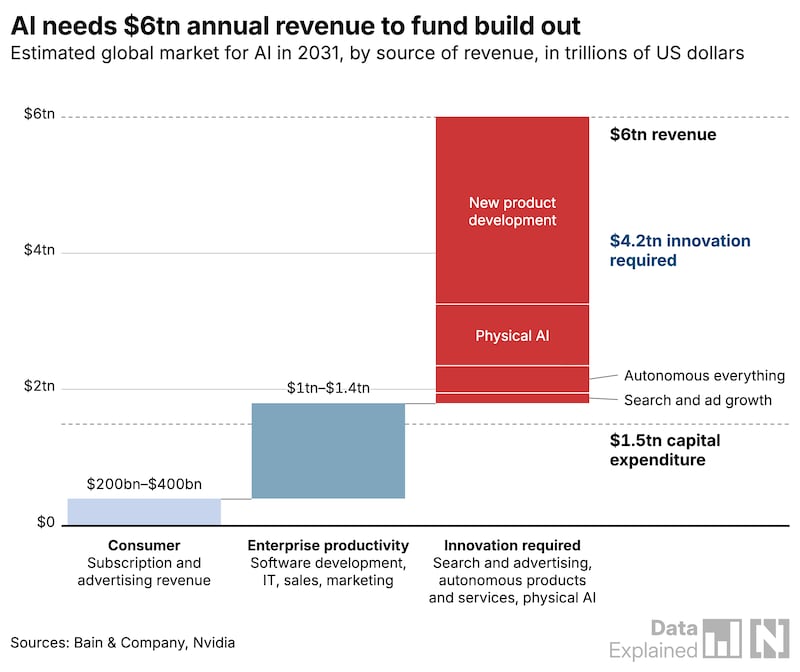
Consider the scale of investment and the gap between that and the revenue model necessary to fund it.
- The arms race among hyperscalers (Microsoft, Google, Amazon, Meta, and Oracle) is accelerating: Their capital expenditures could reach $780 billion in 2026, nearly five times the level of just three years earlier.
- Leading-edge AI data centers today are approaching 1 gigawatt (GW) of power capacity. By 2027, many are expected to approach 2 GW facilities, with 9 GW campuses emerging by the end of the decade.
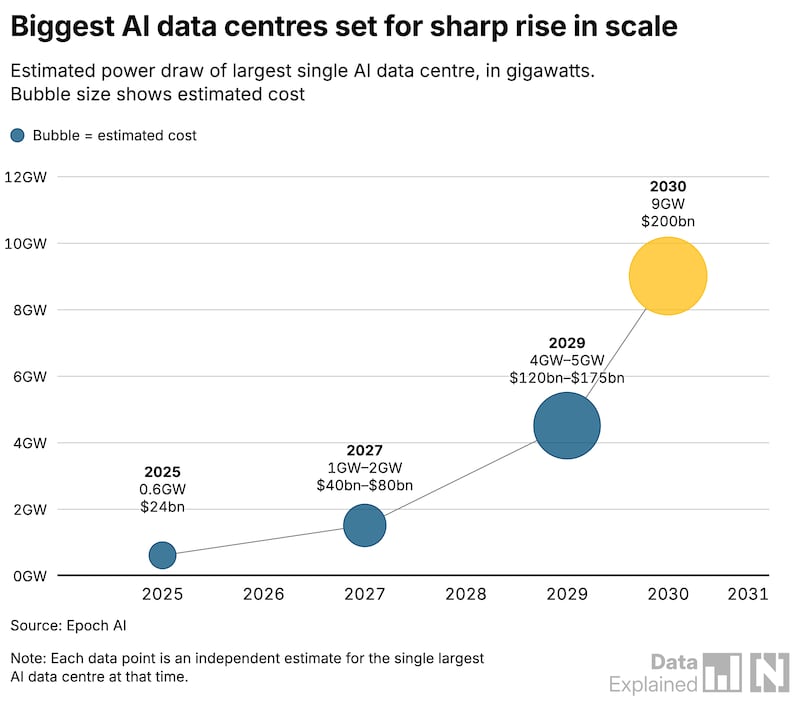
The scale of individual AI data-center projects illustrates the infrastructure requirements underlying those projections. Bain said AI data-center size and cost are increasing rapidly, with leading facilities approximately doubling in scale every 12 to 16 months. Meta Platforms’ Prometheus data center in Ohio, for example, had approximately 600 MW of capacity and an estimated cost of $24 billion in 2025, according to Epoch AI. The facility is projected to reach as much as 2 GW of capacity and cost approximately $80 billion by 2027. Epoch AI projects that Prometheus could reach 5 GW by 2029, with costs of up to $175 billion, and 9 GW by 2030, at an estimated cost of $200 billion.
Such growth places data-center infrastructure squarely within the telecommunications and network-infrastructure domain. Multi-gigawatt AI campuses require high-density optical interconnects, large-scale Ethernet or InfiniBand fabrics, low-latency east-west traffic engineering, high-capacity metro and long-haul connectivity, and resilient access to electric generation and transmission capacity. The infrastructure challenge consequently extends beyond data-center construction to the coordinated scaling of semiconductor supply chains, transport networks, power systems, cooling infrastructure and specialized technical labor.
Bain identified electric-grid capacity, access to GPUs and other critical infrastructure components, talent availability, workforce retention, public acceptance and regulatory requirements as important factors shaping the pace and geography of AI data-center deployment. Resource consumption, noise and community impacts are also becoming material considerations in project planning and approval processes.
Governments in the UAE, Saudi Arabia, the European Union, South Korea and the United States are supporting the expansion of AI and data-centre infrastructure, Bain said. The firm described data centres as increasingly important to technology innovation, economic development and national sovereignty.
The Bain report stated: “Capital needs for data infrastructure will remain high … bottlenecks in power, semiconductors, and other inputs carry large capital needs of their own, opening additional entry points for investors. And as sovereign infrastructure becomes a bigger part of national strategies, partnerships offer both a way in and geographic diversification.”
…………………………………………………………………………………………………………………………………………………………………………………………………………………….
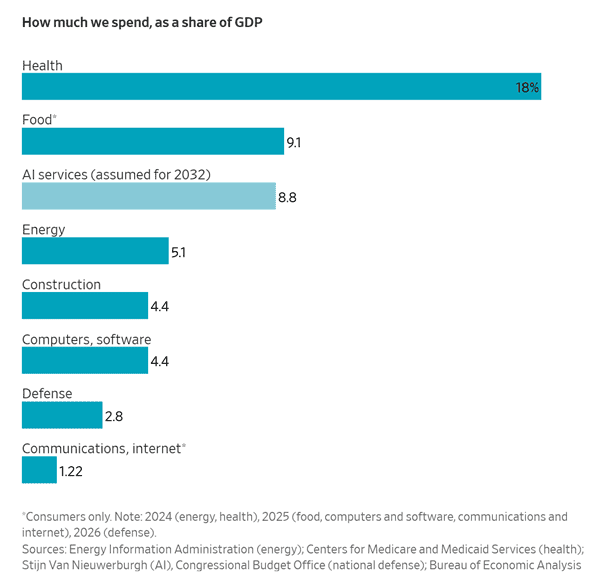
Greg Ip of the WSJ: Believers in the artificial-intelligence boom need to take a very close look at this number: 9% of GDP. That is how much American businesses and consumers eventually have to spend per year on the services of companies like Anthropic and OpenAI to justify the staggering sums being committed to the technology right now.
Is it plausible that Americans will spend as much of their income on this one technology as they do on food? Roughly twice what the nation pays for all forms of energy or all computers and software? Seven times what consumers spend on phone, streaming, and internet services combined?
You should be skeptical. Even the most transformative inventions eventually run into the law of diminishing returns: each additional dollar a user spends yields less additional productivity (or enjoyment) than the last. That imposes a natural ceiling. The question, of course, is where that ceiling is. Whether or not you think 9% of GDP is right, you have to care, because this figure isn’t some fever dream: it is implicit in the dollars that investors and companies are committing right now.
The figure is courtesy of Columbia University finance professor Stijn Van Nieuwerburgh. His paper, first presented at the Brookings Institution, showed that the AI build-out is now bigger than any investment boom in American history. His more intriguing, and sobering, statistic is how much revenue AI would have to garner to justify that boom.
Conclusions:
- Dramatic innovation will be required to deliver the revenue necessary to fund the gap.
- The economics required to generate ROI from AI infrastructure are demanding trillions in new revenue, not just cost savings.
- The industry needs a wave of application innovation comparable with what mobile and cloud unlocked, not just productivity gains on existing workflows.
- The infrastructure is being built ahead of the demand curve, and funding it sustainably will require adding approximately 1% to the annual global GDP growth rate.
- The question is whether the applications arrive in time to pay for it.
……………………………………………………………………………………………………………………………………………………………………………………………………………….
References:
https://www.bain.com/insights/topics/technology-report/
https://www.wsj.com/tech/ai/will-america-spend-9-of-its-gdp-on-ai-the-industry-is-counting-on-it-3501bb4f?st=HkbAZs&reflink=desktopwebshare_permalink&mc_cid=65590ec418&mc_eid=5917efd771
The AI Infrastructure Build-Out: A $10 Trillion Bet on Compute, Power, and Networks
Dell’Oro: Data Center capex grew 92% in 2Q-2026 (caveats galore)
Dell’Oro: 2H2026 Data Center Capex to Accelerate due to massive AI Deployments
PwC: Global AI data center spending to hit $31.6tn by 2050; Role of full stack orchestration layer explained
Nvidia CEO Huang: AI is the largest infrastructure buildout in human history; AI Data Center CAPEX will generate new revenue streams for operators
AI risks and backlash increase; Recap of the circular loop of fake AI profits and hyperscaler markups of private AI companies
China vs U.S.: Race to Generate Power for AI Data Centers as Electricity Demand Soars
How will fiber and equipment vendors meet the increased demand for fiber optics in 2026 due to AI data center buildouts?
Expose: AI is more than a bubble; it’s a data center debt bomb
Will billions of dollars big tech is spending on Gen AI data centers produce a decent ROI?
Huge Risks for the proposed $500B AI Investments from Giant Wall Street firms
Can the debt fueling the new wave of AI infrastructure buildouts ever be repaid?
3 thoughts on “Bain & Co: AI Infrastructure Buildout Will Require $6 Trillion Revenue by 2031 to Support Massive CAPEX”
Leave a Reply

AI is becoming a major bond-market issue because it is transforming a technology capex boom
into a large, correlated, long-duration debt cycle. With AI-linked borrowers accounting for 49% of
new investment-grade issuance in 2026 (source:WSJ), the bond market is being asked to absorb an exceptional
amount of additional corporate and infrastructure debt.
Hyperscaler Debt & Capex Projections (2026–2027)
-2026 Debt Issuance: Projected between $220 billion and $250+ billion for major US hyperscalers (Alphabet / Google, Amazon, Meta, Microsoft, and Oracle), with broader AI-related market debt reaching up to $570 billion.
-2027 Forecast: Goldman Sachs projects direct hyperscaler debt issuance to nearly double to around $400 billion (Jeff Pu estimates $419 billion) as companies finance over a third of their infrastructure needs.
-Aggregate Capex: Combined capital expenditures are expected to hit roughly $940 billion in 2026 and scale past $1.3 trillion in 2027. Market Share: Hyperscaler investment-grade bond sales have jumped from roughly 2% of total U.S. supply (2022–2024) to roughly 9% in 2026. Credit Impact: Credit spreads on a 10-year hyperscaler credit basket have widened from historical 40–75bp ranges toward 90bp+, driven by leverage concerns.
-Cash Flow Outlook: S&P Global Ratings expects all major hyperscalers to run negative free operating cash flow through 2026 and 2027, with a cash-flow inflection point not projected until 2028–2029
The artificial-intelligence investment boom increasingly looks like it will struggle to generate sufficient returns, Panmure Liberum strategist Joachim Klement says. “We are seeing some blocks being pulled out of the Jenga Tower that is the AI capex boom,” Klement says. “Higher debt costs makes it extremely difficult for neoclouds and hyperscalers to finance further data centers now that their free cash flows have evaporated.” For instance, cloud-computing company CoreWeave saw its cost of borrowing soar over the past two sessions as shares in chip makers and data center companies are falling sharply across the globe.
https://www.wsj.com/business/tech-media-telecom-roundup-market-talk-2c407ece