

Dell’Oro: Enterprise PON Deployments expected to increase 844% year-over-year
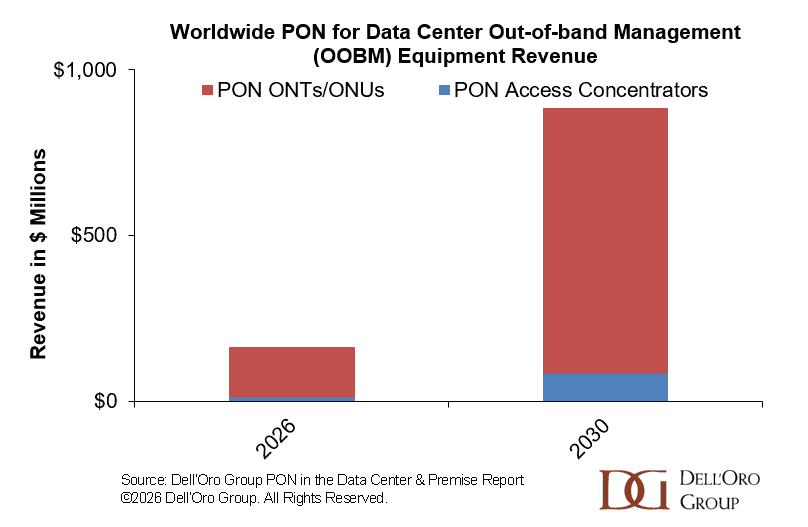
According to a new Dell’Oro Group report, “PON in the Data Center and Premise Advanced Research Report“ recently published, total 2026 Data Center PON equipment revenues are expected to increase 844% year-over-year (Y/Y), driven by hyperscalers looking to use the point-to-multipoint technologies to reduce the cabling and power consumption requirements of their out-of-band management networks.
“PON technologies are increasingly moving from traditional residential networks to enterprise and data center applications, providing additional growth opportunities for PON equipment providers,” said Jeff Heynen, Vice President of Broadband Access and Home Networking market research at Dell’Oro Group. “We see hyperscalers and enterprises, both large and small, increasingly deploying PON technologies for passive fiber distribution that is lower cost and that maintains its value far longer than traditional copper infrastructure,” added Heynen.
Additional highlights from the PON in the Data Center and Premise Advanced Research Report:
- Total cumulative spending on data center PON equipment from 2026 to 2030 is expected to exceed $3 billion, as hyperscalers, neocloud providers, and colocation providers all deploy PON for their out-of-band and infrastructure management networks.
- Enterprises are increasingly deploying Passive Optical LAN (POL) as the long-term benefits of increased speeds and lower operational costs outweigh the costs of deploying fiber in the building.
- Chinese operators continue to deploy tens of millions of master and subtended ONTs to deliver fiber-to-the-room (FTTR) services to their residential broadband customers.
………………………………………………………………………………………………………………………………………………………………………………
Editorial Analysis:
This extremely bullish forecast points to a potentially important new use case for PON: not as a replacement for the high-bandwidth, low-latency Ethernet fabric that interconnects servers and storage, but as an economical physical layer for the separate networks used to monitor, provision, and recover data-center infrastructure. In that role, a passive optical distribution architecture can consolidate fiber runs and avoid electrically powered aggregation equipment in parts of the management network, potentially simplifying expansion and reducing operational overhead.
Dell’Oro’s projected 844% year-over-year revenue increase should be read in the context of an early-stage market: the percentage reflects rapid adoption from a comparatively small base rather than an indication that PON will displace mainstream data-center switching. Nevertheless, the report’s forecast of more than $3 billion in cumulative 2026–2030 spending indicates that hyperscale, neocloud, and colocation operators are sufficiently interested to make data-center PON a material adjacent market for OLT, ONT, and ONU suppliers.
The enterprise opportunity is somewhat different. Passive Optical LAN can extend fiber deeper into commercial buildings, with optical terminals serving end-user areas rather than relying entirely on copper horizontal cabling and access switches. The principal trade-off is front-loaded installation complexity—especially where fiber pathways must be added or upgraded—against the prospect of longer infrastructure life, higher available access speeds, and lower energy use over the building lifecycle. Dell’Oro also includes enterprise/MDU POL and business FTTR applications in its five-year forecast coverage, suggesting that it views these segments as part of the same widening PON equipment ecosystem.
China’s large-scale FTTR deployments provide a useful volume counterweight to these specialized data-center and enterprise applications. Master and subtended ONT architectures enable operators to extend fiber connectivity from the residence gateway to individual rooms, creating another demand source for optical endpoints and related PON equipment. Together, these developments suggest that future PON market growth will depend increasingly on diversification beyond conventional residential FTTH—while also requiring vendors to address application-specific management, installation, and interoperability requirements.
The Dell’Oro Group PON in the Data Center and Premise Advanced Research Report includes 5-year market forecasts for PON Optical Line Terminals (OLTs), and PON Optical Network Terminals (ONTs) and Optical Network Units (ONUs) used in Data Center [Out-of-band management (OOBM), infrastructure management (DCIM)], Enterprise/MDU [Passive Optical LAN (POL), Fiber-to-the-room for business (FTTR-B)] , and Fiber-to-the room (FTTR) applications. To purchase this report, please contact us by email at [email protected].
References:
PON in Data Centers Expected to Grow at 52 Percent CAGR from 2026-2030, According to Dell’Oro Group
Dell’Oro: 2H2026 Data Center Capex to Accelerate due to massive AI Deployments
Analysis: Broadcom’s end-to-end 50G PON Edge AI portfolio with WiFi 8 support
Highlights of FiberConnect 2024: PON-related products dominate
Nokia and Google Fiber trial 50G PON – first in the U.S.
Nokia and Hong Kong Broadband Network Ltd deploy 25G PON
HKT is first to deploy 50G PON technology in Hong Kong