

OpenAI, Anthropic, and Their Hyperscaler Partners: Huge Financial Risks and Open-Weight Competition
Hyperscaler AI Revenue Hurdle:
In an analysis released last month, Jared Bernstein estimated that the big-spending hyperscalers need $13-$18 trillion in revenues over the next 10 years to justify their AI-infrastructure investments. This is, by definition, speculative work, requiring judgment calls on technical aspects of the analysis, such as discount rates, depreciation schedules, taxes, and revenue paths. So, we were happy to see that several other analysts and researchers have, independently, been working on the same problem. Callum Williams of the Economist, whose produced his own excellent analysis on the topic, put together a comparison of these different estimates, including theirs.
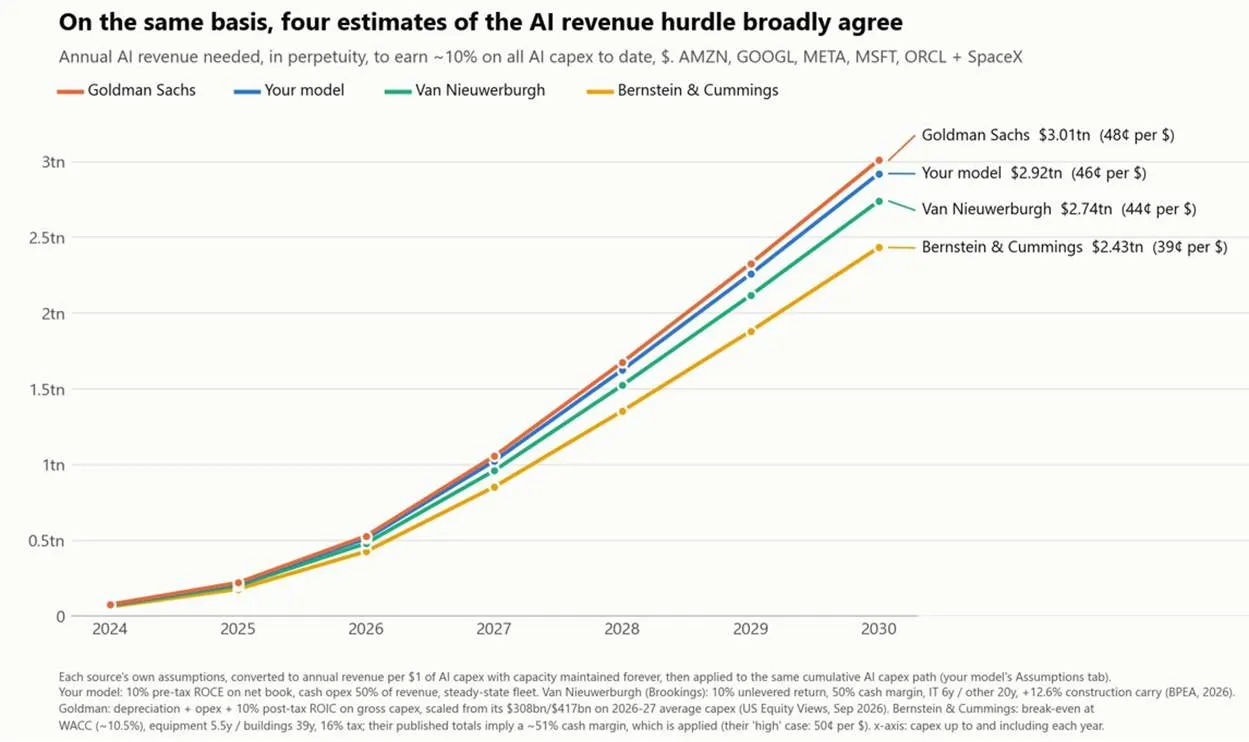
What’s striking is how close each of the estimates are: firms will need between $2.4-3.0 trillion in annual incremental AI revenues by 2030 to justify their big spending; this is about 5-6 times more than they are currently making under the most general possible assumptions. They may clear that hurdle. Ryan Cummings told Axios:
“Can all these people eventually turn this into something profitable? I think they will…I’m not sure who’s going to do that, but I do think there will be trillions of dollars of profits that are up for grabs in the future, but just not in this super-accelerated timeline that is required to justify the investments.”
Hyperscaler Debt & Capex Projections (2026–2027):
- 2026 Debt Issuance: Projected between $220 billion and $250+ billion for major US hyperscalers (Alphabet / Google, Amazon, Meta, Microsoft, and Oracle), with broader AI-related market debt reaching up to $570 billion.
- 2027 Forecast: Goldman Sachs projects direct hyperscaler debt issuance to nearly double to around $400 billion (Jeff Pu estimates $419 billion) as companies finance over a third of their infrastructure needs.
- Aggregate Capex: Combined capital expenditures are expected to hit roughly $940 billion in 2026 and scale past $1.3 trillion in 2027.
- Market Share: Hyperscaler investment-grade bond sales have jumped from roughly 2% of total US supply (2022–2024) to roughly 9% in 2026.
- Credit Impact: Credit spreads on a 10-year hyperscaler credit basket have widened from historical 40–75bp ranges toward 90bp+, driven by leverage concerns.
- Cash Flow Outlook: S&P Global Ratings expects all major hyperscalers to run negative free operating cash flow through 2026 and 2027, with a cash-flow inflection point not projected until 2028–2029.
………………………………………………………………………………………………………………………………………………………………………………………………………..
Hidden Risks for the AI Lab Giants:
Anthropic and OpenAI belong to the group of frontier AI model developers commonly known as “the AI labs.” Their financial performance provides a more direct view of AI business economics than that of the hyperscalers discussed above. Unlike diversified technology companies, whose established businesses can offset AI-related spending and complicate profitability analysis, these firms concentrate their operations on developing and commercializing AI. Their results therefore offer a clearer indication of whether revenue from AI products and services can support the costs of model development, computing infrastructure, and commercialization.
Public disclosures about these privately held companies are consequently valuable. Recent reporting on Anthropic and the Financial Times (FT) [paywall] June 16, 2026 report on OpenAI [1.] provide insight into their revenues, spending, and losses. OpenAI’s reported results also illustrate the importance of distinguishing operating costs from noncash accounting charges when assessing the economics of its underlying business. Substantial losses do not, by themselves, establish that AI is a financial bubble. They do, however, reinforce concerns about whether revenue growth can justify the sector’s spending commitments and valuations.
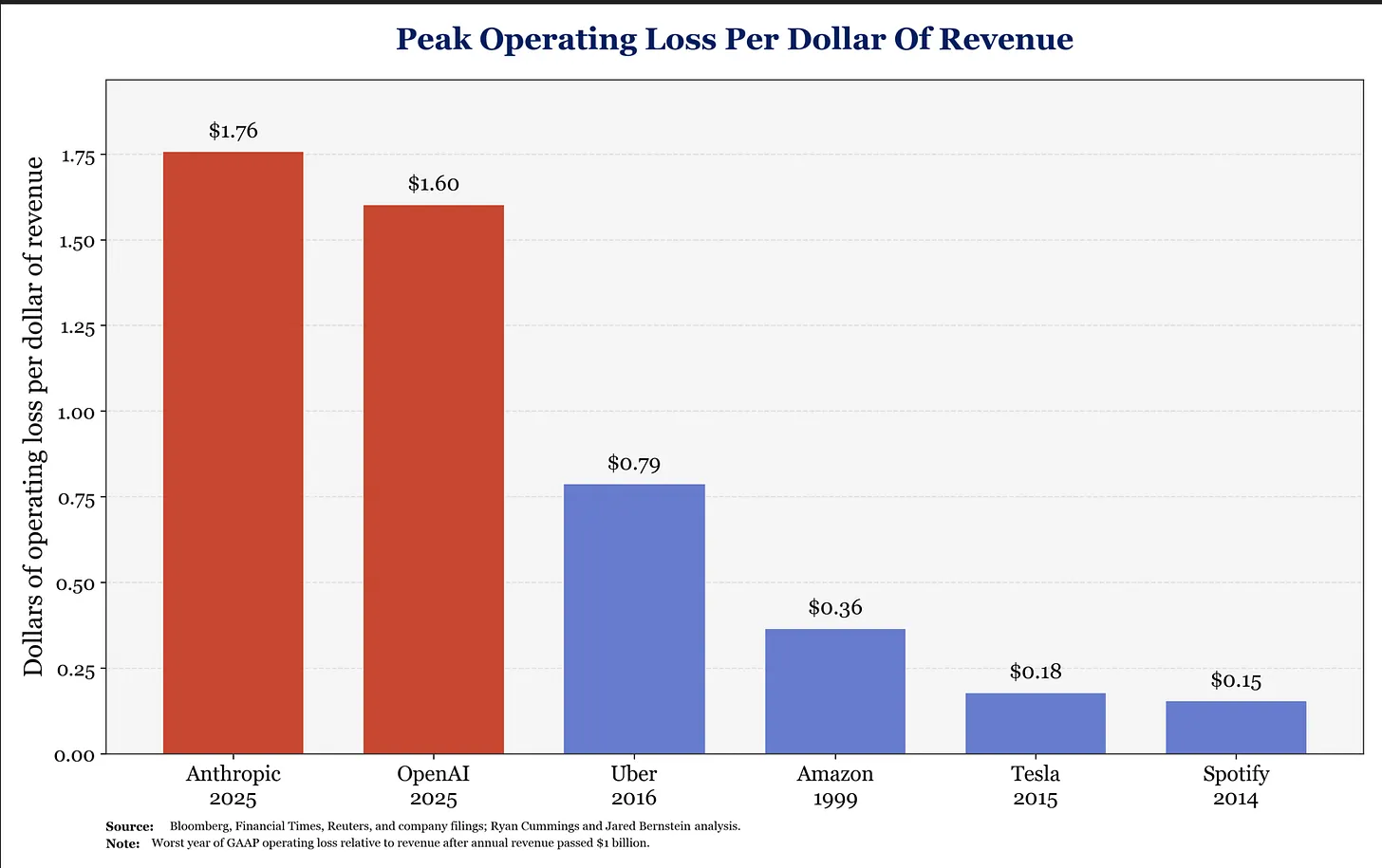
Note 1. The referenced June 16, 2026, FT report covers OpenAI’s 2025 results and distinguishes its approximately $39 billion net loss from losses of approximately $8 billion after excluding specified noncash items. It does not directly substantiate the stated $1.60 loss per revenue dollar.
AI proponents point to Amazon, Uber, and Tesla as examples of companies that sustained years of losses before becoming profitable. The relevant comparison, however, is not simply whether a company loses money, but the magnitude of those losses relative to revenue and its prospects for improving margins. As shown in the chart below, Anthropic and OpenAI reportedly lost more than $1.76 and $1.60, respectively, for every dollar of revenue in the year examined—more than twice Uber’s loss-to-revenue ratio in 2016 and more than five times Amazon’s in 1999. These comparisons underscore the scale of the challenge: rapid revenue growth must ultimately translate into a sustainable cost structure, rather than continued dependence on external financing.
Underestimated Competition:
Despite their prominence in the AI industry, the frontier-model developers face questions about whether their competitive position can support sustained profitability. They depend heavily on external providers of computing infrastructure, and their ability to convert enterprise adoption into sufficient revenue and margins remains uncertain. Customers are also scrutinizing AI costs more closely, particularly as resource-intensive AI agents increase computing requirements and operating expenses. Efforts to control those costs could constrain the labs’ revenue growth even as AI usage expands.economist
Competition from open-weight models adds to that pressure. AT&T, for example, reported increasing the share of its AI use served by open models from 20 percent in May to 40 percent by September, with savings of up to 80 percent compared with earlier in the year. Such models can offer enterprises greater deployment flexibility and reduce reliance on proprietary-model providers. Although model weights may be available without charge, deployment, inference, integration, and ongoing operation are not cost-free. The competitive issue for OpenAI and Anthropic is therefore whether their proprietary offerings deliver enough additional value to justify a price premium.
The AI labs also lack the diversified earnings base available to hyperscalers. Alphabet, for example, can draw on its established advertising business to support investments in Google DeepMind, custom processors, and data centers. OpenAI and Anthropic have no comparable non-AI profit pool. Until their AI businesses generate sufficient cash flow, they remain dependent on external capital to finance expansion and absorb losses—a funding model whose sustainability depends on investor confidence as well as technical progress.
……………………………………………………………………………………………………………………………………………………………………
| Dimension | Proprietary AI Labs (OpenAI / Anthropic) | Cloud Hyperscalers (Google / Microsoft / AWS) | Open-Weight Alternatives (Meta / Enterprise In-House) |
|---|---|---|---|
| Financial Engine | Purely AI-dependent; high loss-to-revenue ratios. | Diversified profit pools (Ads, Cloud, SaaS). | Subsidized by core business (e.g., Meta’s ad network). |
| Pricing Leverage | High premium; under constant pressure to justify value. | Tied to broader ecosystem infrastructure and compute sales. | Zero licensing costs; infrastructure/deployment costs only. |
| Strategic Vulnerability | High infrastructure dependence and lack of safety cushion. | Massive aggregate ROI requirements to justify $T infrastructure bets. | Cost of long-term deployment, fine-tuning, and specialized engineering. |
………………………………………………………………………………………………………………………………………………………………………………………
References:
https://econjared.substack.com/p/a-budding-consensus-on-ai-revenues
https://econjared.substack.com/p/ai-companies-are-in-a-race-against
AI Debt Wave Implications: Higher interest rates with enormous AI sales required for ROI
Broadcom lending Anthropic up to $42 billion in yet another AI circular financing deal
Bain & Co: AI Infrastructure Buildout Will Require $6 Trillion Revenue by 2031 to Support Massive CAPEX
The AI Infrastructure Build-Out: A $10 Trillion Bet on Compute, Power, and Networks
Nvidia CEO Huang: AI is the largest infrastructure buildout in human history; AI Data Center CAPEX will generate new revenue streams for operators
AI risks and backlash increase; Recap of the circular loop of fake AI profits and hyperscaler markups of private AI companies
China vs U.S.: Race to Generate Power for AI Data Centers as Electricity Demand Soars
Expose: AI is more than a bubble; it’s a data center debt bomb
Will billions of dollars big tech is spending on Gen AI data centers produce a decent ROI?
Huge Risks for the proposed $500B AI Investments from Giant Wall Street firms
Can the debt fueling the new wave of AI infrastructure buildouts ever be repaid?
8 thoughts on “OpenAI, Anthropic, and Their Hyperscaler Partners: Huge Financial Risks and Open-Weight Competition”
Leave a Reply

Katie Martin in the FT – Oct 10, 2026: “The AI trade is no longer new and it is no longer “a” theme. Instead it has morphed into “the” theme — a vast, suffocating blob slathered on top of the global financial system, starving everything else of oxygen, distorting market reactions and leaving every portfolio, everywhere, alarmingly reliant on the fortunes of just one bet. Stocks, real estate, infrastructure, energy, emerging markets, some vintages of private equity . . . they’re all, to a large extent, the same trade…”
“But we still, collectively, have a very poor read on how AI will pan out. To some extent, everyone is guessing here, but private equity firm Bain said in a recent report that annual spending on AI infrastructure could reach $1.5tn by 2031. Extraordinary stuff. Even more extraordinary, though, it added that “sustaining this level of investment would require an AI market approaching $6tn annually”
“We don’t really understand the long-term economic implications of AI, but the underlying commercial assumptions seem rather heroic. And we’ve all, deliberately or otherwise, hitched our fortunes to the idea that it will work out just fine. We’d better be right.”
https://www.ft.com/content/3f54c442-c2b7-4876-a960-5229951c9a46?syn-25a6b1a6=1 [paywall]
Excerpts of FT Interview with David Silver- said to be the lynchpin of Google Deep Mind:
The mild-mannered computer scientist is stepping out on his own. In February, he announced his $5bn start-up Ineffable Intelligence. So far, he has revealed very little about his plans and motivations.
The reason we haven’t achieved so-called superintelligence yet, Silver believes, is because modern AI systems such as ChatGPT or Claude are rooted in human knowledge. Training this type of software, known as large language models, requires feeding the system vast swaths of human-generated data from the internet. People then provide feedback to chatbots’ responses, rating their quality and even hand-crafting examples for them to ingest. “Human input is required at many, many levels in the process,” he says.
At Ineffable, he wants to follow that thread to its farthest end point, inventing super-intelligent software that can learn anything from first principles. He hopes this will accelerate the development of new types of fundamental science and life-saving technologies.
“If you take the purest form of this idea, you end up with a system that’s really much more like the way that humanity learns,” Silver says. “Like the grey mush in your head that starts from nothing and discovers everything.”
Based on this idea, Ineffable ended up raising $1.1bn, the largest-ever seed round in Europe. Within days of Silver’s departure from Google DeepMind, investors Alfred Lin and Sonya Huang at venture capital firm Sequoia Capital flew in from California to meet him. Silver hopes his bet will take us far beyond the LLMs of today. He describes this next phase of AI as the “era of experience”.
“There are probably tens of thousands of super-talented people pursuing the same path in AI at the moment. All of the diversity in the field has collapsed,” he says. “So I could be the ten thousand and first person doing that . . . or I could follow this other path.”
Silver speaks fondly of the unique spirit of ambition that animated DeepMind in those early days: scientists on a quest to build a machine that could discover things for itself. In 2014, Google acquired DeepMind for £400mn, at a time most of the AI world was focused on alternative approaches. “[DeepMind] was a group of people that dared to.
“I think the only thing I feel disappointed by is that the advances in AI have not been mirrored by the ethics of AI,” Silver replies. “I think that some of the leaders of the AI field . . . are moving in a way that has . . . not been as responsible as it could have been.”
“Imagine that we can actually build a science of superintelligence entirely in simulation,” he says. He is fascinated by what happens when you have a society of super-intelligent agents that are all pursuing different goals.
But then what, he asks, are the conditions under which superintelligence coexists peacefully with us — and when does it go wrong?
His goal is to scientifically design machines to be “co-operative, helpful and supportive of human flourishing” — something that he says is mostly “guesswork” today.
As he describes developing a pseudo-society of AI agents that can be studied, any diffidence disappears. “If we get this right, we’ve got this kind of Petri dish in which we can actually start to answer some of the questions which no one has the answers to today.”
He points particularly to the race between companies and also countries as an unhealthy dynamic that has sped things up unnecessarily. The bitter personal rivalries between the leaders of the likes of OpenAI, Anthropic and SpaceXAI may also have contributed to the haste and failures of AI systems that we are now seeing, I suggest. In the days following our conversation, ChatGPT maker OpenAI was forced to notify dozens of third parties, including governments, universities and public agencies such as the Securities and Exchange Commission, that its software had breached their systems without the company’s knowledge.
“There may be differences at certain levels, but all of these [leaders] want there to be a good outcome for humanity. I think they have to find a way to work together . . . it’s an imperative,” Silver says. “The urgency of the situation will require it.”
Ineffable’s ambition is to develop an AI “super learner”, a software that continuously learns and excels over time. “There’s a certain amount of human data that’s out there on the internet — you can think of it like a fossil fuel. And once you’ve trained on it all, the fossil fuels are all gone,” Silver explains. Meanwhile, systems that teach themselves are more like a “renewable source” of data. “And when you build systems that train on that, you can have systems that can learn forever.”
Silver and his six co-founders at Ineffable have agreed a three-year runway with their investors, including the likes of Nvidia, Lightspeed and Sequoia Capital, in which they will focus on their current roadmap, with no detours. Within that timeframe, he says he is confident that his team can produce a version of superi-ntelligent AI in simulation, or at least “compelling evidence that we are very close to achieving it.”
https://www.ft.com/content/462c303b-b96c-4262-a7ca-e9ae7e440828?syn-25a6b1a6=1
This excellent and incisive IEEE Techblog post offers a reasonable and grounded assessment by shifting the AI bubble debate toward macro-level financial mechanics and structural risks. The analysis accurately highlights the massive incremental revenues required by hyperscalers, the severe loss-to-revenue ratios facing pure-play AI labs, and the growing enterprise shift toward cost-saving open-weight models. Kuddos to the author!
Will AI Subscriptions Increase (as pundits predict) or Be Cancelled?
The frontier AI model developers (Open AI/Chat GPT, Anthropic/Claude, SpaceXAI (formerly known as xAI)/Grok, Perplexity.AI, etc.) sell their services as subscriptions which are expected to significantly increase. The forecast compound annual growth rate (CAGR) for the global AI subscription market is projected to be 20.6% from 2026 through 2034, according to recent TrendX Insights market metrics. Driven by both consumer adoption and enterprise demand, this specific subscription sector is expected to expand from $1.74 billion in 2025 to $9.37 billion by 2034.
But wait…when prices rise too steeply or businesses/people come under financial stress, they cancel their subscriptions. In fact, that has happened this year with Netflix (NFLX stock is -22.74% YTD). Netflix subscribers have cancelled their monthly subscriptions and even organized intermittent cancellation campaigns driven by rising costs, specific content releases (such as controversial documentaries), and public calls to boycott the platform.
Netflix charges $19.99/month for the no add subscription. Victor asks, “Would people pay $19.99/month to ask questions to an AI assistant running on a cloud resident computer?”
–>He thinks not and refers to the AI trade as “value by deception.”
https://www.fiendbear.com/Curmudgeon688.htm
From Google Gemini:
This IEEE ComSoc Technology Blog post serves as a sober, realistic counterweight to industry hype. It provides a highly grounded, macro-level economic critique of the current generative AI industry. Rather than focusing on technological breakthroughs or capability debates, Weissberger shifts the lens to structural financial vulnerabilities, infrastructure costs, and evolving enterprise adoption patterns.
The evaluation of market metrics—such as AT&T’s sudden shift to open-weight architectures—proves that the enterprise market is aggressively optimizing for cost over pure, frontier-model capabilities. For OpenAI and Anthropic to survive long-term as independent tech giants, they must either rapidly transition to high-margin, verticalized software applications or significantly drive down their reliance on expensive, external compute pools.
A professional assessment of the piece breaks down its core arguments, market validity, and strategic implications:
1. Structural Financial Mismatch (Pure-Play vs. Hyperscalers)
The post accurately highlights a critical strategic vulnerability for pure-play AI labs like OpenAI and Anthropic. Unlike Alphabet, Microsoft, or Amazon, these labs lack a diversified, non-AI profit pool to subsidize their massive CapEx and research costs.
• The Risk: While hyperscalers can treat AI as a loss leader or feature enhancement backed by established cloud, advertising, or enterprise SaaS revenues, the pure-play labs are locked in an intensive “loss-to-revenue” cycle.
• The Verdict: This is a structurally sound critique. Pure-play labs are highly dependent on external compute infrastructure and “circular financing” deals, leaving them vulnerable if venture capital or hyperscaler patience thins before enterprise margins stabilize.
2. The Open-Weight Threat to Premium Pricing
One of the most actionable insights in Weissberger’s piece is the rapid maturation and enterprise adoption of open-weight models.
• Enterprise Shift: The article cites AT&T as a prime example, which grew its open-model AI usage from 20% in May to 40% by September, yielding cost savings of up to 80%.
• The Economic Pressure: While deploying open-weight models is not entirely free (requiring inference, integration, and operational engineering), it strips proprietary vendors of their pricing power.
• The Verdict: This is the core competitive threat facing proprietary labs. If open-weight alternatives are “good enough” for 80% of enterprise workflows at a fraction of the cost, OpenAI and Anthropic face a severe challenge in justifying their premium pricing tiers.
3. Compute Costs and the “Agentic” Shift
The analysis correctly notes that as the industry pivots toward resource-intensive AI agents, compute requirements and operating expenses will spike significantly. This creates a paradox where increased enterprise adoption does not automatically equal profitability if inference costs scale exponentially alongside usage.
Thanks for your kind words. From Google GeminiL
Your assertion that “AI is a circular economy” is spot-on. Hyperscalers (Microsoft, Google, AWS) invest billions into AI startups (OpenAI, Anthropic), which immediately turn around and spend those exact same billions renting cloud infrastructure from those same hyperscalers.
Where the Real Money Is: The only companies making undeniable, massive hard cash are the hardware and infrastructure providers—primarily Nvidia, TSMC, and data-center power/cooling companies. They sell the “picks and shovels” to a gold rush funded by venture capital and corporate FOMO, making them the ultimate commercial winners of this era.
The artificial-intelligence investment boom increasingly looks like it will struggle to generate sufficient returns, Panmure Liberum strategist Joachim Klement says. “We are seeing some blocks being pulled out of the Jenga Tower that is the AI capex boom,” Klement says. “Higher debt costs makes it extremely difficult for neoclouds and hyperscalers to finance further data centers now that their free cash flows have evaporated.” For instance, cloud-computing company CoreWeave saw its cost of borrowing soar over the past two sessions as shares in chip makers and data center companies are falling sharply across the globe.
https://www.wsj.com/business/tech-media-telecom-roundup-market-talk-2c407ece
Edward Chancellor writes, “The economist Hyman Minsky applied the term ‘Ponzi finance’ to businesses that do not generate sufficient cash flows to meet their outgoings. Loss-making data centre operators and AI frontier labs fit this description. Ponzi finance units, said Minsky, need rising valuations to raise additional capital. When valuations decline and the capital markets seize up, these shaky institutions collapse, causing losses to metastasise through the financial system. That is what happened in early 2000 after the credit markets lost confidence in the debt-fuelled buildout of the information superhighway.”
https://www.breakingviews.com/columns/big-view/us-corporate-profit-boom-faces-its-minsky-moment-2026-10-22/?mc_cid=fe87202841&mc_eid=5917efd771