

Applying Zero Trust at the Wireless Edge: Securing Mixed WPA2 and WPA3 IoT Fleets
By Iftikhar Javed khan with Ajay Lotan Thakur
Abstract
Zero-trust architecture is a security model that eliminates implicit trust based on network location and instead requires every access request to be continuously authenticated, authorized, and validated before it is granted (NIST SP 800-207), Yet while zero-trust architecture is intentionally network-agnostic, practitioners still need concrete design patterns to apply its principles at the wireless edge. This challenge is acute in IoT deployments that span multiple hardware generations, where newer devices support WPA3 while legacy endpoints remain limited to WPA2 and may be unable to support 802.1X supplicants, certificate-based authentication, or endpoint posture agents.
Based on an anonymized critical-infrastructure sensor deployment, this article presents a control pattern that segments devices according to their maximum supported security capability rather than forcing the entire fleet into a single compatibility-mode WLAN. WPA3-capable devices are placed in a WPA3-enforced domain, while WPA2-only devices are confined to a tightly restricted legacy domain.
The pattern combines five controls: capability-aware wireless segmentation, per-device Multi-Pre-Shared Key credentials, least-privilege policy enforcement, RF-exposure reduction, and access-point-integrated wireless intrusion detection. The central argument is that WPA3 is an important wireless security control, but it is not, by itself, a zero-trust architecture. Instead, the article shows how zero-trust principles can be translated into practical controls for networks that cannot immediately replace every legacy endpoint.
The Core Principle: Capability Dictates Posture, Not the Reverse
Most wireless security design begins with a chosen standard and then asks how to make the device fleet conform to it. In a homogeneous estate that works. In a mixed-generation IoT fleet it fails, because the fleet contains devices that physically cannot meet modern baseline sensors that support only WPA2-Personal, cannot run an 802.1X supplicant, and cannot host a posture agent. When a single standard is imposed on such a fleet, one of two things happens: either the network is dragged down to the capability of its weakest device, or the weakest devices are quietly excluded and left unmanaged. Neither is zero trust.
The inversion this article argues for is simple: let each device’s maximum supported security capability determine which policy domain it belongs to, and architect the network around that reality rather than against it. A WPA3-capable sensor and a WPA2-only sensor are not two configurations of the same policy; they are two different risk profiles that deserve two different domains. Once capability is treated as the independent variable, the rest of the design segmentation, credentialing, least-privilege enforcement, RF exposure, and monitoring follows from it.
Step One Is Always Visibility
Before any of this can be designed, the fleet has to be seen. In practice, the first problem in a mixed-capability wireless estate is not choosing controls, it is not knowing, with confidence, what is actually associated with the network and what each device can support. A design built on assumptions about the fleet is a design built on sand.
Visibility therefore comes first, and it has two parts as shown in figure 1. The first is a wireless inventory: enumerating the devices present on the medium, their association state, their supported security modes (WPA2-only versus WPA3-capable, SAE support, Protected Management Frames), and their physical distribution. The second is monitoring the medium itself for what should not be access points and clients that are not part of the sanctioned fleet. Only once the estate is known can devices be grouped by capability and confined to the right domain; and only once the medium is continuously observed can the segmentation be trusted to hold over time.
This reframes the usual order of operations. Segmentation and credentialing are what most WLAN-security discussions start with, but they are the second move. The first move is establishing and maintaining an accurate inventory because you cannot correctly assign a device to a capability domain that you have not yet discovered, and you cannot detect a rogue or misclassified device without ongoing observation.
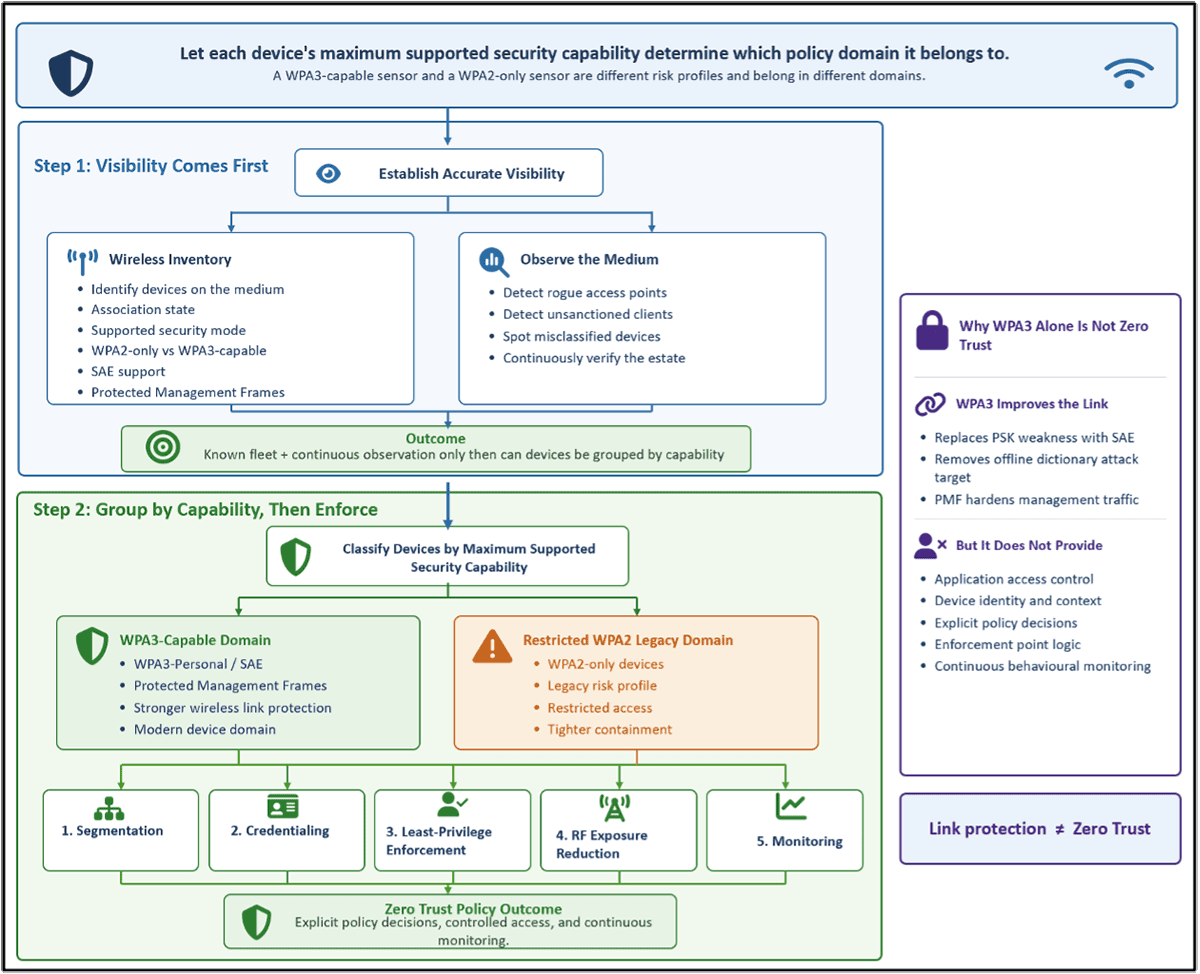
Figure 1: Visibility
Why WPA3 Alone Is Not Zero Trust
WPA3 materially improves the wireless link. Under WPA2-Personal the pairwise master key is derived directly from the passphrase, so an attacker who captures the 4-way handshake can mount an offline dictionary attack against it. WPA3-Personal replaces that PSK authentication with Simultaneous Authentication of Equals (SAE), a password-authenticated key agreement that establishes the pairwise master key without exposing a crackable value the 4-way handshake still runs afterwards to derive and install session keys, but it no longer leaks an offline-attackable target. Protected Management Frames additionally harden management traffic against deauthentication and disassociation abuse. These are real gains, and WPA3-capable devices should use them.
But link protection is not access control. Whether a sensor is on WPA2 or WPA3 says nothing about which application it may reach, whether it may talk to its neighbours, whether it can reach a management interface, or how anomalous behaviour is detected after it has associated. A device can hold a perfectly valid WPA3 credential and still be a compromised endpoint. Zero trust asks a different set of questions than “is the link encrypted”: what is this device, what is it allowed to do, and is it still behaving as expected. Answering those requires credential context, an explicit policy decision, an enforcement point, and continuous monitoring none of which WPA3 provides on its own.

Figure 2: Controls
Control 1 : Capability-Aware Wireless Segmentation
Devices are grouped by their maximum supported wireless security capability and assigned to distinct SSIDs and security zones accordingly: WPA3-capable sensors to a WPA3-enforced domain, WPA2-only devices to a separate, narrowly scoped legacy domain, each with its own firewall and access-control policy.
It is worth being precise about the alternative, because the single-SSID case is often overstated. A WPA2/WPA3 transition-mode SSID is technically possible and would preserve legacy compatibility. The problem is not that one SSID mechanically forces one shared WPA2 key; it is that a transition-mode SSID cannot enforce WPA3-only operation for capable devices, and it places endpoints with materially different risk profiles inside the same wireless policy domain. Separating by capability is a deliberate choice for policy separation and to prevent silent downgrade of capable devices, not a workaround for a technical impossibility. The SSID is not the security boundary; it is the first sorting step, with real enforcement occurring downstream at the firewall or microsegmentation gateway.
Control 2: Per-Device Credential Granularity
A single fleet-wide pre-shared key is replaced with a per-device or narrowly-scoped-group credential scheme, so that a compromised credential exposes one device or a small group rather than the entire fleet, and any one device can be revoked without re-keying everything.
The security benefit is credential granularity and accountability, not cryptographic identity. A pre-shared key remains a possession-based secret: holding it proves possession, not verified device identity, and device identity should never rest on a spoofable MAC address alone. The honest framing is that per-device keying shrinks blast radius and enables granular revocation and gradual rotation, a meaningful improvement over a shared key, but a step below certificate-based authentication, which constrained legacy sensors often cannot support. That gap is precisely why the surrounding controls (segmentation, least-privilege enforcement, monitoring) carry the rest of the load.
Control 3: Least-Privilege Policy Enforcement
This is the control that turns WLAN hardening into a zero-trust pattern, and it is the one most often missing. Each sensor is permitted to reach only the services its function requires, enforced downstream of the wireless layer at a firewall or microsegmentation gateway:
- Permitted: its designated telemetry collector, an authorized DNS resolver, an approved NTP source, and a required update service where applicable.
- Denied: general internet access, sensor-to-sensor communication, any access to wireless or infrastructure management interfaces, and any reach into user, server, or administrative networks.
- Logged: denied flows and policy violations, forwarded to central monitoring for correlation.
Stated plainly: a sensor should be able to send its readings to exactly one collector, resolve names, keep time, and nothing else. Segmentation decides which domain a device lives in; this layer decides what it is allowed to do once there. Without it, capability-aware SSIDs are just better-organized flat networks.
Control 4 : RF-Exposure Reduction
Because the exposure boundary of a wireless network is defined by radio propagation rather than by cabling, access-point placement, transmit power, and minimum data rates are optimized to reduce unnecessary signal propagation beyond the intended service area, validated through an RF survey rather than controller settings alone.
This is defense-in-depth, not a perimeter. RF exposure reduction lowers casual reachability, but a sensitive receiver or a directional antenna can still detect a usable signal outside the intended area, so it must never be presented as containment. Any power or rate change must also preserve required coverage, client uplink performance, roaming behaviour, redundancy, and application reliability; an over-aggressive reduction that breaks associations trades a small exposure gain for an availability loss.
Control 5 : Wireless Intrusion Detection and Continuous Monitoring
Continuous observation of the medium closes the loop opened by the visibility-first principle. Access-point-integrated WIDS/WIPS, or dedicated monitor-mode sensors, observe the over-the-air environment for conditions that IP-layer inspection cannot see, because rogue-AP and evil-twin detection depends on access to raw 802.11 management and control frames rather than post-association traffic.
A practical detection methodology for this environment prioritizes, in order:
- Rogue-AP identification: Unsanctioned access points advertising reachable SSIDs, the highest-priority wireless threat because it can bypass the entire wired policy stack.
- Evil-twin / SSID impersonation: Access points spoofing a legitimate SSID to lure client associations.
- Unauthorized or misclassified clients: Devices associating outside their expected capability domain, or appearing where the inventory says they should not be.
- Association and authentication anomalies: Repeated authentication failures, unexpected device appearance or movement, and deauthentication patterns consistent with over-the-air attack.
Wireless events are forwarded to a central monitoring or SIEM platform and correlated with firewall, authentication, and telemetry logs, so an over-the-air anomaly and a policy violation on the same device can be seen together. Where a network IDS is also used, its role is post-association IP-traffic inspection a separate function from over-the-air 802.11 monitoring, and the two should not be conflated
Reference Architecture
The controls compose into a single flow: capability determines domain, credential and policy determine access, and the medium is continuously observed.
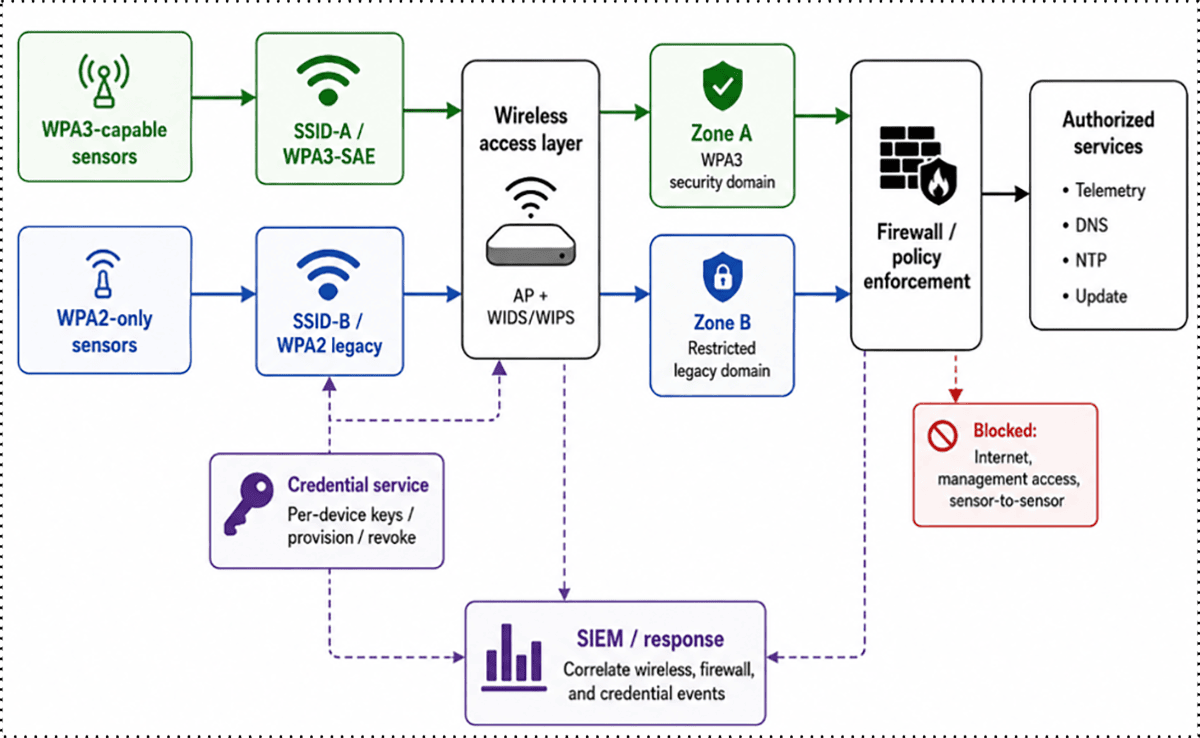
Figure 3: Reference Architecture
Mapping Wireless Properties to Zero-Trust Principles
| Wireless Property | Control Applied | Zero-Trust Principle |
| Heterogeneous device capability | Capability-aware segmentation | Group by risk; do not downgrade capable devices. |
| Shared credential / broad blast radius | Per-device credential granularity | Bounded compromise; granular revocation. |
| Implicit post-association trust | Least-privilege policy enforcement | Explicit per-device authorization. |
| Propagation-defined exposure | RF-exposure reduction | Reduce reachable attack surface (defense-in-depth). |
| Unobserved medium | Visibility + WIDS/WIPS | Assume breach; continuous over-the-air monitoring. |
Applicability to Other IoT Environments
Although derived from a remote environmental-monitoring fleet, the pattern generalizes to any heterogeneous wireless estate that cannot hold every device to one standard healthcare and medical IoT combining modern and legacy or safety devices, building-management and facilities systems, industrial and operational-technology sensors, and smart-city or asset-tracking deployments acquired across long procurement cycles. In each, the same five questions apply, and in the same order: is the estate actually visible; can endpoints be separated by capability and risk; can credentials be scoped per device or small group; can access be restricted to explicitly authorized services; and is the wireless medium continuously monitored.
Limitations and Residual Risks
- WPA2-only legacy devices remain a residual risk until lifecycle replacement; the pattern bounds that risk, it does not eliminate it.
- Per-device pre-shared keys improve granularity but do not provide the assurance of certificate-based authentication.
- RF-exposure reduction lowers casual reachability but cannot prevent reception by sensitive or directional equipment.
- WIDS/WIPS provides detection, not guaranteed prevention; false positives require tuning and operational handling.
- Posture assessment is often limited on constrained endpoints, which is why segmentation and least-privilege enforcement carry more of the load.
- Long-term remediation should include lifecycle planning to retire devices that cannot meet the required security baseline.
Implications for Standards and Practice
As IoT-specific zero-trust guidance matures, the wireless access layer where many IoT deployments are, in practice, most exposed deserves treatment as a primary zero-trust surface rather than a downstream detail. The pattern here is deliberately buildable with widely available capabilities (WPA3/SAE, per-device keying, firewall or microsegmentation policy, AP-integrated WIDS/WIPS), which matters for constrained, hard-to-patch fleets that cannot absorb heavyweight agents. Recent research on trust-boundary management in heterogeneous, multi-radio IoT environments makes a compatible argument that current zero-trust frameworks assume relatively stable networks and under-address dynamic wireless conditions and points to the same conclusion: shared-medium risk, capability-aware segmentation, and wireless monitoring belong in IoT zero-trust frameworks as first-class concerns.
Conclusions
Mixed-capability wireless IoT fleets should not be collapsed into one lowest-common-denominator policy. The more robust approach inverts the usual order: let each device’s capability dictate its security domain, establish and maintain visibility of the medium first, and then apply capability-aware segmentation, per-device credentialing, least-privilege enforcement, RF-exposure reduction, and continuous wireless monitoring on top of that foundation. WPA3 is an important control within this pattern, but it is not the pattern itself. The result is a reusable, achievable design for organizations that must secure legacy and modern wireless IoT devices at the same time without waiting for a fleet-wide hardware refresh that may never come.
…………………………………………………………………………………………………………………………………………………………………..
References
- Cloud Security Alliance, Zero Trust Guidance for IoT https://cloudsecurityalliance.org/artifacts/zero-trust-guidance-for-iot
- IEEE Std 802.11-2024 (WLAN MAC and PHY base standard) https://standards.ieee.org/ieee/802.11/10548/
- Wi-Fi Alliance WPA3 certification documentation (SAE, Protected Management Frames)
- J. Shelby, “Zero Trust for Multi-RAT IoT: Trust Boundary Management in Heterogeneous Wireless Network Environments,” arXiv:2602.08989
- Rose, S., Borchert, O., Mitchell, S., and Connelly, S., Zero Trust Architecture, NIST Special Publication 800-207, National Institute of Standards and Technology, August 2020.
- https://www.cwnp.com/uploads/1660_cwnp-wp_revisiting-wpa-2-understanding-its-security-gaps-and-evaluating-the-move-to-wpa3_ver120224.pdf

About the author:
Iftikhar Javed khan is an enterprise security architect specializing in wireless security and zero-trust architecture for IoT and critical-infrastructure environments. He holds the Cisco CCIE and CWNP CWNE credentials and is a Senior Member of the IEEE. https://www.linkedin.com/in/iftikhar-j-03aa5533/