

Omdia’s 2025 Mobile Core Network Leaders: Huawei #1 in market share; Nokia #1 for portfolio competitiveness
Highlights of Omdia’s “Market Landscape: Core Vendors” Report:
1. Market Share:
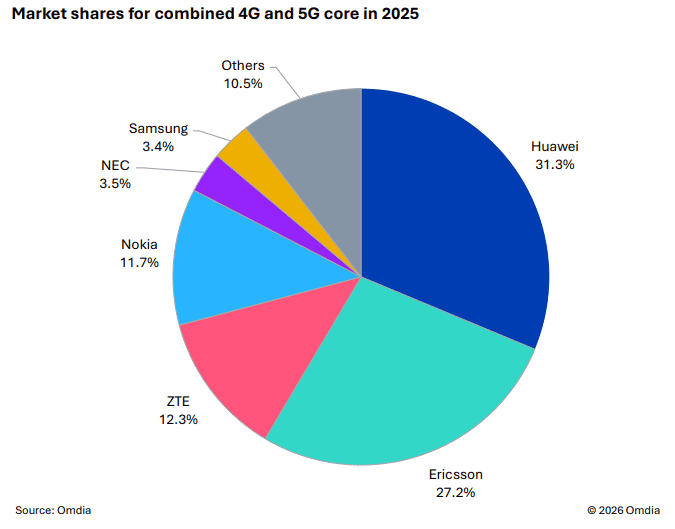
Five vendors control the 4G and 5G core market with a combined market share of 86.1% in 2025, down from 87.4% in 2024. The top three players collectively captured 70.9% of total revenue. With such a concentration of market power, each vendor is increasingly focused on asserting leadership, particularly as competition intensifies around the next-generation 5G core. However, measuring market leadership in this space has its challenges
In 2025, Huawei was the market leader. It was followed by Ericsson, ZTE, Nokia, NEC, and Samsung Electronics.
• Ericsson, Huawei, and ZTE captured a combined 70.9% of global core revenue in 2025, up from 68.3% in 2024. When Nokia and NEC are added, these top five companies generated 86.1% of total core revenue in 2025, up from 87.4% in 2024. This is very high but still less than the 95.4% captured by these vendors in 2020, which indicates that upcoming vendors are collectively gaining market share.
• Huawei gained 5.0 percentage points in market share thanks to a more favorable geographical mix and market share gains in emerging markets. Ericsson, ZTE, and Nokia, however, lost share.
• Market share remains an important component of vendor strategy. Some vendors deliberately trade short-term margins for increased share, leveraging competitive pricing to secure new business, especially within the 5G core space, which presents fresh monetization opportunities. Conversely, others may prioritize margin protection over top-line growth, consciously sacrificing share to maintain profitability. A single vendor may use both approaches depending on the geography, project scope, or timing.
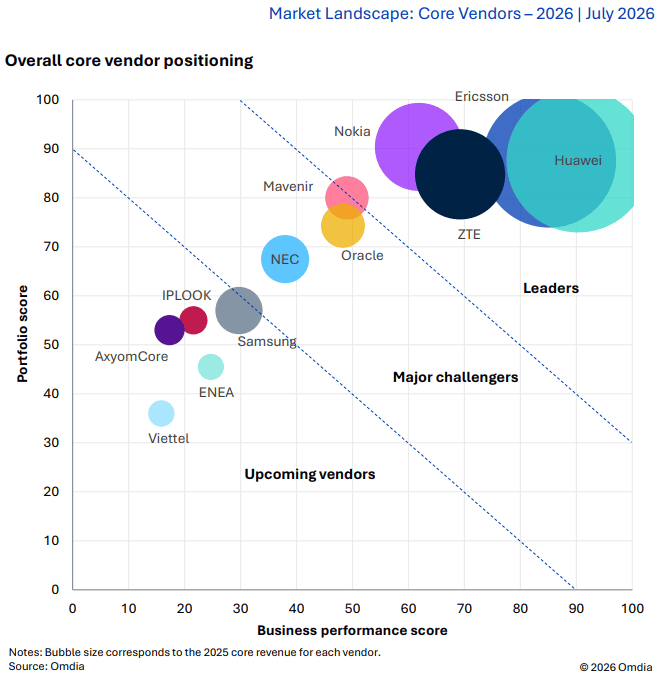
Samsung Electronics and four other vendors including the new participant, AxyomCore, are in the upcoming mobile core vendors group. However, caution is required when benchmarking these vendors, given the relatively fewer network functions (NFs) that they develop and their smaller market reach compared with the larger players.
Note: For 4G and 5G core revenue, Omdia did not include Communications Service Providers (CSPs)’ spending in NF virtualization infrastructure (NFVi) or server and management software.
…………………………………………………………………………………………………………………………………………………………………………………………………………………………………….
2. Portfolio Competitiveness:
Nokia was ranked No. 1 for mobile core portfolio competitiveness with the Finland headquartered company a leader across all seven competitiveness categories: core portfolio breadth, cloud-native maturity, signaling, automation, core as a service, AI/ML and analytics, and implementations of other network functions. The recognition reflects Nokia’s continued investment in mobile core technologies that help operators modernize their networks for the AI era. Recent deployments include the world’s first commercial mobile telco service based on 5G Core SaaS; Core SaaS Edge enabling local breakout for roaming subscribers; core network resilience solutions; telecom core modernization programs, and mission-critical network upgrades supporting the IoT, rail and utilities sectors.
“Core networks are becoming the intelligence layer of modern communications, connecting cloud-native operations, AI-driven automation and application innovation. This recognition from Omdia highlights the breadth and maturity of our portfolio across every major category operators are using to evaluate connectivity partners who can help them move toward more autonomous, resilient and programmable networks.” Kal De, SVP, Core Networks, Nokia.
“Nokia continues to distinguish itself as a technology leader in core networks, with advanced capabilities in categories spanning cloud native maturity, automation, AI/ML and analytics, and Core as a Service. These are no longer optional innovations but strategic requirements for telecommunication providers pursuing greater operational efficiency, service agility and monetization opportunities. Nokia’s comprehensive approach demonstrates a deep understanding of both current operator challenges and the future direction of the telecom market. Roberto Kompany, Principal Analyst, Mobile Infrastructure, Omdia.
3. Selected Mobile Core Vendor Strategies:
Huawei and ZTE dominate the global 5G mobile core landscape, combined representing over half of the global market revenue. Unlike Western vendors who heavily rely on US-based hyperscalers (AWS, Microsoft Azure, Google Cloud) to realize a cloud core, Huawei and ZTE use an entirely different playbook. Their strategy relies on vertically integrated, proprietary Telco Clouds combined with intensive AI-native automation, while focusing geographically on domestic, Middle Eastern, African, and Asia-Pacific markets due to geopolitical restrictions in Europe and North America.
Huawei and ZTE sell the entire mobile core vertical stack: the underlying hardware, the cloud virtualization layer, and the mobile core software.
- Huawei’s Strategy: Huawei actively positions its Huawei Cloud and proprietary platform (Telco Intelligent Converged Cloud – TICC) as the direct alternative to AWS or Azure for global operators. Instead of validating their 5G core on American hyperscalers, they build end-to-end “Cloud-Network Synergy” environments using their own Kunpeng and Ascend chipsets.
- ZTE’s Strategy: ZTE deploys its 5G Common Core Solution. It uses their in-house Distributed Cloud infrastructure, which fully abstracts 2G/3G/4G/5G pipelines into a singular, containerized platform. They target extreme reliability through proprietary data layers (like their stateless cloud database) rather than outsourcing data management to a public cloud.
In sharp contrast, non-Chinese mobile core vendors (Nokia, Ericsson, Samsung) treat the mobile core as pure application software meant to run on hyperscaler public clouds.
Nokia’s core portfolio supports deployment models spanning private, public and hybrid cloud environments and helps operators simplify core operations through automation, AI-driven analytics, resilient architectures and network exposure capabilities. The company’s approach enables telecom providers and mission-critical enterprises to accelerate service innovation while reducing operational complexity and improving network agility. Nokia is a primary driver of the “Core on Multi-Cloud” strategy, intentionally designing its cloud-native 5G Standalone (SA) core to be completely infrastructure-agnostic.
- AWS: Nokia collaborates with AWS to deploy automated, cloud-native packet core and IMS voice functions natively on AWS infrastructure.
- Google Cloud: Nokia utilizes Google Cloud infrastructure to run its 5G core while integrating Google’s advanced Generative AI and data analytics tools for autonomous network operations.
- Microsoft Azure: Nokia tightly integrates its core applications with Azure’s carrier-grade hybrid cloud platforms, optimizing hosting configurations for low-latency enterprise and edge applications.
-
- Google Cloud: Ericsson deeply collaborates with Google Cloud to evolve its cloud-native packet core stack, optimizing it to run on Google’s autonomous cloud infrastructure paired with Google’s Cloud TPUs and GPUs for network AI scaling.
- AWS: Ericsson partners with AWS to validate its 5G core functions on AWS Outposts, targeting hybrid cloud deployments for tier-1 operators.
- AWS: Samsung optimizes its cloud-native 5G Core on AWS to allow operators to quickly spin up network slices and private 5G instances.
- Microsoft Azure & Google Cloud: Samsung partners with both hyperscalers to deliver end-to-end virtualized network functions (VNFs) at the enterprise edge
…………………………………………………………………………………………………………………………………………………………………………………………………………………
References:
https://www.nokia.com/asset/215526/
Telco investments in mobile core networks surge 83% in 2025-Q4, but what about ROI?
5G in Europe: Broad coverage but 5G SA cloud native core network lags other major markets (Table)
Dell’Oro: Telecom carriers are on a 5G SA spending spree with more to come
GSA: 5G Non Terrestrial Networks, 5G SA and 5G Advanced gain momentum
Dell’Oro: Mobile Core Networks +15% in 2025; Ookla: Global Reality Check on 5G SA and 5G Advanced in 2026
Dell’Oro: RAN market stable, Mobile Core Network market +14% Y/Y with 72 5G SA core networks deployed
One thought on “Omdia’s 2025 Mobile Core Network Leaders: Huawei #1 in market share; Nokia #1 for portfolio competitiveness”
Leave a Reply

According to Dell’Oro Group: 5G Mobile Core Network (MCN) revenue in EMEA grew over 30 percent in 2Q 2026, contributing more revenue to the worldwide 5G MCN market than any other region.
“So far in 2026, eighty percent of the operators to have launched 5G Standalone (SA) networks for consumer services have been in Europe,” stated Siân Morgan, Sr. Director at Dell’Oro Group. “This helped EMEA 5G MCN revenue to reach a high-water mark in 2Q 2026, and we expect this region will keep expanding in the coming quarters.
“The growth in 5G MCN occurred despite an escalation in server prices causing mobile network operators to scrutinize the cost of network projects. On the other hand, IMS revenue contracted for the third quarter in a row, with most regions seeing a drop in Voice core revenue,” continued Morgan.
Additional highlights from the 2Q 2026 Mobile Core Network and Multi-Access Edge Computing Report include:
-MCN market dynamics were stable, with Huawei, Ericsson and Nokia growing MCN revenue in alignment with total market expansion.
-4G Wireless Packet Core revenue outpaced the market for the third quarter in a row, driven by mobile network operators that have not yet moved to 5G SA.
-In nominal terms, revenue from 5G MCN has still not reached the levels achieved by 4G MCN, with the pressure to automate operations and grow ARPU counterbalanced by the rising cost of infrastructure.
https://www.delloro.com/news/european-telcos-push-emea-5g-mobile-core-revenue-to-a-new-high-in-2q-2026/