

Ericsson and MediaTek Demonstrate 3GPP-Based GNSS RTK Positioning with Sub-30cm Accuracy Over a Commercial 5G Network
Ericsson and MediaTek have completed a world-first end-to-end demonstration of high-precision outdoor positioning over a commercial 5G network, using standardized 3GPP Global Navigation Satellite Systems (GNSS) Real-Time Kinematic (RTK) assistance. The trial achieved stable outdoor positioning accuracy below 30 cm using a handset’s integrated antenna, demonstrating a scalable path to decimeter-level positioning without proprietary positioning infrastructure or dedicated external GNSS hardware.
The demonstration validates how 5G networks can distribute GNSS RTK correction information efficiently to devices for industrial automation, autonomous mobility, drones, robotics, and other applications requiring reliable, mission-critical location awareness.
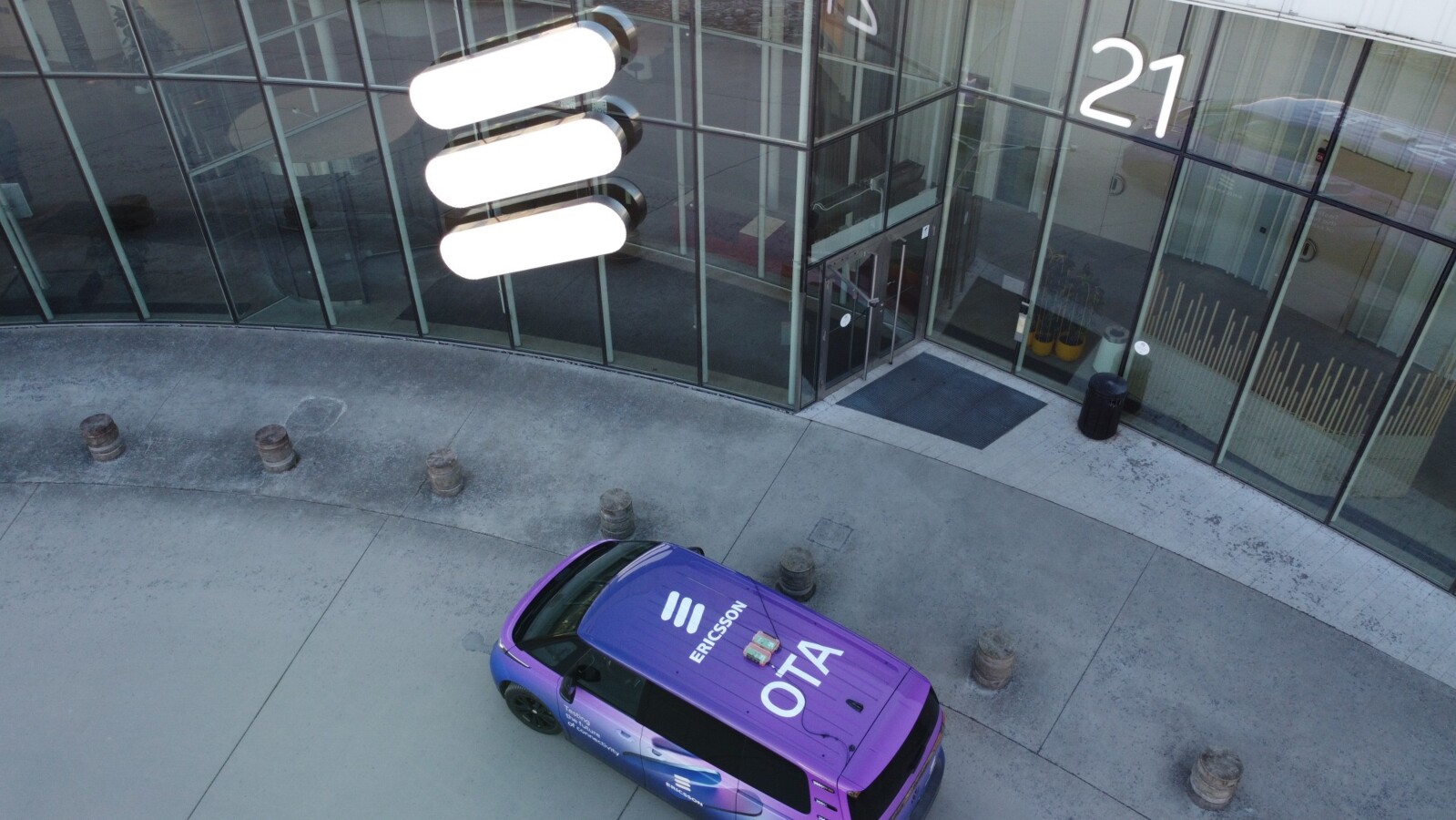
Image courtesy of Ericsson
………………………………………………………………………………………………………………………………………………………………………………………………………………………
Technical highlights:
-
Sub-30 cm positioning performance: The device achieved stable outdoor accuracy below 30 cm with its built-in antenna. With a geodetic-grade GNSS antenna, the same RTK approach can support centimeter-class positioning performance.
-
3GPP-standardized architecture: The solution uses capabilities specified in 3GPP Release 16 for GNSS positioning assistance, enabling an interoperable architecture across compatible networks, positioning servers, chipsets, and devices.
-
End-to-end unicast and broadcast validation: Both delivery modes were demonstrated end to end:
-
Unicast GNSS RTK: LPP assistance messages are delivered through Secure User Plane Location (SUPL) over standard IP connectivity, enabling targeted delivery to individual UEs.
-
Broadcast GNSS RTK: RTK assistance data is transmitted through Positioning System Information Blocks (PosSIBs), allowing common assistance information to be delivered simultaneously to all capable devices within a cell.
-
-
Efficient scaling model: Broadcast delivery can reduce repeated transmission of identical RTK correction data in high-density areas, while unicast can be used for lower-traffic scenarios, individualized service handling, or LTE-connected devices. This supports flexible selection of the most efficient assistance-delivery method based on coverage, device population, and radio-resource conditions.
-
Secured broadcast operation: While broadcast information is radio-accessible to devices in the coverage area, 3GPP mechanisms support encrypted positioning assistance. Authorized subscribers obtain the required decryption material through the 5G Core, including the Access and Mobility Management Function (AMF), protecting access to premium high-precision positioning services.
GNSS correction support:
The trial supports two standardized GNSS correction-data models:
-
Observation State Representation (OSR): Provides corrections derived for a specific receiver or location context, including GNSS observation-related corrections.
-
State Space Representation (SSR): Delivers correction parameters associated with GNSS satellite orbit, clock, bias, and atmospheric error states. SSR is particularly suitable for scalable service delivery because the common state information can be applied by many devices across a service area.
In both cases, the UE applies the received RTK assistance in real time to mitigate satellite, orbital, clock, ionospheric, tropospheric, and other GNSS error sources that limit conventional standalone GNSS accuracy.
Network and device implementation:
The test used Ericsson’s 5G Core, Ericsson Network Location (ENL), Ericsson 5G Advanced Location Services, and Ericsson RAN to generate, manage, and distribute OSR and SSR correction information through the mobile network. MediaTek validated the device side using its latest 5G modem technology with integrated GNSS capability, including real-time processing of advanced GNSS correction data with power-optimized implementation.
“This is a milestone for the 5G ecosystem,” said Johan Hultell, Head of Product RAN Software at Ericsson. “Together with MediaTek, we make high-precision location more accessible to device makers and enterprises, accelerating use in manufacturing, transport and beyond.”
Dr. HC Hwang, General Manager of Wireless Communication Systems and Partnerships at MediaTek, added: “The collaboration with Ericsson demonstrates how 5G Advanced technology can unlock new value for consumers and enterprises alike. Our modems with integrated GNSS are ready to support these advanced positioning services, paving the way for the next generation of intelligent devices.”
Technology backgrounder:
Conventional standalone GNSS typically provides positioning accuracy in the range of several meters. RTK improves this performance by using measurements from accurately surveyed reference stations to generate correction assistance. In the 3GPP architecture, this assistance is delivered through the cellular network using LPP-based positioning procedures and, where applicable, broadcast system information.
By standardizing the delivery of GNSS RTK assistance over 4G and 5G networks, operators can offer high-precision location capabilities at network scale. This creates a standards-based foundation for digitalized industrial operations, autonomous systems, intelligent transportation, asset tracking, and spatially aware consumer devices.
Accuracy to within tens of centimeters is a significant improvement compared to traditional GNSS, which is accurate to within several meters, and therefore paves the way for more advanced use cases. These include the safe operation of autonomous vehicles, drones and industrial robots in complex outdoor environments, Ericsson said. Complex environments encompasses places like factories, logistics hubs, ports, and mines etc.
…………………………………………………………………………………………………………………………………………………………………………………………………………………………………………
References:
https://www.ericsson.com/en/news/2026/8/ericsson-and-mediatek-raise-the-bar-for-location-accuracy
https://www.telecoms.com/5g-6g/ericsson-and-mediatek-put-precise-5g-positioning-through-its-paces
MediaTek overtakes Qualcomm in 5G smartphone chip market
MediaTek will use TSMC to make its Dimensity SoC’s in 2024
AT&T’s 600 MHz Deployment with Ericsson: Turning Low-Band Spectrum Into Coverage and Uplink Capacity
AT&T/Ericsson Demonstrate 5G-Based ISAC for Drone Detection at World Cup Stadium
Ericsson leads SK Telecom AI RAN vs. NVIDIA’s GPU centric AI RAN Alliance
AI-RAN and Agentic AI get real: Ericsson, Nokia, Verizon & other operators enter into a new network automation era
Analysis: Ericsson’s leading role in French INTENTION 6G project