

Oct 2026: PRELIMINARY DRAFT NEW ITU-R WP 5D REPORT: M.[IMT-2030.SUBMISSION]
Backgrounder:
At the closing plenary of the 53rd meeting of ITU-R WP 5D (on October 8, 2026 in Geneva, Switzerland), two IMT 2030 related documents were progressed and will be sent to SG 5 for approval in December 2026:
- Draft revision of Document IMT-2030/2 “Process” – Submission, evaluation process and consensus building for IMT-2030.
- [Preliminary] draft new Report ITU-R M.[IMT-2030.SUBMISSION] – Requirements, evaluation criteria and submission templates for the development of IMT-2030.
We cover the latter report in this article.
Introduction:
This ITU-R Report covers the minimum technical requirements, evaluation criteria and submission templates for the development of Recommendations and Reports on IMT-2030 (6G), such as the detailed specifications of IMT 2030, and provides:
- The service, spectrum and technical performance requirements for candidate Radio Interface Technologies (RITs)/Set of Radio Interface Technologies (SRITs) for IMT 2030;
- Evaluation guidelines including evaluation criteria and procedures to evaluate technology submissions for IMT-2030;
- Submission templates that proponents need to utilize to organize the information that is required in a submission of a candidate technology for evaluation. Proponents need to provide the required information. Details on this item is beyond the scope of this article.
–>Please see References at the bottom of this article for more information.
Scope:
This Report supports the submission and evaluation process for IMT-2030 initiated by Circular Letter 5/LCCE/115 and its Addenda. It addresses the minimum technical requirements, evaluation criteria, as well as submission templates required for a complete submission of RITs and/or SRITs for IMT 2030.
IMT-2030 minimum technical requirements:
The minimum technical requirements (also referred to as “minimum requirements” in this Report) established in this section relate to services, spectrum and technical performance aspects of IMT 2030. The intent of the requirements is to ensure that IMT-2030 technologies are able to fulfil the objectives of IMT-2030 and to set a specific level of performance that each proposed technology needs to achieve in order to be accepted within ITU-R for IMT-2030.
It is to be noted that the requirements are not intended to restrict the full range of capabilities or performance that candidate technologies for IMT 2030 might achieve, nor are they intended to describe how the IMT 2030 technologies might perform in actual deployments under operating conditions that could be different from those presented in ITU R Recommendations and Reports on IMT 2030. Furthermore, this Report is not intended to restrict the implementation details of IMT-2030 technology on the aspect of how to meet these requirements.
Also, IMT-2030 is expected to be built on overarching aspects, including sustainability, security and resilience, connecting the unconnected, and ubiquitous intelligence, which act as design principles commonly applicable to all usage scenarios as described in § 3 in Recommendation ITU-R M.2160. The proponents are encouraged to describe how the candidate RIT/SRIT incorporates these design principles in the description template in § 5.2.3.1, where applicable.
Services:
Recommendation ITU-R M.2160 – Framework and overall objectives of the future development of IMT for 2030 and beyond, envisions six usage scenarios for IMT-2030:
– Immersive communication (IC).
– Hyper reliable and low-latency communication (HRLLC).
– Massive communication (MC).
– AI and communication (AIAC).
– Integrated sensing and communication (ISAC).
– Ubiquitous connectivity (UC).
Diverse services and applications for the six usage scenarios are envisaged, as shown in Figure 1. in Recommendation ITU-R M.2160 (reproduced below).
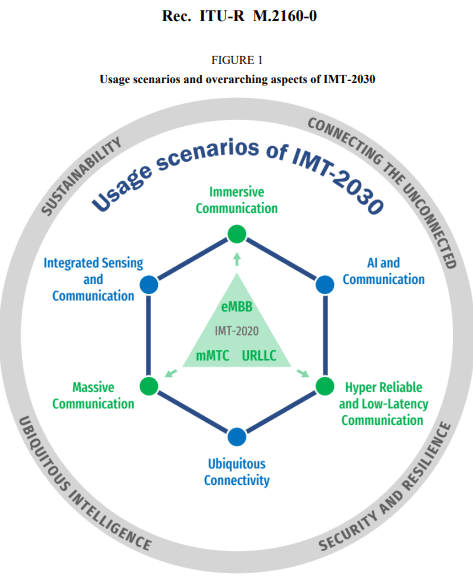
IMT-2030 RIT/SRIT shall support a wide range of services across different usage scenarios, for which the evaluation methodology is found in § 7.3.4 of Report ITU-R M.[IMT-2030.EVAL].
Spectrum:
The following frequency bands have been identified for the terrestrial component of IMT in the ITU Radio Regulations:
- 450-470 MHz (see No. 5.286AA of the Radio Regulations (RR))
- 470-698 MHz (see RR Nos. 5.295, 5.308A, 5.296A, 5.307A)
- 694/698-960 MHz (see RR Nos. 5.313A, 5.317A)
- 1 427-1 518 MHz (see RR Nos. 5.341A, 5.346, 5.341B, 5.341C, 5.346A)
- 1 710-2 025 MHz (see RR Nos. 5.384A, 5.388)
- 2 110-2 200 MHz (see RR No. 5.388)
- 2 300-2 400 MHz (see RR No. 5.384A)
- 2 500-2 690 MHz (see RR No. 5.384A)
- 3 300-3 400 MHz (see RR Nos. 5.429B, 5.429D, 5.429F)
- 3 400-3 600 MHz (see RR Nos. 5.430A, 5.431B, 5.432A, 5.432B, 5.433A)
- 3 600-3 700/3 800 MHz (see RR Nos. 5.434, 5.433B, 5.434B, 5.435B)
- 4 800-4 990 MHz (see RR Nos. 5.441A, 5.441B)
- 6 425-7 025/7 125 MHz (see RR Nos. 5.457D, 5.457E, 5.457F)
- 10-10.5 GHz (see RR No. 5.480A)
- 24.25-27.5 GHz (see RR No. 5.532AB)
- 37-43.5 GHz (see RR No. 5.550B)
- 45.5-47 GHz (see RR No. 5.553A)
- 47.2-48.2 GHz (see RR No. 5.553B)
- 66-71 GHz (see RR No. 5.559AA).
Technical performance:
Report ITU-R M.[IMT-2030.TECH PERF REQ] describes the key requirements related to the minimum technical performance for IMT 2030 candidate RIT and also provides information about the individual requirements for items and values chosen.
IMT-2030 evaluation:
Report ITU-R M.[IMT-2030.EVAL] provides guidelines for the procedure, the methodology and the criteria (technical performance, spectrum and service) to be used in evaluating the candidate IMT-2030 RITs/SRITs for a number of test environments. The evaluation procedure is designed in such a way that the overall performance of a candidate RIT/SRIT is fairly and consistently assessed on a technical basis. Candidate RITs or SRITs shall be evaluated according to the guidelines in Report ITU-R M.[IMT-2030.EVAL].
Criteria to be fulfilled by candidate RITs/SRITs: The process, the steps and the relevant timelines for the development of IMT-2030 are described in Document IMT-2030/2(Rev.1) – Submission, evaluation process and consensus building for IMT-2030. Additional specific details may be found on the ITU-R IMT-2030 web page under the link “Web page for the IMT-2030 submission and evaluation process.”
Development of candidate RITs/SRITs (Step 2):
The required criteria to be fulfilled by an RIT/SRIT are as follows:
An RIT shall fulfil the minimum requirements of at least six test environments comprising three test environments under IC, one test environment under MC, one test environment under HRLLC and one test environment under ISAC, as well as the minimum requirements of either UC or AIAC. An SRIT consists of a number of component RITs complementing and interworking with each other. Each component RIT shall fulfil the minimum requirements of at least four test environments comprising two test environments under IC, one test environment under either MC or HRLLC, and one test environment under ISAC, as well as the minimum requirements of either UC or AIAC. Together as an SRIT, it shall fulfil the minimum requirements of all seven test environments comprising the four usage scenarios IC, MC, HRLLC and ISAC, as well as the minimum requirements of either UC or AIAC.
……………………………………………………………………………………………………………………………………………………………
References:
https://www.itu.int/md/R00-SG05-CIR-0115/en
https://www.itu.int/dms_pubrec/itu-r/rec/m/R-REC-M.2160-0-202311-I!!PDF-E.pdf
https://www.itu.int/en/ITU-R/study-groups/rsg5/rwp5d/imt-2030/pages/default.aspx
ITU-R M.[IMT-2030.EVAL] & ITU-R M.[IMT-2030.SUBMISSION] reports: Evaluation & Submission Guidelines for 6G RIT/SRITs (6G)
ITU-R WP 5D Timeline for submission, evaluation process & consensus building for IMT-2030 (6G) RITs/SRITs
Perspective & Analysis of ITU-R Workshop on IMT-2030 (6G) terrestrial radio interfaces: February 10, 2027 in Geneva, Switzerland
IMT-2030 (“6G”) Minimum Technology Performance Requirements for Radio Interface Technologies
Sept 2026 3GPP meeting updates for 5G Advanced and 6G planning (with timeline for submisson to ITU-R WP 5D via ATIS)
Roles of 3GPP and ITU-R WP 5D in the IMT 2030/6G standards process
3GPP approves timelines for Release 21 which will specify 6G RAN, Core and 5G Advanced