

Light Counting: optical transceiver sales surge; IEEE 802.3 and ITU-T optical transport standards explained/UEC addendum
Sales of All Types of Optical Transceivers Set New Records:
Light Counting reports that the sales of optical transceivers, shown in the first figure below, illustrates the new record set in Q2 2026 and estimates for the rest of 2026. Sales of Ethernet transceivers currently account for about 80% of the total market. Shipments of “legacy products”—800G 2xDR4 and 2xFR4, as well as 400ZR/ZR+, were up sharply in Q2, by up to 3x year-over-year in terms of units, well ahead of the market research firm’s expectations. Unit shipments of 100G and 400G Ethernet transceivers also set new records. Even 10G Ethernet was up. Volume shipments of 1.6T Ethernet transceivers and 800ZR/ZR+ are off to a great start this year, but this was less surprising.
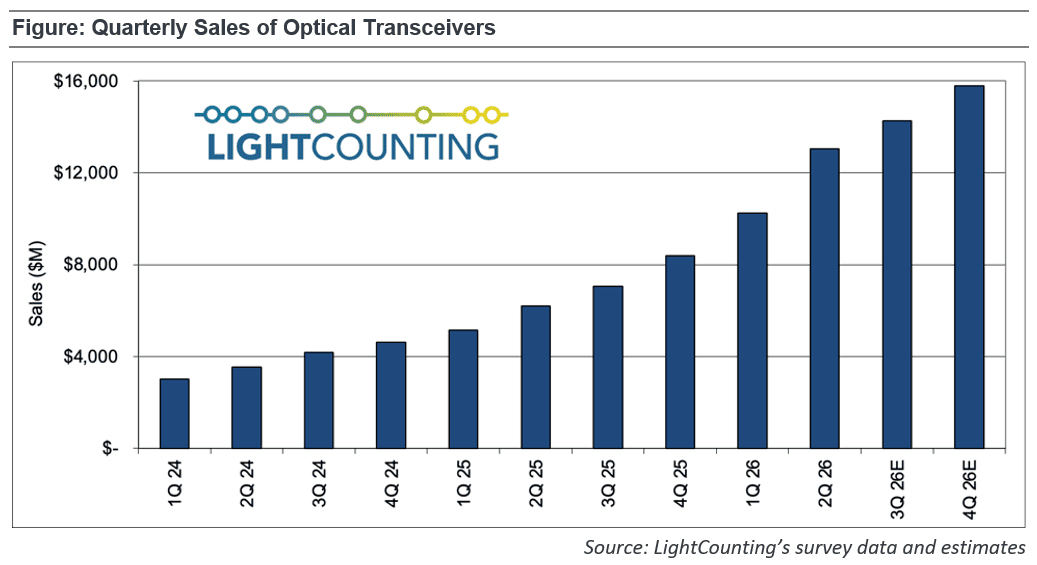
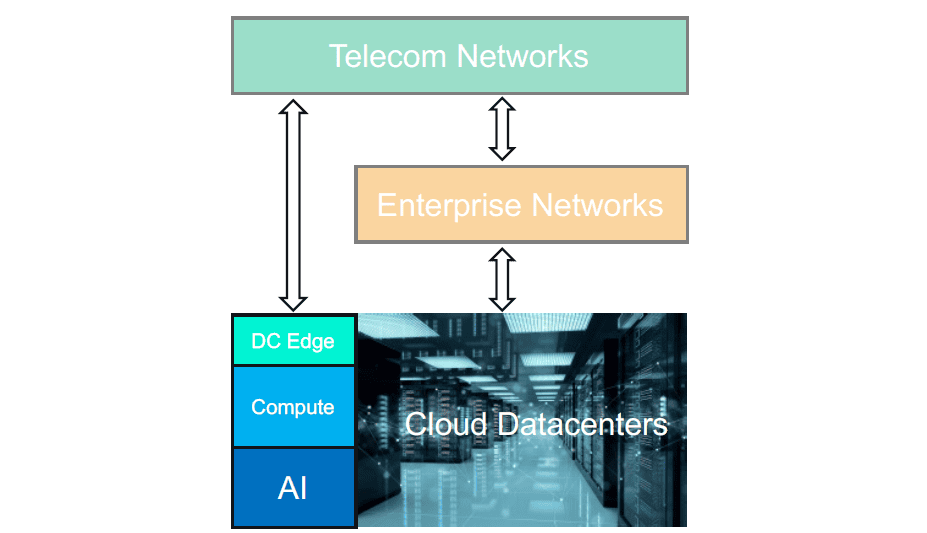
Image Credit: Light Counting
……………………………………………………………………………………………………………………………………………………………………………………………………………………………………………
Leading suppliers of optical transceivers reported record revenues and profits, despite component shortages. Here are Q2-2026 results for the top two suppliers:
- Innolight achieved a record revenue of $3.3 billion in Q2, up 192% year-over-year and up 16% sequentially. The company’s net income was $1.16 billion, up 249% year-over-year and up 40% sequentially. Gross margin increased this quarter, driven by sequential volume growth of 1.6T products.
- Eoptolink reported a record revenue of $1.8 billion in Q2, up 109% year-over-year and up 53% sequentially. The company’s net income was $698 million, up 113% year-over-year and up 74% quarter-over-quarter.
| Supplier | Estimated 2025 Sales / Segment Revenue | Market Context & Performance |
|---|---|---|
| InnoLight Technology | $5.3 Billion | Market Leader (#1); revenue surged 61% year-over-year driven by mass delivery of 800G and 1.6T modules. |
| Eoptolink | $3.5 Billion | Moved to #2 globally; registered an astonishing ~188% segment surge supplying 400G/800G optics to Amazon and Nvidia. |
| Coherent Corp. | ~$4.0 – $4.5 Billion (Data Center & Comm. Segment) | Coherent was overtaken by Eoptolink in pure transceiver rankings, but its broader communications segment generated massive revenues (including a record $1.2 Billion in Q4 2025 alone). |
| Cisco Systems | ~$1.5 – $2.0 Billion (Optical/Acacia) | Cisco captures a massive chunk of the telecom and coherent pluggable market through its internal networking sales and Acacia subsidiary. |
| Lumentum Holdings | ~$1.0 – $1.3 Billion | Reported record revenues and high double-digit growth by the end of 2025, heavily buoyed by their NeoPhotonics integration. |
| Broadcom | ~$800 Million – $1.1 Billion (Modules/Engines) | While Broadcom generates over $18B+ quarterly in overall networking/AI silicon, its specific optical transceiver and co-packaged optical engine sales represent a smaller, premium segment. |
| Accelink Technologies | ~$600 – $800 Million | Maintained a steady footprint setting new shipping records for Chinese domestic cloud providers and 5G operators. |
| Sumitomo Electric | ~$400 – $500 Million | Holds a reliable niche focused primarily on specialized telecom optical components and compact Japanese network infrastructure deployments. |
This demand is being driven primarily by AI data-center build-outs, where the scaling of accelerator clusters requires concurrent investment in compute, switching, optical interconnect, power, and cooling. Ethernet is increasingly central to scale-out fabrics and, in some architectures, to emerging scale-up designs.
The reported growth at leading suppliers illustrates how rapidly demand is propagating through the component supply chain. As note above, Innolight reported nearly 200% year-over-year growth in optical-transceiver sales during the first half of 2026. Such results are consistent with an industry that is simultaneously absorbing high volumes of 800G modules and preparing the supply chain for 1.6T transitions.
Optical Transceiver Standards:
The standards baseline spans both Ethernet and optical transport.
- For intra-data-center connectivity and some point-to-point data-center-interconnect applications, IEEE 802.3df-2024 standardized Ethernet MAC parameters for 800GbE, together with physical-layer and management specifications for 400GbE and 800GbE operation.
- IEEE P802.3dj is developing 200 Gb/s-per-lane electrical and optical interfaces for 200GbE, 400GbE, 800GbE, and 1.6TbE Ethernet operation.
- For carrier optical-transport and WDM applications, ITU-T G.709 defines the OTN digital transport hierarchy and interfaces; ITU-T G.959.1 specifies OTN physical-layer interface application codes; and ITU-T G.698.2 defines single-channel optical-interface parameters for amplified DWDM “black-link” applications.
- A carrier can transport an Ethernet PHY signal directly over a coherent wavelength. The clearest standardized example is OIF 400ZR, which carries a 400GBASE-R host signal transparently over a single coherent DWDM carrier. It is explicitly specified as a 400G BASE-R PHY interface, rather than as a full ITU-T G.709 OTUk line signal.
Optical Ethernet Standards and Product Transition:
The current optical upgrade cycle spans multiple Ethernet (IEEE 802.3) generations:
It is important to distinguish standardized Ethernet interface rates from the broader product roadmap of optical suppliers. IEEE 802.3df standardized 800 GbE, while IEEE P802.3dj addresses 1.6 TbE and the associated 200 Gb/s-per-lane physical-layer ecosystem. By contrast, 2.4T and 3.2T transceiver products may be relevant to future system architectures, but they should not be presented as ratified IEEE Ethernet rates at this stage. Please see the Addendum below for an explanation of he Ultra Ethernet Consortium.
ITU-T OTN and WDM Recommendations:
While IEEE 802.3 specifications define Ethernet MAC and PHY operation, they are not the only standards framework relevant to high-speed optical modules. In optical transport networks, ITU-T Recommendations define the digital transport structure, optical-channel parameters, WDM frequency plans, and interoperable line-side interface requirements. Optical transceivers must meet the requirements of the applicable interface standard (IEEE 802.3 or ITU-T) or implementation agreement for their intended deployment. For intra-data-center Ethernet links, this normally means IEEE 802.3 PHY specifications and applicable MSAs. For OTN, WDM, or carrier interdomain applications, the relevant requirements may additionally include ITU-T G.709, G.959.1, G.698.2, and G.694.1.
- ITU-T G.709 specifies the interfaces and digital hierarchy of the Optical Transport Network (OTN), including optical transport units and associated overhead, forward-error-correction, and multiplexing structures. An Ethernet client signal may therefore be mapped into an OTN container for transport across a metro, regional, long-haul, or subsea optical network.
- ITU-T G.959.1 specifies Optical Transport Network physical-layer interfaces, including interdomain interface requirements for single-channel and multichannel optical systems. Its application codes define parameters such as nominal bit rate, reach class, wavelength range, transmitter characteristics, receiver tolerance, and optical power budgets. The recommendation is intended to enable transverse, or multivendor, compatibility at optical interfaces crossing administrative-domain boundaries; it can also be used for intra-domain interfaces where appropriate. The current G.959.1 edition, issued in 2024 and subsequently amended, includes interfaces relevant to high-speed PAM4-based optical transport applications.
- ITU-T G.698.2 is also relevant where pluggable coherent or direct-detect modules connect into amplified DWDM systems. It specifies single-channel optical-interface parameters for amplified multichannel DWDM applications, using a “black-link” model that defines interoperability at the transmitter-side and receiver-side reference points while allowing the intervening photonic line system to remain implementation-specific. The recommendation addresses metro-oriented amplified DWDM applications and defines channel spacings based on the ITU-T G.694.1 frequency grid. Consequently, an optical transceiver used entirely within a hyperscale data-center Ethernet fabric will typically be specified primarily against IEEE 802.3 PHY requirements and relevant multi-source agreements.
In summary, a coherent pluggable used as a router-to-ROADM, router-to-transponder, or interdomain line-side interface may additionally need to comply with ITU-T OTN and DWDM interface requirements—particularly G.709, G.959.1, G.698.2, and the G.694.1 frequency-grid framework. Compliance depends on the intended application code and reference point, rather than on the module form factor alone.
Standards framing:
A concise way to explain the division of responsibility is as follows:
…………………………………………………………………………………………………………………………………………………………………………………………………………………………………………..
Cloud Capex is Through the Roof:
The magnitude of current cloud capital expenditure is exceptional and is the primary driver for the optical transport market. For example, Oracle, reported $28.5 billion in capital expenditures in its most recent quarter, up 235% year over year, against quarterly revenue of $19.3 billion, up 30%. This illustrates the extent to which an established enterprise-software supplier is being repositioned around AI infrastructure and cloud capacity. See References below for more examples of hyperscaler’s enormous capex.
Chinese hyperscalers are pursuing a similar, if less publicly transparent, investment pattern. Tencent’s capex surged 194% y-o-y in Q2, reaching $7.7 billion, up 68% sequentially. Alibaba’s capex was $9.9 billion for the quarter, up 86% year-over-year and up 156% compared to the previous quarter, used primarily to build AI compute infrastructure. Baidu’s capex for the quarter reached $1.67 billion, surging 219% year‑on‑year and 96% quarter‑on‑quarter. Alibaba and Tencent’s reported capital-expenditure percentage increases greatly exceed their revenue growth, which remained closer to the 15%–20% range. The widening gap between capital intensity and near-term revenue growth is a defining characteristic of the present AI infrastructure cycle.
Nvidia commented that it expects to see another 70% growth in capex of cloud companies for 2027—similar to the growth reported by the TOP 4 Cloud companies in 2026. Nvidia must know this well, since the company is engineering multiple financial projects to support the hyper growth.
Super-cycle, but not in a straight line:
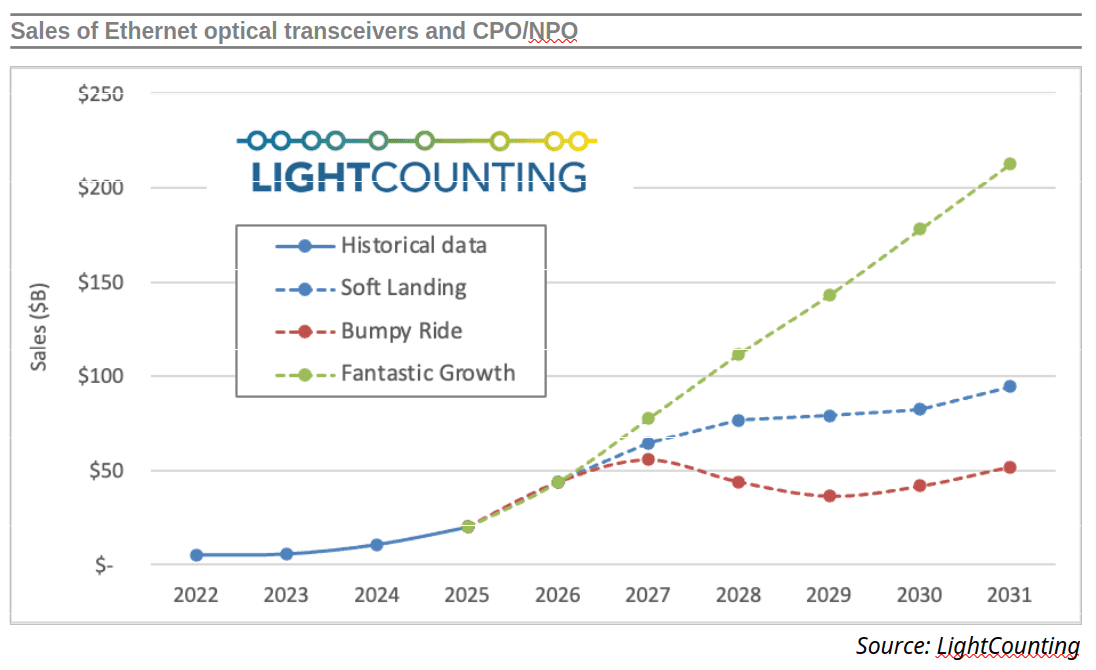
The market is clearly in an optical-interconnect supercycle. However, the present rate of expansion is unlikely to persist indefinitely. Even under a continued high-growth scenario, the forecast assumes that growth moderates from 120% in 2026 to 76% in 2027 and to approximately 20% by 2031.
The base-case forecast adopts a soft-landing assumption: cloud capital expenditure remains strong, but procurement normalizes as the supply chain expands, deployment schedules mature, and customers improve utilization of installed infrastructure. The forecast model assumes a 50% increase in cloud capital expenditure in 2027—below the roughly 70% growth contemplated by the most bullish industry forecasts.
That assumption is deliberately more conservative because optical-component supply chains historically respond aggressively to changes in customer procurement signals. Current conditions already show evidence of this effect: suppliers are expanding capacity and product portfolios rapidly in response to exceptional demand for high-speed pluggable optics.
Historical transceiver sales data from 2004 through 2025 also indicate that the sector is cyclical. Periods of two to three years of strong growth have frequently been followed by flat or declining years as inventory, manufacturing capacity, and end-market deployment plans return to balance. In that context, a soft landing is possible, but a more volatile bumpy-ride scenario—characterized by a supply-chain correction during 2027–2030—remains plausible.
Architecture matters:
The forecast also incorporates a structural counterweight to unit demand: optical-interconnect efficiency is improving. AI-cluster architectures are evolving in ways that can reduce the number of optical transceivers required per accelerator, even as total cluster bandwidth continues to rise.
Several developments are relevant:
-
TPU-based and other tightly integrated accelerator systems can reduce the optical-interconnect requirement per XPU relative to more externally networked cluster designs.
-
Multi-plane network topologies can improve path diversity and bisection bandwidth while reducing the need for redundant interconnect resources in certain deployments.
-
Higher-radix switch silicon enables flatter fabrics, reducing the number of network tiers, hop count, and associated optical interfaces.
-
The transition from 100 Gb/s-per-lane to 200 Gb/s-per-lane signaling—under development in IEEE P802.3dj—raises port density and system bandwidth, but also changes the optics-per-bandwidth relationship.
Accordingly, the relevant demand metric is not simply accelerator count. It is the interaction among accelerator architecture, scale-up versus scale-out topology, switch radix, oversubscription design, optical reach, packaging approach, and the extent to which the deployment uses pluggable optics, linear-drive optics, linear-receive optics, co-packaged optics, or near-packaged optics.
Light Counting Report Scope:
The report covers more than 100 Ethernet optical-interconnect product categories, including:
-
100G, 200G, 400G, 800G, 1.6T, 2.4T, and 3.2T retimed transceivers.
-
Linear pluggable optics and linear-drive/linear-receive optical architectures, including LPO and LRO.
-
Co-packaged optics and near-packaged optics, including CPO and NPO.
-
Products segmented by reach, interface technology, and application.
The market analysis is segmented by end customer into cloud, telecommunications, and enterprise markets. The cloud segment is further divided by customer group—top-five U.S. cloud providers, top-five Chinese cloud providers, and other cloud operators—and by application: conventional cloud and front-end networking, AI scale-out networks, and AI scale-up networks.
Conclusions:
The Ethernet optical transceiver market is benefiting from an AI-driven infrastructure build-out that is materially stronger than expected only six months ago. Yet the same intensity that creates the 2026 upside also increases the risk of a later inventory, capacity, or capital-expenditure correction. The key analytical question for 2027–2031 is no longer whether the market will grow; it is whether the industry can transition from extraordinary demand acceleration to a sustainable deployment cadence without repeating the supply-chain overshoots that have characterized prior optical-networking cycles.
Addendum – The Ultra Ethernet Consortium (UEC):
The UEC is separate from IEEE 802.3, but its work is deliberately built on—and coordinated with—the IEEE Ethernet PHY and MAC ecosystem. UEC is not an IEEE 802.3 task force and does not itself ratify IEEE 802.3 amendments. Instead, it publishes an Ethernet-based AI/HPC networking specification across multiple layers and works with relevant standards-development organizations where changes or formal standardization are needed. UEC uses and extends Ethernet, rather than that UEC defines a separate Ethernet PHY.
Division of responsibility:
How UEC relates to IEEE 802.3:
UEC’s stated premise is an Ethernet-based, open, interoperable stack for AI and HPC. Its work is designed to retain compatibility with the broad Ethernet ecosystem while optimizing behavior above—and in selected optional cases at—the PHY/link boundary. It does not replace IEEE 802.3-defined Ethernet port rates or optical PMDs.ultraethernet+1
That means:
-
IEEE 802.3df supplies the standardized 800GbE Ethernet MAC/PHY foundation.
-
IEEE P802.3dj is developing 200 Gb/s-per-lane electrical and optical interfaces for 200GbE through 1.6TbE operation.
-
UEC defines how AI/HPC systems can use such Ethernet links more effectively: particularly host-to-network interaction, RDMA-oriented transport, congestion control, traffic distribution, reliability behavior, and large-scale fabric operation.ieee802+2
UEC Specification 1.0 was released in June 2025, with Version 1.0.2 published in January 2026. UEC describes the result as a full communications stack, with scope extending from applications and transport through switching, link behavior, optics/cables integration, management, and security. UEC 1.0 is designed to operate with Ethernet-compatible physical-layer technology. It contemplates 100 Gb/s-per-lane and 200 Gb/s-per-lane signaling, which aligns naturally with the industry transitions covered by IEEE 802.3df and P802.3dj. However, UEC does define optional Ethernet PHY and link-layer features, so it is not accurate to say that it has no Layer 1 or Layer 2 relevance whatsoever.
……………………………………………………………………………………………………………………………………………………………………………………………………………..
References:
https://www.lightcounting.com/newsletter/en/september-2026-quarterly-market-update-371
https://www.lightcounting.com/report/september-2026-ethernet-optics-372
Dell’Oro: Data Center capex grew 92% in 2Q-2026 (caveats galore)
Hyperscaler capex > $600 bn in 2026 a 36% increase over 2025 while global spending on cloud infrastructure services skyrockets
Dell’Oro: 2H2026 Data Center Capex to Accelerate due to massive AI Deployments
Alphabet’s 2026 capex forecast soars; Gemini 3 AI model is a huge success
Bain & Co: AI Infrastructure Buildout Will Require $6 Trillion Revenue by 2031 to Support Massive CAPEX
Impact of optical component shortages & bottlenecks explained + Hyperscaler’s CAPEX
Hyperscaler AI Race: Soaring Capex Wipes Out Free Cash Flow; AGI and Digital Gods
How will fiber and equipment vendors meet the increased demand for fiber optics in 2026 due to AI data center buildouts?
One thought on “Light Counting: optical transceiver sales surge; IEEE 802.3 and ITU-T optical transport standards explained/UEC addendum”
Leave a Reply

This comprehensive and incisive IEEE Techblog post stands out for its holistic view of the ecosystem. Rather than looking at market figures in a vacuum, it connects financial growth to standards activity and physical-layer bottlenecks. It clearly illustrates that while traditional telecom capex is flat, AI data center scale-out is driving an unprecedented technological transition toward high-speed optical transceivers and modules.
The focus of the piece is specifically on the shift from standard retimed pluggable optics to alternative architectures (LPO vs. CPO) to address the power and latency wall in AI clusters, alongside the networking protocol layer improvements driven by the Ultra Ethernet Consortium (UEC) which is described in the Addendum.