

IEEE–ITU Sustainable Climate Symposium
Part II: Outcomes from the IEEE–ITU Sustainable Climate Symposium
IEEE–International Telecommunication Union (ITU) Symposium on Achieving a Sustainable Climate – Part II
by Marta Koch, IEEE Europe Member & PhD Researcher & Teaching Facilitator, Imperial College London with Alan J Weissberger, IEEE Techblog Content Manager
Editor’s Note: This is the second of a two-part article summarizing this ITU-IEEE Symposium. Part I is here.
Why AI Matters for Sustainable Telecommunications:
The IEEE–ITU Symposium on underscored that developing AI‑enabled sustainable telecommunications networks represents a fundamentally multidisciplinary challenge situated at the intersection of communications engineering, energy systems, computer science, climate science, and public policy. Delivering meaningful climate outcomes through digital technologies requires not only progress in algorithms, architectures, and network optimization, but also institutional frameworks that enable responsible, interoperable, and scalable deployment across diverse operational contexts.
A systems-level view of telecommunications sustainability os needed—beyond traditional performance metrics—to one where future networks are intelligent, adaptive, and energy‑efficient by design. Building on ITU analyses positioning AI, advanced connectivity, and digital platforms as key enablers of environmental action, participants also highlighted the importance of understanding their environmental trade‑offs.
Machine Learning for Climate‑Aware Network Optimization:
Machine learning (ML) is emerging as a strategic enabler of climate‑aligned energy management across telecom networks. ML techniques now underpin network‑wide energy optimisation, demand and renewable generation forecasting, power–communications coordination, and climate services such as early warning and adaptive planning. In resource‑constrained or climate‑vulnerable contexts, ensuring model robustness, transparency, and alignment with sustainability objectives is essential. Research priorities include energy‑ and carbon‑aware model design, integration of grid and resilience metrics, and standardised evaluation methods for sustainability‑critical ML applications.
Use Cases for Energy‑Efficient Operations via AI:
Important AI applications include traffic prediction, adaptive resource management, energy‑aware RAN optimisation, and predictive network sleep modes. Cross‑layer and multi‑timescale optimisation enables maximum energy efficiency without compromising service quality.
Network Resilience Under Climate Stress:
With climate‑related disruptions increasing globally, AI‑enabled predictive maintenance, self‑healing architectures, and climate‑aware planning have become core to resilient network operations. These approaches align with UN‑led initiatives on climate services and disaster early warning systems.
Power–Communications Interdependencies:
Participants highlighted the coupling between power and communications systems, emphasising cascading‑failure scenarios and the potential of AI‑enabled digital twins for joint optimisation. These perspectives align with ITU frameworks on digital public infrastructure and smart sustainable cities, which stress interoperability across physical and digital systems.
Sustainable AI and Hardware–Software Co‑Design:
Effective climate action depends on co‑optimising physical and digital infrastructure—from data centres and energy systems to ML models and orchestration layers. Sustainable network intelligence requires energy‑efficient algorithms, hardware‑aware deployment, and system‑level governance. The approach aligns with ITU’s Green Digital Action initiative and related efforts by ISO, IEC, UNEP, and WMO to advance standards‑driven, science‑informed digital sustainability.
Digital Public Infrastructure and Climate‑Resilient Digitalization:
Digital Public Infrastructure (DPI)—open and interoperable systems for identity, payments, data exchange, and connectivity—was highlighted as foundational for inclusive, climate‑resilient digital transformation. Effective DPI design requires governance, risk management, and safeguards, as emphasised by UNDP and the UN Office for Digital and Emerging Technologies.
IEEE Technology Assessment Tool:
The symposium introduced an IEEE envisioning proof‑of‑concept tool to support sustainable network planning through systematic assessment of digital and energy technologies, evaluating trade‑offs across performance, sustainability, and resilience.
Importance of International Standards:
A central outcome of the symposium was recognition of the critical role of international standardization in translating technological innovation into practical, climate‑relevant impact. As telecommunications networks become increasingly software‑defined, AI‑driven, and interconnected with energy and physical infrastructure systems, standards provide the technical and governance foundations essential for interoperability, data integrity, trustworthiness, and long‑term sustainability. Presentations from global standards organizations highlighted the importance of harmonized frameworks that can minimize market fragmentation, facilitate cross‑border interoperability, and incorporate environmental and resilience criteria directly into network design, operation, and lifecycle management.
Standards were identified as key to scalable, trustworthy AI deployment, with interoperability and data governance central to ITU‑T Study Group 5’s agenda.
Sessions also reinforced the importance of equitable access—advancing AI‑assisted network planning and cost‑efficient deployment in climate‑vulnerable regions to balance sustainability, affordability, and inclusion.The symposium further emphasized the need for a system‑level approach, recognizing that telecommunications networks operate as integral components within broader energy, transport, and urban infrastructure ecosystems. In this context, AI and machine learning increasingly serve as coordinating layers across hardware, software, and physical assets, enabling cross‑domain optimization. Standardization plays a crucial enabling role by aligning interfaces, performance metrics, and assessment methodologies across sectors, thereby supporting coherent operation of digital and physical systems under conditions of resource constraint, geopolitical uncertainty, and climate stress.
Implications for IEEE Communications Society:
For IEEE Communications Society (ComSoc) members, discussions highlighted a dual responsibility and opportunity. There is a responsibility to ensure future communications networks are designed to minimize environmental impact, maintain resilience under climate extremes, and promote equitable access to essential connectivity and data sharing.
Simultaneously, there is an opportunity for researchers and practitioners to contribute technical evidence, performance models, and quantitative metrics that inform and advance international standardization.
By maintaining sustained collaboration among research institutions, industry stakeholders, standards bodies, and policy entities—and engaging with the broader frameworks of global climate and sustainable‑development governance—the telecom community can play a defining role in enabling energy‑efficient, climate‑aware, and resilient digital infrastructure worldwide.
…………………………………………………………………………………………………………………………………………………………………………
References:
[1] M. Koch and UN Climate Technology Centre and Network (UN CTCN), “Maximizing Emerging Trends in Locally-Led AI Solutions for Climate Action,” SDG Knowledge Hub, International Institute for Sustainable Development, 2025.
https://sdg.iisd.org/commentary/guest-articles/maximizing-emerging-trends-in-locally-led-ai-solutions-for-climate-action/
[2] M. Koch, “Stakeholder asset-mapping of climate technology infrastructures,” Nature Reviews Earth & Environment, 2025.
DOI: 10.1038/s43017-025-00737-z
[3] World Meteorological Organization, Early Warnings for All: Executive Action Plan 2023–2027, WMO, Geneva, 2023.
https://wmo.int/media/magazine-article/overview-of-early-warnings-all-executive-action-plan-2023-2027
[4] United Nations Environment Programme, Global Climate Risk Assessment Framework, UNEP, Nairobi, 2023.
https://www.unepfi.org/themes/climate-change/2023-climate-risk-landscape/
[5] ITU, WMO, UNEP, and UNFCCC, Global Initiative on Resilience to Natural Hazards through AI Solutions, United Nations, Geneva. https://www.itu.int/en/ITU-T/extcoop/ai4resilience/Pages/default.aspx
[6] ITU-T Study Group 5, Work Programme on Environment, Climate Action, Circular Economy and Electromagnetic Fields, International Telecommunication Union, Geneva.
https://www.itu.int/en/ITU-T/studygroups/2022-2024/05/
[7] International Telecommunication Union – Telecommunication Standardization Sector, Building Digital Public Infrastructure for Cities and Communities, ITU, Geneva, 2025.
https://www.itu.int/dms_pub/itu-t/opb/tut/T-TUT-SMARTCITY-2025-9-PDF-E.pdf
[8] International Telecommunication Union – Telecommunication Standardization Sector, Frontier Technologies to Protect the Environment and Tackle Climate Change (T-TUT-ICT-2020-02), ITU, Geneva, 2020.
https://www.itu.int/dms_pub/itu-t/opb/tut/T-TUT-ICT-2020-02-PDF-E.pdf
[9] International Telecommunication Union – Telecommunication Standardization Sector, Smart Sustainable Cities and Digital Infrastructure Frameworks, ITU, Geneva, 2025.
https://www.itu.int/dms_pub/itu-t/opb/tut/T-TUT-SMARTCITY-2025-6-PDF-E.pdf
[10] International Telecommunication Union, Green Digital Action, ITU, Geneva.
https://www.itu.int/initiatives/green-digital-action/
[11] World Bank Group, Digital Public Infrastructure and Development: A World Bank Group Approach, Washington, DC, 2025.
https://openknowledge.worldbank.org/entities/publication/cca2963e-27bf-4dbb-aa5a-24a0ffc92ed9
[12] United Nations Office for Digital and Emerging Technologies and United Nations Development Programme, DPI Safeguards Initiative. https://www.dpi-safeguards.org
……………………………………………………………………………………..
About Marta Koch:

Marta Koch is an IEEE member, PhD Researcher and Teaching Facilitator at Imperial College London, Research Associate at the Oxford Computational Political Science Group at the University of Oxford and Research Consultant at UNOPS. She has been nominated as research delegate to UN Climate Change (UNFCCC), UNEP, UNDESA, UNIDO and ITU meetings.
Part I: Outcomes from the IEEE–ITU Sustainable Climate Symposium
IEEE–International Telecommunication Union (ITU) Symposium: Achieving a Sustainable Climate 2025 Outcomes: Capitalizing on AI for Energy-Efficient and Climate Resilient Telecommunications Networks
By Marta Koch, IEEE Europe Member & PhD Researcher & Teaching Facilitator, Imperial College London with Alan J Weissberger, IEEE Techblog Content Manager
Editor’s Note: This is the first of a two part article summarizing this ITU-IEEE Symposium. The second article is here.
Introduction:
Telecommunications networks are increasingly recognized as critical infrastructure for both economic development and societal resilience. As climate change accelerates and energy systems undergo rapid transformation, the telecoms sector faces a dual challenge: 1.] Reducing its own environmental footprint while ensuring reliable connectivity under growing physical, climatic, and 2.] Systemic stress.
These two themes were the focus of the IEEE–International Telecommunication Union (ITU) Symposium on Achieving a Sustainable Climate, which was held in December 2025 at the ITU headquarters in Geneva.
The symposium convened researchers, industry leaders, standards bodies, and United Nations agencies to examine how digital transformation, artificial intelligence (AI), and emerging ICT solutions can support the energy transition and climate mitigation and adaptation, and the governance and standardisation developments needed to effectively and sustainably leverage this technology globally.
As an Imperial College London researcher and IEEE member, I attended the symposium as part of ongoing work at the intersection of telecommunications, artificial intelligence, and climate action, with a focus on the governance, design, and deployment of AI-enabled systems for climate mitigation and adaptation, as well as the environmental and systems-level sustainability of AI-driven digital infrastructure.
Organization and Collaboration:
The symposium was co-organized by the ITU Telecom Standardization Bureau (ITU-T) and ITU T Study Group 5, which focuses on environment, climate action, circular economy, and electromagnetic fields. This collaboration underscored the central role of international standardization in shaping sustainable, climate-resilient ICT systems and provided a strong standards-oriented framework for discussions on AI deployment, energy efficiency, and network resilience [6].
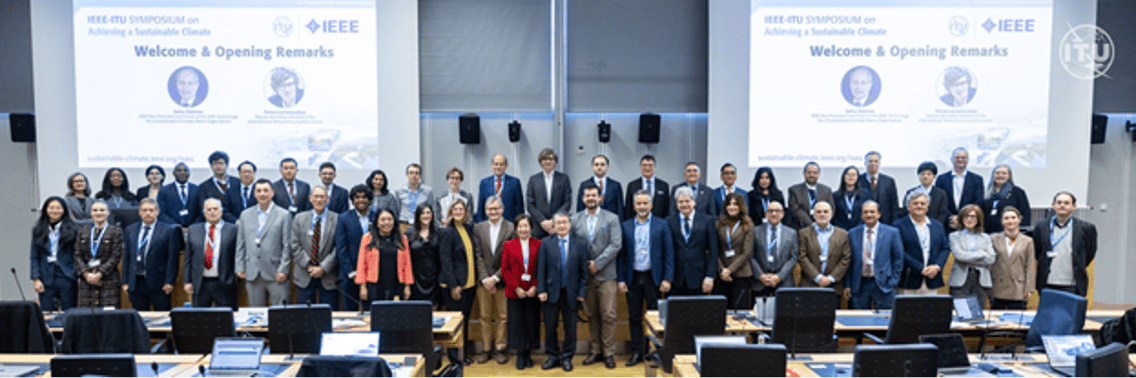
Symposium photo courtesy of the ITU
……………………………………………………………………………………………………………………………………….
Key Discussion Themes:
Across plenary sessions, thematic panels and case studies, several cross-cutting issues emerged:
- Expanding role of AI and machine learning (ML) in enabling more energy-efficient, resilient, and inclusive telecommunications networks.
- The role of the ICT sector in accelerating decarbonisation and strengthening climate adaptation, particularly in support of the global energy transition
- Interactions between physical and digital infrastructure systems, including electrification and communications, as enablers of circular economy models
- Digital and AI standardisation as foundations for sustainable, climate-resilient development and place- and people-based outcomes
- Intersections between decarbonisation, electrification, circularity, digital access, and equity
- Public–private collaboration models supporting climate finance, eco-design, and scalable deployment in climate-vulnerable and developing regions.
International Policy Governance Perspectives at the Symposium:
The symposium featured strong representation from international organisations, grounding technical discussions in policy, standards, finance, and real-world deployment realities across the ICT, energy, and climate domains.
ITU delegates Tomas Lamanauskas, Seizo Onoe, Bilel Jamoussi, and Dominique Würges emphasized the importance of aligning global mandates with local needs in sustainable ICT ecosystems.
The following are essential to both decarbonization and resilient digital infrastructure: robust standards, interoperability, and AI governance frameworks (particularly those addressing environmental sustainability, circular economy principles, and responsible management of electromagnetic fields). That message was consistent with the opening plenary’s framing of international policy, eco-design, and circularity as foundational for practical deployment.
Energy and electrification perspectives were discussed by Dario Liguti of the United Nations Economic Commission for Europe and Norela Constantinescu of the International Renewable Energy Agency. They highlighted the global energy transition focus on both progress and persistent gaps in decarbonization and electrification. Coordinated planning between energy systems and telecommunications can significantly improve resilience, system efficiency, and equity for climate-adaptive services.
Industrial deployment and logistics viewpoints were provided by Luca Longo of the United Nations Industrial Development Organization and Yaxuan Chen of the Universal Postal Union. They described how integrated ICT and energy solutions could enhance operational outcomes, sustainability, and service delivery across industrial and sectoral contexts. Cross-sector collaboration was identified as a critical enabler of scalable impact.
Standards alignment was discussed by Matthew Doherty of the International Electrotechnical Commission and Noelia García Nebra of the International Organization for Standardization. They reinforced the essential need for international standards frameworks for translating research and innovation into deployable, interoperable solutions. This theme resonated strongly with the standards session’s emphasis on practical tools to support sustainable, climate-resilient outcomes across markets and regions.
Financing and digital innovation perspectives were contributed by Seth Ayers of the World Bank, who highlighted how digital and AI-enabled approaches can help unlock finance, de-risk investment, and expand access to sustainable energy and connectivity solutions in underserved and marginalised contexts, supporting climate resilience and inclusive growth.
Disaster risk reduction and emergency management perspectives were contributed by Yuji Maeda of NTT, Inc., Maeda-son highlighted how advanced aerial technologies and environmental sensing can be used to mitigate the impacts of extreme natural events. He shared ground-breaking research at NTT in Japan demonstrating the world’s first drone designed to act as a “flying lightning rod”, an invention selected by TIME Magazine as one of the Best Inventions of 2025. They are using a protective Faraday cage and a conductive tether to deliberately trigger and safely redirect lightning strikes away from critical infrastructure, illustrating the potential for drone-enabled systems to improve emergency response, infrastructure protection, and climate resilience.
Innovation diffusion was addressed by Heather Jacobs of WIPO GREEN, who underscored the importance of technology transfer, matchmaking platforms, and collaboration mechanisms in scaling affordable and climate-relevant digital and energy technologies. Her remarks highlighted the symposium’s focus on public–private partnerships and global deployment pathways.
A European Green Digital Coalition case study was presented by Ilias Iakovidis of the European Commission Directorate-General for Communications Networks, Content and Technology. He highlighted the development and deployment of a scientific methodology to assess the Net Carbon Impact of ICT solutions. His contribution demonstrated how digitalisation’s sustainability benefits can be quantified and scaled through coordinated industry engagement, financial sector alignment, and evidence-based deployment guidelines.
The growing Global Initiative on Resilience to Natural Hazards through AI Solutions was presented by Elena Xoplaki, Vice-Chair of the UN ITU, WMO, and UNEP Global Initiative on Resilience to Natural Hazards. She explained how AI, data integration, and resilient telecommunications networks underpin multi-hazard early warning systems and climate risk reduction efforts worldwide [5].
……………………………………………………………………………………………………………………………………….
Part II. of this report, listing all references, is here.
About Marta Koch:
Marta Koch is an IEEE member, PhD Researcher and Teaching Facilitator at Imperial College London, Research Associate at the Oxford Computational Political Science Group at the University of Oxford and Research Consultant at UNOPS. She has been nominated as research delegate to UN Climate Change (UNFCCC), UNEP, UNDESA, UNIDO and ITU meetings.
Her research and consultancy work focuses on digital and AI governance, development and deployment for climate action and sustainable development, with particular emphasis on climate technology digital and physical infrastructures and the sustainability of AI and digitalisation. Her research has been funded by the United Nations, Natural Environment Research Council (NERC) and the UK Science & Technology Network (STN) under the Foreign, Commonwealth & Development Office and the Department for Science, Innovation & Technology, and endorsed by the UNESCO International Decade of Sciences for Sustainable Development.