

Cisco Execs: New “Network Supercycle” as Agentic AI Workloads Reshape Telecom Infrastructure
By Alan J Weissberger
Executive Summary:
The rapid rise of agentic artificial intelligence (AI) is expected to drive material changes across data centers, service provider networks, and the broader telecom ecosystem. As agentic AI moves from chat-oriented interactions to autonomous digital agents, Cisco says that those workloads will not only increase traffic volumes, but also alter traffic characteristics in ways that place new demands on latency, security, orchestration, and distributed compute placement.
“We are entering into a Network Supercycle,” Jeetu Patel, Cisco’s president and chief product officer, said during his opening keynote at Cisco Live in Las Vegas.
As a result, network operators will need more resilient transport, edge compute, and optical capacity to support new traffic patterns and security demands.
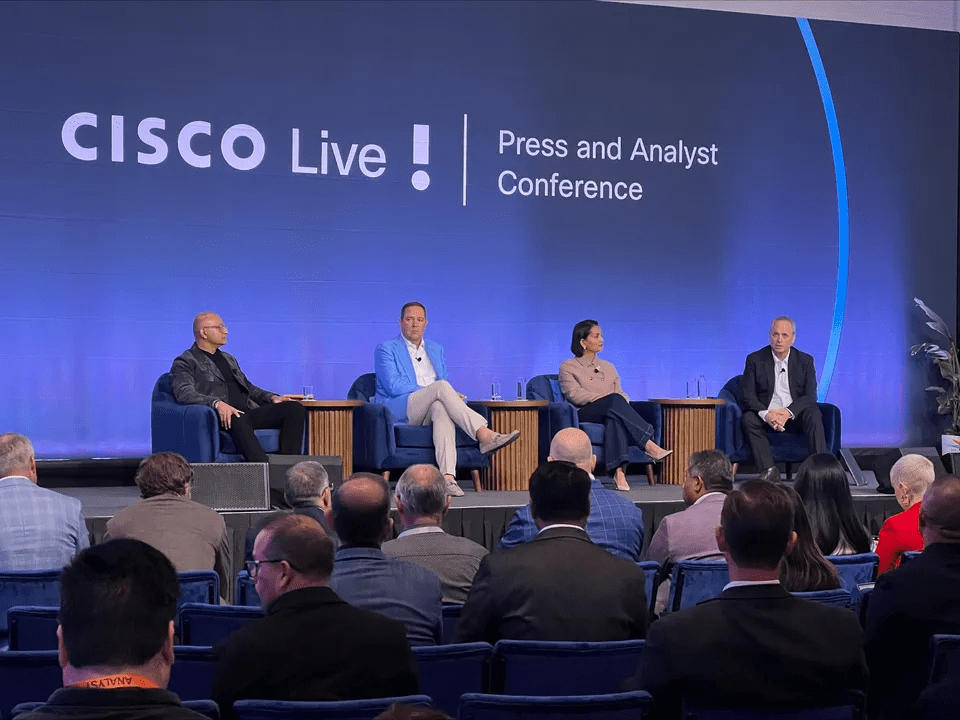
Cisco execs pictured (left to right): Jeetu Patel, president and chief product officer; Chuck Robbins, chairman and CEO; Liz Centoni, EVP and chief customer experience officer; and Steven Clayton, SVP and chief communications officer.
Source: Jeff Baumgartner/Light Reading
AI Traffic Impact on Transport Requirements:
From a transport perspective, agentic AI traffic is likely to be more persistent, more interactive, and more latency-sensitive than conventional application traffic. Cisco has said AI-related network traffic is expected to triple over the next three years, with inference flows emerging as a major driver of load growth. That shift could place pressure on transport architectures that were optimized primarily for human-driven web, video, and enterprise application traffic
The implication for service providers is that traffic engineering will need to evolve toward finer-grained path control, stronger telemetry, and improved handling of asymmetric flows. AI sessions that span multiple exchanges between users, applications, and digital agents may also require more sophisticated policy enforcement and security integration across WAN, metro, and access layers.
Edge Compute Needs Grow:
Cisco’s remarks also point to a growing role for edge compute in telecom and cable networks. Some operators are already repurposing legacy central offices and mini data centers to support AI workloads, reflecting a broader shift toward distributed inference close to the user or device.
That architecture matters because many agentic AI use cases will be latency constrained and will not perform efficiently if all processing is centralized in distant cloud regions. Comcast and Charter have both announced AI edge strategies, underscoring how access networks can become part of the compute fabric rather than acting solely as last-mile connectivity.
For network operators, this suggests a new operational model in which compute, storage, and network functions are increasingly coordinated across regional and edge sites. In practical terms, the network becomes part of the application execution environment, not just the transport layer beneath it.
Optical Network Implications:
Optical infrastructure will likely carry much of the burden created by distributed AI deployments. As inference workloads expand across regional hubs, edge sites, and centralized clouds, operators may need higher-capacity optical transport to sustain east-west traffic between distributed compute nodes.
That points to greater demand for dense 400G and 800G interconnects, more flexible wavelength management, and lower-latency optical paths between metro aggregation points and AI facilities. The challenge is not only to scale throughput, but also to preserve path diversity, minimize jitter, and maintain predictable performance for machine-to-machine workloads that are increasingly sensitive to delay.
As AI traffic becomes more dynamic and more operationally critical, optical networks may need to be engineered with the same level of service awareness traditionally associated with enterprise transport and carrier-grade voice or mobile backhaul.
Security is a Top Priority:
Cisco cited security as a serious concern for agentic AI traffic. CEO Chuck Robbins said AI agents designed to help enterprise customers can run roughshod without a proper defense that can quickly detect, intercept and possibly “kill” them before they get out of control. It becomes an even bigger issue when they are built to be nefarious.
“AI changes the speed of defense,” Robbins said. “It’s empowering adversaries at a pace that we haven’t seen in our careers … These [AI] models are as bad as they are ever going to be …They’re only going to get better.”
Anthropic’s new Claude Mythos model, which can auto-detect and possibly exploit software vulnerabilities at scale, is now a “CEO-level discussion,” he added.
“We’re living in a post-Mythos world where security has to be fused and baked into the network,” Patel said, holding that vulnerabilities can now being attacked as soon as they arise.
“We need to reimagine security” in the AI era, Patel said, noting that AI agents will not only handle tasks locally but will be heading outside to connect to third-party agents, servers and various tools.
“Every agentic action is a routing challenge, a trust decision and a telemetry event,” Patel said. The emergence of agentic AI, he said, is shifting the security and permission focus from “access control” (for us humans) to “action control” for agents that will need to be closely monitored, controlled and, if needed, quickly intercepted.
“People don’t trust these agents right now,” Patel said later during a separate discussion with press and analysts.
These concerns also extend to AI agent identity, which Cisco is addressing with its recent agreement to acquire Astrix Security.
This extends to other types of guardrails and observability metrics, too, including the notion of “tokenomics” – essentially keeping tabs on how many tokens an AI agent could consume. If the agent is found to be overspending on tokens, it could be intercepted and shut down.
Patel suggested that, without guardrails, what a company pays for AI tokens for a year could be consumed by an agent in a week. Assessing such AI agent behavior was a key driver of Cisco’s acquisition of Galileo Technologies.
Cisco’s AI Stack:
Cisco is focused on a vertically integrated platform – starting with its Silicon One platform for data centers and enterprise devices, optics, switches, routers and access points, apps and services, and wrapped by a new Cisco Cloud Control platform announced this week. Though Cisco Cloud Control is able to provide unified access to Cisco’s tools, apps and services, such as Meraki, Catalyst and Splunk, Patel stressed that it will also be able to integrate with third parties and support an open ecosystem. Cisco is starting out with support from 52 partners, including AWS, Google Cloud, NetBrain and ServiceNow.
Telecom Market Transition:
Robbins said Cisco used AI to scan 1.8 billion lines of code in 25 different programming languages over the past eight weeks. Without AI models, that would’ve taken eight years, he said.
Patel described the industry as being at a pivotal moment, moving from chat bots to more advanced agents that function as “digital coworkers.” He noted that “These agents are going to be everywhere.”
That transition suggests telecom networks will increasingly support autonomous machine interactions at scale, with implications that extend beyond bandwidth growth into security, policy control, and distributed systems design. For operators and vendors alike, the strategic question is no longer whether AI will affect the network, but how quickly the network architecture can adapt.
………………………………………………………………………………………………………………………
References:
https://www.lightreading.com/ai-machine-learning/cisco-ai-driving-a-network-supercycle-
Cisco report: Agentic AI to reshape WAN traffic, AI inference will be ~25% of total traffic by 2035
Cisco’s Silicon One G300 as the dominant AI networking fabric, competing with Broadcom’s Tomahawk 6 series
Will the wave of AI generated user-to/from-network traffic increase spectacularly as Cisco and Nokia predict?
Analysis: Cisco, HPE/Juniper, and Nvidia network equipment for AI data centers
Cisco to join Stargate UAE consortium as a preferred tech partner
Cisco CEO sees great potential in AI data center connectivity, silicon, optics, and optical systems
8 thoughts on “Cisco Execs: New “Network Supercycle” as Agentic AI Workloads Reshape Telecom Infrastructure”
Leave a Reply

Cisco believes that the emergence of agentic AI traffic, and the expectation that agents will be interacting with other agents in increasing instances, will alter the very nature of Internet traffic, with the duration of those “transactions” taking much longer than human-led actions.
Like us humans, AI agents scan and read data, but do it much faster and for longer periods. Cisco estimates that, on average, AI agents consume 450% more data traffic than humans to do the same task while also taking about two times longer to perform it.
“And a lot of these flows are multidirectional…the traffic patterns with AI are different,” Shenoy said. Agents, he explained, can “farm out” these things simultaneously, process them and then output a response.
For now, much of this is happening with enterprise traffic, with coding via platforms such as Codex (via ChatGPT) and Claude being the greatest source of traffic, he said.
Cable ops and telcos positioned to stand up and monetize ‘inferencing clouds’
But the inferencing trend and the emergence of agents as the primary consumers of AI is causing AI to extend beyond the data center and drive things toward a more distributed architecture that could, for example, push cable operators to set up their own “inferencing clouds” and enable them to extend well beyond providing connectivity. These set ups could end up competing with or complementing the GPU-centric neoclouds that are being stood up for inferencing and to support the desire for secure, sovereign networks for AI.
https://www.lightreading.com/ai-machine-learning/cisco-sees-rising-role-for-service-providers-in-ai-s-inferencing-era
Telco is still treating AI traffic as a synchronous chat interface, failing to account for the kinetic scale of what is actually occurring. The transition from human-latency software to machine-velocity swarms has already happened, and nobody is prepared for what is coming.
AI coding tools like Claude Code and OpenAI’s Codex are functioning as autonomous, industrial-grade software engineering agents running at massive scale…
https://sebastianbarros.substack.com/
Very insightful read. As AI workloads continue to grow in scale and complexity, the need for more efficient and resilient network infrastructure will only increase. Cisco’s perspective on this emerging trend is definitely worth following.
This article accurately identifies a major strategic shift, arguing that agentic AI requires massive network infrastructure upgrades due to unique, high-volume traffic patterns. It correctly highlights that this “network super cycle” demands moving security to hardware-level, line-rate processing while positioning Cisco to lead in AI-optimized connectivity.
This post is super interesting! The idea of a “Network Supercycle” due to agentic AI workloads really makes me wonder—how will traditional telecom companies adapt their infrastructure for these rapid changes?
Unlike traditional software or early AI chatbots, agentic AI uses autonomous digital agents that execute multi-step workflows, collaborate with other AI agents, and make real-time decisions without human intervention. This fundamentally changes the nature of internet and telecom traffic.
Traditional internet traffic is asymmetric; users download large amounts of data (like video streaming) but upload very little. Cisco points out that agentic AI completely flips and breaks this model due to three traffic characteristics:
1. High Uplink Demand: Multi-agent collaboration and autonomous coding systems create bursty, high-volume data uploads.
2. Extreme Latency Sensitivity: Autonomous agents interacting in real time cannot tolerate network delays, stressing existing 5G networks.
3. Persistent, Interactive Flows: Instead of brief bursts of data, AI agents maintain continuous, complex dialogues across networks, causing AI-related traffic to triple over the next three years.
To handle these workloads, Cisco predicts that tech giants and telecom operators must completely rebuild their infrastructure. This creates an aggressive investment cycle across several layers:
1. Wide Area Networks (WANs): AI inference is projected to consume 25% of all global WAN traffic by 2035. Massive scaling of subsea cables and long-haul transport systems.
2. Data Center Interconnects: Massive “East-West” data transfers between distributed AI compute and storage hubs. Upgrading to ultra-fast 800G and 1.6T silicon photonics and optical circuit switching.
3. Fiber Infrastructure: Drastic shortage of physical fiber paths capable of sustaining multi-gigawatt AI clusters.Multi-billion-dollar hyperscaler deals for advanced hollow-core and high-density ribbon fiber.
4. Telecom Edge: Processing AI requests centrally takes too long for real-time agents. Moving compute power to the network edge via AI-RAN (Radio Access Networks) and 5G Advanced/6G architectures.
In summary, Cisco is signaling that the AI boom is no longer just a software or chip-shortage story. It has officially become a physical networking bottleneck!
The article’s focus on how agentic AI could change network traffic patterns is particularly interesting. What stood out to me is that the challenge isn’t simply about increasing bandwidth, but also about latency, distributed computing, security, and managing much more dynamic traffic patterns. The idea of moving some AI inference closer to users could have a significant impact on how telecom networks are designed.
I also think the discussion about shifting from human access control toward monitoring and controlling AI agent actions raises some important questions for future network architecture.
August 13, 2026 – Cisco Earnings Highlights:
-Cisco Q4 revenue hit a record $17.3B as AI infrastructure orders surged to $4B
Hyperscalers had triple-digit order growth, with Silicon One leading Cisco’s AI infrastructure momentum
-Telco orders jumped 30% as operators prep networks for AI traffic and scale-across demand
-Cisco rode the AI wave to record fiscal Q4 results, as revenue rose 18% year on year to $17.3 billion and net income jumped 51% to $3.9 billion.
Cloud continued to be a notable driver of Cisco’s success, with CEO Chuck Robbins noting product orders from service providers and cloud customers were up 95%. AI infrastructure orders from four of the top hyperscalers increased “in the triple digits,” he added.
All told, it took $4 billion in AI infrastructure orders in FQ4, bringing its full year order total to $9.3 billion. The majority of these (60%) were for its Silicon One family of routing and switching systems with the remainder going toward optics.
Three of its hyperscale wins were for its P200-based systems. You can read our coverage about those here.
“As AI workloads become increasingly distributed across clusters and facilities, we believe demand for this technology will remain strong,” Robbins said.
In addition to hyperscaler demand, Robbins said Cisco took “over $400 million in AI infrastructure orders from neocloud, sovereign and enterprise customers in Q4.”
Networking product orders jumped 40% and even telco orders grew 30%, a notable change from 9% growth in the previous quarter.
“They’re building out their infrastructure to actually be ready for technologies like the scale-across opportunity,” Robbins said of the shift in telco demand. “We think the network traffic related to AI-based scale-across versus traditional data center interconnect is roughly 14x what it might have been before. So, the telcos are building to get ready for that.”
Cisco fiscal Q4 earnings metrics:
-Revenue of $17.3 billion, with networking revenue up 28% to $9.8 billion
-Net income of $3.9 billion
-AI infrastructure orders of $4 billion
-AI infrastructure revenue projected to grow to $7.5 billion in fiscal 2027
Analyst Comments:
Morningstar Senior Equity Analyst William Kerwin wrote in a note to investors that Cisco is “converting AI demand into revenue faster than anticipated, while its momentum across campus and enterprise remains healthy.”
And while the company doesn’t share its order backlog numbers “The company booked more AI infrastructure business than what it recognized as revenue, leaving a healthy backlog that should start flowing in the coming year.”
He pointed to Cisco’s $9.3 billion total in AI infrastructure orders for its fiscal 2026. With only $4 billion of that converted into revenue thus far, that means more than half of Cisco’s AI order volume is yet to be recognized as revenue.
Dell’Oro Group VP Jimmy Yu noted that despite the tight supply environment all AI vendors are facing, “there are no significant increases in lead times” for Cisco, something he said is “a benefit of higher vertical integration.”
650 Group Technology Analyst Alan Chris DePuy highlighted comments from Cisco’s leadership indicating it is shifting away from merchant silicon and leaning into its Silicon One offerings.
“The company stated it plans to get away from merchant silicon completely by Fiscal 2029 (July), so it’s right around the corner,” he wrote on LinkedIn. “Couple this with triple-digit Y/Y orders from 4 separate hyperscalers and a $1B F4Q26 (July) Acacia order, and you can see Cisco has pivoted towards chips and optics and their eventual integration.”
https://www.fierce-network.com/cloud/cisco-closes-fy2026-record-revenue-cites-ai-demand-and-networking-growth
This is a really insightful breakdown of how agentic AI will reshape network infrastructure, especially with the increased demands on optical networks and edge compute. The security challenges highlighted are particularly critical – it’s like a whole new game where the rules are constantly evolving. Here’s a breakdown of the changes caused by agentic AI:
Optical Networks: Shifting to Fluid, Ultra-Low Latency Fabrics:
Agentic AI does not just stream data; it orchestrates massive, multi-modal workflows across distributed clusters. This changes optical infrastructure in three distinct ways:From Static Links to Dynamic Mesh: Traditional optical networks are provisioned for peak static capacity. Agentic AI requires Optical Circuit Switching (OCS) that can reconfigure network topologies in milliseconds to support sudden, massive east-west traffic spikes as agents collaborate.The Demise of Latency Tolerances: Agentic workflows often involve a chain of sub-agents (e.g., an executive agent calling a coding agent, which calls a testing agent). Every link in the chain compounds latency. Optical networks must push toward hollow-core fiber and co-packaged optics (CPO) to eliminate the microscopic delays that stall agentic reasoning.Massive Bandwidth for Memory Syncing: Agents rely on long-context windows and dynamic Vector Databases (RAG). Transferring these massive, real-time “memory spaces” between data centers requires Terabit-per-second optical pipes operating continuously, rather than during off-peak hours.
Edge Compute: Moving from Data Collectors to Autonomous Decision Hubs:
Agentic AI cannot afford the round-trip time to a centralized cloud for time-critical actions. The edge must evolve from a passive cache into an intelligent, survivalist compute layer.Distributed Agent Swarms: Instead of running one massive model in a mega-cloud, the edge will host swarms of micro-agents. A factory edge node might run hundreds of specialized agents—one for a robotic arm, one for thermal tracking, one for inventory—all negotiating with each other locally.Adaptive Resource Poaching: Agentic AI can judge its own resource needs. If an edge agent detects a critical anomaly, it will autonomously “borrow” compute power from neighboring edge nodes or IoT gateways, requiring a highly fluid, decentralized container orchestration layer.Continuous Local Training (TinyML Evolution): Edge nodes will no longer just run inference. Agents will use local execution data to continuously fine-tune small language models (SLMs) at the edge, requiring hardware that balances low-power inference with efficient, localized training loops.
New Security Requirements -Polymorphic Threats vs. Autonomous Defense:
When AI agents are talking to other AI agents, traditional security concepts like static firewalls, perimeter defense, and human-in-the-loop approval completely break down. The rules are changing in real time:API Chaos and “Prompt Injection” Propagation: Agents interact via APIs and natural language. A malicious actor could inject a prompt into a public database. When a gathering agent reads that data, it becomes compromised and executes malicious API calls downstream, infecting the entire corporate network without a single line of traditional malware code.The Speed-of-Light Attack Vector: Rogue or compromised agents can execute network attacks, data exfiltration, or resource draining at machine speed. Human security operations centers (SOCs) cannot react fast enough. The network defense must be equally agentic—employing autonomous guardrail agents that monitor, isolate, and neutralize rogue agents in microseconds.
Dynamic Identity and Access Management (IAM):
Currently, permissions are granted to users or specific applications. In an agentic world, an agent might spin up ten sub-agents to complete a task. How do you verify the identity and privilege level of a ephemeral, AI-generated sub-agent? Networks will require cryptographic, time-bound intent verification to ensure an agent isn’t exceeding its brief.Resource Exhaustion (Algorithmic DoS): Attackers can deploy loops of complex queries designed to force defense agents into deep reasoning cycles, burning expensive edge compute and optical bandwidth, effectively crippling the infrastructure financially and operationally.
Many telcos have already implemented agentic AI for customer service and are now evaluating AI for network operations, said Ishwar Parulkar, CTO Telecom at AWS, in an interview with Fierce Network. Parulkar pointed out that network operations differ from the other two major AI use cases telcos have explored: customer service and organizational efficiency. Those can build on lessons learned in other industries. But the challenge of teaching AI agents to optimize the interactions between radios, frequency bands, servers, smartphones and telco software is unique to the wireless industry.
AWS has helped several telcos use AI to boost network efficiency, including BT, NTT Docomo and C-Spire. Parulkar said the hardest part of AI for wireless networks is building the software layer that helps agents contextualize and understand data. “There’s this emerging layer in the middle of context and semantics that has to be created, and what we learned was that most of the effort goes into creating that layer,” said Parulkar. He said a new service called AWS Context, set for launch in December, is being developed to help “build that layer in the middle” for telecom and other industries.
https://www.fierce-network.com/wireless/roi-not-enough-telcos-seek-unique-value-ai