

SHIELD-6G with AI-native cyber threat intelligence platform to enhance cybersecurity for Europe’s future 6G networks
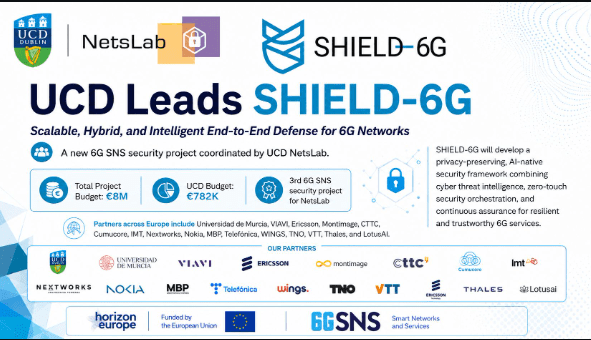
The SHIELD-6G (Scalable, Hybrid, and Intelligent End-to-End Defense for 6G Networks) project is exploring ways of strengthening cybersecurity for Europe’s future 6G networks. Backed by an €8 million ($9 million) grant from the European Commission, the 36-month initiative brings together 19 international partners to build an AI-native cyber threat intelligence platform for future networks. Telefónica, Ericsson and Nokia are among 19 companies and research organizations from 10 European countries (Ireland, Spain, Finland, France, the Netherlands, Italy, Greece, Latvia, Estonia, and Turkey) are involved. The project is being coordinated by University College Dublin.
“Future 6G networks are expected to support highly sensitive and mission-critical applications, including connected healthcare, autonomous industrial operations, smart manufacturing, maritime connectivity, and resilient public and private communications,” states the press release.
“6G networks will form the foundation of Europe’s next generation of digital services, but their success will depend on trust, resilience, and security by design,” said Madhusanka Liyanage, Associate Professor/Ad Astra Fellow and Director of Graduate Research at the School of Computer Science, University College Dublin, Ireland. “SHIELD‑6G brings together a strong European consortium to develop intelligent cybersecurity capabilities that can protect critical services and support Europe’s digital sovereignty.”
“6G is way more complex than 5G, because it manages more devices, and there’s more automation, and with automation there come problems,” says Bart Siniarski, director at MBP Network Technology, a Shield-6G member organization. “The attack surface will be extended by a couple of magnitudes. So when we step into 6G — which is, to me, 5G on AI steroids — there are going to be problems at the beginning. And then over time [the goal is that] we are comfortable using 6G in critical infrastructure like hospitals or factories or maybe in shipping and militaries.”
………………………………………………………………………………………………………………………………………………………
The SHIELD-6G project tests and validates its AI-native cyber threat intelligence platform across three primary mission-critical use cases. These scenarios are selected because they require ultra-reliable low latency, mass automation, and high security.
Core AI Security Technologies:
Privacy-Preserving Analytics: Uses federated learning and differential privacy to train threat detection models locally on edge devices. Networks share intelligence without exposing sensitive underlying user data.
Explainable AI (XAI): Ensures complex model decisions are transparent by providing clear, human-readable explanations for network blocks or flags. This prevents false alarms from interrupting critical infrastructure like hospitals or shipping lanes.
Zero-Touch Security Orchestration: Combines automation with secure multi-party computation to isolate and mitigate zero-day network breaches. Responses trigger dynamically with minimal human intervention.
Digital Twin Simulation: Embeds AI models into a network digital twin environment to safely stress-test defenses. The software predicts how an attack will propagate before it affects live network traffic.
………………………………………………………………………………………………………………………………………………………
-
- AI-Native Threat Detection: Developing an automated, real-time cyber defense platform for identifying and mitigating known and unknown threats, including zero-day attacks.
- Privacy & Resilience: Using secure multi-party computation and federated learning to ensure user data remains private while improving systemic network resilience.
- Real-World Validation: Testing the 6G security framework across critical use cases such as connected healthcare, smart manufacturing, and maritime connectivity.
- Coordinating Institution: University College Dublin (UCD).
- Key Partners: Includes multinational companies, specialist SMEs (such as UCD spinout MBP Systems), and the global defense and aerospace giant Thales.
- Funding: Backed by the EU under the Horizon Europe program through the Smart Networks and Services Joint Undertaking (SNS JU).
-
- Remote Medical Operations: Securing ultra-low latency connections required for real-time remote robotic surgeries and critical patient monitoring.
- Data Privacy Compliance: Ensuring that highly sensitive personal health telemetry data remains private during processing.
- Interconnected Medical Devices: Safeguarding thousands of continuous-monitoring hospital IoT devices from unauthorized network penetration.
-
- Autonomous Industrial Operations: Protecting automated, closed-loop machinery and collaborative factory floor robots from data injection or remote hijacking.
- Digital Twin Environments: Modeling and simulating cyberattacks safely inside factory digital twins without disrupting ongoing physical production.
- Supply Chain Automation: Securing end-to-end logistics automation against zero-day vulnerabilities in multi-stakeholder industrial software.
- Autonomous Shipping & Logistics: Defending open-sea navigation, automated port loading systems, and vehicle-to-infrastructure communication channels.
- Critical Coastal Infrastructure: Ensuring stable, tamper-proof communications for offshore installations like deep-sea cargo networks and renewable energy hubs.
- Satellite-Terrestrial Handover: Securing the handoff of tracking data as vessels transition between ground stations and global satellite communication networks.
The SHIELD-6G platform utilizes AI-native, privacy-preserving, and automated technologies to establish a Cyber Threat Intelligence (CTI) pipeline tailored for 6G networks. These technologies allow multi-stakeholder networks to self-heal against cascading vulnerabilities without sharing raw data.
……………………………………………………………………………………………………………………………………………………………
References:
https://www.telecoms.com/5g-6g/european-consortium-launches-shield-6g-security-project
https://www.darkreading.com/cybersecurity-operations/eu-6g-network-security
linkedin.com/posts/bartsiniarski_shield6g-6g-cybersecurity-activity-7467489224217460736-A0yi
Analysis & Implications of the Communications Cybersecurity Information Sharing and Analysis Center (C2 ISAC)
Key Differences Between Network Cybersecurity and Control System Cybersecurity & Why It Matters
Anthropic’s Project Glasswing aims to reshape IT cybersecurity
Emerging Cybersecurity Risks in Modern Manufacturing Factory Networks
Cisco to lay off more than 4,000 as it shifts focus to AI and Cybersecurity
StrandConsult Analysis: European Commission second 5G Cybersecurity Toolbox report
GSA Meetup: Cyber Security Continues as Major Obstacle for IoT Adoption
Demythifying Cyber security: IEEE ComSocSCV April 19th Meeting Summary
One thought on “SHIELD-6G with AI-native cyber threat intelligence platform to enhance cybersecurity for Europe’s future 6G networks”
Leave a Reply

This article is a solid project announcement that accurately frames SHIELD-6G as a Horizon Europe-backed effort to develop a 6G-native cyber threat intelligence platform using AI-based detection, federated learning, digital twins, and automated response concepts. SHIELD-6G looks like a credible, well-timed European effort to define security requirements before 6G deployment hardens into a large installed base. Its emphasis on AI-native threat intelligence, privacy-preserving analytics, digital twins, and automated response aligns with the likely security shape of 6G systems, especially for mission-critical use cases.
The project seems to have the right architectural instincts: security by design, not retrofitted controls after deployment, and a focus on low-latency, highly automated environments where manual SOC workflows will not scale. The consortium size, EU backing, and UCD coordination also make it look more substantive than a typical hype announcement.
The article’s use cases—connected healthcare, smart manufacturing, and maritime connectivity—are appropriate stress cases because they combine safety, resilience, and privacy constraints. The strongest part of the piece is the mix of federated learning, differential privacy, explainable AI, secure multi-party computation, and digital twins, which is a plausible toolkit for 6G-era security research.
However, the AI native cyber platform must prove it can handle model poisoning, adversarial false positives, or automated response errors at carrier scale. The SHIELD-6G concept is sound, but the hard part will be operational robustness, not the vocabulary of the solution.