

3GPP approves timelines for Release 21 which will specify 6G RAN, Core and 5G Advanced
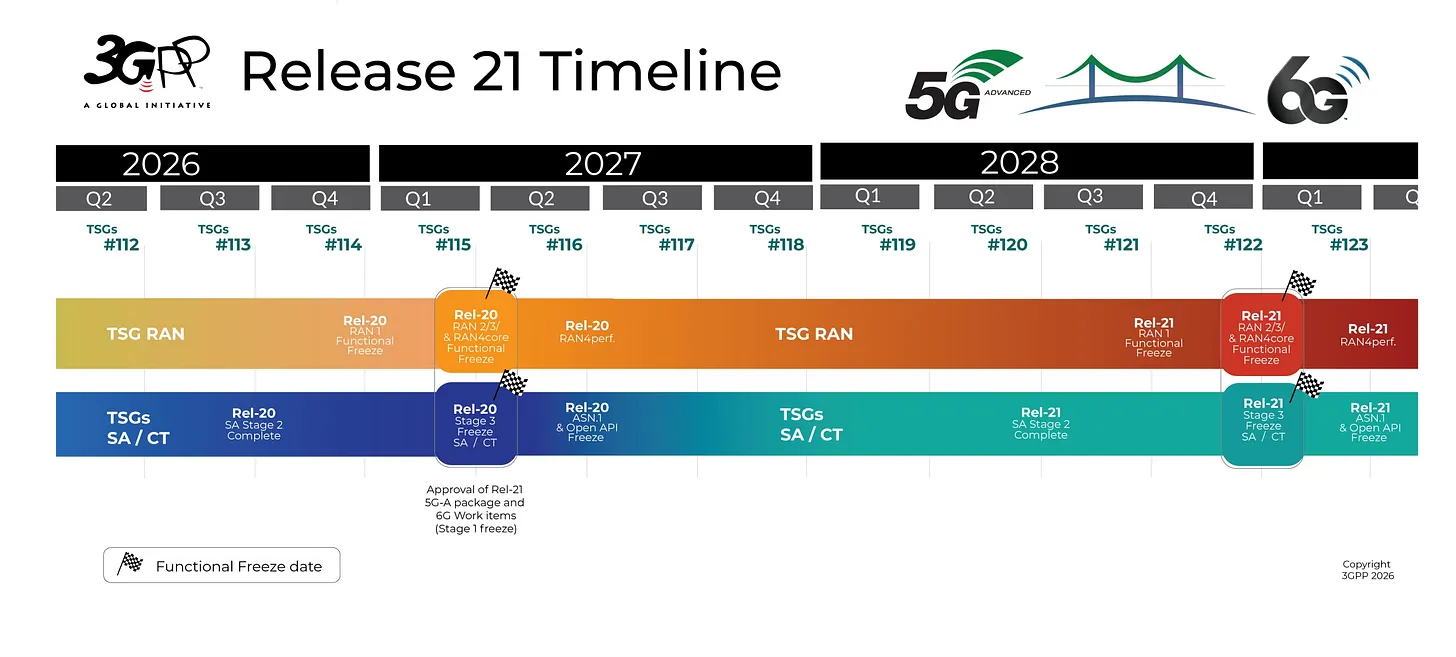
At 3GPPs meeting last week in Singapore, Technical Specification Group (TSG) RAN #112 approved the full Release-21 timeline jointly proposed by the three TSG Chairs. On June 12th, more than 150 participants from the regions ICT community attended ‘3GPP 6G Standardization: From Study to Specification,’ featuring the combined technical leadership of 3GPP. Topics covered in the summit included the 3GPP Chairs’ analysis of progress this week on 5G Advanced work items and 6G studies across the TSGs. There were also expert overviews on some key topics: AI/ML, ISAC (integrated sensing and communications), Massive MIMO evolution, NTN standards cooperation and security considerations for the 3GPP 6G System.
This formally completes the first 6G study item in 3GPP and sets the stage for the third quarter this year in which 3GPP working groups must settle numerous questions, including the migration architecture that network operators have wanted a decision on for over a year. 3GPP TSG RAN Chairman Younsun Kim, PhD, Samsung, said during a joint session with the other two TSGs (SA and CT) that “no decisions were possible” on migration options, with input now hoped for at TSG RAN#113, scheduled for September 14–17, 2026 in Madrid, Spain. Vodafone warned in a 3GPP contribution titled, “Good migration option decisions in September need hardware impacting decisions now!” that the September decision point only works if the plenary stopped deferring decisions.
Some achievements at this 3GPP Singapore meeting:
- Over 590 standards delegates welcomed by our Hosts to Singapore.
- Social events and a Singapore Industry summit on 3GPP held.
- Singapore Ministry and Government visitors welcomed as guests.
- All Work Items and Study Items for 5G‑Advanced on schedule in Release‑
- 14 Study Items for 6G progressing.
- The TSG RAN Study on 6G Scenarios and requirements (TR 38.914) approved this week.
- First timeline for early 6G specifications approved (Rel-21).
3GPP’s Release 21 will comprise the first 6G specs as well as 5G-Advanced. Release 21 work items for 6G and 5G-Advanced are scheduled to be approved with a first functional freeze in March 2027 and a second freeze in June 2028, with a “checkpoint” in March 2028 for 80% of the work to be done. The stage 3 final freeze is set for December 2028. The full and final code freeze is scheduled for March 2029.
Guy Daniels wrote in a blog post titled, “Analysis of 3GPP RAN #112: Timeline locked but the migration question unanswered“:
There is a 3GPP structural oddity in the details. The March 2027 6G “package approval” is the approval of a placeholder whose RAN2/3/4 content is finalized three months later. This is deliberate concurrency, not an oversight, it’s how the 3GPP works. The normative engineering windows are equally tight: RAN1 runs Q2 2027 to Q3 2028; RAN2/3/4 run Q3 2027 to Q4 2028; six quarters each to specify a new radio generation.”
“The Scenarios and Requirements study is finished, but the political questions it deferred are not. The requirements now say what 6G must do. September begins the fight over what it will be.”
……………………………………………………………………………………………………………………………………………………………………………………………………………………………….
In a blog post summarizing last week’s plenary meeting, Ericsson said 6G standardization “is in full swing” and highlighted some of the early 6G decisions, including choices for waveform, modulation, channel coding, a basic security framework and supported bandwidths. The agreed 6G waveform is to use cyclic-prefix orthogonal frequency-division multiplexing (CP-OFDM) in the downlink. There are two options for uplink: CP-OFDM and discrete Fourier transform spread OFDM (DFT-s-OFDM). Supported bandwidths will range from 3MHz to 400MHz. 3GPP also agreed that 5G channel codes “will be largely reused” in 6G.
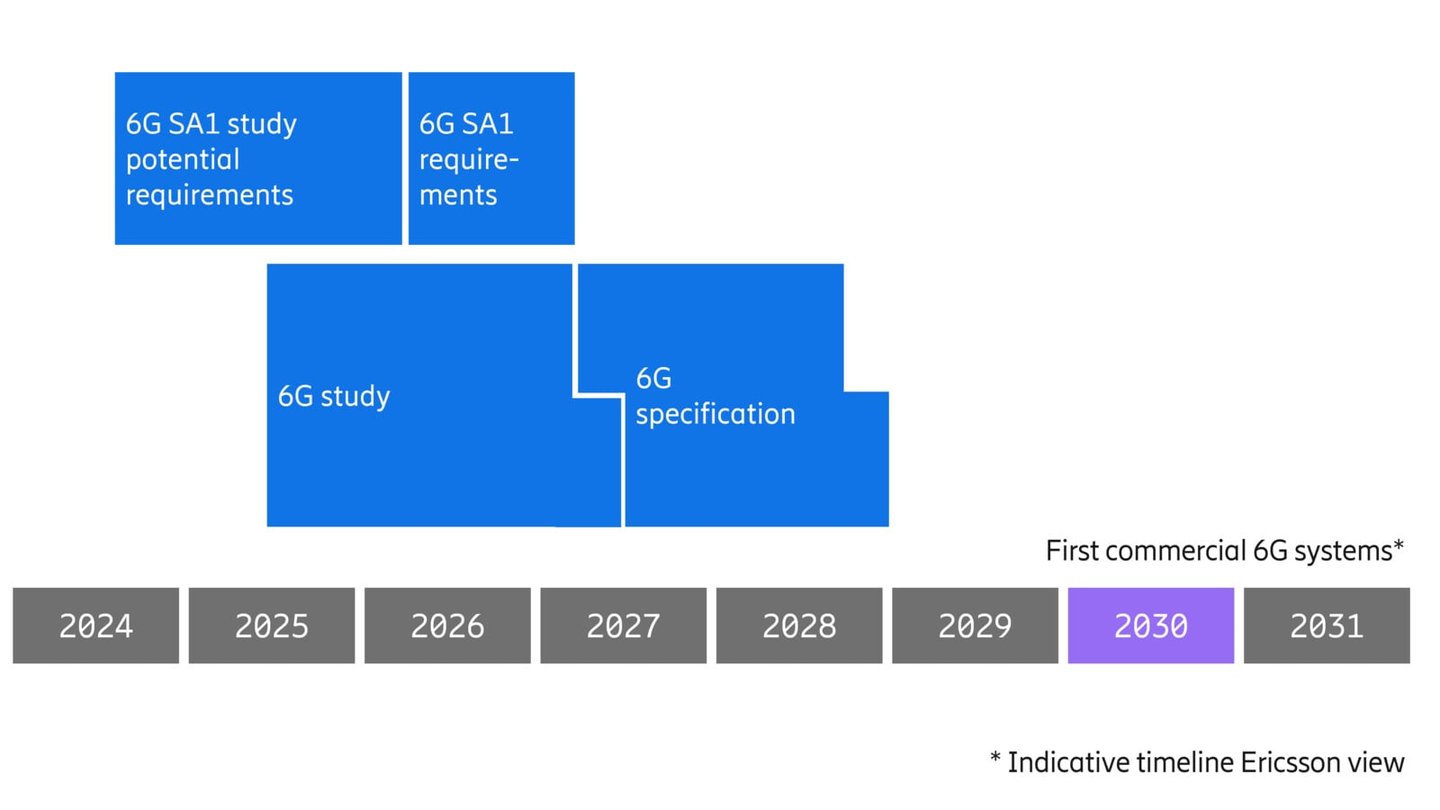
Here’s Ericsson’s timeline for 6G:
“6G is coming into focus…We are at a point now where a lot of pieces of the puzzle are starting to come together,” Gabriel Brown, senior principal analyst at Omdia, explained in a recent podcast with colleague and analyst Ruth Brown (no relation). The analysts also presented the 6G state of play at the 6G Summit hosted by ATIS’s Next G Alliance ahead of Network X Americas last month. Gabriel noted there has been a mindset shift among telcos about 6G from being “cautious” to “embracing it.” He said that the World Radiocommunication Conference next year (WRC-27) and the Summer Olympic Games in Los Angeles in 2028 will be important “checkpoints” for the anticipated early 2029 arrival of the 6G standards.
“[The LA Summer Olympics] is going to be an amazing opportunity for the U.S. ecosystem to showcase the potential of next-generation connectivity…It’s a chance to show how wireless can serve all the other industries there,” he added.
It will be important to watch for 3GPP’s September 2026 Madrid meeting output deliverables to get a sense of what functions and features might be in 6G RANs.
……………………………………………………………………………………………………………………………………………………………………………………….
6G Core Network:
The 6G core network architecture (such as signaling, network management, security, 6G specific features, and AI-native core architecture) will be defined in Release 21 Stage-2 (System & Architecture) scheduled to be completed in June 2028. Stage-3 (Protocol Specifications) is slated for December 2028 with ASN.1 & OpenAPI Freeze to be completed in March 2029.
3GPP decided NOT to liaise/contribute their 5G SA core network architecture specs to ITU-T, but ETSI rubber stamped them. Just as they did with IMT-2020 (5G), 3GPP will likely maintain exclusive development and control over all non-radio specifications for IMT-2030 (6G). Instead of formalizing them through ITU-T. 3GPP relies on its own Organizational Partners, e.g. ETSI and ATIS, to adopt the core network framework in their standards. 3GPP decided to bypass ITU-T for the 5G mobile core network, opting to develop 5G SA core network specs directly to ensure rapid, market-driven deployment.
……………………………………………………………………………………………………………………………………………………………………………………………
Addendum – 3GPP specs are NOT standards and have no legal standing:
What most, if not all, telecom trade publications (like this one) get completely wrong is that 3GPP does not produce standards, but specifications via their Releases. Those must be contributed, discussed, debated and approved by official SDOs like ITU-R and ETSI or other 3GPP members.
In the case of 5G/IMT 2020, ATIS presented all 3GPP RIT/SRIT specifications as contributions to ITU-R WP5D, which is 100% responsible for all IMT terrestrial radio interface standards (ITU-R recommendations). It should also be noted that ITU-R WP 5D has sole responsibility for IMT 2030/6G Frequency Arrangements which will be done after 6G frequencies are agreed at the ITU World Radiocommunication Conference (WRC-27),which is scheduled to take place from October 18 to November 12, 2027, in Shanghai, China.
“The 3GPP Technical Specifications and Technical Reports have, in themselves, no legal standing. They only become “official” when transposed into corresponding publications of the Partner Organizations (or the national / regional standards body acting as publisher for the Partner). At this point, the specifications are referred to as UMTS within ETSI and FOMA within ARIB/TTC.”
https://portal.etsi.org/new3g/specs/publications_partners.htm
From Qualcomm:
“3GPP Organization – Fixing three common misconceptions: 3GPP develops technical specifications, not standards. This is a subtle, but important organizational clarification. 3GPP is an engineering organization that develops technical specifications. These technical specifications are then transposed into standards by the seven regional Standards Setting Organizations (SSOs) that form the 3GPP partnership.”

https://www.qualcomm.com/news/onq/2017/08/understanding-3gpp-starting-basics
The Partnership Project is not a legal entity but is a collaborative activity between the following recognized Standards Development Organizations (SDO):
- The Association of Radio Industries and Businesses (ARIB) – Japan
- The Alliance for Telecommunications Industry Solutions (ATIS) – US
- China Communications Standards Association (CCSA) – China
- The European Telecommunications Standards Institute (ETSI) – Europe
- Telecommunications Standards Development Society (TSDSI) – India
- Telecommunications Technology Association (TTA) – South Korea
- Telecommunication Technology Committee (TTC) – Japan
The Partnership Project is entitled the “THIRD GENERATION PARTNERSHIP PROJECT” and may be known by the acronym “3GPP.”
………………………………………………………………………………………………………………………………………………………………………………………………
References:
https://www.3gpp.org/news-events/3gpp-news/tsg112#:~:text=3GPP%20plenaries
https://www.3gpp.org/news-events/3gpp-news/rel21-timeline
https://6gfutures.substack.com/p/analysis-of-3gpp-ran-112-timeline
https://www.ericsson.com/en/blog/2026/6/6g-standardization-key-milestones-and-ran-decisions
https://www.3gpp.org/about-us/legal-matters
https://portal.etsi.org/new3g/specs/publications_partners.htm
https://www.lightreading.com/6g/it-s-official-6g-specs-are-set-for-early-2029
https://www.itu.int/en/ITU-R/study-groups/rsg5/rwp5d/imt-2030/Pages/default.aspx
Roles of 3GPP and ITU-R WP 5D in the IMT 2030/6G standards process
ITU-R M.[IMT-2030.EVAL] & ITU-R M.[IMT-2030.SUBMISSION] reports: Evaluation & Submission Guidelines for 6G RIT/SRITs (6G)
IMT-2030 (“6G”) Minimum Technology Performance Requirements for Radio Interface Technologies
Comparing AI Native mode in 6G (IMT 2030) vs AI Overlay/Add-On status in 5G (IMT 2020)
Analysis: Nvidia’s rumored new 6G AI-RAN – likely features/functions and industry impact
ITU-R WP 5D Timeline for submission, evaluation process & consensus building for IMT-2030 (6G) RITs/SRITs
ITU-R WP 5D reports on: IMT-2030 (“6G”) Minimum Technology Performance Requirements; Evaluation Criteria & Methodology
AI wireless and fiber optic network technologies; IMT 2030 “native AI” concept
Highlights of 3GPP Stage 1 Workshop on IMT 2030 (6G) Use Cases
Should Peak Data Rates be specified for 5G (IMT 2020) and 6G (IMT 2030) networks?
GSMA Vision 2040 study identifies spectrum needs during the peak 6G era of 2035–2040
Highlights and Summary of the 2025 Brooklyn 6G Summit
NGMN: 6G Key Messages from a network operator point of view
Nokia and Rohde & Schwarz collaborate on AI-powered 6G receiver years before IMT 2030 RIT submissions to ITU-R WP5D
Verizon’s 6G Innovation Forum joins a crowded list of 6G efforts that may conflict with 3GPP and ITU-R IMT-2030 work
Nokia Bell Labs and KDDI Research partner for 6G energy efficiency and network resiliency
Deutsche Telekom: successful completion of the 6G-TakeOff project with “3D networks”
Market research firms Omdia and Dell’Oro: impact of 6G and AI investments on telcos
Qualcomm CEO: expect “pre-commercial” 6G devices by 2028
Ericsson and e& (UAE) sign MoU for 6G collaboration vs ITU-R IMT-2030 framework
Virtualization’s role in 5G Advanced (3GPP Release 18) and a proposed new hardware architecture
5 thoughts on “3GPP approves timelines for Release 21 which will specify 6G RAN, Core and 5G Advanced”
Leave a Reply

3GPP Backgrounder: 3GPP organizes its technical work into three distinct TSGs, each covering a specific area of the mobile network architecture:
–TSG RAN (Radio Access Network): Responsible for the radio interface, physical layer, base stations, and radio protocols.
–TSG SA (Services and System Aspects): Responsible for the overall system architecture, security, privacy, and service capabilities.
–TSG CT (Core Network and Terminals): Responsible for core network protocols, user equipment (smartphones/terminals) capabilities, and external network interfaces.
Working Groups (WGs): Each TSG is subdivided into multiple Working Groups where the detailed technical drafting takes place.
Plenary Meetings: The TSGs meet quarterly for “Plenary” sessions to officially review and approve the technical specifications (TS) and reports (TR) submitted by the working groups.
The lack of agreement on migration at the June 2026 3GPP meeting is not a minor procedural issue. It goes to the heart of several fundamental questions:
-Will 6G use a completely new radio interface or evolve from NR?
-How will operators migrate from standalone 5G networks?
-Can existing spectrum assets be reused efficiently?
-What degree of backward compatibility will be required?
-How much disruption are operators willing to accept?
If no agreement was reached on those issues, then Release 21 is much less mature than some industry headlines suggest.
Exactly correct and thanks for noting the lack of agreement on 5G to 6G RIT/SRIT migration path. 3GPP has not confirmed what 6G will look like, other than it will have native AI capability. 3GPP is actively debating fundamental structural questions like:
Clean Break vs. Backward Compatibility: Will 6G require a completely new, non-backward-compatible waveform at the physical layer, or will it tightly integrate with 5G Advanced via dual-connectivity frameworks?
Standalone vs. Non-Standalone core network: Will there be an initial “6G NSA” path utilizing the 5G Core, or will 6G mandate a native 6G Core from day one?
Spectrum Coexistence: How will 5G NR and 6G RIT dynamically share the upper mid-band (7–24 GHz) and sub-THz frequencies without catastrophic mutual interference?
Because neither 3GPP nor ITU-R WP 5D has frozen these architectural baselines, any definitive claim about the final nature of the 6G RAN or core network is purely speculative
The GSMA 6G Community, also referred to as the 6G Task Force (6GTF), aims to establish a structured and collaborative platform to guide the evolution of future mobile networks. It seeks to identify, assess, and build consensus on emerging trends, key use cases, and enabling technologies that will shape 6G Systems, while ensuring alignment with market demands and broader societal needs, such as sustainability and inclusivity.
The 6G Community also supports global standardization efforts by highlighting priority topics and fostering early industry convergence to reduce fragmentation. Central to its approach is the promotion of open collaboration and knowledge sharing across operators, vendors, academia, and the wider ecosystem. At the time of writing, the 6GTF has 150 members on the GSMA internal platform.
High Priority Work Item: AI/ML
This group focuses on the integration of advanced AI/ML capabilities, particularly Agentic AI, into future network and service architectures. It explores relevant use cases, requirements, and their potential value, including return on investment and associated infrastructure requirements. The group also examines enabling architectures, protocols, interfaces, and APIs needed to support AI agents within telecom environments, while assessing the broader impact of AI-driven systems on network functions and services, such as core and RAN control, interoperability, voice, and roaming.
The group has already launched a white paper entitled “AI Agents and Agentic Protocols for Telecom Networks: Gaps and requirements for interoperable multi-agent systems” at MWC Barcelona 2026. The paper is available to download.
https://www.gsma.com/solutions-and-impact/technologies/networks/wp-content/uploads/2012/10/GSMA-6G-Progress-Report-May-2026.pdf
Because 3GPP does not submit non-radio specifications to the ITU-T, there are no official ITU-T standards for the 5G SA Core Network. Instead, 3GPP routes these exact architectural specifications (such as TS 23.501 and TS 23.502) directly to its regional partners like ETSI and ATIS to be published directly as industry standards.
This exact same operational blueprint is already being actively repeated for 6G / IMT-2030 core network architecture. 3GPP maintains exclusive development over the mobile core network, bypassing ITU-T to ensure a market-driven deployment.
Since 3GPP is a partnership project rather than a legal standards body, its finalized non-radio core specifications are passed directly to its Organizational Partners (OPs)—such as the European Telecommunications Standards Institute (ETSI) and the Alliance for Telecommunications Industry Solutions (ATIS)—to be formally transposed and adopted as regional standards