

IMT-2030/6G Spectrum Sharing: The Roles of WRC-27, NTIA and ITU-R WP 5D
Introduction:
Spectrum sharing is emerging as a core requirement for IMT 2030/6G, as policymakers and operators seek additional capacity in bands already supporting federal, satellite and other incumbent services. A “Spectrum and Test Strategy for the 6G Era” panel was held online as part of the 3rd edition of RCR’s 6G Forum on October 6, 2026. Panelists included representatives from the National Telecommunications and Information Administration (NTIA), AT&T, LitePoint and the Dynamic Spectrum Alliance highlighted the implications for spectrum access, interference management, equipment testing and migration from IMT 2020/5G. Internationally, ITU-R WP5D is a focal point for IMT 2030 spectrum sharing along with WRC-27 (both are described below).
The approach aligns with Recommendation ITU-R M.2160, the framework for IMT-2030, which identifies spectrum-sharing technologies and enhanced coexistence techniques as areas for continued development. The challenge extends beyond identifying additional frequencies: the industry must establish technically viable operating conditions that protect incumbents while supporting commercially useful mobile deployments.
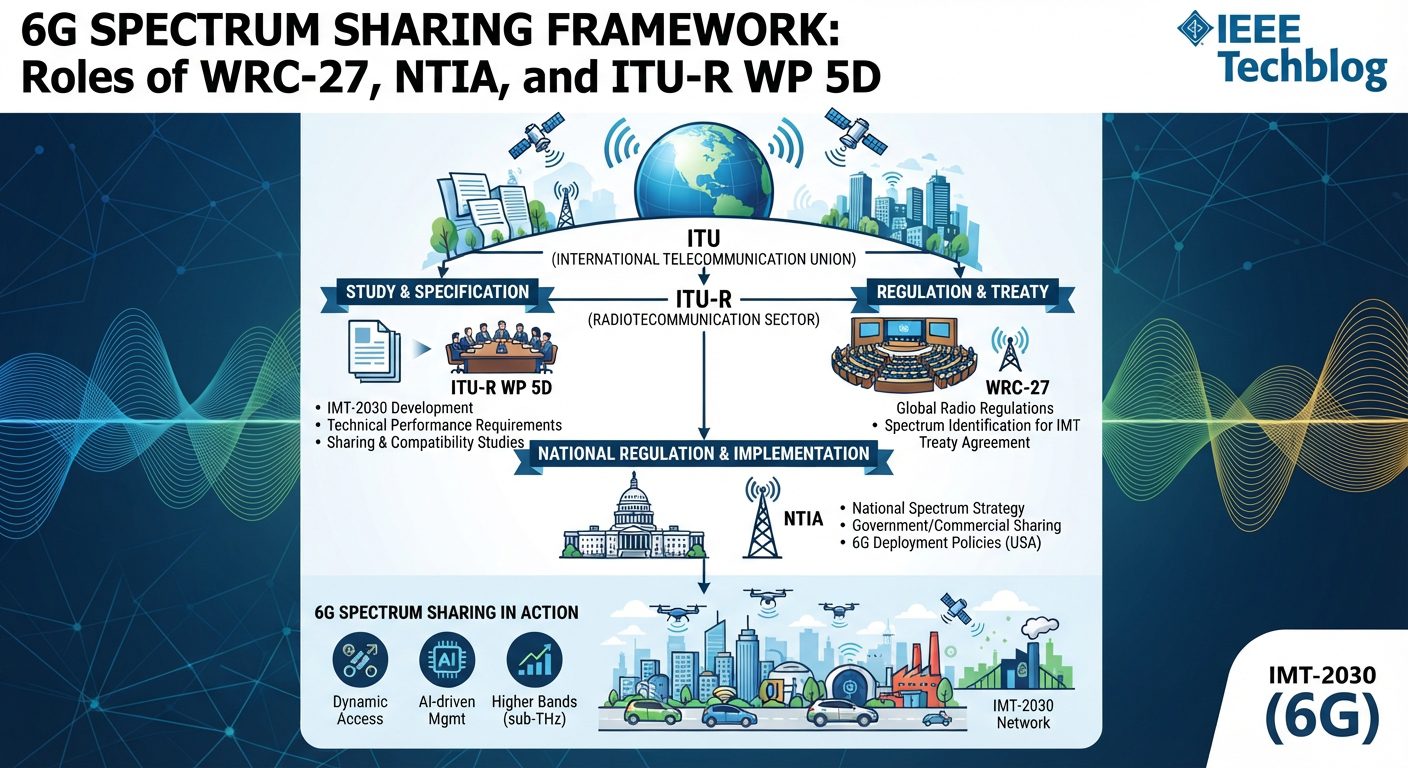
Image Credit: Google Gemini
…………………………………………………………………………………………………………………………………………………………………………………………U.S. Spectrum Pipeline – reallocation does not necessarily mean clearance:
In the United States, NTIA has a congressional mandate to identify 500 MHz of federal spectrum for commercial use within five years of the 2025 legislation. The broader legislative spectrum pipeline calls for 800 MHz by 2034. NTIA’s work includes studies of spectrum in the 1.6 GHz, 2.7 GHz, 4.4 GHz and 7 GHz ranges. Derek Khlopin, NTIA’s deputy associate administrator for spectrum, cautioned that identifying spectrum for commercial use does not necessarily mean incumbent systems can be cleared immediately.
Some federal systems could remain in affected bands “for a significant amount of time,” requiring continued sharing or other protection measures. “There will be more sharing necessary because the demands certainly aren’t stopping, not just from the mobile community, but from other spectrum users as well on the commercial side,” Khlopin said.
He described the likely outcome as “a bit of a mixed bag”: some systems could relocate, while others would remain under arrangements such as static exclusion zones or dynamic spectrum access. He cited the Citizens Broadband Radio Service (CBRS) as a “great model,” and suggested that better spectrum-use data and AI-based scheduling tools could improve sharing efficiency.
……………………………………………………………………………………………………………………………………………………………………………………………..
ITU-R and WRC-27: Establishing the conditions for additional IMT spectrum:
The international counterpart to these national studies is the ITU Radiocommunication Sector’s (ITU-R) preparatory work for the World Radiocommunication Conference 2027 (WRC-27).
Agenda item 1.7, under Resolution 256 (WRC-23), addresses sharing and compatibility studies and the development of technical conditions for International Mobile Telecommunications (IMT) in three frequency ranges: 4.4–4.8 GHz; 7.125–8.4 GHz, or portions thereof; 14.8–15.35 GHz.
The studies must account for existing primary services in both the candidate bands and adjacent spectrum. ITU-R Working Party 5D is the responsible group, working with other relevant ITU-R working groups.
These are candidate bands under study, not spectrum already cleared or guaranteed for 6G. Resolution 256 also specifies regional differences in the scope of potential IMT identification. Notably, the 4.4–4.8 GHz identification studies concern Regions 1 and 3, rather than Region 2, which includes the United States. The US domestic spectrum process and WRC-27 therefore overlap, but their frequency ranges and regulatory scope are not identical.ucc+1
The connection to the panel’s discussion is direct: sharing and incumbent protection are central to determining whether—and under what conditions—additional spectrum can support IMT. WRC-27’s agenda item 1.7 concerns those spectrum conditions, rather than the detailed design of the 6G air interface.
ITU-R WP 5D Spectrum Sharing Projects:
ITU-R Working Party 5D (WP 5D) is actively conducting spectrum sharing and compatibility studies for IMT-2030 (6G) across candidate frequency bands. WP 5D’s role is technical and preparatory: it develops Conference Preparatory Meeting (CPM) texts, technical sharing studies, compatibility analyses, and draft regulatory methods (working towards CPM reports extending through late 2026/2027). Here are the relevant 5D projects under World Radiocommunication Conference 2027 (WRC-27) agenda items:
- Agenda Item 1.7 (AI 1.7): WP 5D has received numerous sharing and compatibility studies for candidate bands, developing working documents and resolving technical criteria (such as power flux-density [PFD] calculations).
- Agenda Item 1.3/1.13 and related studies: WP 5D studies regulatory and technical parameters to protect the terrestrial components of IMT, collaborating jointly with other groups like WP 4C (satellite services).
- Technical & Evaluation Frameworks: WP 5D finalized key deliverables including draft reports on technical performance requirements (Report ITU-R M.[IMT-2030.TECH PERF REQ]) and submission/evaluation guidelines ahead of candidate Radio Interface Technology (RIT/SRIT) submissions kicking off in early 2027.
ITU-R Member States and regional telecommunication organizations (such as APT, CEPT, CITEL, ATU, Arab Spectrum Management Group) use WP 5D’s technical sharing and compatibility studies as the factual baseline to negotiate and submit Common Proposals (CPs) and national positions to WRC-27.
Separately, IMT-2030 candidate Radio Interface Technologies (RITs/SRITs) will begin being submitted to WP 5D starting around February 2027 (via proponents like 3GPP via ATIS). However, 5D will be tasked with generating IMT 2030 Frequency Arrangements after WRC-27 specifies the associated frequency bands.
………………………………………………………………………………………………………………………………………………………………………………………………………….
Interference management and the expanding test matrix:
For operators, access to shared spectrum must translate into sufficiently predictable network performance. Khushboo Kalyani, product marketing manager at LitePoint, said regulators and standards bodies need to define interference conditions—including transmit-power limits, unwanted emissions, waveform characteristics and frequency offsets—so equipment manufacturers and test vendors can evaluate devices against a consistent set of requirements
“There could be 100 different real-world situations that a device comes through. You essentially cannot test against that,” she said. The practical alternative is to select representative test cases that characterize device performance under shared-spectrum and interference conditions
The challenge will intensify as 6G introduces additional frequency bands, sharing arrangements, modulation schemes and antenna configurations. Kalyani warned that these variables could substantially expand the test matrix, lengthening development cycles and increasing manufacturing test costs.
“You’re essentially now going to be testing a combination of combinations,” she said. She expects the industry to concentrate on practical subsets of scenarios rather than attempt exhaustive testing of every configuration.
MRSS: A potentially more efficient migration mechanism than DSS:
The panel also examined a separate form of sharing: coexistence between successive generations of cellular radio access technology within an operator’s spectrum.
Milap Majmundar, AVP, emerging network, spectrum technologies and standards at AT&T Labs, said multi-radio access technology spectrum sharing (MRSS) between 5G and 6G could avoid some of the inefficiencies associated with LTE/5G dynamic spectrum sharing (DSS).
DSS incurred overhead from LTE control channels and the need to accommodate LTE’s cell-specific reference signals. By comparison, “[New Radio/NR] does not have these fixed common reference signals,” he said. NR’s leaner signal structure provides a more favorable starting point for intergenerational spectrum sharing.lightreading+1
“I’m actually quite optimistic that we will be able to make, as an industry, 5G/6G MRSS to be much more efficient than what we had with 4G/5G DSS,” Majmundar said.
MRSS could enable operators to introduce 6G in existing 5G spectrum, leveraging established coverage rather than relying exclusively on new upper-midband deployments. However, its eventual efficiency, equipment-upgrade requirements and carrier-aggregation capabilities remain important implementation questions. MRSS addresses migration within cellular networks; it does not replace the incumbent-sharing and compatibility work required to open additional bands.itu+1
Upper 6 GHz: Diverging national approaches:
Martha Suarez, president of the Dynamic Spectrum Alliance, argued that planning for the next generation of connectivity should also account for Wi-Fi and non-terrestrial networks.
“I agree with the concept that 6G should have sharing as part of the concept itself. I think it’s harder now to find exclusive bands for everything,” she said, adding that spectrum could support different applications according to deployment conditions and local requirements
Suarez pointed to the United Kingdom’s proposed upper-6 GHz framework as an example of how priority access and sharing could coexist.
Under the proposal described by Ofcom, 6.425–6.585 GHz would be prioritized for Wi-Fi, while 6.585–7.125 GHz would be prioritized for mobile. An automated frequency coordination (AFC) system would support controlled Wi-Fi access to the mobile-priority portion, including in locations where mobile networks are not deployed and before mobile services enter the band. This is more specific than unrestricted access whenever a channel appears idle: sharing would operate under defined technical conditions and coordination controls.
Suarez said such arrangements could balance investment certainty with more intensive spectrum use. “Those models could also be considered,” she said. The United States has taken a different approach, permitting unlicensed operation across 5.925–7.125 GHz, subject to the applicable device-class and incumbent-protection rules. Suarez endorsed that policy and encouraged other countries to consider its benefits.lightreading+1 and they think that they will need part of the upper 6GHz band for future networks. But we are encouraging them to have some type of sharing,” Suarez said.
The upper-6 GHz debate should not be conflated with WRC-27 agenda item 1.7: that item’s 7 GHz candidate range begins at 7.125 GHz, immediately above the upper-6 GHz band. National decisions on mobile/Wi-Fi coexistence and ITU-R studies of additional IMT spectrum are related elements of future spectrum planning, but they concern distinct frequency ranges and regulatory processes.
……………………………………………………………………………………………………………………………………………………………………………………………………
References:
https://apt.int/sites/default/files/file_tag/2026/03/WP_5D_UPDATES.pdf
https://www.lightreading.com/6g/6g-faces-a-spectrum-sharing-future
https://www.ericsson.com/en/6g/spectrum
Oct 2026: PRELIMINARY DRAFT NEW ITU-R WP 5D REPORT: M.[IMT-2030.SUBMISSION]
ITU-R M.[IMT-2030.EVAL] & ITU-R M.[IMT-2030.SUBMISSION] reports: Evaluation & Submission Guidelines for 6G RIT/SRITs (6G)
ITU-R WP 5D Timeline for submission, evaluation process & consensus building for IMT-2030 (6G) RITs/SRITs
Perspective & Analysis of ITU-R Workshop on IMT-2030 (6G) terrestrial radio interfaces: February 10, 2027 in Geneva, Switzerland
IMT-2030 (“6G”) Minimum Technology Performance Requirements for Radio Interface Technologies
Sept 2026 3GPP meeting updates for 5G Advanced and 6G planning (with timeline for submisson to ITU-R WP 5D via ATIS)
Roles of 3GPP and ITU-R WP 5D in the IMT 2030/6G standards process
3GPP approves timelines for Release 21 which will specify 6G RAN, Core and 5G Advanced
One thought on “IMT-2030/6G Spectrum Sharing: The Roles of WRC-27, NTIA and ITU-R WP 5D”
Leave a Reply

From Google Gemini:
The post is highly accurate and exactly on the mark. It provides an objective, deeply realistic view of the structural challenges facing 6G spectrum orchestration without the superficial commercial fluff often found in mainstream industry publications. The technical assessment is accurate for three critical reasons:
1. Pragmatic Grounding of the “Golden Band” (7.125–8.4 GHz)
The post correctly focuses on the 7.125–8.4 GHz band as the primary pivot point for global 6G harmonization. While WRC-27 Agenda Item 1.7 also mandates studies on the 4.4–4.8 GHz and 14.8–15.35 GHz bands, those frequencies face steep roadblocks or complete unavailability in North America. Identifying the 7–8 GHz range as the critical “upper mid-band” battlefield for balancing coverage and capacity perfectly aligns with current international regulatory realities.
2. Accurately Navigating Coexistence Over Eviction
Rather than treating 6G spectrum allocation as an open-and-shut land grab, the analysis is realistic about spectrum sharing and compatibility. The 7.125–8.4 GHz band is densely populated by formidable, non-commercial incumbent operations, including fixed-satellite services (FSS), mobile-satellite systems (MSS), and vital federal Earth-exploration/meteorological systems. The post accurately captures that the true challenge for WRC-27 is engineering complex, dynamic sharing criteria (such as power flux-density limits) rather than expecting simple eviction.
3. Clear Demarcation of Jurisdictional Roles
The post stays technically precise regarding the distinct institutional mandates:
• ITU-R WP 5D is correctly positioned as the group leading the preparatory compatibility studies and technical criteria for WRC-27.
• The NTIA is properly framed in its statutory role—coordinating U.S. federal positions and aligning domestic initiatives (like the National Spectrum Strategy) with international ITU-R inputs.
By emphasizing that 6G deployment timelines hinge entirely on solving these technical coexistence models before the late 2027 World Radiocommunication Conference, the analysis cuts right through vendor hype and delivers a sharp regulatory reality check.