

MWC26 Doha Recap: Strong Turnout; GSMA-ITU Letter of Intent; Open Questions Remain
Introduction:
MWC26 Doha closed on Nov 10th with over 10,000 attendees from 100 countries and territories, 195 speakers, about 100 exhibitors, sponsors and partners, and 42 partnerships and announcements signed in the Announcement Lounge. It was also the first MWC to run alongside an ITU Plenipotentiary Conference (PP-26). Held every four years, ITU PP-26 serves as the highest decision-making body to determine ITU’s strategic and financial plans, elect its leadership, and set its overall direction. Together, the two events united industry leaders, policymakers and innovators to explore critical digital issues transforming society.
Sianne Ryder, CEO, Events and Industry Services, GSMA Ltd, said:
“This week at MWC26 Doha, policymakers and regulators sat side by side with industry leaders and innovators to debate, connect and shape MENA’s digital future. Co-locating with the opening days of ITU PP-26 created something unique: a place where those setting the global digital agenda could engage directly with the operators, technology companies and investors bringing it to life. The result was sharper conversations, stronger connections and a clearer path from policy to progress. We look forward to seeing the partnerships forged in Doha deliver impact across the region and beyond. Thank you to everyone who joined us – and especially to our hosts at MCIT.”
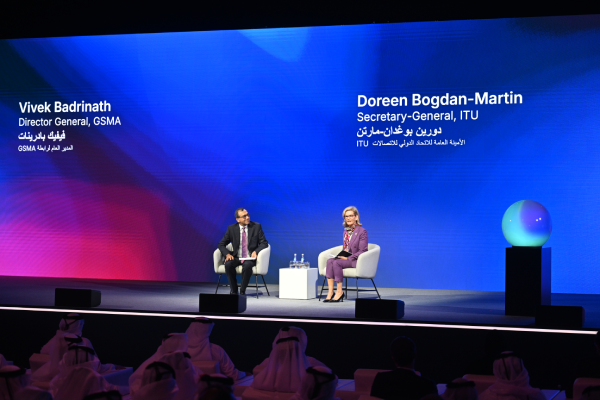
Photo Credit: GSMA
The GSMA’s closing press release is full of impressive statistics and signed agreements. This IEEE Techblog post separates what was announced from what was demonstrated, and asks what evidence is still missing.
………………………………………………………………………………………………………………………………………………………………………………………………………………………………………..
Open, trusted AI for telecoms”: a non-binding letter and unproven models
The GSMA-ITU Letter of Intent
The most widely publicized conference deliverable is the GSMA-ITU letter of intent on “trusted, open AI for telecoms.” According to RCR Wireless, it is non-binding, and neither organization has disclosed funding, staffing, deadlines, governance or licensing terms. RCR reports that the framework builds on the GSMA’s Open Telco AI program. It covers telco-grade AI for network operations and standards, telecom-specific data assets, and training, deploying and evaluating the OTel open model family. RCR frames the underlying motivation as reducing operators’ dependence on a few large AI providers.
The letter also formalizes existing ties. The ITU already hosts AI challenges developed with the GSMA, ETSI, IEEE and others, and the letter sits alongside, but separate from, the ITU’s OTAI initiative on AI agent interoperability. How the two efforts will be coordinated is not stated.
The first workstream covers telco-grade AI for network operations, infrastructure and standards. The second covers telecom-specific data assets, and the third covers training, deploying and evaluating the OTel open model family. They also plan to align technical standards, open data interoperability and evaluation frameworks. The stated aim is “secure, transparent and high-precision AI across global networks.” The wrap-up MWC26 Doha press release gives no performance data, datasets or timelines for this GSMA-ITU collaboration.
GSMA also announced a collaboration with Khalifa University and AMD on radio frequency foundation models. Built around the GSMA’s Open Telco AI program, it reaffirms that network operators shouldn’t depend on a handful of large providers for AI intelligence.
Open Telco AI models: what the evidence shows
The models behind the initiative are where measurable claims belong. For OTel, RCR notes that OTel 2.0 passed 30 million downloads by October, though downloads don’t measure deployment. It also reports that AT&T’s roughly 90% benchmark figure is vendor-reported, the OTel paper describes the resource as English-only and mainly text-based, and its main evaluations use unseen portions of its own corpus rather than fully independent benchmarks. “Open-weight” means the weights can be downloaded and adapted, which is not the same as open source. GSMA and ITU sign letter of intent on telecom AI +2
RFGPT. The most technical announcement at the show was an operator evaluation initiative for RFGPT from Khalifa University, GSMA and AMD. RFGPT is an RF foundation model that combines wireless signal understanding with natural-language interaction, hosted on AMD compute with API access. Operators can request a two-week trial. The six evaluation areas include identifying technologies such as Wi-Fi, Bluetooth, LTE, 5G NR, UMTS and DVB-S2, recognizing modulation schemes, analyzing wideband multi-signal environments, assessing coexistence and interference, estimating WLAN and NR user density, and interpreting 5G NR parameters such as SSB patterns and CSI-RS and SRS configurations.
The release describes capabilities and potential uses. It gives no accuracy figures, training-data description, signal-to-noise conditions, or comparison with conventional RF analysis tools. Useful questions for the evaluation include how it compares with established signal classifiers, how often it gives confident wrong answers, and what operator data leaves the network when a hosted API is used.
“Open” and “trusted,” in a geopolitical context
The AI collaboration is unfolding amid a policy dispute. RCR notes that Open Telco AI’s participants include China Telecom, China Unicom and China Mobile, and that Huawei is a sponsor and data contributor. Huawei was also the event’s headline sponsor and gave a keynote titled “The Infrastructure of Intelligence.”
Meanwhile, PP-26 continues. The conference runs about three weeks, with delegates from ITU’s 194 Member States, so MWC overlapped only its opening. A CircleID analysis describes a US proposal on ITU Resolution 214 that would replace “artificial intelligence” with “super intelligence,” remove references to shared concerns, and prohibit ITU work supporting AI governance, regulation and ethics. The outcome isn’t known yet. Separately, Malaysia’s communications minister described AI as creating a “compute divide” between developed and developing nations. “Trusted” will be easier to assess once governance, licensing and supply-chain terms are published.
ITU meeting in Qatar to address digital opportunities and challenges – Developing Telecoms +2
Agentic AI: governance language, no deliverables yet
The Agentic AI Summit description says it would examine the balance between autonomy, trust, safety and human oversight. That describes a topic rather than an outcome. For network operations, autonomy claims are easier to evaluate with a stated autonomy level, the actions agents may take, how policy is enforced, and failure behavior. I did not find those details in the materials reviewed.
6G: what “already underway” means
The Future Networks Summit description says the 6G transition is already underway through intelligent, programmable and interoperable 5G networks. Network APIs, automation, edge, private networks and satellite integration are real and progressing, but they are 5G-Advanced work. Readers should look for which specific features, and in which 3GPP release, are meant when “6G” is used.
Satellite and NTN: organizer statistics
The Satellite & NTN Summit description says 2026 is “go time” for D2D, the Middle East has 11 D2D partnerships between satellite companies and telcos, and 500-600 million people have no coverage. It also cites consolidation moves, including Amazon/Globalstar/Viasat and Space42/Equatys. [verify each; the page gives no sources] A partnership is not yet a commercial service. Spectrum, device support and regulatory approval will determine which ones become products. (For the U.S. side of this story, see my earlier posts on SpaceX’s 800 MHz spectrum and Starlink Mobile.)
One concrete demo
Ooredoo Qatar, Ericsson, Eonetics, Hikvision and GSMA Fusion linked a tethered drone in Melbourne with the GSMA Pavilion in Doha, more than 12,000 km away. The distance makes a good headline, but long-haul IP connectivity is not a property of 5G itself. The release gives no latency, throughput, uplink performance, drone-to-core architecture or setup time, so the demo shows feasibility rather than performance.
Independent coverage
Post-event coverage so far largely restates the GSMA release. Examples include Fast Company Middle East, IndexBox and TelecomTV, which labels its item “Via GSMA.” Huawei’s account is a vendor release. Reporting on measured performance, stage discussion and attendee reaction was limited in what I could find.
Evidence we’d like to see
- The full text of the GSMA-ITU letter, with scope, governance and licensing.
- Independent benchmarks for OTel and RFGPT against conventional tools.
- Latency and throughput data from the emergency-response demo.
- Operator evidence of agentic AI in production, including guardrails.
- The 3GPP features behind “6G is already underway.”
- The final outcome on ITU Resolution 214 at PP-26.
Much of the post-event coverage repeats the GSMA’s numbers. One Gulf Business piece carries “brand-view” in its URL path, and the Huawei item is a vendor announcement. Independent reporting, such as measured performance, attendee skepticism and what was said on stage, was scarce in what I could find.
End Note:
GSMA, ITU and IEEE will host a webinar on November 18 introducing the AI Agents for RAN Challenge, which uses the Giulia simulator.
……………………………………………………………………………………………………………………………………………………..
References:
https://www.mwcdoha.com/agenda
https://rcrwireless.com/20261112/ai/gsma-itu-letter-of-intent-telecom-ai