

AI infrastructure spending boom: a path towards AGI or speculative bubble?
by Rahul Sharma, Indxx with Alan J Weissberger, IEEE Techblog
Introduction:
The ongoing wave of artificial intelligence (AI) infrastructure investment by U.S. mega-cap tech firms marks one of the largest corporate spending cycles in history. Aggregate annual AI investments, mostly for cloud resident mega-data centers, are expected to exceed $400 billion in 2025, potentially surpassing $500 billion by 2026 — the scale of this buildout rivals that of past industrial revolutions — from railroads to the internet era.[1]
At its core, this spending surge represents a strategic arms race for computational dominance. Meta, Alphabet, Amazon and Microsoft are racing to secure leadership in artificial intelligence capabilities — a contest where access to data, energy, and compute capacity are the new determinants of market power.
AI Spending & Debt Financing:
Leading technology firms are racing to secure dominance in compute capacity — the new cornerstone of digital power:
- Meta plans to spend $72 billion on AI infrastructure in 2025.
- Alphabet (Google) has expanded its capex guidance to $91–93 billion.[3]
- Microsoft and Amazon are doubling data center capacity, while AWS will drive most of Amazon’s $125 billion 2026 investment.[4]
- Even Apple, typically conservative in R&D, has accelerated AI infrastructure spending.
Their capex is shown in the chart below:
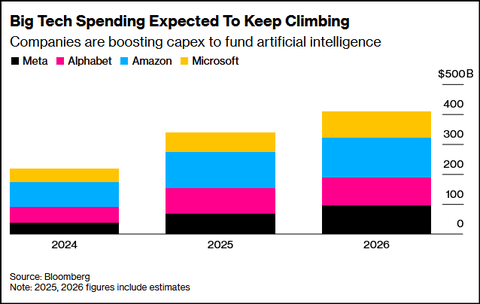
Analysts estimate that AI could add up to 0.5% to U.S. GDP annually over the next several years. Reflecting this optimism, Morgan Stanley forecasts $2.9 trillion in AI-related investments between 2025 and 2028. The scale of commitment from Big Tech is reshaping expectations across financial markets, enterprise strategies, and public policy, marking one of the most intense capital spending cycles in corporate history.[2]
Meanwhile, OpenAI’s trillion-dollar partnerships with Nvidia, Oracle, and Broadcom have redefined the scale of ambition, turning compute infrastructure into a strategic asset comparable to energy independence or semiconductor sovereignty.[5]
Growth Engine or Speculative Bubble?
As Big Tech pours hundreds of billions of dollars into AI infrastructure, analysts and investors remain divided — some view it as a rational, long-term investment cycle, while others warn of a potential speculative bubble. Yet uncertainty remains — especially around Meta’s long-term monetization of AGI-related efforts.[8]
Some analysts view this huge AI spending as a necessary step towards achieving Artificial General Intelligence (AGI) – an unrealized type of AI that possesses human-level cognitive abilities, allowing it to understand, learn, and adapt to any intellectual task a human can. Unlike narrow AI, which is designed for specific functions like playing chess or image recognition, AGI could apply its knowledge to a wide range of different situations and problems without needing to be explicitly programmed for each one.
Other analysts believe this is a speculative bubble, fueled by debt that can never be repaid. Tech sector valuations have soared to dot-com era levels – and, based on price-to-sales ratios, are well beyond them. Some of AI’s biggest proponents acknowledge the fact that valuations are overinflated, including OpenAI chairman Bret Taylor: “AI will transform the economy… and create huge amounts of economic value in the future,” Taylor told The Verge. “I think we’re also in a bubble, and a lot of people will lose a lot of money,” he added.
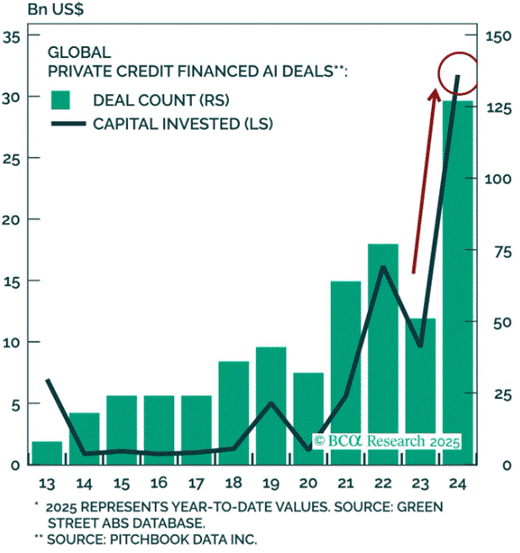
Here are a few AI bubble points and charts:
- AI-related capex is projected to consume up to 94% of operating cash flows by 2026, according to Bank of America.[6]
- Over $75 billion in AI-linked corporate bonds have been issued in just two months — a signal of mounting leverage. Still, strong revenue growth from AI services (particularly cloud and enterprise AI) keeps optimism alive.[7]
- Meta, Google, Microsoft, Amazon and xAI (Elon Musk’s company) are all using off-balance-sheet debt vehicles, including special-purpose vehicles (SPVs) to fund part of their AI investments. A slowdown in AI demand could render the debt tied to these SPVs worthless, potentially triggering another financial crisis.
- Alphabet’s (Google’s parent company) CEO Sundar Pichai sees “elements of irrationality” in the current scale of AI investing which is much more than excessive investments during the dot-com/fiber optic built-out boom of the late 1990s. If the AI bubble bursts, Pichai said that no company will be immune, including Alphabet, despite its breakthrough technology, Gemini, fueling gains in the company’s stock price.

…………………………………………………………………………………………………………………..
From Infrastructure to Intelligence:
Executives justify the massive spend by citing acute compute shortages and exponential demand growth:
- Microsoft’s CFO Amy Hood admitted, “We’ve been short on capacity for many quarters” and confirmed that the company will increase its spending on GPUs and CPUs in 2026 to meet surging demand.
- Amazon’s Andy Jassy noted that “every new tranche of capacity is immediately monetized”, underscoring strong and sustained demand for AI and cloud services.
- Google reported billions in quarterly AI revenue, offering early evidence of commercial payoff.
Macro Ripple Effects – Industrializing Intelligence:
AI data centers have become the factories of the digital age, fueling demand for:
- Semiconductors, especially GPUs (Nvidia, AMD, Broadcom)
- Cloud and networking infrastructure (Oracle, Cisco)
- Energy and advanced cooling systems for AI data centers (Vertiv, Schneider Electric, Johnson Controls, and other specialists such as Liquid Stack and Green Revolution Cooling).
| Company Name | Core Expertise | Key Solutions for AI Data Centers |
|---|---|---|
| Vertiv | Critical infrastructure (power & cooling) | Offers full-stack solutions with air and liquid cooling, power distribution units (PDUs), and monitoring systems, including the AI-ready Vertiv 360AI portfolio. |
| Schneider Electric | Energy management & automation | Provides integrated power and thermal management via its EcoStruxure platform, specializing in modular and liquid cooling solutions for HPC and AI applications. |
| Johnson Controls | HVAC & building solutions | Offers integrated, energy-efficient solutions from design to maintenance, including Silent-Aire cooling and YORK chillers, with a focus on large-scale operations. |
| Eaton | Power management | Specializes in electrical distribution systems, uninterruptible power supplies (UPS), and switchgear, which are crucial for reliable energy delivery to high-density AI racks. |
- LiquidStack: A leader in two-phase and modular immersion cooling and direct-to-chip systems, trusted by large cloud and hardware providers.
- Green Revolution Cooling (GRC): Pioneers in single-phase immersion cooling solutions that help simplify thermal management and improve energy efficiency.
- Iceotope: Focuses on chassis-level precision liquid cooling, delivering dielectric fluid directly to components for maximum efficiency and reduced operational costs.
- Asetek: Specializes in direct-to-chip (D2C) liquid cooling solutions and rack-level Coolant Distribution Units (CDUs) for high-performance computing.
- CoolIT Systems: Known for its custom direct liquid cooling technologies, working closely with server OEMs (Original Equipment Manufacturers) to integrate cold plates and CDUs for AI and HPC workloads.
–>This new AI ecosystem is reshaping global supply chains — but also straining local energy and water resources. For example, Meta’s massive data center in Georgia has already triggered environmental concerns over energy and water usage.
Global Spending Outlook:
- According to UBS, global AI capex will reach $423 billion in 2025, $571 billion by 2026 and $1.3 trillion by 2030, growing at a 25% CAGR during the period 2025-2030.
Compute demand is outpacing expectations, with Google’s Gemini saw 130 times rise in AI token usage over the past 18 months, highlighting soaring compute and Meta’s infrastructure needs expanding sharply.[9]
Conclusions:
The AI infrastructure boom reflects a bold, forward-looking strategy by Big Tech, built on the belief that compute capacity will define the next decade’s leaders. If Artificial General Intelligence (AGI) or large-scale AI monetization unfolds as expected, today’s investments will be seen as visionary and transformative. Either way, the AI era is well underway — and the race for computational excellence is reshaping the future of global markets and innovation.
…………………………………………………………………………………………………………………………………………………………………………………………………………………………….
Footnotes:
[1] https://www.investing.com/news/stock-market-news/ai-capex-to-exceed-half-a-trillion-in-2026-ubs-4343520?utm_medium=feed&utm_source=yahoo&utm_campaign=yahoo-www
[2] https://www.venturepulsemag.com/2025/08/01/big-techs-400-billion-ai-bet-the-race-thats-reshaping-global-technology/#:~:text=Big%20Tech’s%20$400%20Billion%20AI%20Bet:%20The%20Race%20That’s%20Reshaping%20Global%20Technology,-3%20months%20ago&text=The%20world’s%20largest%20technology%20companies,enterprise%20strategy%2C%20and%20public%20policy.
[3] https://www.businessinsider.com/big-tech-capex-spending-ai-earnings-2025-10?
[4] https://www.investing.com/analysis/meta-plunged-12-amazon-jumped-11–same-ai-race-different-economics-200669410
[5] https://www.cnbc.com/2025/10/15/a-guide-to-1-trillion-worth-of-ai-deals-between-openai-nvidia.html
[6] https://finance.yahoo.com/news/bank-america-just-issued-stark-152422714.html
[7] https://news.futunn.com/en/post/64706046/from-cash-rich-to-collective-debt-how-does-wall-street?level=1&data_ticket=1763038546393561
[8] https://www.businessinsider.com/big-tech-capex-spending-ai-earnings-2025-10?
[9] https://finance.yahoo.com/news/ai-capex-exceed-half-trillion-093015889.html
……………………………………………………………………………………………………………………………………………………………………………………………………………………………
About the Author:
Rahul Sharma is President & Co-Chief Executive Officer at Indxx – a provider of end-to-end indexing services, data and technology products. He has been instrumental in leading the firm’s growth since 2011. Raul manages Indxx’s Sales, Client Engagement, Marketing and Branding teams while also helping to set the firm’s overall strategic objectives and vision.
Rahul holds a BS from Boston College and an MBA with Beta Gamma Sigma honors from Georgetown University’s McDonough School of Business.

……………………………………………………………………………………………………………………………………………………………………………………………………………………………
References:
Curmudgeon/Sperandeo: New AI Era Thinking and Circular Financing Deals
Expose: AI is more than a bubble; it’s a data center debt bomb
Can the debt fueling the new wave of AI infrastructure buildouts ever be repaid?
AI spending boom accelerates: Big tech to invest an aggregate of $400 billion in 2025; much more in 2026!
Big tech spending on AI data centers and infrastructure vs the fiber optic buildout during the dot-com boom (& bust)
FT: Scale of AI private company valuations dwarfs dot-com boom
Amazon’s Jeff Bezos at Italian Tech Week: “AI is a kind of industrial bubble”
AI Data Center Boom Carries Huge Default and Demand Risks
Will billions of dollars big tech is spending on Gen AI data centers produce a decent ROI?
Dell’Oro: Analysis of the Nokia-NVIDIA-partnership on AI RAN
RAN silicon rethink – from purpose built products & ASICs to general purpose processors or GPUs for vRAN & AI RAN
Nokia in major pivot from traditional telecom to AI, cloud infrastructure, data center networking and 6G
Reuters: US Department of Energy forms $1 billion AI supercomputer partnership with AMD
………………………………………………………………………………………………………………………………………………………………………….
3 thoughts on “AI infrastructure spending boom: a path towards AGI or speculative bubble?”
Leave a Reply

Oracle is hustling to build AI-capable data centers worldwide and taking on tens of billions of dollars of debt to finance those projects. Companies such as OpenAI, xAI, Meta, Nvidia and others have generated a pledged pipeline of $553 billion in future spending with Oracle.
The company began laying off thousands of workers worldwide on March 31st, just days after announcing a massive office expansion in Nashville. It’s estimated that between 20,000 and 30,000 employees were laid off.
https://www.bizjournals.com/nashville/news/2026/03/31/oracle-layoffs-global-data-center-ai.html
The bar for tech companies to make AI profitable was already high. Then came a surge in memory-chip prices that has sent costs through the roof, adding fresh urgency to questions about who’s going to pay for it all and how. The tech companies that are largely funding the AI boom have been avoiding that riddle. They need to invest in chips and data centers as fast as they can to capitalize on the world-changing potential of AI, they argue. This isn’t the time for prudence.
Now, though, the cost of AI isn’t growing just because they are adding to data-center footprints. It is rising because the stuff they need to buy to make it all work is a lot more expensive.
Memory has become a big issue of late. The most advanced AI computing setups require more of the most advanced kind of memory chips available. This is called high-bandwidth memory. Tech companies are competing to secure supplies, giving memory manufacturers the upper hand on pricing.
The impact has been dramatic. Microsoft last week said about $25 billion of its annual capital expenditures of around $190 billion were down to “higher component pricing.” That’s code for more expensive memory. Google parent Alphabet and Meta Platforms also cited higher component costs in raising their capital-spending plans.
The impact of the memory crunch has already been far-reaching in consumer electronics. It is hitting PCs and smartphones as memory makers divert production to more profitable AI-related products. Surging prices will have an impact on AI itself, too. Tech companies are already under pressure to show their AI investments are paying off as depreciation accelerates and eats into reported profit. And returns on AI ultimately must come from people who use it. That may be in the form of subscription fees, time spent watching advertisements, software licenses or some other novel way tech companies devise to get money out of customers’ pockets. Making that financial model work is suddenly a lot harder.
“We stand on the walls, sentinels of the inner sanctum, against the assault of AI slop. The Ontology is based firmly in reality—there is, here, a dialectic between ground truth, tribal knowledge, and enhancements.”
— Alex Karp, Palantir Technologies chief executive, on the advantages of his company’s approach to AI
Hyperscalers’ earnings growth this quarter was boosted by an unusually large contribution from equity stakes in private companies.
Microsoft reported “only” $942mn of other income in the first three months of the year, but this line item has now made $7.2bn over the past nine months.
Alphabet and Amazon generated “other income” totaling $53 billion in Q1 2026, which accounted for nearly 60% of those two companies’ income in Q1 and 34% of the total $155 billion in income this quarter across the five largest hyperscalers. This represents the group’s largest collective share of earnings attributable to “other income” in at least a decade. Of this $53 billion in “other income,” $49 billion was explicitly due to equity stakes in private companies.
This is another sign of just how comically codependent the AI tech industry has become.
Not only have private investments and increasingly engorged funding rounds become a meaningful driver of the hyperscalers’ aggregate earnings, but the money the hyperscalers have pumped into the likes of Anthropic and OpenAI has allowed the AI companies to sign huge computing deals with Alphabet’s Google Cloud, Microsoft’s Azure and Amazon Web Services.
OpenAI and Anthropic now make up about half of the entire cloud computing order books at Oracle, Alphabet, Amazon and Microsoft.
This Fortune piece is a mindblower: Google and Amazon’s biggest profit driver last quarter was their Anthropic stakes—which they haven’t sold. “Nearly half of Alphabet’s record $62.6 billion profit—about $28.7 billion—”did not come from search ads, cloud services or any of its products at all. It came from Alphabet updating the value of the equity it owns in private companies, primarily Anthropic, the AI startup in which Alphabet holds a stake estimated at 14% before the announcement of an additional $40 billion commitment last week.”
References:
https://www.ft.com/content/be97df0a-76b1-4cb0-9ba4-d1117d8d1450
https://fortune.com/2026/04/30/google-amazon-ai-profits-anthropic-stake-bubble-earnings-2026/
https://finance.yahoo.com/sectors/technology/articles/google-amazon-biggest-profit-driver-170449859.html